
Gtest:事件
前言
有时候在测试的时候,我们会在测试前做一些初始化活动,和测试后做一些清理工作,gtest提供了多种事件机制,非常方便我们在案例之前或之后做一些操作。总结一下gtest的事件一共有3种:
- 全局的,所有案例执行前后。
- TestSuite级别的,在某一批案例中第一个案例前,最后一个案例执行后。
- TestCase级别的,每个TestCase前后。
接下来按照倒叙3→2→1介绍如何使用事件机制
TestCase事件
TestCase事件是挂在每个案例执行前后的,实现方式和上面的几乎一样,不过需要实现的是SetUp方法和TearDown方法:
1. SetUp()方法在每个TestCase之前执行
2. TearDown()方法在每个TestCase之后执行
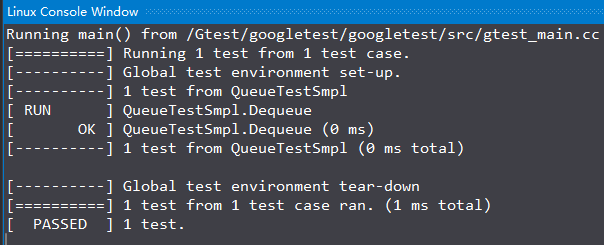
演示代码(Linux环境)
main.cpp
#include "sample-inl.h"

#include "gtest/gtest.h"

namespace {

    class QueueTestSmpl : public testing::Test {

    protected:

        virtual void SetUp() {

            //q0_.Enqueue(1);

            q1_.Enqueue();

            q1_.Enqueue();

            q2_.Enqueue();

        }

        virtual void TearDown() {

        }

        static int Double(int n) {

            return  * n;

        }

        // A helper function for testing Queue::Map().

        void MapTester(const Queue<int> * q) {

            // Creates a new queue, where each element is twice as big as the

            // corresponding one in q.

            const Queue<int> * const new_q = q->Map(Double);

            // Verifies that the new queue has the same size as q.

            ASSERT_EQ(q->Size(), new_q->Size());

            // Verifies the relationship between the elements of the two queues.

            for (const QueueNode<int>*n1 = q->Head(), *n2 = new_q->Head();

                n1 != nullptr; n1 = n1->next(), n2 = n2->next()) {

                EXPECT_EQ( * n1->element(), n2->element());

            }

            delete new_q;

        }

        // Declares the variables your tests want to use.

        Queue<int> q0_;

        Queue<int> q1_;

        Queue<int> q2_;

    };

    // Tests Dequeue().

    TEST_F(QueueTestSmpl, Dequeue) {

        int * n = q0_.Dequeue();

        EXPECT_TRUE(n == nullptr);

        n = q1_.Dequeue();

        ASSERT_TRUE(n != nullptr);

        EXPECT_EQ(, *n);

        EXPECT_EQ(1u, q1_.Size());

        delete n;

        n = q1_.Dequeue();

        ASSERT_TRUE(n != nullptr);

        EXPECT_EQ(, *n);

        EXPECT_EQ(0u, q1_.Size());

        delete n;

        n = q2_.Dequeue();

        ASSERT_TRUE(n != nullptr);

        EXPECT_EQ(, *n);

        EXPECT_EQ(0u, q2_.Size());

        delete n;

    }

}  // namespace
sample-inl.h
#ifndef GTEST_SAMPLES_SAMPLE_INL_H_

#define GTEST_SAMPLES_SAMPLE_INL_H_

#include <stddef.h>

template <typename E>  // E is the element type

class Queue;

template <typename E>  // E is the element type

class QueueNode {

    friend class Queue<E>;

public:

    // Gets the element in this node.

    const E& element() const { return element_; }

    // Gets the next node in the queue.

    QueueNode* next() { return next_; }

    const QueueNode* next() const { return next_; }

private:

    // Creates a node with a given element value.  The next pointer is

    // set to NULL.

    explicit QueueNode(const E& an_element)

        : element_(an_element), next_(nullptr) {}

    // We disable the default assignment operator and copy c'tor.

    const QueueNode& operator = (const QueueNode&);

    QueueNode(const QueueNode&);

    E element_;

    QueueNode* next_;

};

template <typename E>  // E is the element type.

class Queue {

public:

    // Creates an empty queue.

    Queue() : head_(nullptr), last_(nullptr), size_() {}

    // D'tor.  Clears the queue.

    ~Queue() { Clear(); }

    // Clears the queue.

    void Clear() {

        if (size_ > ) {

            // 1. Deletes every node.

            QueueNode<E>* node = head_;

            QueueNode<E>* next = node->next();

            for (; ;) {

                delete node;

                node = next;

                if (node == nullptr) break;

                next = node->next();

            }

            // 2. Resets the member variables.

            head_ = last_ = nullptr;

            size_ = ;

        }

    }

    size_t Size() const { return size_; }

    QueueNode<E>* Head() { return head_; }

    const QueueNode<E>* Head() const { return head_; }

    QueueNode<E>* Last() { return last_; }

    const QueueNode<E>* Last() const { return last_; }

    void Enqueue(const E& element) {

        QueueNode<E>* new_node = new QueueNode<E>(element);

        if (size_ == ) {

            head_ = last_ = new_node;

            size_ = ;

        }

        else {

            last_->next_ = new_node;

            last_ = new_node;

            size_++;

        }

    }

    E* Dequeue() {

        if (size_ == ) {

            return nullptr;

        }

        const QueueNode<E>* const old_head = head_;

        head_ = head_->next_;

        size_--;

        if (size_ == ) {

            last_ = nullptr;

        }

        E* element = new E(old_head->element());

        delete old_head;

        return element;

    }

    template <typename F>

    Queue* Map(F function) const {

        Queue* new_queue = new Queue();

        for (const QueueNode<E>* node = head_; node != nullptr;

            node = node->next_) {

            new_queue->Enqueue(function(node->element()));

        }

        return new_queue;

    }

private:

    QueueNode<E>* head_;  // The first node of the queue.

    QueueNode<E>* last_;  // The last node of the queue.

    size_t size_;  // The number of elements in the queue.

    // We disallow copying a queue.

    Queue(const Queue&);

    const Queue& operator = (const Queue&);

};

#endif  // GTEST_SAMPLES_SAMPLE3_INL_H_
TestSuite事件
这个相对来说比较简单,相对上面的实现就是替换成静态的SetUpTestCase,代码
class FooTest : public testing::Test {

 protected:

 //准备资源

  static void SetUpTestCase() {

    shared_resource_ = new ;

  }

  //释放资源

  static void TearDownTestCase() {

    delete shared_resource_;

    shared_resource_ = NULL;

  }

  // 资源

  static T* shared_resource_;

};
全局事件
也是很简单的,就是继承于testing::Environment而已。
class FooEnvironment: public testing::Environment

{

    public:

        virtual void SetUp()

        {

            printf("Environment SetUp!\n");

            a = 100;

        }

        virtual void TearDown()

        {

            printf("Environment TearDown!\n");

        }

        int a;     //共享数据

};

FooEnvironment* foo_env;  //对象指针声明

TEST(firstTest, first)    //访问共享数据并改变它的值

{

    printf("in the firstTest, foo_env->p is %d\n", foo_env->a);

    foo_env->a ++;

}

TEST(secondTest, second)  //访问共享数据

{

    printf("in the secondTest, foo_env->p is %d\n", foo_env->a);

}

int main(int argc, char* argv[])

{

    foo_env = new FooEnvironment;

    testing::AddGlobalTestEnvironment(foo_env);     //注册

    testing::InitGoogleTest(&argc, argv);

    return RUN_ALL_TESTS();

}
Gtest:事件的更多相关文章
- JNI详解---从不懂到理解
转载:https://blog.csdn.net/hui12581/article/details/44832651 Chap1:JNI完全手册... 3 Chap2:JNI-百度百科... 11 C ...
- gtest 三种事件机制
前言: 1.首先说明gtest中事件的结构层次: 测试程序:一个测试程序只有一个main函数,也可以说是一个可执行程序是一个测试程序.该级别的事件机制会在程序的开始和结束执行. 测试套件:代表一个测试 ...
- gTest详解
1. 安装使用 1.1 安装 在https://code.google.com/p/googletest/ 下载源码 进入msvc, 注意编译方式, 如果是dll, 选择 gtest-md 编译生成l ...
- 白盒测试之gtest第一个demo
认识gtest工具后,关于它的使用,下面将用一个demo程序演示一下gtest的用法以及成果展示. 一.需要测试的C++代码: #include "myfunction.h" // ...
- gtest框架使用
gtest文档说明: 由于公司单元测试的需要,自己花了大半天时间下载了一个gtest框架,使用了一些测试例子,总览了coderzh的玩转gtest测试框架,又看了几篇gtest博客,写下了以下内容,作 ...
- gtest的安装和测试[good]
一.前言 本篇将介绍一些gtest的基本使用,包括下载,安装,编译,建立我们第一个测试Demo工程,以及编写一个最简单的测试案例. 二.下载 如果不记得网址, 直接在google里搜gtest,第一个 ...
- gtest简短,简单易用
gtest它是一种跨平台的(Liunx.Mac OS X.Windows.Cygwin.Windows CE and Symbian)的C++测试框架.有google该公司宣布. gtest台上为编写 ...
- gtest框架
解析gtest框架运行机制 1.前言 Google test是一款开源的白盒单元测试框架,据说目前在Google内部已在几千个项目中应用了基于该框架的白盒测试. 最近的工作是在搞一个基于gtest ...
- 简单易懂的单元测试框架-gtest(二)
简介 事件机制用于在案例运行前后添加一些操作(相当于挂钩函数).目前,gtest提供了三种等级的事件,分别: 全局级,所有案例执行的前后 TestSuite级,某一个案例集的前后 TestCa ...
随机推荐
- Spring MVC -- 单元测试和集成测试
测试在软件开发中的重要性不言而喻.测试的主要目的是尽早发现错误,最好是在代码开发的同时.逻辑上认为,错误发现的越早,修复的成本越低.如果在编程中发现错误,可以立即更改代码:如果软件发布后,客户发现错误 ...
- 和至少为K的最短子数组
返回 A 的最短的非空连续子数组的长度,该子数组的和至少为 K 如果没有和至少为 K 的非空子数组,返回 -1 . 示例 1: 输入:A = [1], K = 1 输出:1 示例 2: 输入:A = ...
- Spring生态圈的概要说明
Spring生态圈的概要说明 以下摘抄自<Spring Boot实战>一书某章节. ================================= Spring 主要jar包 (1 ...
- ArcGIS Server 10.2忘记用户名密码的解决方案
忘记了ArcGIS Server Manager的密码,可以采用以下方法进行重置. 1.找到ArcGIS Server的安装目录 D:\Program Files\ArcGIS\Server\tool ...
- sql-server-dmv-starter-pack
SELECT wait_type , ) AS [wait_time_s] FROM sys.dm_os_wait_stats DOWS WHERE wait_type NOT IN ( 'SLEEP ...
- 浅谈 Docker 安全合规建设
通过阅读网上帖子及浏览相关信息,大家可能会产生一种错觉:Docker 安全性不足,对 Docker 导入生产环境持保守态度.不过实际情况是,虽然我们需要对容器的安全性高度关注,但只要使用得当,完全可以 ...
- Java 文件完整性校验 MD5 sha1 sha256 sha224 sha384 sha512
由于项目中需要使用文件做备份,并且要提供备份文件的下载功能.备份文件体积较大,为确保下载后的文件与原文件一致,需要提供文件完整性校验. 网上有这么多此类文章,其中不少使用到了 org.apache.c ...
- Android EditText禁止回车换行
在做一个登录页面的时候,发现了输入手机号的EditText可以输入回车的bug,影响用户体验,在此分享下解决办法. 百度了很多,都是设置singline=true的或者设置maxLines=" ...
- PHP不过过滤防止xss攻击的方法
PHP不过过滤防止xss攻击的方法<pre> $content=htmlspecialchars($content); $pos=strpos($content,"\u" ...
- QT5的QChart使用记录
如果需要在QT中使用QChart类,需要在安装的时候勾选QChart选项,在工程的 .pro 文件里面添加 QT += charts 语句,包含 QChart 头文件就行了. 对于图表的显示,可以先拖 ...