
spring日志加载代码解析
项目用的是springmvc+spring+mybatis框架,
配置日志的时候非常简单,仅仅是把commons-logging、log4j,还有slf4j-log4j三个日志相关的jar包导入项目,然后在classpath中加个log4j.properties的配置文件即可。
但是你有没有想过Log4j是什么时候被加载进虚拟机的?为什么我们没有手动加载,spring和mybatis就能自动的用起来log4j,毫不见外?
spring使用的是commons-logging,

mybatis用的是自己写的,
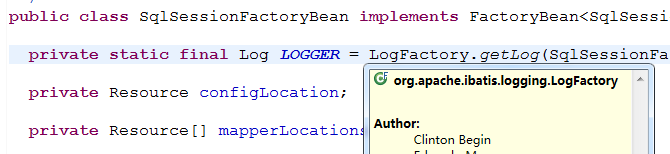
看一下源码,非常简单,一个个的去试,没有这个就进入下一个,直到找到了log4j

这两个工具其实都只是日志工具的规范,可以理解成接口,而log4j才是一个实实在在的日志实现。
但是slf4j在什么地方?——虽然这两个工具没用到slf4j,我还是把它放进来,因为我引入的其他工具会用到它。。比如:

下面开始看代码代码来说明一下log4j是怎么被加载到虚拟机的:
首先我们来看spring,我们从web.xml看起,加载spring:


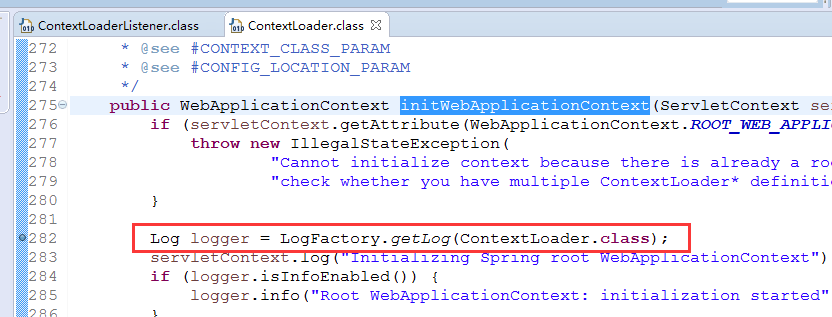
到这里我们看到了LogFactory,这是commons-logging的一个log工厂,这里用的是这个虚类的一个静态方法,我们继续看这个方法:

再看getFactory(代码较长,可以直接跳过先看后边的结论):
 public static LogFactory getFactory() throws LogConfigurationException {

         // Identify the class loader we will be using

         ClassLoader contextClassLoader = getContextClassLoaderInternal();

         if (contextClassLoader == null) {

             // This is an odd enough situation to report about. This

             // output will be a nuisance on JDK1.1, as the system

             // classloader is null in that environment.

             if (isDiagnosticsEnabled()) {

                 logDiagnostic("Context classloader is null.");

             }

         }

         // Return any previously registered factory for this class loader

         LogFactory factory = getCachedFactory(contextClassLoader);

         if (factory != null) {

             return factory;

         }

         if (isDiagnosticsEnabled()) {

             logDiagnostic(

                     "[LOOKUP] LogFactory implementation requested for the first time for context classloader " +

                     objectId(contextClassLoader));

             logHierarchy("[LOOKUP] ", contextClassLoader);

         }

         // Load properties file.

         //

         // If the properties file exists, then its contents are used as

         // "attributes" on the LogFactory implementation class. One particular

         // property may also control which LogFactory concrete subclass is

         // used, but only if other discovery mechanisms fail..

         //

         // As the properties file (if it exists) will be used one way or

         // another in the end we may as well look for it first.

         Properties props = getConfigurationFile(contextClassLoader, FACTORY_PROPERTIES);

         // Determine whether we will be using the thread context class loader to

         // load logging classes or not by checking the loaded properties file (if any).

         ClassLoader baseClassLoader = contextClassLoader;

         if (props != null) {

             String useTCCLStr = props.getProperty(TCCL_KEY);

             if (useTCCLStr != null) {

                 // The Boolean.valueOf(useTCCLStr).booleanValue() formulation

                 // is required for Java 1.2 compatibility.

                 if (Boolean.valueOf(useTCCLStr).booleanValue() == false) {

                     // Don't use current context classloader when locating any

                     // LogFactory or Log classes, just use the class that loaded

                     // this abstract class. When this class is deployed in a shared

                     // classpath of a container, it means webapps cannot deploy their

                     // own logging implementations. It also means that it is up to the

                     // implementation whether to load library-specific config files

                     // from the TCCL or not.

                     baseClassLoader = thisClassLoader;

                 }

             }

         }

         // Determine which concrete LogFactory subclass to use.

         // First, try a global system property

         if (isDiagnosticsEnabled()) {

             logDiagnostic("[LOOKUP] Looking for system property [" + FACTORY_PROPERTY +

                           "] to define the LogFactory subclass to use...");

         }

         try {

             String factoryClass = getSystemProperty(FACTORY_PROPERTY, null);

             if (factoryClass != null) {

                 if (isDiagnosticsEnabled()) {

                     logDiagnostic("[LOOKUP] Creating an instance of LogFactory class '" + factoryClass +

                                   "' as specified by system property " + FACTORY_PROPERTY);

                 }

                 factory = newFactory(factoryClass, baseClassLoader, contextClassLoader);

             } else {

                 if (isDiagnosticsEnabled()) {

                     logDiagnostic("[LOOKUP] No system property [" + FACTORY_PROPERTY + "] defined.");

                 }

             }

         } catch (SecurityException e) {

             if (isDiagnosticsEnabled()) {

                 logDiagnostic("[LOOKUP] A security exception occurred while trying to create an" +

                               " instance of the custom factory class" + ": [" + trim(e.getMessage()) +

                               "]. Trying alternative implementations...");

             }

             // ignore

         } catch (RuntimeException e) {

             // This is not consistent with the behaviour when a bad LogFactory class is

             // specified in a services file.

             //

             // One possible exception that can occur here is a ClassCastException when

             // the specified class wasn't castable to this LogFactory type.

             if (isDiagnosticsEnabled()) {

                 logDiagnostic("[LOOKUP] An exception occurred while trying to create an" +

                               " instance of the custom factory class" + ": [" +

                               trim(e.getMessage()) +

                               "] as specified by a system property.");

             }

             throw e;

         }

         // Second, try to find a service by using the JDK1.3 class

         // discovery mechanism, which involves putting a file with the name

         // of an interface class in the META-INF/services directory, where the

         // contents of the file is a single line specifying a concrete class

         // that implements the desired interface.

         if (factory == null) {

             if (isDiagnosticsEnabled()) {

                 logDiagnostic("[LOOKUP] Looking for a resource file of name [" + SERVICE_ID +

                               "] to define the LogFactory subclass to use...");

             }

             try {

                 final InputStream is = getResourceAsStream(contextClassLoader, SERVICE_ID);

                 if( is != null ) {

                     // This code is needed by EBCDIC and other strange systems.

                     // It's a fix for bugs reported in xerces

                     BufferedReader rd;

                     try {

                         rd = new BufferedReader(new InputStreamReader(is, "UTF-8"));

                     } catch (java.io.UnsupportedEncodingException e) {

                         rd = new BufferedReader(new InputStreamReader(is));

                     }

                     String factoryClassName = rd.readLine();

                     rd.close();

                     if (factoryClassName != null && ! "".equals(factoryClassName)) {

                         if (isDiagnosticsEnabled()) {

                             logDiagnostic("[LOOKUP]  Creating an instance of LogFactory class " +

                                           factoryClassName +

                                           " as specified by file '" + SERVICE_ID +

                                           "' which was present in the path of the context classloader.");

                         }

                         factory = newFactory(factoryClassName, baseClassLoader, contextClassLoader );

                     }

                 } else {

                     // is == null

                     if (isDiagnosticsEnabled()) {

                         logDiagnostic("[LOOKUP] No resource file with name '" + SERVICE_ID + "' found.");

                     }

                 }

             } catch (Exception ex) {

                 // note: if the specified LogFactory class wasn't compatible with LogFactory

                 // for some reason, a ClassCastException will be caught here, and attempts will

                 // continue to find a compatible class.

                 if (isDiagnosticsEnabled()) {

                     logDiagnostic(

                         "[LOOKUP] A security exception occurred while trying to create an" +

                         " instance of the custom factory class" +

                         ": [" + trim(ex.getMessage()) +

                         "]. Trying alternative implementations...");

                 }

                 // ignore

             }

         }

         // Third try looking into the properties file read earlier (if found)

         if (factory == null) {

             if (props != null) {

                 if (isDiagnosticsEnabled()) {

                     logDiagnostic(

                         "[LOOKUP] Looking in properties file for entry with key '" + FACTORY_PROPERTY +

                         "' to define the LogFactory subclass to use...");

                 }

                 String factoryClass = props.getProperty(FACTORY_PROPERTY);

                 if (factoryClass != null) {

                     if (isDiagnosticsEnabled()) {

                         logDiagnostic(

                             "[LOOKUP] Properties file specifies LogFactory subclass '" + factoryClass + "'");

                     }

                     factory = newFactory(factoryClass, baseClassLoader, contextClassLoader);

                     // TODO: think about whether we need to handle exceptions from newFactory

                 } else {

                     if (isDiagnosticsEnabled()) {

                         logDiagnostic("[LOOKUP] Properties file has no entry specifying LogFactory subclass.");

                     }

                 }

             } else {

                 if (isDiagnosticsEnabled()) {

                     logDiagnostic("[LOOKUP] No properties file available to determine" + " LogFactory subclass from..");

                 }

             }

         }

         // Fourth, try the fallback implementation class

         if (factory == null) {

             if (isDiagnosticsEnabled()) {

                 logDiagnostic(

                     "[LOOKUP] Loading the default LogFactory implementation '" + FACTORY_DEFAULT +

                     "' via the same classloader that loaded this LogFactory" +

                     " class (ie not looking in the context classloader).");

             }

             // Note: unlike the above code which can try to load custom LogFactory

             // implementations via the TCCL, we don't try to load the default LogFactory

             // implementation via the context classloader because:

             // * that can cause problems (see comments in newFactory method)

             // * no-one should be customising the code of the default class

             // Yes, we do give up the ability for the child to ship a newer

             // version of the LogFactoryImpl class and have it used dynamically

             // by an old LogFactory class in the parent, but that isn't

             // necessarily a good idea anyway.

             factory = newFactory(FACTORY_DEFAULT, thisClassLoader, contextClassLoader);

         }

         if (factory != null) {

             /**

              * Always cache using context class loader.

              */

             cacheFactory(contextClassLoader, factory);

             if (props != null) {

                 Enumeration names = props.propertyNames();

                 while (names.hasMoreElements()) {

                     String name = (String) names.nextElement();

                     String value = props.getProperty(name);

                     factory.setAttribute(name, value);

                 }

             }

         }

         return factory;

     }
以上代码会先试图从classpath中加载commons-logging.properties等几个commons-logging才有的东西,直到208行代码,

我们看到最后创建了一个LogFactoryImpl的实例,然后返回了。
回头看看我们上边的代码:

看完了getFactory我们知道最后我们得到的是LogFactoryImpl的实例,
那么接下来我们该去这个类中看看它的getInstance方法了:
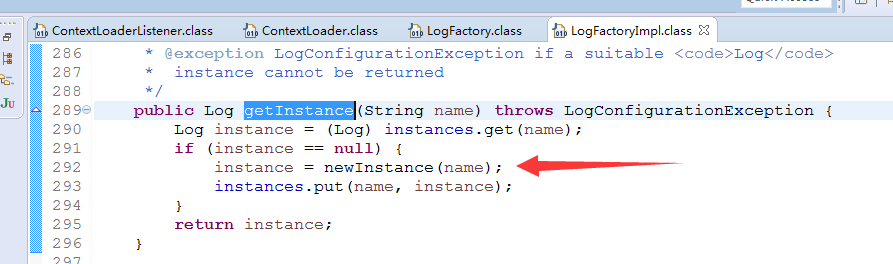
非常简单,在这里创建了一个Log的实例,这也是最关键的地方,我们去看看这个方法。

经过我个人进一步的代码分析logConstructor这个东西是空的,我就不再展开了,这时我们看541行这个方法,这里才是真正的创建Log实例:

这个方法名我们能看懂,就是去发现系统中的Log实现,也就是一个找的过程,后边的782行是找找系统变量中有没有commons-logging自己的指明实现类类名的变量,结果是没有的,因为我没有配。
这个方法还没完,中间是一大段的注释,我们直接看后边的重点:

这个时候开始遍历一个字符串数组,依此去系统中找有没有这个数组中的实现类,我们看看这个数组先。

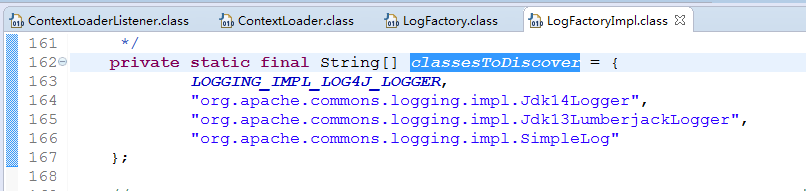
大家看到了什么?log4j,现在大家基本已经知道为什么了,后边的代码如果还有兴趣可以自己去看,其实就是一个个的试着去系统中加载这些类,加载不到处理一下ClassNotFoundException然后继续找下一个。
完毕。
最后如果大家想看看commons-logging自己的日志,可以写一个Listener放在web xml第一个位置,把下边一句代码弄上:

你们会从日志中看到多了很多内容,其中有一句是:
[LogFactoryImpl@1302539661 from org.apache.catalina.loader.WebappClassLoader@1536551745] Class 'org.apache.commons.logging.impl.Log4JLogger' was found at 'jar:file:/E:/eaipweb/wtpwebapps/EAIP/WEB-INF/lib/commons-logging-1.1.1.jar!/org/apache/commons/logging/impl/Log4JLogger.class'
这回真完毕了。
spring日志加载代码解析的更多相关文章
- spring资源加载结构解析
1.spring中资源加载使用resources的原因? 在java将不同资源抽象成url,然后通过注册不同的hander来处理不同读取逻辑,一般hander使用协议的前缀来命名,如http,jar, ...
- Spring如何加载log4j配置文件
今天有朋友在群里问了这个问题,于是写了这篇文章进行整理. 问题如下: 在项目中添加了log4j.properties配置文件,并没有在Spring配置文件中配置,也没有在web.xml中配置,但是代码 ...
- spring boot 加载web容器tomcat流程源码分析
spring boot 加载web容器tomcat流程源码分析 我本地的springboot版本是2.5.1,后面的分析都是基于这个版本 <parent> <groupId>o ...
- HTML文档、javascript脚本的加载与解析
1.onload事件 1.1 onload事件分类 a.文档加载完成事件(包括脚本.图片等资源都加载完),绑定方法:<body onload="doSomething()"& ...
- Tomcat源码分析——SERVER.XML文件的加载与解析
前言 作为Java程序员,对于Tomcat的server.xml想必都不陌生.本文基于Tomcat7.0的Java源码,对server.xml文件是如何加载和解析的进行分析. 加载 server.xm ...
- HTML页面加载和解析流程详细介绍
浏览器加载和渲染html的顺序 1. IE下载的顺序是从上到下,渲染的顺序也是从上到下,下载和渲染是同时进行的. 2. 在渲染到页面的某一部分时,其上面的所有部分都已经下载完成(并不是说所有相关联的元 ...
- html页面加载和解析流程
HTML页面加载和解析流程 用户输入网址(假设是个html页面,并且是第一次访问),浏览器向服务器发出请求,服务器返回html文件: 浏览器开始载入html代码,发现<head>标签内有一 ...
- Bean Definition从加载、解析、处理、注册到BeanFactory的过程。
为了弄清楚Bean是怎么来的,花费了大把功夫,现在要把Bean Definition的加载.解析.处理.注册到bean工厂的过程记下来.这只是bean definition 的加载.解析.处理.注册过 ...
- spring容器加载完毕做一件事情(利用ContextRefreshedEvent事件)
关键字:spring容器加载完毕做一件事情(利用ContextRefreshedEvent事件) 应用场景:很多时候我们想要在某个类加载完毕时干某件事情,但是使用了spring管理对象,我们这个类引用 ...
随机推荐
- CXF浅析
CXF 框架支撑环境 CXF 框架是一种基于 Servlet 技术的 SOA 应用开发框架,要正常运行基于 CXF 应用框架开发的企业应用,除了 CXF 框架本身之外,还需要 JDK 和 Ser ...
- [Codeforces-div.1 167B] Wizards and Huge Prize
[Codeforces-div.1 167B] Wizards and Huge Prize 试题分析 注意到每个物品互相独立,互不干扰之后就非常好做了. 算出一个物品最后的价值期望,然后乘以K即可. ...
- BZOJ 4059 [Cerc2012]Non-boring sequences(启发式分治)
[题目链接] http://www.lydsy.com/JudgeOnline/problem.php?id=4059 [题目大意] 一个序列被称为是不无聊的,仅当它的每个连续子序列存在一个独一无二的 ...
- 【斜率优化】bzoj3675-[Apio2014]序列分割&&Uoj104
题目大意 将一个长度为N的非负整数序列分割成k+l个非空的子序列,每次选择一位置分割后,将会得到一定的分数,这个分数为两个新序列中元素和的乘积.求最大的分数. [UOJ104]并输出任意一种方案 思路 ...
- Mysql五种时间格式
YEAR [字节数]:1 [取值范围]:1901~2155 [赋值]: 4位数字 2位字符串:'00'~'69'相当于2000~2069:'70'~'99'相当于1970~1999 2位数字:与2位数 ...
- 手Q游戏中心上线 完美释放娱乐基因
今年A股市场上手游概念股的表现可谓“独当一面”,不少和手游沾边的公司股价都翻了倍.在笔者看来,这些手游企业的股价明显高得离谱,这轮行情可以证明资本市场对手游的关注度非常高,但并不意味着这些手游 ...
- 【mysql】备份篇2:使用java程序定期备份mysql数据库
承接备份篇1, 在备份篇1中,使用dat文件加+系统计划任务程序完成mysql定期备份任务 在这一篇,备份使用java程序定期备份mysql数据库. 下面代码和程序思想给出: package com. ...
- 前端工业化工具Grunt初体验
今天来学学Grunt~~目的是为了自动化!自动压缩...自动修复...自动合并等... 提示:Grunt基于Node.js,安装之前要先安装Node.js 1.安装 grunt-cli npm ins ...
- java访问ad域
1.活动目录(AD) Active Directory 是用于 Windows Server 的目录服务.它存储着网络上各种对象的有关信息,并使该信息易于管理员和用户查找及使用.Active Dire ...
- REDIS数据备份集群部署和双集群同步工具redis-migrate-tool
REDIS 版本 < 4.0 笔者用的是 v=3.0.7 REDIS集群创建镜像:registry.cn-shenzhen.aliyuncs.com/cp_m/redis-trib:0.1.3 ...