
leetcode二叉树题目总结
leetcode二叉树题目总结
题目链接:https://leetcode-cn.com/leetbook/detail/data-structure-binary-tree/
前序遍历(NLR)
public List<Integer> preorderTraversal(TreeNode root) {
List<Integer> res = new ArrayList<>();
preOrder(root, res);
return res;
}
public void preOrder(TreeNode root, List<Integer> res) {
if (root == null)
return;
res.add(root.val);
preOrder(root.left, res);
preOrder(root.right, res);
}
中序遍历(LNR)
inOrder(root.left, res);

res.add(root.val);

inOrder(root.right, res);
后序遍历( LRN )
postOrder(root.left, res);
postOrder(root.right, res);
res.add(root.val);
层次遍历
    3
   / \
  9  20
    /  \
   15   7
结果
[
  [3],
  [9,20],
  [15,7]
]
关键代码
public List<List<Integer>> levelOrder(TreeNode root) {

    // 空树判断

    if(root == null) return result;

    // 返回的结果

    List<List<Integer>> result = new ArrayList<>();

    // 队列

    Queue<TreeNode> queue = new LinkedList<>();

    // 根节点入队

    queue.add(root);

    // 队列不为空则循环

    while(queue.size()>0){

        // 内层节点序列

        List<Integer> temp = new ArrayList<>();

        // 遍历队列,把当前层的元素从队列取出来,将下一层放入队列

        for(int i=0;i<size;i++){

            // 当前节点放入结果数组

            TreeNode cur = queue.poll();

            temp.add(cur);

            // 左节点入队

            if(cur.left){

                queue.add(cur.left);

            }

            // 右节点入队

            if(cur.right){

                queue.add(cur.right)

            }

        }

        result.add(temp);

    }

    return result;

}
二叉树最大深度
递归解决:
递归出口 当前节点 == null 返回0
递归逻辑 Math.max(maxDept(root.left) +1, maxDepth(root.right) +1)
public int maxDepth(TreeNode root) {

    if(root == null) return 0;

    return Math.max(maxDepth(root.left)+1, maxDepth(root.right)+1);

}
对称二叉树
递归法:
递归出口: 两个节点同时为空 return true 有一个为空 return false
递归逻辑: 返回当前节点值是否相等 && 递归节点1的左节点和节点2的右节点 && 递归节点2的右节点和节点1的左节点
class Solution {

    public boolean isSymmetric(TreeNode root) {

        return isMirror(root, root);

    }

    public boolean isMirror(TreeNode t1, TreeNode t2) {

        if (t1 == null && t2 == null) return true;

        if (t1 == null || t2 == null) return false;

        return (t1.val == t2.val)

                && isMirror(t1.left, t2.right)

                && isMirror(t1.right, t2.left);

    }

}
路径总和
递归法: 递归出口: 当前节点==null判断 当前的 target是否为0,是则返回true,否返回false
递归逻辑: DFS所有节点,每次遍历到当前节点将target-cur.val
class Solution {

    public boolean hasPathSum(TreeNode root, int targetSum){

        // 处理root为空的情况

        if(root == null){

             return false;

        }

        // 叶子节点判定当前路径是否可行

        if(root.left==null && root.right==null){

            return root.val == targetSum;

        }

        return hasPathSum(root.left,targetSum-root.val) || hasPathSum(root.right,targetSum-root.val);

    }

}
中序后序构造二叉树
思路:
通过后序遍历确定每一个根节点
通过DFS递归,限定范围得到左右子树
递归出口 后序遍历的head > tail
通过找到当前节点在中序遍历中的位置限定范围
class Solution {
public TreeNode buildTree(int[] inorder, int[] postorder) {
int len=inorder.length;
if(len==0)return null;
return dfs(inorder,postorder,0,len-1,0,len-1);
}
TreeNode dfs(int[] inorder, int[] postorder,int head1,int tail1, int head2,int tail2){
// 由于postOrder每次都会在tail-1 所以当只有一个元素则会返回
if(head2>tail2)return null;
int val=postorder[tail2];
TreeNode root=new TreeNode(val);
if(head2==tail2)return root;
int mid=0; //拆分点mid的位置是相对的,因为h1!=h2
while(inorder[head1+mid]!=val)mid++;
root.left=dfs(inorder, postorder, head1, head1+mid-1, head2, head2+mid-1);
root.right=dfs(inorder, postorder, head1+mid+1, tail1, head2+mid, tail2-1);
return root;
}
}
笔记:
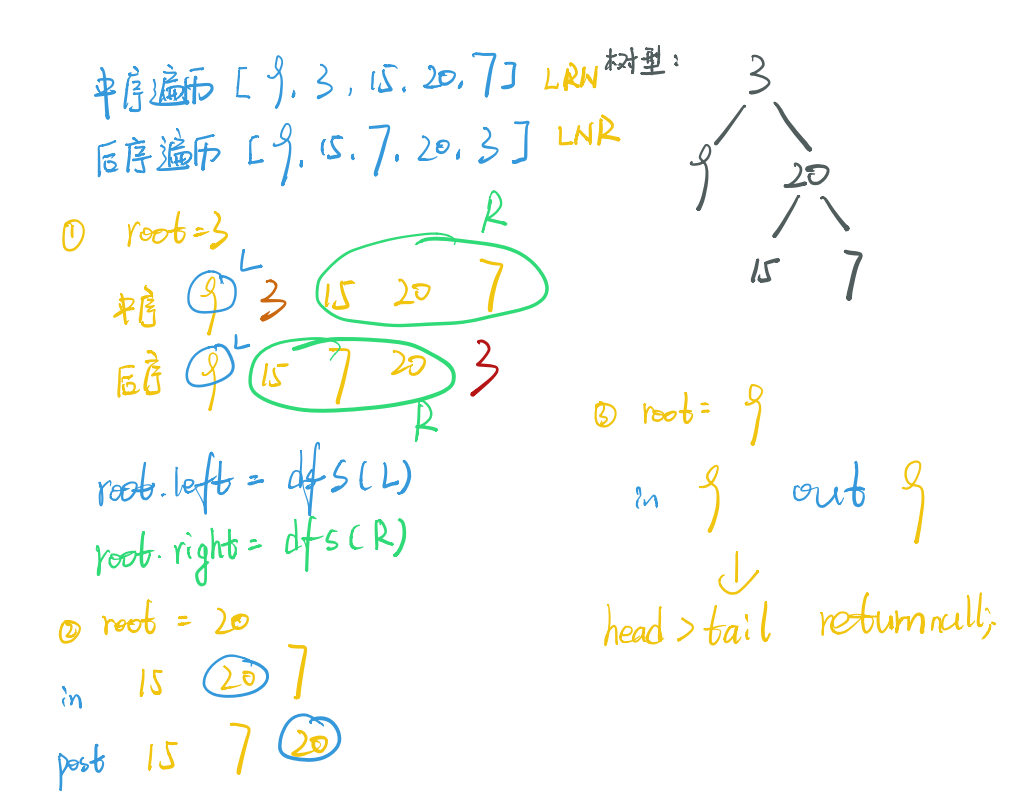
前序中序构造二叉树类似
和中序前序类似, 只是每次的限定范围不同
二叉树填充右侧指针
递归法: 限定完美二叉树
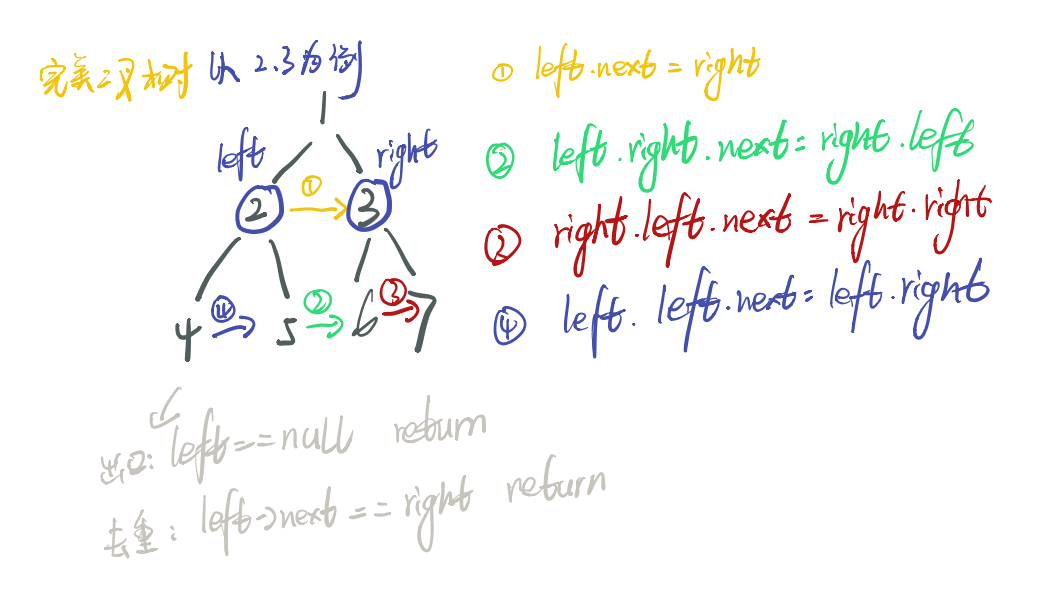
class Solution {
    public Node connect(Node root){
        if(root!=null) dfs(root.left, root.right);
        return root;
    }
    void dfs(Node left, Node right){
        if(left ==null || left.next == right) return;
        left-> next = right;
        dfs(left.left, left.right);
        dfs(left.right, right.left);
        dfs(right.left, right.right);
    }
}
一般情况
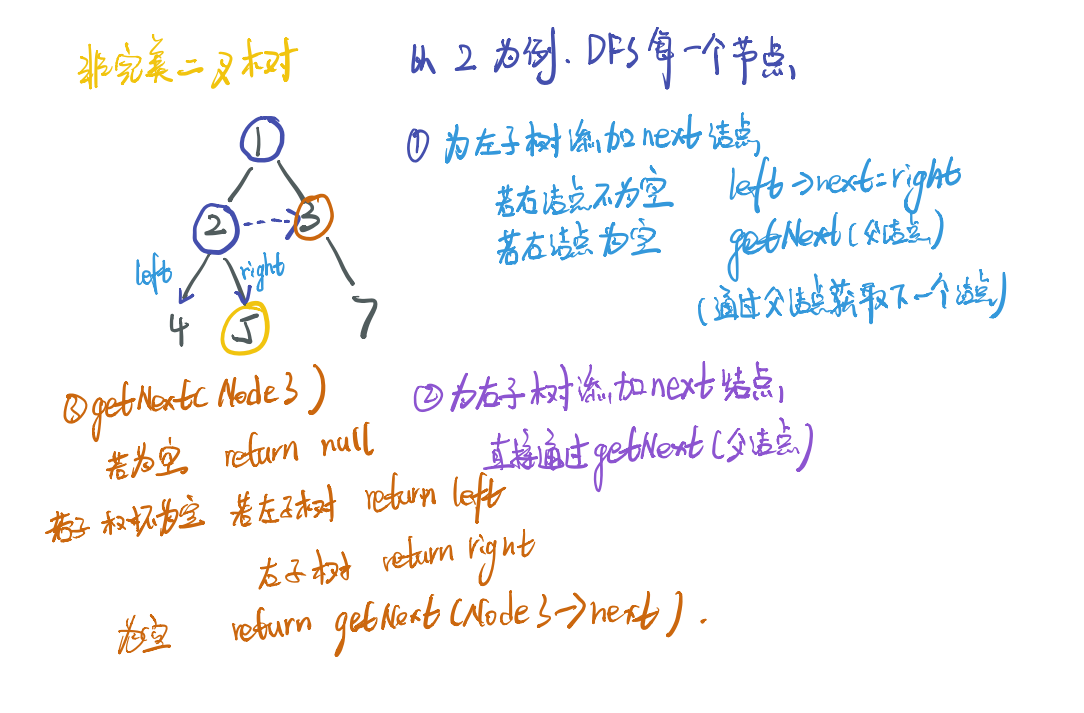
/*
// Definition for a Node.
class Node {
public:
int val;
Node* left;
Node* right;
Node* next;
Node() : val(0), left(NULL), right(NULL), next(NULL) {}
Node(int _val) : val(_val), left(NULL), right(NULL), next(NULL) {}
Node(int _val, Node* _left, Node* _right, Node* _next)
: val(_val), left(_left), right(_right), next(_next) {}
};
*/
class Solution {
public:
Node* connect(Node* root) {
// 空树判断
if( root == nullptr ) return nullptr;
// 左树为空
if( root -> left != nullptr ) {
if( root -> right != nullptr){
// 最普遍的情况
root -> left -> next = root -> right;
}
else
// 父节点的next的第一个子节点作为next
root -> left -> next = getNext(root -> next);
}
// 右节点不为空
if( root->right != nullptr){
// next
root -> right -> next = getNext( root-> next );
}
// 先判断右节点
connect(root->right);
connect(root->left);
return root;
}
// 通过父节点获取子节点的next结点
Node* getNext(Node* uncle){ if( uncle == nullptr ) return nullptr; if( uncle -> left != nullptr) return uncle->left; if( uncle -> right != nullptr ) return uncle->right; return getNext(uncle->next);
}
};
最近公共祖先
整体思路:1. 通过BFS得到每个节点和其父节点的Map
通过Set,保存p到根节点的路径
在通过获得q到根节点的路径,判断第一个包含在原来的set的节点为最先公共祖先
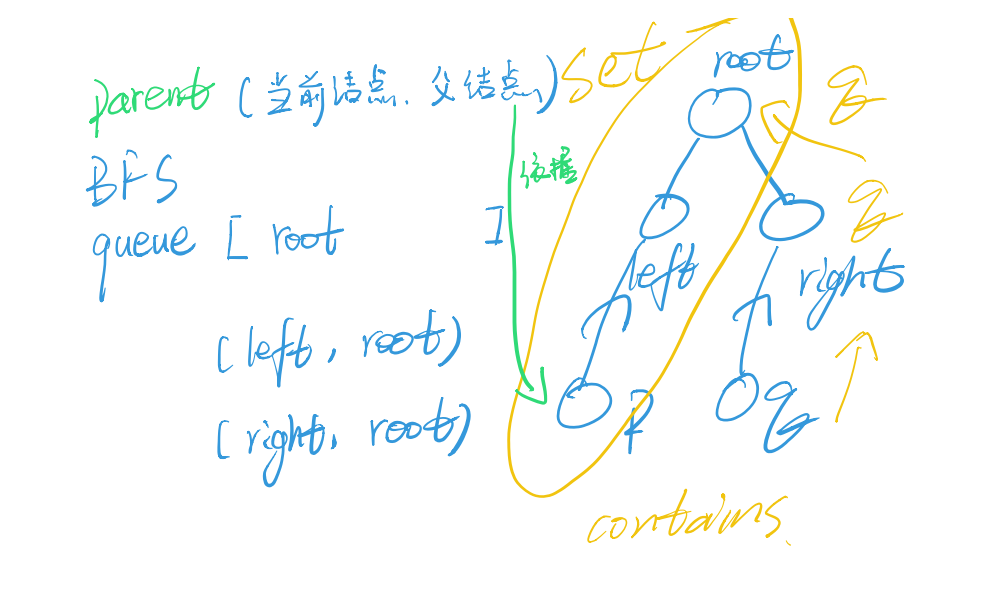
代码:
public TreeNode lowestCommonAncestor(TreeNode root, TreeNode p, TreeNode q) {
//记录遍历到的每个节点的父节点。
Map<TreeNode, TreeNode> parent = new HashMap<>();
Queue<TreeNode> queue = new LinkedList<>();
//根节点没有父节点,所以为空
parent.put(root, null);
//队列入队
queue.add(root);
//直到两个节点都找到为止。
while (!parent.containsKey(p) || !parent.containsKey(q)) {
//队列是一边进一边出,这里poll方法是出队,
TreeNode node = queue.poll();
if (node.left != null) {
//左子节点不为空,记录下他的父节点
parent.put(node.left, node);
//左子节点不为空,把它加入到队列中
queue.add(node.left);
}
//右节点同上
if (node.right != null) {
parent.put(node.right, node);
queue.add(node.right);
}
}
Set<TreeNode> ancestors = new HashSet<>();
//记录下p和他的祖先节点,从p节点开始一直到根节点。
while (p != null) {
ancestors.add(p);
p = parent.get(p);
}
//查看p和他的祖先节点是否包含q节点,如果不包含再看是否包含q的父节点……
while (!ancestors.contains(q))
q = parent.get(q);
return q;
}
二叉树的序列化和反序列化
分析思路:
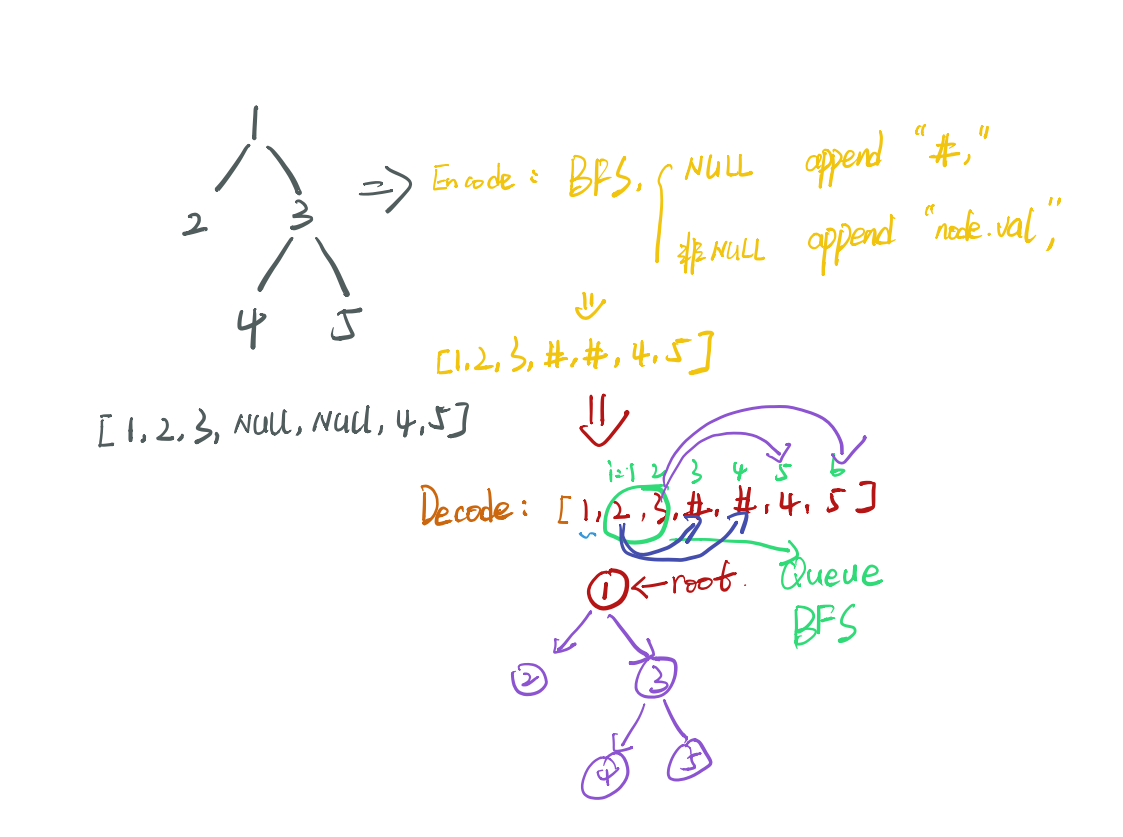
代码:
/**
* Definition for a binary tree node.
* public class TreeNode {
* int val;
* TreeNode left;
* TreeNode right;
* TreeNode(int x) { val = x; }
* }
*/
public class Codec {
// Encodes a tree to a single string.
public String serialize(TreeNode root) {
if(root == null) return "#";
Queue<TreeNode> queue = new LinkedList<TreeNode>();
StringBuffer res = new StringBuffer();
queue.add(root);
while(!queue.isEmpty()){
TreeNode node = queue.poll();
if(node == null){
res.append("#,");
continue;
}
res.append(node.val + ",");
queue.add(node.left);
queue.add(node.right);
}
return res.toString();
}
// Decodes your encoded data to tree.
public TreeNode deserialize(String data) {
if(data == "#") return null;
Queue<TreeNode> queue = new LinkedList<>();
String[] values = data.split(",");
// 第一个节点
TreeNode node = new TreeNode(Integer.parseInt(values[0]));
queue.add(node);
for(int i =1; i < values.length; i++){
TreeNode treeNode = queue.poll();
if(!"#".equals(values[i])){
treeNode.left = new TreeNode(Integer.parseInt(values[i]));
queue.add(treeNode.left);
}
if(!"#".equals(values[++i])){
treeNode.right = new TreeNode(Integer.parseInt(values[i]));
queue.add(treeNode.right);
}
}
return node;
}
}
// Your Codec object will be instantiated and called as such:
// Codec ser = new Codec();
// Codec deser = new Codec();
// TreeNode ans = deser.deserialize(ser.serialize(root));
leetcode二叉树题目总结的更多相关文章
- 面试大总结之二:Java搞定面试中的二叉树题目
package BinaryTreeSummary; import java.util.ArrayList; import java.util.Iterator; import java.util.L ...
- leetcode上题目的分类
leetcode链表部分题目 https://zhuanlan.zhihu.com/p/29800285 <[Leetcode][链表]相关题目汇总/分析/总结> leetcode堆部分题 ...
- 二叉树题目集合 python
二叉树是被考察频率非常高的数据结构.二叉树是按照“父节点-左子树&右子树”这样的方式,由根节点不断向下扩展,形成一棵树的结构.二叉树经常被提到的三种遍历方式:前序遍历.中序遍历和后序遍历,既是 ...
- LeetCode二叉树实现
LeetCode二叉树实现 # 定义二叉树 class TreeNode: def __init__(self, x): self.val = x self.left = None self.righ ...
- LeetCode高频题目(100)汇总-Java实现
LeetCode高频题目(100)汇总-Java实现 LeetCode高频题目(100)汇总-Java实现 目录 第01-50题 [Leetcode-easy-1] Two Sum [Le ...
- LeetCode算法题目解答汇总(转自四火的唠叨)
LeetCode算法题目解答汇总 本文转自<四火的唠叨> 只要不是特别忙或者特别不方便,最近一直保持着每天做几道算法题的规律,到后来随着难度的增加,每天做的题目越来越少.我的初衷就是练习, ...
- LeetCode SQL题目(第一弹)
LeetCode SQL题目 注意:Leetcode上的SQL编程题都提供了数据表的架构程序,只需要将它贴入本地数据库即可调试自己编写的程序 不管是MS-SQL Server还是MySQL都需要登陆才 ...
- LeetCode 二叉树,两个子节点的最近的公共父节点
LeetCode 二叉树,两个子节点的最近的公共父节点 二叉树 Lowest Common Ancestor of a Binary Tree 二叉树的最近公共父亲节点 https://leetcod ...
- 已知前序(后序)遍历序列和中序遍历序列构建二叉树(Leetcode相关题目)
1.文字描述: 已知一颗二叉树的前序(后序)遍历序列和中序遍历序列,如何构建这棵二叉树? 以前序为例子: 前序遍历序列:ABCDEF 中序遍历序列:CBDAEF 前序遍历先访问根节点,因此前序遍历序列 ...
随机推荐
- 2021.08.05 P7095 不离【扶咕咕出题】(贪心)
2021.08.05 P7095 不离[扶咕咕出题](贪心) [P7095 yLOI2020] 不离 - 洛谷 | 计算机科学教育新生态 (luogu.com.cn) 题意: 游戏中人物有两个属性,我 ...
- Linux的软件安装tomcat 以及jdk
因为tomcat的启动需要jdk,所以我们先安装jdk,安装完成后再安装tomcat 具体的文件大家可以到官网下载,下面介绍安装步骤 目录 jdk安装 1.通过xftp或者其他方式将安装包传到我们的L ...
- RecyclerView + SQLite 简易备忘录-----中(2)
(3)RecyclerView的实现 ---中间的内容 RecyclerView是一个比ListView更加强大的滚动控件.要使用这个控件需要先在项目的build.gradle中添加RecyclerV ...
- Hadoop(一)Hadoop核心架构与安装
Hadoop是什么 大白话,Hadoop是个存储数据,计算数据的分布式框架.核心组件是HDFS.MapReduce.Yarn. HDFS:分布式存储 MapReduce:分布式计算 Yarn:调度Ma ...
- 论文解读(GMT)《Accurate Learning of Graph Representations with Graph Multiset Pooling》
论文信息 论文标题:Accurate Learning of Graph Representations with Graph Multiset Pooling论文作者:Jinheon Baek, M ...
- java高级用法之:JNA中的Memory和Pointer
目录 简介 Pointer 特殊的Pointer:Opaque Memory 总结 简介 我们知道在native的代码中有很多指针,这些指针在JNA中被映射成为Pointer.除了Pointer之外, ...
- 专门为小白准备的入门级mybatis-plus-generator代码自动生成器,提高开发效率。值得收藏
引入依赖 <dependency> <groupId>com.baomidou</groupId> <artifactId>mybatis-plus-g ...
- linux系统平均负载高(load average)
系统平均负载高(load average) 问题现象 两个案例都是:系统平均负载高,但cpu,内存,磁盘io都正常 什么是系统平均负载 平均负载是指单位时间内,系统处于可运行状态和不可中断状态的平均进 ...
- How to fetch data with React Hooks
Where can I make API call with hooks in react? Async useEffect is pretty much unreadable How to fetc ...
- 玩转ASP.NET 6.0框架-序言
ASP.NET Core是微软提供的强大的web框架,它有很多潜在的强大而有用的功能. 本专栏的目标是帮助您把框架的隐藏能力最大限度地发挥出来,让您能够按需定制ASP NET Core框架.本专栏提供 ...