
Trie树(c++实现)——转载自jihite的博客
Trie树(c++实现)
原理
先看个例子,存储字符串abc、ab、abm、abcde、pm可以利用以下方式存储
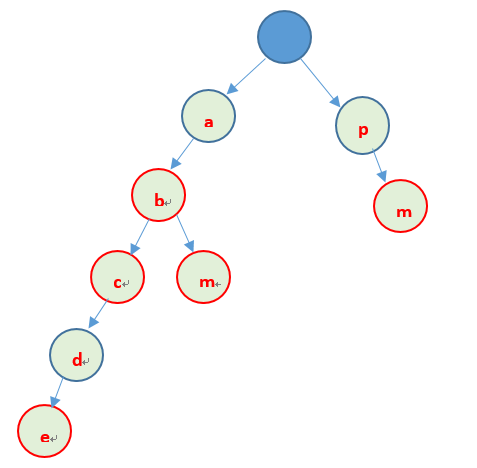
上边就是Trie树的基本原理:利用字串的公共前缀来节省存储空间,最大限度的减少无谓的字串比较。
应用
Trie树又称单词查找树,典型的应用是用于统计,排序和保存大量的字符串(不仅用于字符串),所以经常被搜索引擎系统用于文本词频的统计。
设计
trie,又称前缀树或字典树,是一种有序树,用于保存关联数组,其中的键通常是字符串。与二叉查找树不同,键不是直接保存在节点中,而是由节点在树中的位置决定。一个节点的所有子孙都有相同的前缀,也就是这个节点对应的字符串,而根节点对应空字符串。一般情况下,不是所有的节点都有对应的值,只有叶子节点和部分内部节点所对应的键才有相关的值。
结点可以设计成这样:
class trieNode

{

    public:

        trieNode() : terminableSize(), nodeSize() { for(int i = ; i < Size; ++i) children[i] = NULL; }

        ~trieNode()

        {

            for(int i = ; i < Size; ++i)

            {

                delete children[i];

                children[i] = NULL;

            }

        }

    public:

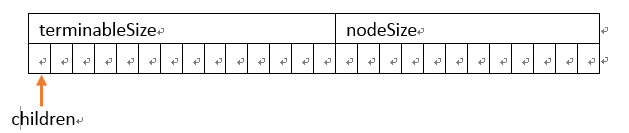
        int terminableSize;          //存储以此结点为结尾的字串的个数

        int nodeSize;                //记录此结点孩子的个数

        trieNode* children[Size];    //该数组记录指向孩子的指针

};
图示
树设计成这样:
template<int Size, class Type>

class trie

{

    public:

        typedef trieNode<Size> Node;

        typedef trieNode<Size>* pNode;

        trie() : root(new Node) {}

        template<class Iterator>

        void insert(Iterator beg, Iterator end);

        void insert(const char *str);

        template<class Iterator>

        bool find(Iterator beg, Iterator end);

        bool find(const char *str);

        template<class Iterator>

        bool downNodeAlone(Iterator beg);

        template<class Iterator>

        bool erase(Iterator beg, Iterator end);

        bool erase(const char *str);

        int sizeAll(pNode);

        int sizeNoneRedundant(pNode);

    public:

        pNode root;

    private:

        Type index;

};
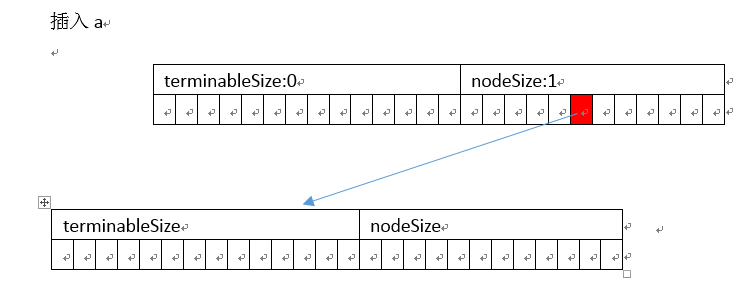
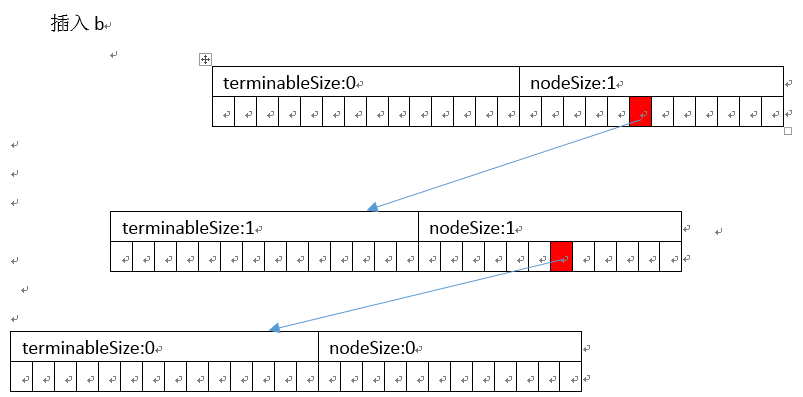
index字串索引利用(char % 26) 得到,这样'a' % 26 = 19, 'b' % 26 = 20
实现
插入
以插入abc、ab为例
 ]
]
删除
删除结点,首先查找此字串是否在树中,如果在树中,再查找此结点以下的部分是不是都是只有一个孩子,并且每个结点只有叶子结点是结束结点,如果不是继续往下重复上边过程。
统计字串个数
分两种情况
- 计算重复的字串的个数:是结束结点,此时加的是terminabel的个数
- 计算不重复的字串的个数:是结束结点,此时加的是1(当terminabel>0)的个数
参考代码
#include <iostream>

#include <cstring>

using namespace std;

template<int Size>

class trieNode

{

    public:

        trieNode() : terminableSize(), nodeSize() { for(int i = ; i < Size; ++i) children[i] = NULL; }

        ~trieNode()

        {

            for(int i = ; i < Size; ++i)

            {

                delete children[i];

                children[i] = NULL;

            }

        }

    public:

        int terminableSize;

        int nodeSize;

        trieNode* children[Size];

};

template<int Size, class Type>

class trie

{

    public:

        typedef trieNode<Size> Node;

        typedef trieNode<Size>* pNode;

        trie() : root(new Node) {}

        template<class Iterator>

        void insert(Iterator beg, Iterator end);

        void insert(const char *str);

        template<class Iterator>

        bool find(Iterator beg, Iterator end);

        bool find(const char *str);

        template<class Iterator>

        bool downNodeAlone(Iterator beg);

        template<class Iterator>

        bool erase(Iterator beg, Iterator end);

        bool erase(const char *str);

        int sizeAll(pNode);

        int sizeNoneRedundant(pNode);

    public:

        pNode root;

    private:

        Type index;

};

template<int Size, class Type>

template<class Iterator>

void trie<Size, Type>::insert(Iterator beg, Iterator end)

{

    pNode cur = root;

    pNode pre;

    for(; beg != end; ++beg)

    {

        if(!cur->children[index[*beg]])

        {

            cur->children[index[*beg]] = new(Node);

            ++cur->nodeSize;

        }

        pre = cur;

        cur = cur->children[index[*beg]];

    }

    ++pre->terminableSize;

}

template<int Size, class Type>

void trie<Size, Type>::insert(const char *str)

{

    return insert(str, str + strlen(str));

}

template<int Size, class Type>

template<class Iterator>

bool trie<Size, Type>::find(Iterator beg, Iterator end)

{

    pNode cur = root;

    pNode pre;

    for(; beg != end; ++beg)

    {

        if(!cur->children[index[*beg]])

        {

            return false;

            break;

        }

        pre = cur;

        cur = cur->children[index[*beg]];

    }

    if(pre->terminableSize > )

        return true;

    return false;

}

template<int Size, class Type>

bool trie<Size, Type>::find(const char *str)

{

    return find(str, str + strlen(str));

}

template<int Size, class Type>

template<class Iterator>

bool trie<Size, Type>::downNodeAlone(Iterator beg)

{

    pNode cur = root;

    int terminableSum = ;

    while(cur->nodeSize != )

    {

        terminableSum += cur->terminableSize;

        if(cur->nodeSize > )

            return false;

        else          //cur->nodeSize = 1

        {

            for(int i = ; i < Size; ++i)

            {

                if(cur->children[i])

                    cur = cur->children[i];

            }

        }

    }

    if(terminableSum == )

        return true;

    return false;

}

template<int Size, class Type>

template<class Iterator>

bool trie<Size, Type>::erase(Iterator beg, Iterator end)

{

    if(find(beg, end))

    {

        pNode cur = root;

        pNode pre;

        for(; beg != end; ++beg)

        {

            if(downNodeAlone(cur))

            {

                delete cur;

                return true;

            }

            pre = cur;

            cur = cur->children[index[*beg]];

        }

        if(pre->terminableSize > )

            --pre->terminableSize;

        return true;

    }

    return false;

}

template<int Size, class Type>

bool trie<Size, Type>::erase(const char *str)

{

    if(find(str))

    {

        erase(str, str + strlen(str));

        return true;

    }

    return false;

}

template<int Size, class Type>

int trie<Size, Type>::sizeAll(pNode ptr)

{

    if(ptr == NULL)

        return ;

    int rev = ptr->terminableSize;

    for(int i = ; i < Size; ++i)

        rev += sizeAll(ptr->children[i]);

    return rev;

}

template<int Size, class Type>

int trie<Size, Type>::sizeNoneRedundant(pNode ptr)

{

    if(ptr == NULL)

        return ;

    int rev = ;

    if(ptr->terminableSize > )

        rev = ;

    if(ptr->nodeSize != )

    {

        for(int i = ; i < Size; ++i)

            rev += sizeNoneRedundant(ptr->children[i]);

    }

    return rev;

}

template<int Size>

class Index

{

    public:

        int operator[](char vchar)

        { return vchar % Size; }

};

int main()

{

    trie<, Index<> > t;

    t.insert("hello");

    t.insert("hello");

    t.insert("h");

    t.insert("h");

    t.insert("he");

    t.insert("hel");

    cout << "SizeALL:" << t.sizeAll(t.root) << endl;

    cout << "SizeALL:" << t.sizeNoneRedundant(t.root) << endl;

    t.erase("h");

    cout << "SizeALL:" << t.sizeAll(t.root) << endl;

    cout << "SizeALL:" << t.sizeNoneRedundant(t.root) << endl;

}
结果
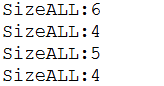
技术实现细节
1. 对树的删除,并不是树销毁结点,而是通过结点自身的析构函数实现
2. 模版类、模版函数、非类型模版可以参考:http://www.cnblogs.com/kaituorensheng/p/3601495.html
3. 字母的存储并不是存储的字母,而是存储的位置,如果该位置的指针为空,则说明此处没有字母;反之有字母。
4. terminableNum存储以此结点为结束结点的个数,这样可以避免删除时,不知道是否有多个相同字符串的情况。
Trie树(c++实现)——转载自jihite的博客的更多相关文章
- 【转载】国内网站博客数据统计选免费Google Analytics还是百度统计
[转载]国内网站博客数据统计选免费Google Analytics还是百度统计 Google Analytics谷歌统计是我用的第一个网站统计工具,当然现在也一直在用.Google Analytics ...
- 转载来自朱小厮博客的 一文看懂Kafka消息格式的演变
转载来自朱小厮博客的 一文看懂Kafka消息格式的演变 ✎摘要 对于一个成熟的消息中间件而言,消息格式不仅关系到功能维度的扩展,还牵涉到性能维度的优化.随着Kafka的迅猛发展,其消息格式也在 ...
- 如何快速转载CSDN中的博客
看到一篇<如何快速转载CSDN中的博客>,介绍通过检查元素→复制html来实现快速转载博客的方法.不过,不知道是我没有领会其精神还是其他原因,测试结果为失败.
- [转]如何快速转载CSDN中的博客
原文:https://blog.csdn.net/bolu1234/article/details/51867099 前言 对于喜欢逛CSDN的人来说,看别人的博客确实能够对自己有不小的提高,有时 ...
- 【转载】如何快速转载CSDN中的博客
前言 对于喜欢逛CSDN的人来说,看别人的博客确实能够对自己有不小的提高,有时候看到特别好的博客想转载下载,但是不能一个字一个字的敲了,这时候我们就想快速转载别人的博客,把别人的博客移到自己的空间 ...
- JavaScript资源大全中文版(Awesome最新版--转载自张果老师博客)
JavaScript资源大全中文版(Awesome最新版) 目录 前端MVC 框架和库 包管理器 加载器 打包工具 测试框架 框架 断言 覆盖率 运行器 QA 工具 基于 Node 的 CMS 框 ...
- 转载自jguangyou的博客,XML基本属性大全
android:layout_width 指定组件布局宽度 android:layout_height 指定组件布局高度 android:alpha 设置组件透明度 android:backgroun ...
- 在mac系统安装Apache Tomcat的详细步骤(转载自himi的博客,修改了错误添加了图片)
链接地址:http://blog.csdn.net/liuyuyefz/article/details/8072485 1. 2. 3. 4. 5. 对于Apache Tomcat 估计很多童鞋都会, ...
- 一个最最简易的RPC框架雏形---转载自梁飞的博客
查阅RPC与HTTP区别的时候, 无意间发现一篇博客,内容是一个简易的RPC服务框架, 仔细一看, 不得了,博主竟然就是阿里dubbo的作者. 原文链接在此: http://javatar.iteye ...
随机推荐
- 网易Java程序员两轮面试,这些问题你能答对几个?
一转眼,2018 年已经过去了,你是否在满意的公司?拿着理想的薪水? 虽然"钱多.事少.离家近"的工作可能离技术人比较远,但是找到一份合适的工作,其实并不像想象中那么难.但是,有些 ...
- [IOI2005]Riv河流
题目链接:洛谷,BZOJ 前置知识:莫得 题解 直接考虑dp.首先想法是设状态 \(dp[u][i]\) 表示u的子树内建 \(i\) 个伐木场且子树内木头都运到某个伐木场的最小花费.发现这样的状态是 ...
- Vuex是什么?
记得去年公司招聘前端工程师的时候,我要负责准备面试题去考验面试者,让我记忆深刻的有一件事,我看大多数面试者简历上都写了熟练掌握Vuex,然而当我问起的时候,大部分回答都支支吾吾,解释不清,而当我提起与 ...
- Plugin 表格列自定义显示隐藏插件TableCustom.js
TableCustom 案例展示 下载地址 https://github.com/chaorenzeng/TableCustom.js.git 快速使用 1.引入TableCustom.css和Tab ...
- CSS总结六:动画(一)ransition:过渡、animation:动画、贝塞尔曲线、step值的应用
transition-property transition-duration transition-timing-function transition-delay animation-name a ...
- 可能是全网最全的http面试答案
HTTP有哪些方法? HTTP1.0定义了三种请求方法: GET, POST 和 HEAD方法 HTTP1.1新增了五种请求方法:OPTIONS, PUT, DELETE, TRACE 和 CONNE ...
- 获取指定开始行数$start,跨度$limit的文件内容
// 获取指定开始行数$page,跨度$step的文件内容 function getLine($file_name, $start, $limit) { $f = new SplFileObject( ...
- 深入分析 Docker 镜像原理
摘要:近日, DaoCloud 软件工程师孙宏亮在 CSDN Container 微信群为大家带来了 Docker 镜像原理的深度分享,本次分享的重点是 Docker 镜像,分享的内容主要包含两个部分 ...
- export CommonJS AMD ES6
export https://www.cnblogs.com/fayin/p/6831071.html 导入文件: a - b - c ,对象隔代消失,可转成函数返回 导入模块对象(命名) ...
- MyBatis、JDBC相关知识
引言 在mybatis的基础知识中我们已经可以对mybatis的工作方式窥斑见豹.但是,为什么还要要学习mybatis的工作原理?因为,随着mybatis框架的不断发展,如今已经越来越趋于自动化,从代 ...