
Understanding about numerical stability, convergence and consistency
In a computer simulation of the real world, physical quantities, which usually have continuous distributions governed by partial differential equations (PDEs), can be solved by numerical methods such as finite element method (FEM) and boundary element method (BEM). Whether the obtained solution is a good approximation of the reality and whether the numerical schemes can proceed properly under perturbations of different error sources, such as numerical quadrature error and round-off error, should be clarified before any code implementation. To answer these questions, this post will introduce the fundamental concepts of numerical stability, convergence and consistency according to the following figure.
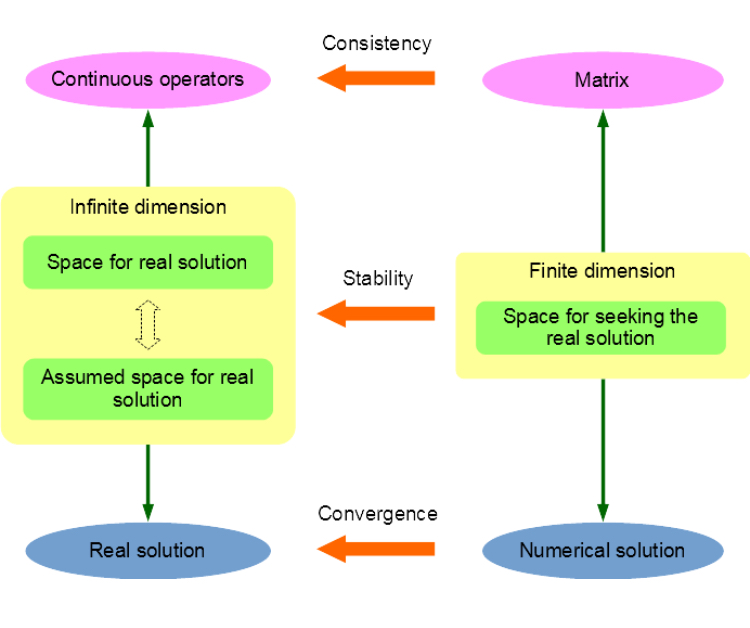
Let \(u\) be the real solution of the following general variational problem for a PDE:
\[
\text{Solve $u \in U$: } a(u, v) = (f, v) \quad (\forall v \in W),
\]
where both \(U\) and \(W\) are Hilbert spaces, \(a(\cdot, \cdot): U \times W \rightarrow \mathbb{K}\) with \(\mathbb{K} \in \{\mathbb{R}, \mathbb{C}\}\) is a sesquilinear or bilinear form and \(f: W \rightarrow \mathbb{K}\) is a continuous linear functional on \(W\). The solution \(u\) belongs to the space \(U\) of continuous functions with infinite dimension. For ease of further analysis, priori assumption is usually adopted for such function space thus we have the assumed function space \(V\). For example, the countably normed spaces \(V = B_{\varrho}(\Gamma)\) used in the \(hp\)-BEM is defined as
\[
B_{\varrho}(\Gamma) = \{ v \in L^2(\Gamma): v \circ \kappa_K \in B_{\varrho}(K_0) \},
\]
where
- \(\Gamma\) is the boundary manifold of the solution domain, which is covered by the mesh \(\{K_i\}_{i=1}^{N_M}\) with \(N_M\) as the number of mesh elements;
- \(K_0\) is the reference cell and \(K\) is the real cell which may be curved;
- \(\kappa_K: K_0 \rightarrow K\) is the mapping from the reference cell to the real cell;
- \(B_{\varrho}(K_0)\) is the countably normed space restricted on the reference cell, which has constraints on the norm of all the derivatives of \(v\). Its formulation is given as below:
\[
B_{\varrho}(K_0) = \big\{ v \in L^2(K_0): \Norm{r_X^{k - \varrho} \left( \Pd{}{r_X} \right)^k \left( \vartheta (\alpha_X - \vartheta_X) \right)^{l - \varrho} \left( \Pd{}{\vartheta_X} \right)^l v}_{L^2(U_X)} \leq C d^{k+l+1} k! l!\big\},
\]
for which I do not provide more explanation in this post, but just give you an impression that the construction of the assumed solution function space can be quite complicated.
To solve the PDE on a computer, a finite dimensional subspace \(V^L\) of \(V\) must be constructed, in which a solution is to be sought as an approximation of the real solution by using some sort of numerical method. Then the stability condition means, for any function \(u\) in the real space \(U\) or the assumed space \(V\) of infinite dimension, whether there exists a function \(v\) in the finite dimensional space \(V^L\), such that the norm of their difference can be controlled to be arbitrarily small as \(N_L\), the dimension of space \(V^L\), increases. For example, in the \(hp\)-BEM, a subspace \(V^L\) can be constructed to have the following exponential stability condition:
\[
\begin{equation}
\label{eq:stability-condition}
\forall u \in B_{\varrho}(\Gamma): \inf_{v \in V^L} \norm{u - v}_{L^2(\Gamma)} \leq C \exp(-b N_L^{1/4}).
\end{equation}
\]
Once the solution \(u^L \in V^L\) for the finite dimensional problem is obtained from a general method such as the Galerkin method, i.e.
\[
\text{Solve $u^L \in V^L$: } a(u^L, v) = (f, v) \quad (\forall v \in V^L),
\]
the concept of convergence comes into play, which ensures that the difference between this \(u^L\) and the real solution \(u\) can be controlled. For example, if the following condition can be satisfied:
\[
\Norm{P_L A u^L} \geq C_s \Norm{u^L} \quad (\forall u^L \in V^L),
\]
where \(P_L: V \rightarrow V^L\) is the projection operator, \(A: V^L \rightarrow (V^L)'\) is the associated operator of the sesquilinear or bilinear form \(a(\cdot, \cdot)\) and \(C_s > 0\) is a constant, it can be proved that the solution obtained from the Galerkin method satisfies
\[
\begin{equation}
\label{eq:convergence-condition}
\norm{u - u^L} \leq C \inf_{v \in V^L} \Norm{u - v}.
\end{equation}
\]
This means the real solution can be properly approximated by the Galerkin solution with the error norm controlled by the approximation capability of the adopted finite dimensional space \(V^L\), and we say the method is convergent. In addition, combing equation \eqref{eq:stability-condition} and \eqref{eq:convergence-condition}, we know the solution has the exponential convergence property:
\[
\begin{equation}
\label{eq:exponential-convergence}
\norm{u - u^L} \leq C \exp(-b N_L^{1/4}).
\end{equation}
\]
Finally, we introduce the concept of consistency. During the discretization of the problem, the sesquilinear or bilinear form \(a(\cdot, \cdot)\), or rather, its associated operator \(A\), is to be approximated by its discrete version, i.e. the stiffness matrix \(A^L\). The evaluation of \(A^L\)'s coefficients usually needs numerical quadrature techniques, which introduces additional numerical error. Even though there is an analytical formula for integration, round-off error limited by the finite computer byte length is unavoidable. Hence, an operator \(\tilde{A}^L\) is obtained being different from \(A^L\). The error between \(A^L\) and \(\tilde{A}^L\) will perturb the adopted numerical method. If the error between the real and numerical solutions \(\Norm{u - \tilde{u}^L}\) can still be controlled, we say the method is consistent. For example, in the \(hp\)-BEM, if the stiffness matrix coefficient error satisfies the following consistent condition
\[
\abs{A^L_{ij} - \tilde{A}^L_{ij}} < \Phi(L) \quad (i,j = 1, \cdots, N_L)
\]
with
\[
\lim_{L \rightarrow \infty} N_L \Phi(L) = 0 \; \text{and} \; \Phi(L) = N_L^{-1} L \sigma^{\varrho L},
\]
the exponential convergence as shown in \eqref{eq:exponential-convergence} can be preserved.
Understanding about numerical stability, convergence and consistency的更多相关文章
- Softmax vs. Softmax-Loss VS cross-entropy损失函数 Numerical Stability(转载)
http://freemind.pluskid.org/machine-learning/softmax-vs-softmax-loss-numerical-stability/ 卷积神经网络系列之s ...
- Softmax vs. Softmax-Loss: Numerical Stability
http://freemind.pluskid.org/machine-learning/softmax-vs-softmax-loss-numerical-stability/ softmax 在 ...
- Understanding Convolution in Deep Learning
Understanding Convolution in Deep Learning Convolution is probably the most important concept in dee ...
- [C4] Andrew Ng - Improving Deep Neural Networks: Hyperparameter tuning, Regularization and Optimization
About this Course This course will teach you the "magic" of getting deep learning to work ...
- 【转】Artificial Neurons and Single-Layer Neural Networks
原文:written by Sebastian Raschka on March 14, 2015 中文版译文:伯乐在线 - atmanic 翻译,toolate 校稿 This article of ...
- AP(affinity propagation)研究
待补充…… AP算法,即Affinity propagation,是Brendan J. Frey* 和Delbert Dueck于2007年在science上提出的一种算法(文章链接,维基百科) 现 ...
- 提高神经网络的学习方式Improving the way neural networks learn
When a golf player is first learning to play golf, they usually spend most of their time developing ...
- 【Caffe 测试】Training LeNet on MNIST with Caffe
Training LeNet on MNIST with Caffe We will assume that you have Caffe successfully compiled. If not, ...
- MR for Baum-Welch algorithm
The Baum-Welch algorithm is commonly used for training a Hidden Markov Model because of its superior ...
随机推荐
- Unity3D动态生成多边形
来自https://blog.csdn.net/qq_14903317/article/details/69668521 自由绘制多边形 https://blog.csdn.net/lei_710 ...
- mysql导入sqlserver数据库表
原文:https://zhidao.baidu.com/question/1114325744502691499.html 在Navicat for MySQL 管理器中,创建目标数据库(注意:因为是 ...
- LOJ 6277-6280 数列分块入门 1-4
数列分块是莫队分块的前置技能,练习一下 1.loj6277 给出一个长为n的数列,以及n个操作,操作涉及区间加法,单点查值. 直接分块+tag即可 #include <bits/stdc++.h ...
- 在VS解决方案资源管理器中自动定位当前编辑中的文件
依次点击 [工具]- [选项] - [项目和解决方案]-[常规]- 勾选[在解决方案资源管理器中跟踪活动项]
- 在TOMCAT下配置工程的默认访问设置(转)
对工程的部署一般是将工程的压缩文件放在tomcat安装目录的webapps下,访问时通过键入:http://localhost:8080/xx(假定为本机访问,xx是部署时的应用工程的访问名字). 而 ...
- MySQL - 查看慢SQL
查看MySQL是否启用了查看慢SQL的日志文件 (1) 查看慢SQL日志是否启用 mysql> show variables like 'log_slow_queries'; +-------- ...
- 前端 ----- 01 -html介绍和head标签
01-html介绍和head标签 主要内容 web标准 浏览器介绍 开发工具介绍 HTML介绍 HTML颜色介绍 HTML规范 HTML结构详解 一.web标准 web准备介绍: w3c:万维网联 ...
- MySql两种存储引擎的区别
MyISAM是MySQL的默认数据库引擎(5.5版之前),由早期的ISAM(Indexed Sequential Access Method:有索引的顺序访问方法)所改良.虽然性能极佳,但却有一个缺点 ...
- log4j 知识点
什么是log4j? log4j 是一个帮助程序员将日志语句输出到各种输出目标的工具. log4j 包的设计使得日志语句可以保留在已发布的代码中,而不会产生高性能成本. log4j 使用分层记录器可以有 ...
- 本文转自 MyEclipse 2015反编译插件安装
本文转自MyEclipse 2015反编译插件安装 分享一下下载插件的地址,百度网盘:链接:http://pan.baidu.com/s/1nturiAH 密码:yk73 其次:我来说下具体操作步骤: ...