
Iterables vs. Iterators vs. Generators
Reprinted from:
Iterables vs. Iterators vs. Generators
Occasionally I've run into situations of confusion on the exact differences between the following related concepts in Python:
- a container
- an iterable
- an iterator
- a generator
- a generator expression
- a {list, set, dict} comprehension
I'm writing this post as a pocket reference for later.
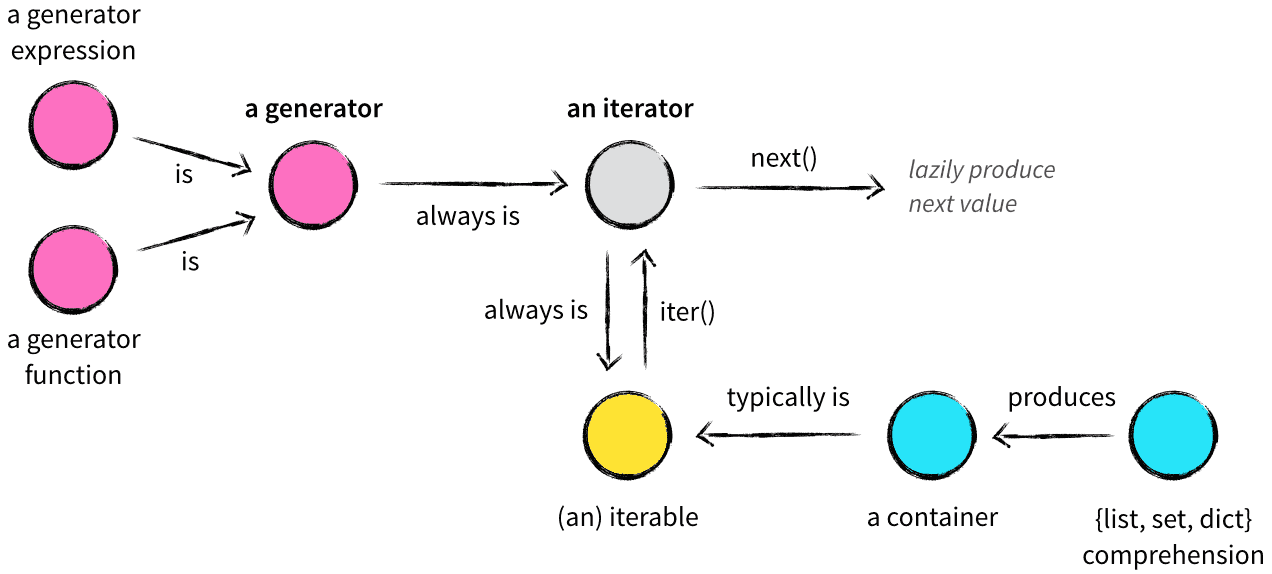
Containers
Containers are data structures holding elements, and that support membership tests. They are data structures that live in memory, and typically hold all their values in memory, too. In Python, some well known examples are:
- list, deque, …
- set, frozensets, …
- dict, defaultdict, OrderedDict, Counter, …
- tuple, namedtuple, …
- str
Containers are easy to grasp, because you can think of them as real life containers: a box, a cubboard, a house, a ship, etc.
Technically, an object is a container when it can be asked whether it contains a certain element. You can perform such membership tests on lists, sets, or tuples alike:
>>> assert 1 in [1, 2, 3]      # lists

>>> assert 4 not in [1, 2, 3]

>>> assert 1 in {1, 2, 3}      # sets

>>> assert 4 not in {1, 2, 3}

>>> assert 1 in (1, 2, 3)      # tuples

>>> assert 4 not in (1, 2, 3)
Dict membership will check the keys:
>>> d = {1: 'foo', 2: 'bar', 3: 'qux'}

>>> assert 1 in d

>>> assert 4 not in d

>>> assert 'foo' not in d  # 'foo' is not a _key_ in the dict
Finally you can ask a string if it "contains" a substring:
>>> s = 'foobar'

>>> assert 'b' in s

>>> assert 'x' not in s

>>> assert 'foo' in s  # a string "contains" all its substrings
The last example is a bit strange, but it shows how the container interface renders the object opaque. A string does not literally store copies of all of its substrings in memory, but you can certainly use it that way.
NOTE:
Even though most containers provide a way to produce every element they contain, that ability does not make them a container but an iterable (we'll get there in a minute).Not all containers are necessarily iterable. An example of this is a Bloom filter. Probabilistic data structures like this can be asked whether they contain a certain element, but they are unable to return their individual elements.
Iterables
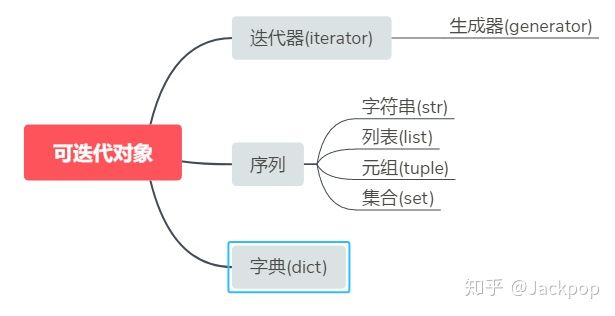
As said, most containers are also iterable. But many more things are iterable as well. Examples are open files, open sockets, etc. Where containers are typically finite, an iterable may just as well represent an infinite source of data.
An iterable is any object, not necessarily a data structure, that can return an iterator (with the purpose of returning all of its elements). That sounds a bit awkward, but there is an important difference between an iterable and an iterator. Take a look at this example:
>>> x = [1, 2, 3]

>>> y = iter(x)

>>> z = iter(x)

>>> next(y)

1

>>> next(y)

2

>>> next(z)

1

>>> type(x)

<class 'list'>

>>> type(y)

<class 'list_iterator'>
Here, x is the iterable, while y and z are two individual instances of an iterator, producing values from the iterable x. Both y and z hold state, as you can see from the example. In this example, x is a data structure (a list), but that is not a requirement.
NOTE:
Often, for pragmatic reasons, iterable classes will implement both__iter__()and__next__()in the same class, and have__iter__()returnself, which makes the class both an iterable and its own iterator. It is perfectly fine to return a different object as the iterator, though.
Finally, when you write:
x = [1, 2, 3]

for elem in x:

    ...
This is what actually happens:
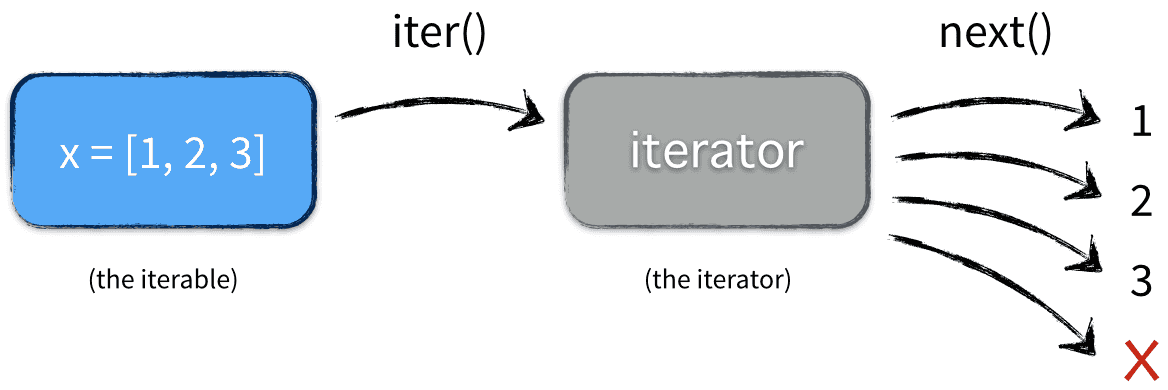
When you disassemble this Python code, you can see the explicit call to GET_ITER, which is essentially like invoking iter(x). The FOR_ITER is an instruction that will do the equivalent of calling next() repeatedly to get every element, but this does not show from the byte code instructions because it's optimized for speed in the interpreter.
>>> import dis

>>> x = [1, 2, 3]

>>> dis.dis('for _ in x: pass')

  1           0 SETUP_LOOP              14 (to 17)

              3 LOAD_NAME                0 (x)

              6 GET_ITER

        >>    7 FOR_ITER                 6 (to 16)

             10 STORE_NAME               1 (_)

             13 JUMP_ABSOLUTE            7

        >>   16 POP_BLOCK

        >>   17 LOAD_CONST               0 (None)

             20 RETURN_VALUE
Iterators
So what is an iterator then? It's a stateful helper object that will produce the next value when you call next() on it. Any object that has a __next__() method is therefore an iterator. How it produces a value is irrelevant.
So an iterator is a value factory. Each time you ask it for "the next" value, it knows how to compute it because it holds internal state.
There are countless examples of iterators. All of the itertools functions return iterators. Some produce infinite sequences:
>>> from itertools import count

>>> counter = count(start=13)

>>> next(counter)

13

>>> next(counter)

14
Some produce infinite sequences from finite sequences:
>>> from itertools import cycle

>>> colors = cycle(['red', 'white', 'blue'])

>>> next(colors)

'red'

>>> next(colors)

'white'

>>> next(colors)

'blue'

>>> next(colors)

'red'
Some produce finite sequences from infinite sequences:
>>> from itertools import islice

>>> colors = cycle(['red', 'white', 'blue'])  # infinite

>>> limited = islice(colors, 0, 4)            # finite

>>> for x in limited:                         # so safe to use for-loop on

...     print(x)

red

white

blue

red
To get a better sense of the internals of an iterator, let's build an iterator producing the Fibonacci numbers:
>>> class fib:

...     def __init__(self):

...         self.prev = 0

...         self.curr = 1

...

...     def __iter__(self):

...         return self

...

...     def __next__(self):

...         value = self.curr

...         self.curr += self.prev

...         self.prev = value

...         return value

...

>>> f = fib()

>>> list(islice(f, 0, 10))

[1, 1, 2, 3, 5, 8, 13, 21, 34, 55]
Note that this class is both an iterable (because it sports an __iter__() method), and its own iterator (because it has a __next__() method).
The state inside this iterator is fully kept inside the prev and curr instance variables, and are used for subsequent calls to the iterator. Every call to next() does two important things:
- Modify its state for the next
next()call; - Produce the result for the current call.
Central idea: a lazy factory
From the outside, the iterator is like a lazy factory that is idle until you ask it for a value, which is when it starts to buzz and produce a single value, after which it turns idle again.
Generators
Finally, we've arrived at our destination! The generators are my absolute favorite Python language feature. A generator is a special kind of iterator—the elegant kind.
A generator allows you to write iterators much like the Fibonacci sequence iterator example above, but in an elegant succinct syntax that avoids writing classes with __iter__() and __next__() methods.
Let's be explicit:
- Any generator also is an iterator (not vice versa!);
- Any generator, therefore, is a factory that lazily produces values.
Here is the same Fibonacci sequence factory, but written as a generator:
>>> def fib():

...     prev, curr = 0, 1

...     while True:

...         yield curr

...         prev, curr = curr, prev + curr

...

>>> f = fib()

>>> list(islice(f, 0, 10))

[1, 1, 2, 3, 5, 8, 13, 21, 34, 55]
Wow, isn't that elegant? Notice the magic keyword that's responsible for the beauty:
yield
Let's break down what happened here: first of all, take note that fib is defined as a normal Python function, nothing special. Notice, however, that there's no return keyword inside the function body. The return value of the function will be a generator (read: an iterator, a factory, a stateful helper object).
Now when f = fib() is called, the generator (the factory) is instantiated and returned. No code will be executed at this point: the generator starts in an idle state initially. To be explicit: the line prev, curr = 0, 1 is not executed yet.
Then, this generator instance is wrapped in an islice(). This is itself also an iterator, so idle initially. Nothing happens, still.
Then, this iterator is wrapped in a list(), which will consume all of its arguments and build a list from it. To do so, it will start calling next() on the islice() instance, which in turn will start calling next() on our f instance.
But one step at a time. On the first invocation, the code will finally run a bit: prev, curr = 0, 1 gets executed, the while True loop is entered, and then it encounters the yield curr statement. It will produce the value that's currently in the curr variable and become idle again.
This value is passed to the islice() wrapper, which will produce it (because it's not past the 10th value yet), and list can add the value 1 to the list now.
Then, it asks islice() for the next value, which will ask f for the next value, which will "unpause" f from its previous state, resuming with the statement prev, curr = curr, prev + curr. Then it re-enters the next iteration of the while loop, and hits the yield curr statement, returning the next value of curr.
This happens until the output list is 10 elements long and when list() asks islice()for the 11th value, islice() will raise a StopIteration exception, indicating that the end has been reached, and list will return the result: a list of 10 items, containing the first 10 Fibonacci numbers. Notice that the generator doesn't receive the 11th next() call. In fact, it will not be used again, and will be garbage collected later.
Types of Generators
There are two types of generators in Python: generator functions and generator expressions. A generator function is any function in which the keyword yield appears in its body. We just saw an example of that. The appearance of the keyword yield is enough to make the function a generator function.
The other type of generators are the generator equivalent of a list comprehension. Its syntax is really elegant for a limited use case.
Suppose you use this syntax to build a list of sqaures:
>>> numbers = [1, 2, 3, 4, 5, 6]

>>> [x * x for x in numbers]

[1, 4, 9, 16, 25, 36]
You could do the same thing with a set comprehension:
>>> {x * x for x in numbers}

{1, 4, 36, 9, 16, 25}
Or a dict comprehension:
>>> {x: x * x for x in numbers}

{1: 1, 2: 4, 3: 9, 4: 16, 5: 25, 6: 36}
But you can also use a generator expression (note: this is not a tuple comprehension):
>>> lazy_squares = (x * x for x in numbers)

>>> lazy_squares

<generator object <genexpr> at 0x10d1f5510>

>>> next(lazy_squares)

1

>>> list(lazy_squares)

[4, 9, 16, 25, 36]
Note that, because we read the first value from lazy_sqaures with next(), it's state is now at the "second" item, so when we consume it entirely by calling list(), that will only return the partial list of sqaures. (This is just to show the lazy behaviour.) This is as much a generator (and thus, an iterator) as the other examples above.
Summary
Generators are an incredible powerful programming construct. They allow you to write streaming code with fewer intermediate variables and data structures. Besides that, they are more memory and CPU efficient. Finally, they tend to require fewer lines of code, too.
Tip to get started with generators: find places in your code where you do the following:
def something():

    result = []

    for ... in ...:

        result.append(x)

    return result
And replace it by:
def iter_something():

    for ... in ...:

        yield x

# def something():  # Only if you really need a list structure

#     return list(iter_something())
Python 的关键字 yield 有哪些用法和用途?
Iterables vs. Iterators vs. Generators的更多相关文章
- Python高级特性(1):Iterators、Generators和itertools(转)
译文:Python高级特性(1):Iterators.Generators和itertools [译注]:作为一门动态脚本语言,Python 对编程初学者而言很友好,丰富的第三方库能够给使用者带来很大 ...
- iterators和generators
iterators >>> mylist=[x*x for x in range(3)] >>> mylist [0, 1, 4] generators >& ...
- ES6中的新特性:Iterables和iterators
目录 简介 什么是iteration Iterable对象 普通对象不是可遍历的 自定义iterables 关闭iterators 总结 简介 为了方便集合数据的遍历,在ES6中引入了一个iterat ...
- Python标准模块--Iterators和Generators
1 模块简介 当你开始使用Python编程时,你或许已经使用了iterators(迭代器)和generators(生成器),你当时可能并没有意识到.在本篇博文中,我们将会学习迭代器和生成器是什么.当然 ...
- Python高级特性(1):Iterators、Generators和itertools(参考)
对数学家来说,Python这门语言有着很多吸引他们的地方.举几个例子:对于tuple.lists以及sets等容器的支持,使用与传统数学类 似的符号标记方式,还有列表推导式这样与数学中集合推导式和集的 ...
- 004_Python高级特性(1):Iterators、Generators和itertools(参考)
对数学家来说,Python这门语言有着很多吸引他们的地方.举几个例子:对于tuple.lists以及sets等容器的支持,使用与传统数学类 似的符号标记方式,还有列表推导式这样与数学中集合推导式和集的 ...
- What's the Difference Between Iterators and Generators in Python
https://www.quora.com/Whats-the-difference-between-iterators-and-generators-in-Python
- python模块学习:Iterators和Generators
转自:http://www.cnblogs.com/zhbzz2007/p/6102695.html 1 迭代器: 迭代器,允许你在一个容器上进行迭代的对象. python的迭代器主要是通过__ite ...
- 理解Python迭代对象、迭代器、生成器
作者:zhijun liu链接:https://zhuanlan.zhihu.com/p/24376869来源:知乎著作权归作者所有.商业转载请联系作者获得授权,非商业转载请注明出处. 本文源自RQ作 ...
随机推荐
- 剑指Offer_编程题_4
题目描述 输入某二叉树的前序遍历和中序遍历的结果,请重建出该二叉树.假设输入的前序遍历和中序遍历的结果中都不含重复的数字.例如输入前序遍历序列{1,2,4,7,3,5,6,8}和中序遍历序列{4,7, ...
- Kademlia、DHT、KRPC、BitTorrent 协议、DHT Sniffer
catalogue . 引言 . Kademlia协议 . KRPC 协议 KRPC Protocol . DHT 公网嗅探器实现(DHT 爬虫) . BitTorrent协议 . uTP协议 . P ...
- 安装saltstack使用的shell
sed -i 's/^#//g' /etc/yum.repos.d/centos6.8.repo sed -i 's/enabled=0/enabled=1/g' /etc/yum.repos.d ...
- com.netflix.client.ClientException: Load balancer does not have available server for client xxxx
版本 spring boot: 2.0.1.RELEASE spring cloud: Finchley.M9 错误 通过zuul调用eureka注册的服务,错误内容如下 Caused by: com ...
- python+selenium 模拟登陆,自动下单
目前写的实在太粗糙,留着,以后来写上
- 09、 在QQ音乐中查找七里香这首歌的精彩评论
找到七里香这首歌的精彩评论 URL https://c.y.qq.com/base/fcgi-bin/fcg_global_comment_h5.fcg?g_tk=5381&l ...
- electron-vue项目搭建
参考:https://simulatedgreg.gitbooks.io/electron-vue/content/cn/getting_started.html 1. cnpm install -g ...
- 4.mysql(slow_log/generic_log/audit)
一.慢查询日志进阶 <1>相关参数 1.slow_query_log #是否开启慢查询日志 2.slow_query_log_file #慢查询日志文件名,在my.cnf我们已经定义为sl ...
- shell 命令使用笔记
1.提取字符串中以.ddd结尾的ddd值 result=$(echo "chip86.500" | grep -Eo '\.[0-9]{1,}' | grep -Eo '[0-9] ...
- 【python小练】0014题 和 0015 题
第 0014 题: 纯文本文件 student.txt为学生信息, 里面的内容(包括花括号)如下所示: { ":["张三",150,120,100], ":[& ...