
Recover Polygon (easy)
The zombies are gathering in their secret lair! Heidi will strike hard to destroy them once and for all. But there is a little problem... Before she can strike, she needs to know where the lair is. And the intel she has is not very good.
Heidi knows that the lair can be represented as a rectangle on a lattice, with sides parallel to the axes. Each vertex of the polygon occupies an integer point on the lattice. For each cell of the lattice, Heidi can check the level of Zombie Contamination. This level is an integer between 0 and 4, equal to the number of corners of the cell that are inside or on the border of the rectangle.
As a test, Heidi wants to check that her Zombie Contamination level checker works. Given the output of the checker, Heidi wants to know whether it could have been produced by a single non-zero area rectangular-shaped lair (with axis-parallel sides).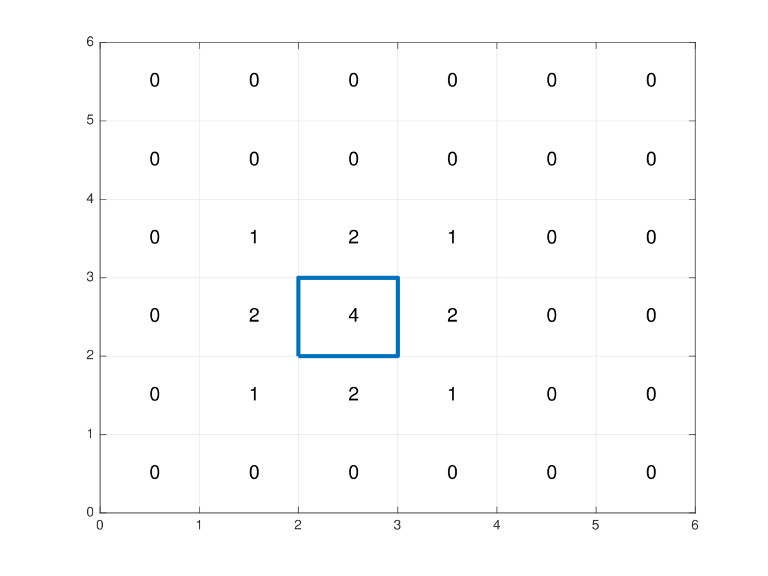
The first line of each test case contains one integer N, the size of the lattice grid (5 ≤ N ≤ 50). The next N lines each contain Ncharacters, describing the level of Zombie Contamination of each cell in the lattice. Every character of every line is a digit between 0and 4.
Cells are given in the same order as they are shown in the picture above: rows go in the decreasing value of y coordinate, and in one row cells go in the order of increasing x coordinate. This means that the first row corresponds to cells with coordinates(1, N), ..., (N, N) and the last row corresponds to cells with coordinates (1, 1), ..., (N, 1).
The first line of the output should contain Yes if there exists a single non-zero area rectangular lair with corners on the grid for which checking the levels of Zombie Contamination gives the results given in the input, and No otherwise.
6
000000
000000
012100
024200
012100
000000
Yes
The lair, if it exists, has to be rectangular (that is, have corners at some grid points with coordinates (x1, y1), (x1, y2), (x2, y1), (x2, y2)), has a non-zero area and be contained inside of the grid (that is, 0 ≤ x1 < x2 ≤ N, 0 ≤ y1 < y2 ≤ N), and result in the levels of Zombie Contamination as reported in the input.
分析:四个角是1,边上是2,内部是4,检查一下即可;
代码:
#include <iostream>

#include <cstdio>

#include <cstdlib>

#include <cmath>

#include <algorithm>

#include <climits>

#include <cstring>

#include <string>

#include <set>

#include <map>

#include <queue>

#include <stack>

#include <vector>

#include <list>

#include <ext/rope>

#define rep(i,m,n) for(i=m;i<=n;i++)

#define rsp(it,s) for(set<int>::iterator it=s.begin();it!=s.end();it++)

#define vi vector<int>

#define pii pair<int,int>

#define mod 1000000007

#define inf 0x3f3f3f3f

#define pb push_back

#define mp make_pair

#define fi first

#define se second

#define ll long long

#define pi acos(-1.0)

const int maxn=1e2+;

const int dis[][]={{,},{-,},{,-},{,}};

using namespace std;

using namespace __gnu_cxx;

ll gcd(ll p,ll q){return q==?p:gcd(q,p%q);}

ll qpow(ll p,ll q){ll f=;while(q){if(q&)f=f*p;p=p*p;q>>=;}return f;}

int n,m,x[],y[];

char a[maxn][maxn];

bool check()

{

    int i,j;

    rep(i,,)rep(j,,)if(a[x[i]][y[i]]!='')return false;

    rep(i,x[]+,x[]-)if(a[i][y[]]!='')return false;

    rep(i,x[]+,x[]-)if(a[i][y[]]!='')return false;

    rep(i,y[]+,y[]-)if(a[x[]][i]!='')return false;

    rep(i,y[]+,y[]-)if(a[x[]][i]!='')return false;

    rep(i,x[]+,x[]-)rep(j,y[]+,y[]-)if(a[i][j]!='')return false;

    return true;

}

int main()

{

    int i,j,k,t;

    scanf("%d",&n);

    rep(i,,n-)scanf("%s",a[i]);

    x[]=y[]=inf,x[]=y[]=-;

    rep(i,,n-)rep(j,,n-)

    if(a[i][j]!='')x[]=min(x[],i),x[]=max(x[],i),y[]=min(y[],j),y[]=max(y[],j);

    if(check())puts("Yes");else puts("No");

    //system ("pause");

    return ;

}
Recover Polygon (easy)的更多相关文章
- oracle_How to Recover Data (Without a Backup!)
How to Recover Data (Without a Backup!) It's the classic career-limiting maneuver(职业限制机动): accidenta ...
- Leetcode 笔记 99 - Recover Binary Search Tree
题目链接:Recover Binary Search Tree | LeetCode OJ Two elements of a binary search tree (BST) are swapped ...
- [LeetCode] Convex Polygon 凸多边形
Given a list of points that form a polygon when joined sequentially, find if this polygon is convex ...
- [LeetCode] Recover Binary Search Tree 复原二叉搜索树
Two elements of a binary search tree (BST) are swapped by mistake. Recover the tree without changing ...
- 【转】Windows下使用libsvm中的grid.py和easy.py进行参数调优
libsvm中有进行参数调优的工具grid.py和easy.py可以使用,这些工具可以帮助我们选择更好的参数,减少自己参数选优带来的烦扰. 所需工具:libsvm.gnuplot 本机环境:Windo ...
- 结合谷歌地图多边形(polygon)与Sql Server 2008的空间数据类型计算某个点是否在多边形内的注意事项
首先在利用 GEOGRAPHY::STPolyFromText(@GeoStr, 4326) 这样的函数把字符串转换为Geography类型时,字符串里经纬度的顺序是 “经度[空格]纬度”,即“lon ...
- [svg 翻译教程]Polyline(折线)polygon(多边形)
原文: http://tutorials.jenkov.com/svg/polygon-element.html Polyline 虽然说这个 元素我没用过,但是还是蛮强大的,也翻译下 示例 < ...
- [OpenGL][SharpGL]用Polygon Offset解决z-fighting和stitching问题
[OpenGL][SharpGL]用Polygon Offset解决z-fighting和stitching问题 本文参考了(http://www.zeuscmd.com/tutorials/open ...
- WebGIS中基于AGS的画圆查询简析以及通过Polygon来构造圆的算法
文章版权由作者李晓晖和博客园共有,若转载请于明显处标明出处:http://www.cnblogs.com/naaoveGIS/. 1.背景 某个项目需求中需要在前端进行画圆查询,将圆范围上的多边形要素 ...
随机推荐
- mybatis------xml的一些规范等
转与拼接: MyBatis 是支持普通 SQL查询,存储过程和高级映射的优秀持久层框架.MyBatis 消除了几乎所有的JDBC代码和参数的手工设置以及结果集的检索.MyBatis 使用简单的 XML ...
- MFC下DLL编程(图解)
MFC下DLL编程(图解) DLL(Dynamic Link Library,动态链接库)是微软公司为Windows和OS/2操作系统设计一种供应用程序在运行时调用的共享函数库.DLL是应用程序的一种 ...
- zencart 自定义函数
---------------------------------------------------------------------------------------------------- ...
- 下载google play上的APP
googol搜索 download apk directly,然后即可看到
- html+javascript实现可拖动可提交的弹出层对话框效果
本文为大家介绍下使用html+javascript实现可拖动弹出层.对话框.可提交,具体代码如下,感兴趣的朋友可以参考下,希望对大家有所帮助 <!DOCTYPE HTML PUBLIC &quo ...
- 第十四章:使用CSS3进行增强
1.为不支持某些属性的浏览器使用polyfill:如果想弥合较弱的浏览器和较强的浏览器之间的功能差异,可以使用polyfill(通常又称作垫片),通常用js实现.但是有些较弱的浏览器运行JS的速度要慢 ...
- LeetCode OJ 101. Symmetric Tree
Given a binary tree, check whether it is a mirror of itself (ie, symmetric around its center). For e ...
- MySQL慢日志查询全解析:从参数、配置到分析工具【转】
转自: MySQL慢日志查询全解析:从参数.配置到分析工具 - MySQL - DBAplus社群——围绕数据库.大数据.PaaS云,运维圈最专注围绕“数据”的学习交流和专业社群http://dbap ...
- js获取tr,td内容并排序
如题 <!DOCTYPE HTML PUBLIC "-//W3C//DTD XHTML 1.0 Transitional//EN" "http://www.w3.o ...
- Spring 实例化bean的三种方式:
方法一:使用构造器实例化bean java代码: package com.model; public class User { private String username; public User ...