
C++string中find,find_first_of和find_last_of的用法
1. size_t find (const string& str, size_t pos = 0)
str.find(str1)
说明:从pos(默认是是0,即从头开始查找)开始查找,找到第一个和str1相匹配的子串,返回该子串的起始索引位置;如果没有找到则返回string::npos
参考:find函数:http://www.cplusplus.com/reference/string/string/find/
2. size_t find_first_of (const string& str, size_t pos = 0)
str.find_first_of(str1)
说明:从pos(默认是是0,即从头开始查找)开始查找,找到第一个和str1相匹配的子串,返回该子串的起始索引位置;如果没有找到则返回string::npos
参考:find_first_of函数:http://www.cplusplus.com/reference/string/string/find_first_of/
3.size_t find_last_of (const string& str, size_t pos = npos)
str.find_last_of(str1)
说明:从npos(默认是字符串最后一个,即从后向前查找)开始查找,找到第一个和str1相匹配的子串,返回该子串的最后一个字符的索引位置;如果没有找到则返回string::npos
参考: find_last_of函数:http://www.cplusplus.com/reference/string/string/find_last_of/
举例如下:
#include<iostream>

using namespace std;

int main(void)

{

    string s = "一蓑烟雨任平生。";

    int len = s.size();

    int count = s.size() / string("一").size();

    cout << "len = " << len << ", count = " << count << endl;

    cout << "find:平: pos = " << s.find("平") << endl;

    cout << "find_first_of:平: pos = " << s.find_first_of("平") << endl;

    cout << "find_last_of:平: pos = " << s.find_last_of("平") << endl;

    int pos = s.find("平", 9);

    cout << "pos:" << pos << endl;

    cout << "。: pos = " << s.find("。") << endl;

    cout << "。: pos = " << s.find_last_of("。") << endl;

    return 0;

}
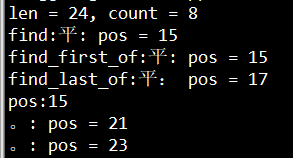
结果:
len = 24, count = 8
find:平: pos = 15
find_first_of:平: pos = 15
find_last_of:平: pos = 17
pos:15
。: pos = 21
。: pos = 23
总结:
C++中一个中文字符(包括汉字和中文符号)在字符串中的长度是3。在一个字符
串中查找中文字符的时候最好不要用find_last_of,因为用find_last_of返回的
是这个中文字符串的最后一个pos,而不是第一个,极容易出错。如上述例子如果
判断一句话是否是以句号结尾,如果用find_last_of进行查找会得到23而一个句
号的长度是3,加起来会大于整个字符串的长度,主要原因还是容易忘记他是子
串的最后一个pos,如果用find或者find_first_of,出错概率较低。
C++string中find,find_first_of和find_last_of的用法的更多相关文章
- (转载)C++ string中find() ,rfind() 等函数 用法总结及示例
string中 find()的应用 (rfind() 类似,只是从反向查找) 原型如下: (1)size_t find (const string& str, size_t pos = 0) ...
- C++string中用于查找的find系列函数浅析
总述: 以下所讲的所有的string查找函数,都有唯一的返回类型,那就是size_type,即一个无符号整数(按打印出来的算).若查找成功,返回按查找规则找到的第一个字符或子串的位置:若查找 ...
- find_first_of()和 find_last_of() 【获取路径、文件名】
find_first_of()和 find_last_of() [获取路径.文件名](2011-06-11 12:44:46)转载▼标签: 杂谈 分类: c string 类提供字符串处理函数,利用 ...
- string中常用的函数
string中常用的函数 发现在string在处理这符串是很好用,就找了一篇文章放在这里了.. 用 string来代替char * 数组,使用sort排序算法来排序,用unique 函数来去重1.De ...
- C++ string中的find()函数
1.string中find()返回值是字母在母串中的位置(下标记录),如果没有找到,那么会返回一个特别的标记npos.(返回值可以看成是一个int型的数) #include<cstring> ...
- C++中 string 中的方法的使用详解
string 字符串在所有的语言中都非常重要,c++也不例外,接下来我们将介绍string中的常用方法 1. size() 和 length() 函数 : 他们返回字符串的真实长度,且不会因为空格而截 ...
- Java的String中的subString()方法
方法如下: public String substring(int beginIndex, int endIndex) 第一个int为开始的索引,对应String数字中的开始位置, 第二个是截止的索引 ...
- Here String 中不该进行分词
我们知道,在 Shell 中,一个变量在被展开后,如果它没有被双引号包围起来,那么它展开后的值还会进行一次分词(word splitting,或者叫拆词,分词这个术语已经被搜索引擎相关技术占用了)操作 ...
- C++string中有关字符串内容修改和替换的函数浅析
1.assign() 原型: //string (1) basic_string& assign (const basic_string& str); //substring (2) ...
随机推荐
- 父元素高度不确定,子元素左右等高的div布局
上一篇介绍了实现几个div并排居中点这里,但是指定了高度,这篇文字主要说一下父元素高度不确定,子元素左或右高度不确定且高度相同布局div盒子 三个div盒子如下 <div class=" ...
- display的值和对应的意义
none:隐藏对应元素,不为隐藏的对象保留其物理空间 block:指定对象为块元素 inline:指定对象为内联元素 inline-block:指定对象为内联块元素 table:指定对象为块元素的表格 ...
- keras 保存模型和加载模型
import numpy as npnp.random.seed(1337) # for reproducibility from keras.models import Sequentialfrom ...
- BiLSTM-CRF学习笔记(原理和理解) 维特比
BiLSTM-CRF 被提出用于NER或者词性标注,效果比单纯的CRF或者lstm或者bilstm效果都要好. 根据pytorch官方指南(https://pytorch.org/tutorials/ ...
- H3C 帧中继配置示例
- 最小生成树prim、
过年那几天确实没好好学习.在老家闲着也是闲着.可是就是没看书. 回来这几天又一直在弄个人博客.买域名云服务器备案什么的- -. 麻烦死了呢. 在腾讯花1块钱备案了一个网站www.goodgoodstu ...
- (超级详细版)利用ThinkPHP3.2.3+PHPExcel实现将表格数据导入到数据库
请先阅读以下步骤再到结尾下载源码 第一步:下载 thinkphp_3.2.3 和 PHPExcel_1.8.0 并解压 对应的网站分别为: http://www.thinkphp.cn/down.ht ...
- Html5 @media + css3 媒体查询
css3 media媒体查询器用法总结 随着响应式设计模型的诞生,Web网站又要发生翻天腹地的改革浪潮,可能有些人会觉得在国内IE6用户居高不下的情况下,这些新的技术还不会广泛的蔓延下去,那你就错 ...
- http header详解,HTTP头、请求头、响应头、实体头
Content-Language,Content-Length,Content-Type,Content-Encoding,mime分析 Accept 指定客户端能够接收的内容类型 Accept:te ...
- Weblogic/WAS之Full GC监控与计算
在网上看到关于内存回收机制,同大家一起分析探讨.堆内存划分为Eden.Survivor 和 Tenured/Old 空间,如下图所示: Minor GC 会清理年轻代的内存,Major GC 是清理老 ...