
Structure And Representation Of MIB Object Names - SNMP Tutorial
30.8 Structure And Representation Of MIB Object Names
We said that ASN.1 specifies how to represent both data items and names. However, understanding the names used for MIBvariables requires us to know about the underlying namespace. Names used for MIB variables are taken from the object identifier namespace administered by ISO and ITU. The key idea behind the object identifier namespace is that it provides a namespace in which all possible objects can be designated. The namespace is not restricted to variables used in network management -- it includes names for arbitrary objects (e.g., each international protocol standard document has a name).
The object identifier namespace is absolute (global), meaning that names are structured to make them globally unique. Like most namespaces that are large and absolute, the object identifier namespace is hierarchical. Authority for parts of the namespace is subdivided at each level, allowing individual groups to obtain authority to assign some of the names without consulting a central authority for each assignment4.
The root of the object identifier hierarchy is unnamed, but has three direct descendants managed by ISO, ITU, and jointly by ISO and ITU. The descendants are assigned both short text strings and integers that identify them (the text strings are used by humans to understand object names; computer software uses the integers to form compact, encoded representations of the names). ISO has allocated one subtree for use by other national or international standards organizations (including U.S. standards organizations), and the U.S. National Institute for Standards and Technology5 has allocated a subtree for the U.S. Department of Defense. Finally, the IAB has petitioned the Department of Defense to allocate it a subtree in the namespace. Figure 30.4 illustrates pertinent parts of the object identifier hierarchy and shows the position of the node used by TCP/IP network management protocols.
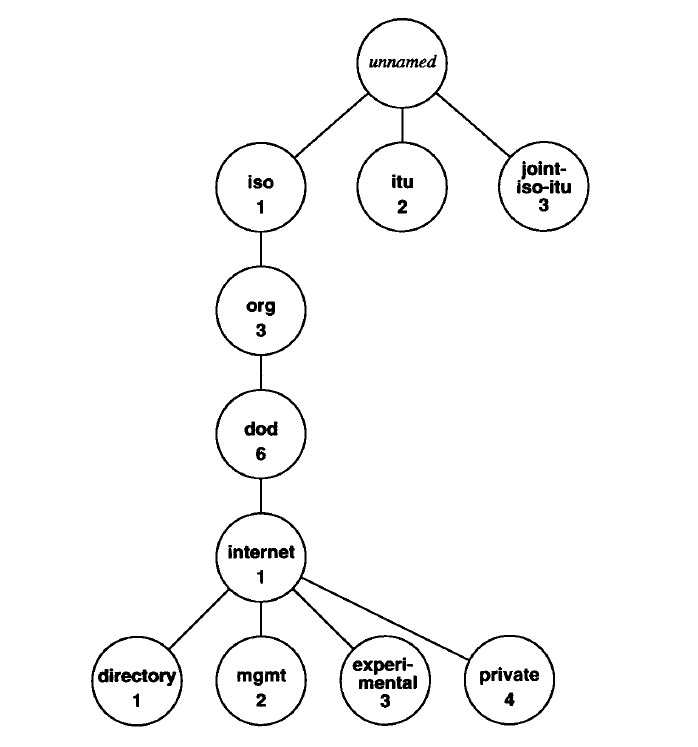

The name of an object in the hierarchy is the sequence of numeric labels on the nodes along a path from the root to the object. The sequence is written with periods separating the individual components. For example, the name 1.3.6.1.2 denotes the node labeled mgmt, the Internet management subtree. The MIBhas been assigned a node under the mgmt subtree with label mib and numeric value 1. Because all MIB variables fall under that node, they all have names beginning with the prefix 1.3.6.1.2.1.
Earlier we said that the MIB groups variables into categories. The exact meaning of the categories can now be explained: they are the subtrees of the mib node of the object identifier namespace. Figure 30.5 illustrates the idea by showing part of the naming subtree under the mib node.


Two examples will make the naming syntax clear. Figure 30.5 shows that the category labeled ip has been assigned the numeric value 4. Thus, the names of all MIB variables corresponding to IP have an identifier that begins with the prefix 1.3.6.1.2.1.4. If one wanted to write out the textual labels instead of the numeric representation, the name would be:
iso . org . dod. internet. mgmt . mib . ip
A MIB variable named ipInReceives has been assigned numeric identifier 3 under the ip node in the namespace, so its name is:
iso . org . dod. internet. mgmt . mib . ip . ipInReceives
and the corresponding numeric representation is:
1 . 3 . 6 . 1 . 2 . 1 . 4 . 3
When network management protocols use names of MIBvariables in messages, each name has a suffix appended. For simple variables, the suffix 0 refers to the instance of the variable with that name. So, when it appears in a message sent to a router, the numeric representation of iplnReceives is:
1 . 3 . 6 . 1 . 2 . 1 . 4 . 3 . 0
which refers to the instance of ipInReceives on that router. Note that there is no way to guess the numeric value or suffix assigned to a variable. One must consult the published standards to find which numeric values have been assigned to each object type.
Thus, programs that provide mappings between the textual form and underlying numeric values do so entirely by consulting tables of equivalences -- there is no closed-form computation that performs the transformation.
As a second, more complex example, consider the MIBvariable ipAddrTable, which contains a list of the IP addresses for each network interface. The variable existsin the namespace as a subtree under ip, and has been assigned the numeric value 20. Therefore, a reference to it has the prefix:
iso . org . dod . internet. mgmt . mib . ip . ipAddrTable
with a numeric equivalent:
1 . 3 . 6 . 1 . 2 . 1 . 4 . 20
In programming language terms, we think of the IP address table as a one-dimensional array, where each element of the array consists of a structure (record) that contains five items: an IP address, the integer index of an interface corresponding to the entry, an IP subnet mask, an IP broadcast address, and an integer that specifies the maximum datagram size that the router will reassemble. Of course, it is unlikely that a router has such an array in memory. The router may keep this information in many variables or may need to follow pointers to find it. However, the MIBprovides a name for the array as if it existed, and allows network management software on individual routers to map table references into appropriate internal variables. The point is:
Although they appear to specify details about data structures, MIB standards donot dictate the implementation. Instead, MIB definitions provide a uniform, virtual interface that managers use to access data; an agent must translate between the virtual items in a MIB and the internal implementation.
Using ASN.1 style notation, we can define ipAddrTable:
ipAddrTable ::= SEQUENCE OF IpAddrEntry
where SEQUENCE and OF are keywords that define an ipAddrTable to be a one dimensional array of IpAddrEntrys. Each entry in the array is defined to consist of five fields (the definition assumes that IpAddresshas already been defined).
IpAddrEntry ::= SEQUENCE {

  ipAdEntAddr

    IpAddress,

  ipAdEntIflndex

    INTEGER,

  ipAdEntNetMask

    IpAddress,

  ipAdEntBcastAddr

    IpAddress,

  ipAdEntReasmMaxSize

    INTEGER (0..65535)

}
Further definitions must be given to assign numeric values to ipAddrEntry and to each item in the IpAddrEntry sequence. For example, the definition:
ipAddrEntry { ipAddrTable 1 }
specifies that ipAddrEntryfalls under ipAddrTableand has numeric value 1. Similarly, the definition:
ipAdEntNetMask { ipAddrEntry 3 }
assigns ipAdEntNetMasknumeric value 3 under ipAddrEntry.
We said that ipAddrTablewas like aone-dimensional array. However, there is a significant difference in the way programmers use arrays and the way network management software uses tables in the MIB. Programmers think of an array as a set of elements that have an index used to select a specific element. For example, the programmer might write xyz[3] to select the third element from array xyz. ASN.1 syntax does not use integer indices. Instead, MIB tables append a suffix onto the name to select a specific element in the table. For our example of an IP address table, the standard specifies that the suffix used to select an item consists of an IPaddress. Syntactically, the IP address (in dotted decimal notation) is concatenated onto the end of the object name to form the reference. Thus, to speclfy the network mask field in the IP address table entry corresponding to address 128.10.2.3, one uses the name:
iso.org.dod. internet.mgmt.mib. ip. ipAddrTable. ipAddrEntry. ipAdEntNetMask. 128.10.2.3
which, in numeric form, becomes:
1 . 3 . 6 . 1 . 2 . 1 . 4 . 20 . 1 . 3 . 128 . 10 . 2 . 3
Although concatenating an index to the end of a name may seem awkward, it provides a powerful tool that allows clients to search tables without knowing the number of items or the type of data used as an index. The next section shows how network management protocols use this feature to step through a table one element at a time.
3 ASN.1 is usually pronounced by reading the dot: "A-S-N dot 1".
4 Readers should recall from the Domain Name System discussion in Chapter 24 how authority for a hierarchical namespace is subdivided.
5 NIST was formerly the National Bureau of Standards.
Abstract from Internetworking With TCP/IP Vol I: Principles, Protocols, and Architecture Fourth Edition,
DOUGLAS E. COMER,
Department of Computer Sciences Purdue University, West Lafayette, IN 47907,
PRENTICE HALL,
Upper Saddle River, New Jersey 07458
Structure And Representation Of MIB Object Names - SNMP Tutorial的更多相关文章
- SNMP Tutorial
Applications: Internet Management (SNMP) 30.1 Introduction 30.2 The Level Of Management Protocols 30 ...
- Examples of MIB Variables - SNMP Tutorial
30.5 Examples of MIB Variables Versions 1 and 2 of SNMP each collected variables together in a singl ...
- Structure Of Management Information - SNMP Tutorial
30.6 The Structure Of Management Information In addition to the standards that specify MIB variables ...
- Simple Network Management Protocol - SNMP Tutorial
30.9 Simple Network Management Protocol Network management protocols specify communication between t ...
- Summary - SNMP Tutorial
30.13 Summary Network management protocols allow a manager to monitor and control routers and hosts. ...
- Formal Definitions Using ASN.1 - SNMP Tutorial
30.7 Formal Definitions Using ASN.1 The SMI standard specifies that all MIB variables must be define ...
- Protocol Framework - SNMP Tutorial
30.4 Protocol Framework TCP/IP network management protocols2 divide the management problem into two ...
- Example: Encoded SNMP Message - SNMP Tutorial
30.11 Example Encoded SNMP Message The encoded form of ASN.1 uses variable-length fields to represen ...
- SNMP Message Format - SNMP Tutorial
30.10 SNMP Message Format Unlike most TCP/IP protocols, SNMP messages do not have fixed fields. Inst ...
随机推荐
- Nagios学习实践系列——产品介绍篇
Nagios介绍 Nagios是一款功能强大.优秀的开源监控系统,它能够让你发现和解决IT架构中存在的问题,避免这些问题影响到关键业务流程. Nagios最早于1999年发布,它在开源社区的影响力是相 ...
- String与int之间的转换
原文: http://www.360doc.com/content/10/1215/00/2258566_78225883.shtml
- MySQL数据库
1.1 数据库的发展史 1.1.1 萌芽阶段--文件系统 文件系统 1.1.2 第一代数据库--层次模型.网状模型 1.1.2.1层次模型 这是一种导航结构,导航结构的优点:分类管理:导航结构的缺点: ...
- java 版本EChart使用
一.简介 EChart是百度开发的js图表软件,用它我们可以很方便地以图形化的方式对数据进行分析统计.该种方式js在页面动态拼接json数据,再进行渲染.这种方法的优点是,灵活,可以随时进行修改.缺点 ...
- 交互式makefile
之前一直不知道在shell中调用read赋值后,怎么传给makefile中的变量,后来才恍然大悟. myname := $(shell read -p "Enter your name:&q ...
- FusionCharts参数说明 (中文)
FushionCharts是把抽象数据图示化的套件,使用方便,配置简单.其相关参数中文说明如下. FusionCharts Free中文开发指南第二版.pdf 功能特性 animation ...
- Linux – Usermod命令参数解析和实例说明
usermod 命令修改系统帐户文件来反映通过命令行指定的变化 1. 首先看看usermod都是有哪些参数 [root@hxweb101 ~]$ usermod --help Usage: userm ...
- chm文件突然乱码了
今天打开一个chm文件的帮组文档时,文档时乱码,以前可不是的哦.不知道自己干什么操作了.上网找了下解决办法. 打开cmd 输入regedit 进入注册表:找到: HKEY_CURRENT_USER\S ...
- [转]MVC过滤器
本文转自:http://www.cnblogs.com/HopeGi/p/3342083.html APS.NET MVC中(以下简称“MVC”)的每一个请求,都会分配给相应的控制器和对应的行为方法去 ...
- 解决“只能通过Chrome网上应用商店安装该程序”的方法
摘要 : 最近有些用户反映某个Chrome插件在安装的时候,提示"只能通过Chrome网上应用商店安装该程序",为了解决这一问题,Chrome插件网带来了相关的解决方法. 某些用户 ...