
Use a TL431 shunt regulator to limit high ac input voltage
Most isolated, offline SMPSs (switched-mode power supplies), including flyback, forward, and resonant, must operate at input voltages of 90 to 260V rms. Some cases even use line-to-line voltages of 400V rms±10%, leading to increased component-voltage ratings and, thus, increased cost of the overall design. In such cases, it is preferable to use input-limiting circuits, allowing you to increase the input voltage to 440V rms without damaging the power-supply components.
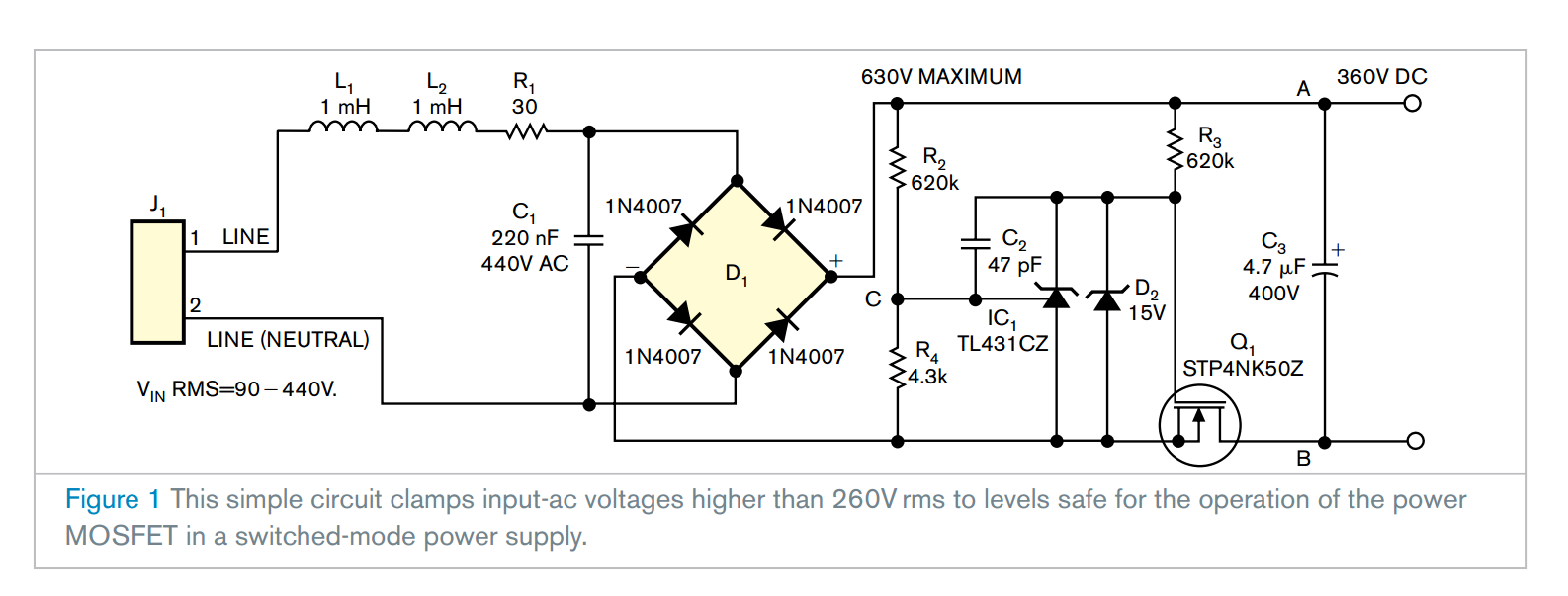
The circuit in Figure 1 limits, or clamps, input-ac voltages higher than 260V rms to levels safe for the operation of the power MOSFET in an SMPS. The circuit employs MOSFET Q1 working as a 100-Hz switch and shunt-regulator IC1, a TL431CZ, setting the clamped high-voltage level by divider R2 and R4. The circuit uses the component values shown. The clamped output voltage is 360V dc, the input voltage is 260V rms, and the maximum input voltage is 440V rms. The circuit was tested at power levels of 5 to 10W.
At an input voltage of less than 260V rms, Point C is less than 2.5V, and IC1 is off, sinking the minimum off-state cathode current. Zener diode D2 breaks down to 15V, ensuring a stable on-state for Q1. This operation is the normal condition of Q1 at input voltages lower than 260V rms. Accordingly, at these voltage levels, the circuit works as a standard full-bridge rectifier under capacitive load C3.
At an input voltage of 260V rms or greater, Point C becomes higher than 2.5V, and IC1turns on, diverting and sinking the current from D2. The gate-to-source voltage of Q1drops to approximately 2V, and Q1 switches off. Now, no current flows to charge bulk capacitor C3 even if the D1 bridge-rectifier diodes are forward-biased. The rectified input-ac voltage is higher than the voltage across C3, but Q1 is off, the loop is interrupted, and no current flows. Accordingly, the output-dc voltage across C3 gets limited because no charging current is available.
When the rectified ac-input voltage starts decreasing, it eventually hits the 2.5V threshold level of Point C, and Q1 again switches on. But current does not flow because the rectifier bridge’s diodes are now reverse-biased; the rectified input-ac voltage is less than the voltage across C3. The voltage across C3 decreases at a rate that the output-power level determines. Eventually, the voltage across C3 and the rectified input-ac voltage intersect at a level when the rectifier bridge’s diodes get forward-biased. Q1 is still on; therefore, charging current starts flowing. A short interval follows, during which both Q1 and D1 conduct. The short charging pulses replenish the energy loss, increasing the voltage to the limited level. When the input voltage gets higher than 260V rms, Q1 again switches off, and the whole process repeats.
Q1 has small power dissipation. During every switching period, the MOSFET is on for only 450 µsec, resulting in high efficiency for this high-voltage-limiting circuit. You can use it as a MOSFET switch with the STMicroelectronics SuperMesh MOSFET STP4NK50Z, which comes in a TO-220 package, but you can also use a Dpak to save space because the MOSFET is not a dissipative-voltage limiter. The current through Q1gets interrupted when the 50/60-Hz rectifying diodes are forward-biased. This current interruption causes ringing on the drain-to-source voltage. The clamping circuit passed the conducted EMI (electromagnetic-interference) tests, according to EN 55022 Class B, using peak and average detection. The 1-mH, 0.2A chokes, L1 and L2, suppress EMI. The 220-nF, 440V-ac capacitor, C1, is a simple snubber element across the rectifying diodes of the D1 bridge.
Use a TL431 shunt regulator to limit high ac input voltage的更多相关文章
- MOSFET shunt regulator substitutes for series regulator
You would normally use a series linear regulator or a dc/dc converter to obtain 3V dc from a higher ...
- Regulator IC forms convenient overvoltage detector
Figure 1 shows a simple, stand-alone overvoltage detector. The intent of the circuit is to monitor a ...
- Linear regulator=low-cost dc/dc converter
The circuit in Figure 1 is a good choice if you need a power supply with high efficiency and you don ...
- Simple dc/dc converter increases available power in dual-voltage system
The schematic in Figure 1 shows a way to increase the power available from a current-limited 5V supp ...
- Tiny microcontroller hosts dual dc/dc-boost converters
Batteries are the typical power sources for portable-system applications, and it is not unusual thes ...
- BQ24296充电管理芯片使用过程中的注意事项
BQ24296遇到的一点问题 概述:BQ24296是TI出品的具有窄范围VDC控制.基于I2C通讯的最大支持3A充电电流的开关式电源路径管理芯片.可以轻松实现2A以上的大电流充电,能量转换效率达到90 ...
- Cascode MOSFET increases boost regulator's input- and output-voltage ranges
Targeting use in portable-system applications that require raising a battery's voltage to a higher l ...
- Changing the Output Voltage of a Switching Regulator on the Fly
http://www.powerguru.org/changing-the-output-voltage-of-a-switching-regulator-on-the-fly/ There are ...
- Linux Regulator Framework(2)_regulator driver
转自蜗窝科技:http://www.wowotech.net/pm_subsystem/regulator_driver.html 说实话,这篇好难懂啊... 1. 前言 本文从regulator d ...
随机推荐
- Eclipse java项目转换为web项目
1.打开.project文件,并修改文件, 修改如下: 找到:<natures> </natures>代码段,在代码段中加入如下内容并保存: <nature>org ...
- ECMAScript 6 Promise 对象
一.Promise的含义 所谓Promise,简单说就是一个容器,里面保存着某个未来才会结束的事件(通常是一个异步操作)的结果.从语法上说,Promise是一个对象,从它可以获取异步操作的消息. 1. ...
- MYSQL三种安装方式--二进制包安装
1. 把二进制包下载到/usr/local/src下 2. 如果是tar.gz包,则使用tar zxvf 进行解压 如果是tar包,则可以使用tar xvf 进行解压 3. $ mv mysql-5. ...
- htaccess附录:正则表达式、重定向代码
.htaccess正则表达式 # 位于行首时表示注释. [F] Forbidden(禁止): 命令服务器返回 403 Forbidden错误给用户浏览器 [L] Last rule(最后一条规则): ...
- 4、GitLab 创建、删除、修改项目
一.gitLab创建项目 1.创建用户组 2.填写组信息后单击“Create group” 其中:“Group path”将显示在git路径中 3.选择需要加入该组的“用户”和“角色”后点击“Add ...
- 转:google测试分享-GTA
原文: http://blog.sina.com.cn/s/blog_6cf812be0102viuh.html 上一次分享了google测试分享-分层测试,有很多自动化测试的策略和实施都要有一个重点 ...
- 六 Python基础 字符串和编码
字符编码 我们已经讲过了,字符串也是一种数据类型,但是,字符串比较特殊的是还有一个编码问题. 因为计算机只能处理数字,如果要处理文本,就必须先把文本转换为数字才能处理.最早的计算机在设计时采用8个比特 ...
- 十五oracle 触发器
一.触发器简介 触发器的定义就是说某个条件成立的时候,触发器里面所定义的语句就会被自动的执行.因此触发器不需要人为的去调用,也不能调用.然后,触发器的触发条件其实在你定义的时候就已经设定好了.这里面需 ...
- 【Sql Server】Sql语句整理
use Person <--添加约束--> Alter table Student alter column Sno ) not null; Alter table Student Add ...
- ref:Spring Integration Zip 不安全解压(CVE-2018-1261)漏洞分析
ref:https://mp.weixin.qq.com/s/SJPXdZWNKypvWmL-roIE0Q 0x00 漏洞概览 漏洞名称:Spring Integration Zip不安全解压 漏洞编 ...