
JavaScript. The core.
Read this article in: Japanese, German (version 2), Arabic, Russian, French, Chinese.
This note is an overview and summary of the “ECMA-262-3 in detail” series. Every section contains references to the appropriate matching chapters so you can read them to get a deeper understanding.
Intended audience: experienced programmers, professionals.
We start out by considering the concept of an object, which is fundamental to ECMAScript.
An object
ECMAScript, being a highly-abstracted object-oriented language, deals with objects. There are also primitives, but they, when needed, are also converted to objects.
An object is a collection of properties and has a single prototype object. The prototype may be either an object or the null value
Let’s take a basic example of an object. A prototype of an object is referenced by the internal [[Prototype]] property. However, in figures we will use __<internal-property>__ underscore notation instead of the double brackets, particularly for the prototype object: __proto__.
For the code:
var foo = {

  x: 10,

  y: 20

};
we have the structure with two explicit own properties and one implicit __proto__ property, which is the reference to the prototype of foo:
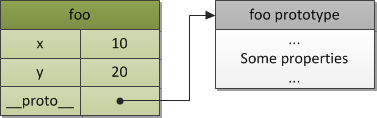
Figure 1. A basic object with a prototype.
What for these prototypes are needed? Let’s consider a prototype chain concept to answer this question.
A prototype chain
Prototype objects are also just simple objects and may have their own prototypes. If a prototype has a non-null reference to its prototype, and so on, this is called the prototype chain.
A prototype chain is a finite chain of objects which is used to implement inheritance and shared properties.
Consider the case when we have two objects which differ only in some small part and all the other part is the same for both objects. Obviously, for a good designed system, we would like to reuse that similar functionality/code without repeating it in every single object. In class-based systems, this code reuse stylistics is called the class-based inheritance — you put similar functionality into the class A, and provide classes B and C which inherit from A and have their own small additional changes.
ECMAScript has no concept of a class. However, a code reuse stylistics does not differ much (though, in some aspects it’s even more flexible than class-based) and achieved via the prototype chain. This kind of inheritance is called a delegation based inheritance (or, closer to ECMAScript, a prototype based inheritance).
Similarly like in the example with classes A, B and C, in ECMAScript you create objects: a, b, and c. Thus, object a stores this common part of both b and c objects. And b and c store just their own additional properties or methods.
var a = {

  x: 10,

  calculate: function (z) {

    return this.x + this.y + z;

  }

};

var b = {

  y: 20,

  __proto__: a

};

var c = {

  y: 30,

  __proto__: a

};

// call the inherited method

b.calculate(30); //

c.calculate(40); //
Easy enough, isn’t it? We see that b and c have access to the calculate method which is defined in a object. And this is achieved exactly via this prototype chain.
The rule is simple: if a property or a method is not found in the object itself (i.e. the object has no such an own property), then there is an attempt to find this property/method in the prototype chain. If the property is not found in the prototype, then a prototype of the prototype is considered, and so on, i.e. the whole prototype chain (absolutely the same is made in class-based inheritance, when resolving an inherited method — there we go through the class chain). The first found property/method with the same name is used. Thus, a found property is called inherited property. If the property is not found after the whole prototype chain lookup, then undefined value is returned.
Notice, that this value in using an inherited method is set to the original object, but not to the (prototype) object in which the method is found. I.e. in the example above this.y is taken from b and c, but not from a. However, this.x is taken from a, and again via the prototype chain mechanism.
If a prototype is not specified for an object explicitly, then the default value for __proto__ is taken — Object.prototype. Object Object.prototype itself also has a __proto__, which is the final link of a chain and is set to null.
The next figure shows the inheritance hierarchy of our a, b and c objects:
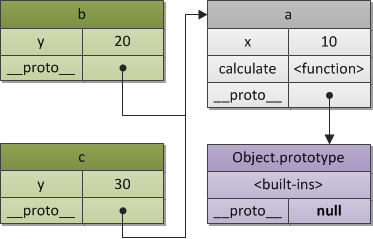
Figure 2. A prototype chain.
Notice: ES5 standardized an alternative way for prototype-based inheritance using Object.create function:

  var b = Object.create(a, {y: {value: 20}});

  var c = Object.create(a, {y: {value: 30}});

You can get more info on new ES5 APIs in the appropriate chapter.

ES6 though standardizes the __proto__, and it can be used at initialization of objects.
Often it is needed to have objects with the same or similar state structure (i.e. the same set of properties), and with different state values. In this case we may use a constructor function which produces objects by specified pattern.
Constructor
Besides creation of objects by specified pattern, a constructor function does another useful thing — it automatically sets a prototype object for newly created objects. This prototype object is stored in the ConstructorFunction.prototype property.
E.g., we may rewrite previous example with b and c objects using a constructor function. Thus, the role of the object a (a prototype) Foo.prototype plays:
// a constructor function

function Foo(y) {

  // which may create objects

  // by specified pattern: they have after

  // creation own "y" property

  this.y = y;

}

// also "Foo.prototype" stores reference

// to the prototype of newly created objects,

// so we may use it to define shared/inherited

// properties or methods, so the same as in

// previous example we have:

// inherited property "x"

Foo.prototype.x = 10;

// and inherited method "calculate"

Foo.prototype.calculate = function (z) {

  return this.x + this.y + z;

};

// now create our "b" and "c"

// objects using "pattern" Foo

var b = new Foo(20);

var c = new Foo(30);

// call the inherited method

b.calculate(30); //

c.calculate(40); //

// let's show that we reference

// properties we expect

console.log(

  b.__proto__ === Foo.prototype, // true

  c.__proto__ === Foo.prototype, // true

  // also "Foo.prototype" automatically creates

  // a special property "constructor", which is a

  // reference to the constructor function itself;

  // instances "b" and "c" may found it via

  // delegation and use to check their constructor

  b.constructor === Foo, // true

  c.constructor === Foo, // true

  Foo.prototype.constructor === Foo, // true

  b.calculate === b.__proto__.calculate, // true

  b.__proto__.calculate === Foo.prototype.calculate // true

);
This code may be presented as the following relationship:
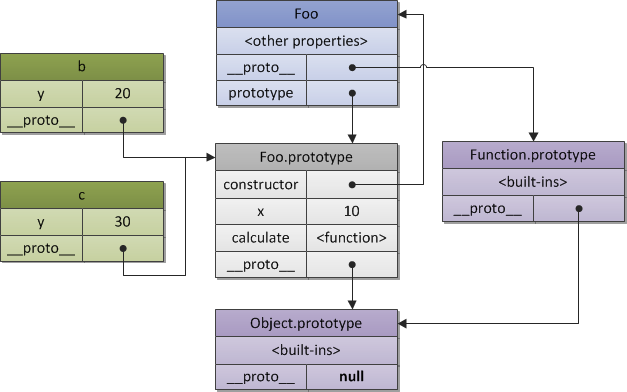
Figure 3. A constructor and objects relationship.
This figure again shows that every object has a prototype. Constructor function Foo also has its own __proto__ which is Function.prototype, and which in turn also references via its __proto__ property again to the Object.prototype. Thus, repeat, Foo.prototype is just an explicit property of Foo which refers to the prototype of b and c objects.
Formally, if to consider a concept of a classification (and we’ve exactly just now classified the new separated thing — Foo), a combination of the constructor function and the prototype object may be called as a “class”. Actually, e.g. Python’s first-class dynamic classes have absolutely the same implementation of properties/methods resolution. From this viewpoint, classes of Python are just a syntactic sugar for delegation based inheritance used in ECMAScript.
Notice: in ES6 the concept of a “class” is standardized, and is implemented as exactly a syntactic sugar on top of the constructor functions
as described above. From this viewpoint prototype chains become as an implementation detail of the class-based inheritance:

// ES6

class Foo {

  constructor(name) {

    this._name = name;

  }

  getName() {

    return this._name;

  }

}

class Bar extends Foo {

  getName() {

    return super.getName() + ' Doe';

  }

}

var bar = new Bar('John');

console.log(bar.getName()); // John Doe
The complete and detailed explanation of this topic may be found in the Chapter 7 of ES3 series. There are two parts: Chapter 7.1. OOP. The general theory, where you will find description of various OOP paradigms and stylistics and also their comparison with ECMAScript, and Chapter 7.2. OOP. ECMAScript implementation, devoted exactly to OOP in ECMAScript.
Now, when we know basic object aspects, let’s see on how the runtime program execution is implemented in ECMAScript. This is what is called an execution context stack, every element of which is abstractly may be represented as also an object. Yes, ECMAScript almost everywhere operates with concept of an object
JavaScript. The core.的更多相关文章
- javascript系列之核心知识点(一)
JavaScript. The core. 1.对象 2.原型链 3.构造函数 4.执行上下文堆栈 5.执行上下文 6.变量对象 7.活动对象 8.作用域链 9.闭包 10.this值 11.总结 这 ...
- 清除css、javascript及背景图在浏览器中的缓存
在实际项目开发过过程中,页面是上传到服务器上的.而为了减少服务器的压力,让用户少加载,浏览器会将图片.css.js缓存到本地中,以便下次访问网站时使用.这样做不仅减少了服务器的压力,并且也减少了用户的 ...
- 【Web前端】清除css、javascript及背景图在浏览器中的缓存
在实际项目开发过过程中,页面是上传到服务器上的.而为了减少服务器的压力,让用户少加载,浏览器会将图片.css.js缓存到本地中,以便下次访问网站时使用.这样做不仅减少了服务器的压力,并且也减少了用户的 ...
- JS学习:JavaScript的核心
分享到 分类 JS学习 发布 ourjs 2013-12-02 注意 转载须保留原文链接,译文链接,作者译者等信息. 作者: JeremyWei 原文: JavaScript The ...
- term "JavaScript"
在Web浏览器上下文中理解的总称“JavaScript”包含几个非常不同的元素. 其中一个是核心语言(ECMAScript),另一个是Web API的集合,包括DOM(文档对象模型) JavaScri ...
- JavaScript Objects in Detail
JavaScript’s core—most often used and most fundamental—data type is the Object data type. JavaScript ...
- atitit.闭包的概念与理解attilax总结v2 qb18.doc
atitit.闭包的概念与理解attilax总结v2 qb18.doc 1.1. 闭包(Closure)是词法闭包(Lexical Closure)的简称,是引用了自由变量的函数.1 2. #---- ...
- addEventListener、attachEvent、cancelBubble兼容性随笔
一.前言 1. element.addEventListener(eventType, handler, capture); (1)参数eventType是要注册句柄的事件类型名. (2)参数hand ...
- 如何:对 SharePoint 列表项隐藏 ECB 中的菜单项
可以通过使用功能框架向编辑控制块 (ECB) 菜单添加新的自定义操作.但是,您不能使用此方法进行相反的操作,即隐藏现有的 ECB 菜单项,因为它们是通过使用 ECMAScript(JavaScript ...
随机推荐
- golang的nil
golang中什么样的类型可以赋值nil? 类型文档中有注定"uninitialized value is nil"的类型都可以赋值nil. golang的基本类型不能赋值nil: ...
- [原创]一个纯css实现兼容各种主流移动pc浏览器的时间轴
废话不多说 Demo 高度完全的自适应 中心思想是table 和第二列行高的50%的上下绝对定位竖线 第一次用codepen less完全不能用啊 连node png之类的都是关键词会被去掉... 马 ...
- [转载]EF Code First 学习笔记:约定配置
要更改EF中的默认配置有两个方法,一个是用Data Annotations(在命名空间System.ComponentModel.DataAnnotations;),直接作用于类的属性上面;还有一个就 ...
- 颜色之RGBA
颜色之RGBA RGB是一种色彩标准,是由红(R).绿(G).蓝(B)的变化以及相互叠加来得到各式各样的颜色.RGBA是在RGB的基础上增加了控制alpha透明度的参数. 语法: color:rgba ...
- svg绘制蓝色星空,月亮,旋转灯塔
<!DOCTYPE html> <html> <head> <meta charset="utf-8"> <meta http ...
- android 开发 对图片编码,并生成gif图片
demo场景: 将2张静态的png格式图片组合生成一个gif图片,间隔500毫秒,关键类:AnimatedGifEncoder 如需要解析gif获取每帧的图片,可参考上一篇博客:<android ...
- MySQL数据库远程连接开启方法
有时候需要远程连接mysql数据库,默认是不可以的,可以参考下面的方法,解决下. 1.登陆自己机器的MySQL数据库:mysql -uroot -p密码 设置root用户可以任意IP访问,代码如下(可 ...
- 前端之JavaScript第三天学习(8)-JavaScript-对象
JavaScript 中的所有事物都是对象:字符串.数字.数组.日期,等等. 在 JavaScript 中,对象是拥有属性和方法的数据. 属性和方法 属性是与对象相关的值. 方法是能够在对象上执行的动 ...
- Java8 Lambda sample (iwantmoon.com出品)
转载请注明出处:http://iwantmoon.com/Post/83a4497a74674612834965857e7bc044 .Net转到Java来,不知不觉已经有两年了,之前已经用习惯的li ...
- C#--简单的串口通信程序
前几天做毕业设计,其中要用到串口和下位机进行通信,于是自己捣鼓了一个简单的串口通信程序. 在做通信之前要先弄一个SerialPort组件出来,当然也可以通过程序来创建.本次设计中采用的是拖的winfo ...