
2. Solving Linear Equations
2.1 Linear Equations Picture
Row Picture
2 by 2 equations
Two equations, Two unknowns
\]
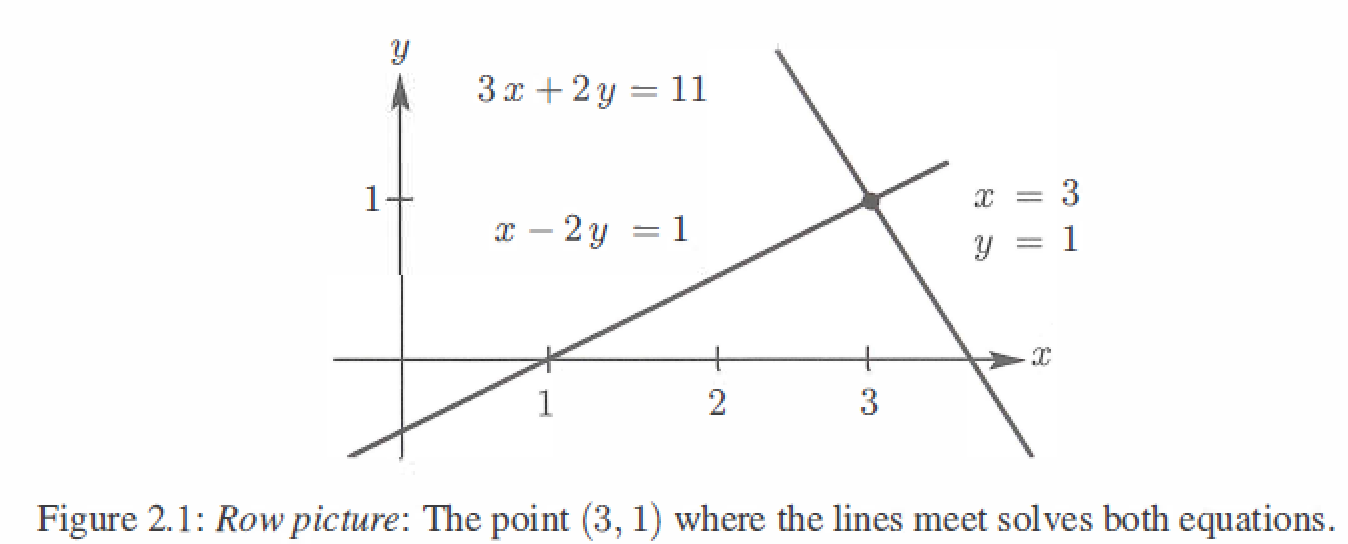
The row picture shows two lines meeting at a single point(the solution).
3 by 3 equations
Three equations, Three unknowns
\]
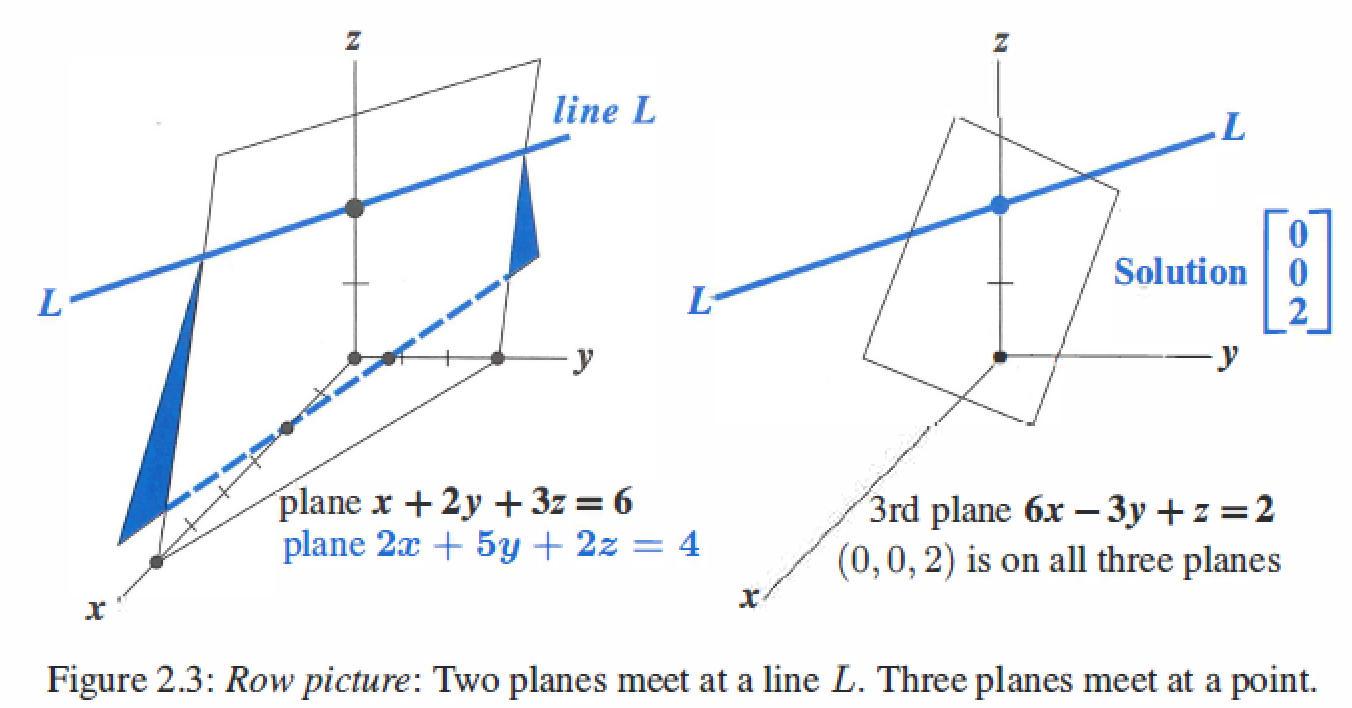
The row picture shows three planes meeting at a single point.
Column Picture
2 by 2 equations
Two equations, Two unknowns
\]
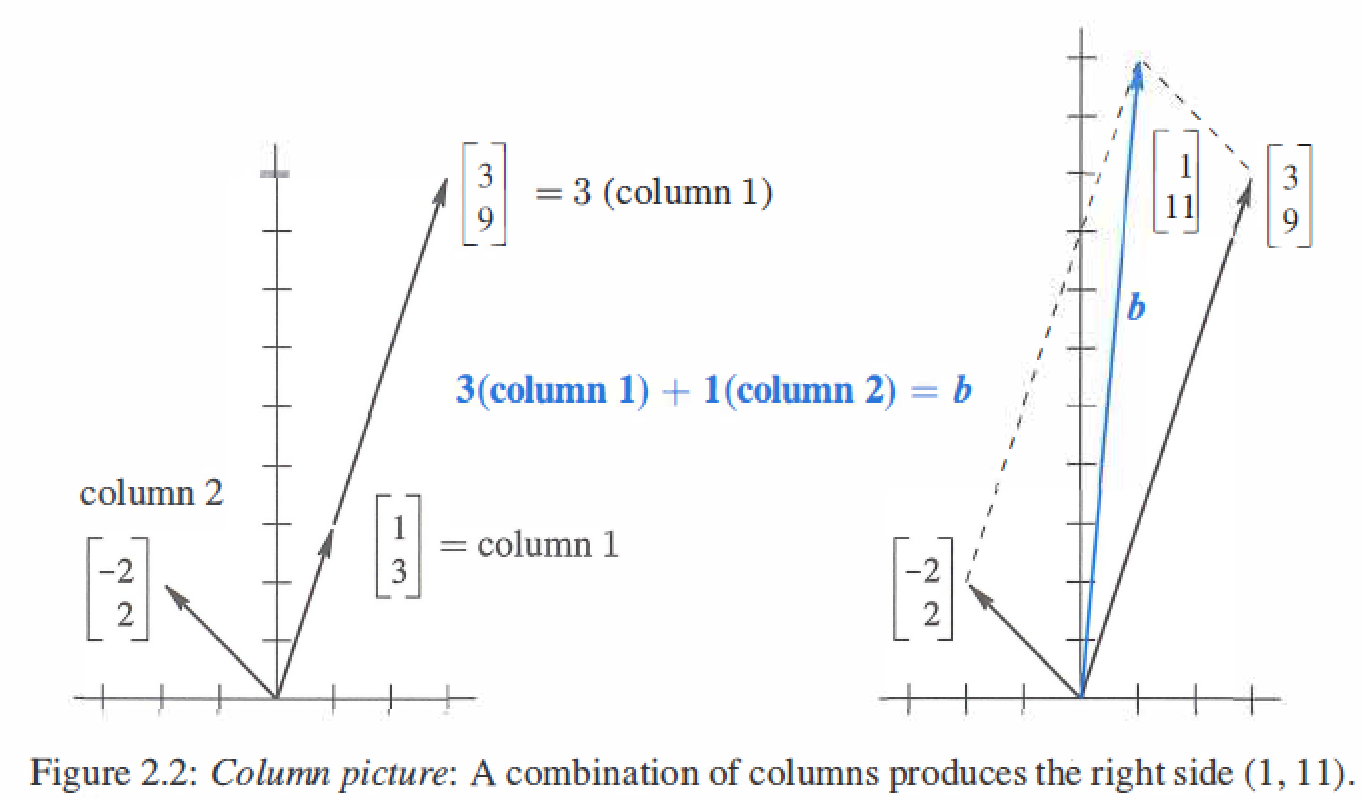
The column picture combines the column vectors on the left side to produce the vector b on the right side.
(The left side of the vector equation is a linear combination of the columns)
3 by 3 equations
Three equations, Three unknowns
\]
The column picture combines three columns to produce b,the coefficients (x,y,z) = (0,0,2).

2.2 Elimination
2.2.1 Gaussian Elimination
- Column 1 : Use the first equation to create zeros below the first pivot.
- Column 2 : Use the new equation 2 to create zeros below the second pivot.
- Column 3 to n : Keep going to find all n pivots and the upper triangular U.
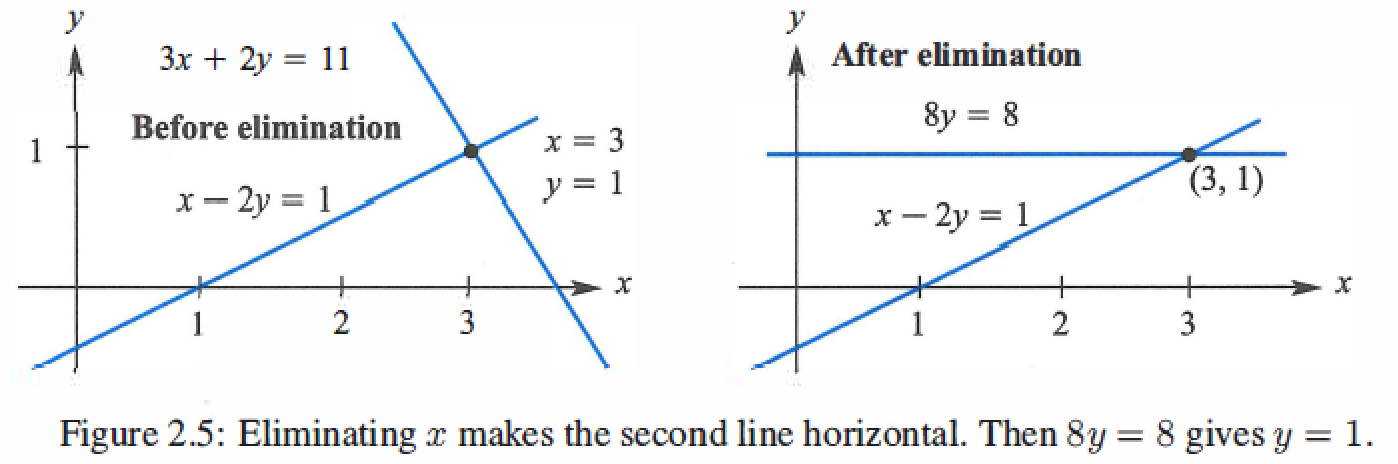
2 by 2
Multiply equation 1 by 3, and Subtract from equation 2.
\]
3 by 3
\]
Elimination Steps
step1 : Subtract 2 times equation 1 from equation 2.
\quad \quad \quad y + z = 4 \\
-2x-3y+7z=10 \end{matrix}
\]
step2 : Subtract -1 times equation 1 from equation 3.
\quad \quad \quad y + z = 4 \\
\quad \quad \quad \quad y+5z=12 \end{matrix}
\]
step3 : Subtract new equation 2 from new equation 3.
\quad \quad \quad \quad y + z = 4 \\
\quad \quad \quad \quad \quad 4z = 8 \end{matrix}
==>Ux = c
\]
U is upper triangular.
Back substitution
z = 2 --> y = 2 --> x = -1
2.2.2 Elimination-Matrix
Elimination multiplies Ax=b by \(E_{21} , E_{31} , E_{41}, ..., E_{n1}\), then \(E_{32} , E_{42}, ..., E_{n2}\) and onward.
- \(E =E_{21} ,..., E_{n1},..., E_{n2},...,E_{n(n-1)}\) , \(EA = [Ea_1...Ea_n]\)
- Augmented matrix : \(E[A\ \ b] = [EA\ \ Eb]\)
example:
\Downarrow \\
\begin{matrix} 2x_1 + 4x_2 - 2x_3 = 2 \\ 4x_1 + 9x_2 - 3x_3 = 8 \\ -2x_1-3x_2+7x_3=10 \end{matrix} \\
\Downarrow \\
\left[ \begin{matrix} 2&4&-2 \\ 4&9&-3 \\ -2&-3&7 \end{matrix} \right]
\left[ \begin{matrix} x_1\\x_2\\x_3 \end{matrix} \right] =
\left[ \begin{matrix} 2\\8\\10 \end{matrix} \right] \\
\Downarrow \\
\left[ \begin{matrix} 1&0&0 \\ -2&1&0 \\ 0&0&1 \end{matrix} \right]
\left[ \begin{matrix} 2&4&-2 \\ 4&9&-3 \\ -2&-3&7 \end{matrix} \right]
\left[ \begin{matrix} x_1\\x_2\\x_3 \end{matrix} \right] =
\left[ \begin{matrix} 1&0&0 \\ -2&1&0 \\ 0&0&1 \end{matrix} \right]
\left[ \begin{matrix} 2\\8\\10 \end{matrix} \right] \\
\Downarrow \\
\left[ \begin{matrix} 2&4&-2 \\ 0&1&1 \\ -2&-3&7 \end{matrix} \right]
\left[ \begin{matrix} x_1\\x_2\\x_3 \end{matrix} \right] =
\left[ \begin{matrix} 2\\4\\10 \end{matrix} \right] \\
\Downarrow \\
\left[ \begin{matrix} 1&0&0 \\ 0&1&0 \\ 1&0&1 \end{matrix} \right]
\left[ \begin{matrix} 2&4&-2 \\ 0&1&1 \\ -2&-3&7 \end{matrix} \right]
\left[ \begin{matrix} x_1\\x_2\\x_3 \end{matrix} \right] =
\left[ \begin{matrix} 1&0&0 \\ 0&1&0 \\ 1&0&1 \end{matrix} \right]
\left[ \begin{matrix} 2\\4\\10 \end{matrix} \right] \\
\Downarrow \\
\left[ \begin{matrix} 2&4&-2 \\ 0&1&1 \\ 0&1&5 \end{matrix} \right]
\left[ \begin{matrix} x_1\\x_2\\x_3 \end{matrix} \right] =
\left[ \begin{matrix} 2\\4\\12 \end{matrix} \right] \\
\Downarrow \\
\left[ \begin{matrix} 1&0&0 \\ 0&1&0 \\ 0&-1&1 \end{matrix} \right]
\left[ \begin{matrix} 2&4&-2 \\ 0&1&1 \\ 0&1&5 \end{matrix} \right]
\left[ \begin{matrix} x_1\\x_2\\x_3 \end{matrix} \right] =
\left[ \begin{matrix} 1&0&0 \\ 0&1&0 \\ 0&-1&1 \end{matrix} \right]
\left[ \begin{matrix} 2\\4\\12 \end{matrix} \right] \\
\Downarrow \\
\left[ \begin{matrix} 2&4&-2 \\ 0&1&1 \\ 0&0&4 \end{matrix} \right]
\left[ \begin{matrix} x_1\\x_2\\x_3 \end{matrix} \right] =
\left[ \begin{matrix} 2\\4\\8 \end{matrix} \right] \\
\Downarrow Back \ \ substitution \\
x_3 = 2 , x_2 = 2, x_1 = -1
\]
2.3 Rules for Matrix Operations
2.3.1 Matrix Multiplication
Matrices A with n columns multiply matrices B with n rows : \(A_{m \times n} B_{n \times p} = C_{m \times p}\)
The regular way
The entry in row i and column j of AB is (row i of A) \(\cdot\) (column j of B): \((AB)_{ij}=a_{i1}b_{1j} + a_{i2}b_{2j}+...+a_{in}b_{nj}\)
\left[ \begin{matrix} *&b_{1j}&*&*\\ &b_{2j}&&\ \\ &\vdots&& \\ &b_{nj}&& \end{matrix} \right]=
\left[ \begin{matrix} &&*&& \\ *&*&(AB)_{ij}&*&* \\ &&*&& \\&&*&& \end{matrix} \right]
\]
The column way
Each column of AB is a combination of the columns of A.
Matrix A times every column of B : \(A[b_1...b_p]=[Ab_1...Ab_p]\)
The row way
Every row of AB is a combination of the rows of B
Every row of A times matrix B : \(\left[\begin{matrix} a_1 \\ a_2 \\ \vdots \\a_n \end{matrix}\right]B=\left[\begin{matrix} a_1B \\ a_2B \\ \vdots \\a_nB \end{matrix}\right]\)
The columns multiply rows
Multiply columns 1 to n of A times rows 1 to n of B. Add those matrices.
\left[\begin{matrix} row_1&\cdots \\ \vdots&\vdots \\row_n&\cdots \end{matrix}\right]
=(col_1)(row_1)+...+(col_n)(row_n)
\]
Block Multiplication
A and B cut into blocks(which are small matrices).
B = \left[\begin{matrix} B_1&B_2\\ B_3&B_4 \end{matrix}\right] \\
AB =\left[\begin{matrix} A_1&A_2\\ A_3&A_4 \end{matrix}\right]
\left[\begin{matrix} B_1&B_2\\ B_3&B_4 \end{matrix}\right] =
\left[\begin{matrix} A_1B_1 + A_2B_3&A_1B_2 + A_2B_4\\ A_3B_1 + A_4B_3&A_2B_2 + A_4B_4\end{matrix}\right]
\]
2.3.2 The Laws for Matrix Operations
Additions
Commutative law : A + B = B + A
Distributive law : c(A + B) = cA + cB
Associative law : A + (B + C) = (A + B) + C
Multiply
Commutative law is usually broken : \(AB \neq BA\)
Distributive law : (A + B)C = AC + BC or C(A + B) = CA + CB
Associative law : A (B C) = (A B) C
2.4 Inverse Matrices
The matrix A is invertible if there exists a matrix \(A^{-1}\) that "inverts" A :
\]
- A is invertible if and only if it has n pivots (row exchanges allowed).
- If Ax = 0 for a nonzero vector x, then A has no inverse.
- The inverse of AB is the reverse product \(B^{-1}A^{-1}\),and \((ABC)^{-1}=C^{-1}B^{-1}A^{-1}\).
- Diagonally dominant matrices are invertible.Each \(|a_{ii}|\)dominates its row.
Gauss-Jordan Method
\]
example $A = \left[ \begin{matrix} 2&3 \ 4&7 \end{matrix}\right] $:
\Downarrow \\
[U \quad L^{-1}]=\left[ \begin{matrix} 2&3&1&0 \\ 0&1&-2&1 \end{matrix}\right] \quad \\
\Downarrow \\
\left[ \begin{matrix} 2&0&7&-3 \\ 0&1&-2&1 \end{matrix}\right] \\
\Downarrow \\
[I \quad A^{-1}]=\left[ \begin{matrix} 1&0&7/2&-3/2 \\ 0&1&-2&1 \end{matrix}\right] \quad \\
\]
2.5 Factorization : A = LU
Gaussian elimination (with no row exchanges) factors A into L times U,the factors L and U are triangular matrices, and L include all their inverse.
\]
\Downarrow \\
(E_{21}^{-1}E_{31}^{-1}...E_{n(n-1)}^{-1})(E_{n(n-1)}...E_{31}E_{21})A = (E_{21}^{-1}E_{31}^{-1}...E_{n(n-1)}^{-1})U \\
\Downarrow \\
A = LU \\
\]
example \(A = \left[ \begin{matrix} 2&1&0 \\ 1&2&1 \\ 0&1&2 \end{matrix}\right] =
\left[ \begin{matrix} 1&0&0 \\ 1/2&1&0 \\ 0&2/3&1 \end{matrix}\right]
\left[ \begin{matrix} 2&1&0 \\ 0&3/2&1 \\ 0&0&4/3 \end{matrix}\right] = LU\)
The triangular factorization can be written : \(A = LU \rightarrow A=LDU\), that D is a diagonal matrix contains the pivots.
Split U into \(DU=\left[ \begin{matrix} d_1&&& \\ &d_2&& \\ &&\ddots \\ &&&d_n \end{matrix}\right]\left[ \begin{matrix} 1&u_{12}/d_1&u_{13}/d_1&\cdots \\ &1&u_{23}/d_2&\vdots \\ &&\ddots \\ &&&1 \end{matrix}\right]\)
example:
\left[ \begin{matrix} 1&0&0 \\ 1/2&1&0 \\ 0&2/3&1 \end{matrix}\right]
\left[ \begin{matrix} 2&1&0 \\ 0&3/2&1 \\ 0&0&4/3 \end{matrix}\right] \\ =
\left[ \begin{matrix} 1&0&0 \\ 1/2&1&0 \\ 0&2/3&1 \end{matrix}\right]
\left[ \begin{matrix} 2&0&0 \\ 0&3/2&0 \\ 0&0&4/3 \end{matrix}\right]\left[ \begin{matrix} 1&1/2&0 \\ 0&1&2/3 \\ 0&0&1 \end{matrix}\right]= LDU
\]
Keys
- The lower triangular L contains the number \(l_{ij}\) that multiply pivot rows, going from A to U. The product LU adds those rows back to recover A.
- On the right side we solve Lc = b (forward) and Ux=c (backward).
- Cost : the left side costs \(1/3(n^3 -n)\) multiplications and subtractions,the right side costs \(n^2\) multiplications and subtractions.
2.6 Transposes and Permutations
Transposes
The columns of \(A^{T}\) are the rows of A
\]
If \(A = \left [ \begin{matrix} 1&2&3 \\ 0&0&4 \end{matrix}\right]\) then \(A^{T} = \left [ \begin{matrix} 1&0 \\ 2&0 \\ 3&4 \end{matrix}\right]\)
Sum : \((A+B)^{T} = A^{T} + B^{T}\)
Product : \((AB)^{T} = B^{T}A^{T}\)
Inverse : \((A^{T})^{-1} = (A^{-1})^{T}\)
Symmetric matrix (\(S^T=S\)):\(U = L^T \rightarrow S = LDU = LDL^T\)
Permutations
A permutation matrix P has the rows of the identity I in any order, \(P_{ij}\) is constructed by exchanging two row i and j of \(I\),and there are \(n!\) permuataion matrices of order n.
3 by 3 permuation matrices:
P_{21} = \left [ \begin{matrix} &1& \\ 1&& \\ &&1 \end{matrix}\right] \quad
P_{31} = \left [ \begin{matrix} &&1\\ &1& \\ 1&& \end{matrix}\right] \\
P_{32} = \left [ \begin{matrix} 1&&\\ &&1 \\ &1& \end{matrix}\right] \quad
P_{32}P_{21} = \left [ \begin{matrix} &1&\\ &&1 \\ 1&& \end{matrix}\right] \quad
P_{21}P_{32} = \left [ \begin{matrix} &&1\\ 1&& \\ &1& \end{matrix}\right]
\]
- If A is invertible then a permutation P will reorder its rows for PA=LU.
- A permutation matrix P has a 1 in each row and column, and \(P^T = P^{-1}\).
2. Solving Linear Equations的更多相关文章
- Linear Equations
4.1 Linear Equations with One Independent Variable
- Linear Equations in Linear Algebra
Linear System Vector Equations The Matrix Equation Solution Sets of Linear Systems Linear Indenpende ...
- 线性代数导论 | Linear Algebra 课程
搞统计的线性代数和概率论必须精通,最好要能锻炼出直觉,再学机器学习才会事半功倍. 线性代数只推荐Prof. Gilbert Strang的MIT课程,有视频,有教材,有习题,有考试,一套学下来基本就入 ...
- Java基础常见英语词汇
Java基础常见英语词汇(共70个) ['ɔbdʒekt] ['ɔ:rientid]导向的 ['prəʊɡræmɪŋ]编程 OO: object ...
- 看到了必须要Mark啊,最全的编程中英文词汇对照汇总(里面有好几个版本的,每个版本从a到d的顺序排列)
java: 第一章: JDK(Java Development Kit) java开发工具包 JVM(Java Virtual Machine) java虚拟机 Javac 编译命令 java ...
- (转)Awesome Courses
Awesome Courses Introduction There is a lot of hidden treasure lying within university pages scatte ...
- 专业英语词汇(Java)
abstract (关键字) 抽象 ['.bstr.kt] access vt.访问,存取 ['.kses]‘(n.入口, ...
- Lua的各种资源1
Libraries And Bindings LuaDirectory > LuaAddons > LibrariesAndBindings This is a list of l ...
- JAVA常用单词
柠檬学院Java 基础常见英语词汇(共 70 个)OO: object-oriented ,面向对象 OOP: object-oriented programming,面向对象编程JDK:Java d ...
- java常用英语单词
abstract (关键字) 抽象 ['.bstr.kt] access vt.访问,存取 ['.kses]'(n.入口,使用权) algorithm n.算法 ['.lg.riem] annotat ...
随机推荐
- 为产品的一堆Visual Studio解决方案引入Directory.Build.props
为什么需要Directory.Build.props? 一个产品有了多个甚至几十个解决方案之后,每个解决方案里面的项目可能会引用一个dll包的不同版本,因此需要集中管理dll包的版本号. .NET的D ...
- Finder Error code -36 “访达” 错误代码-36
导致这个问题的原因是你的iCloud (iCloud和iCloud Drive是不一样的) 快满了. 如果你想解决这个问题,有以下三个方法: 1.多买苹果iCloud.(是的,苹果现在太恶心了.但这是 ...
- 【Azure Storage Account Table】询问批量将存储账户中的表嵌入另一个账户中的办法
问题描述 询问批量将存储账户中的表嵌入另一个账户中的办法? 问题解答 方式一:使用 AzCopy 使用Az copy做表格的导入导出,注意您需要使用Azcopy 7.3版本来实现对Table的操作,可 ...
- C笔记(2014-12备份)
Video1: 1-编译器对待全局变量和局部变量的差别.全局变量分配空间是在数据区,局部变量分配在代码区. (比如局部变量 int lo_var = 2;后面的 = 2;是赋值语句,被编译器转化成机器 ...
- hesitation 单词学习 犹豫 hes 就是 her 粘 助记单词 here
hesitation 单词学习 犹豫 hes 就是 her 粘 助记单词 here hes + itation(ite + ate + ion) hesitation 美: [ˌhezɪˈteɪʃ(ə ...
- kubectl create 与 kubectl apply的区别
kubectl apply和kubectl create都是Kubernetes(k8s)中用于创建或更新资源的命令,但它们在使用方式.功能和灵活性上存在一些区别. 声明式与命令式: kubectl ...
- Performance Improvements in .NET 8 -- JIT部分翻译
相关视频 动态PGO 基准测试设置 在本文中,我包括微基准测试以突出讨论的各个方面.其中大部分基准测试都是使用BenchmarkDotNet v0.13.8实现的,除非另有说明,否则每个基准测试都有一 ...
- Linux输入输出
1.重定向概述 1.什么是重定向 将原本要输出到屏幕的数据信息,重新定向到某个指定的文件中.比如:每天凌晨定时备份数据,希望将备份数据的结果保存到某个文件中. 这样第二天通过查看文件的内容就知道昨天备 ...
- 记录--面试官:“你知道什么情况下 HTTPS 不安全么”
这里给大家分享我在网上总结出来的一些知识,希望对大家有所帮助 面试官:"HTTPS的加密过程你知道么?" 我:"那肯定知道啊." 面试官:"那你知道什 ...
- .NET开源、免费、强大的交互式绘图库
前言 今天大姚给大家分享一款.NET开源(采用MIT许可证).免费.强大的交互式绘图库,该库能够轻松地实现大型数据集的交互式显示.使用几行代码即可快速创建折线图.柱状图.饼图.散点图等不同类型的图表: ...