
Verilog之SOS信号-仿顺序操作
SOS信号:. . . _ _ _ . . .

1.
module sos_module

(

     CLK, RSTn, Pin_Out, SOS_En_Sig

);

    input CLK;

     input RSTn;

     input SOS_En_Sig;

     output Pin_Out;

     /****************************************/

     parameter T1MS = 'd49_999;//DB4CE15开发板使用的晶振为50MHz,50M*0.001-1=49_999

     /***************************************/

     reg [:]Count1;

     always @ ( posedge CLK or negedge RSTn )

         if( !RSTn )

              Count1 <= 'd0;

          else if( isCount && Count1 == T1MS )

              Count1 <= 'd0;

          else if( isCount )

              Count1 <= Count1 + 'b1;

          else if( !isCount )

              Count1 <= 'd0;

    /****************************************/

    reg [:]Count_MS;

     always @ ( posedge CLK or negedge RSTn )

        if( !RSTn )

              Count_MS <= 'd0;

          else if( isCount && Count1 == T1MS )

              Count_MS <= Count_MS + 'b1;

          else if( !isCount )

              Count_MS <= 'd0;

    /******************************************/

    reg isCount;

    reg rPin_Out;

    reg [:]i;

    always @ ( posedge CLK or negedge RSTn )

        if( !RSTn )

             begin

                 isCount <= 'b0;

                    rPin_Out <= 'b0;

                    i <= 'd0;

              end

         else

            case( i )

                'd0 :

                    if( SOS_En_Sig ) i <= 'd1;

                    'd1, 5'd3, 'd5,

                    'd13, 5'd15, 'd17 :

                    if( Count_MS == 'd100 ) begin isCount <= 1'b0; rPin_Out <= 'b0; i <= i + 1'b1; end // short

                    else begin isCount <= 'b1; rPin_Out <= 1'b1; end

                    'd7, 5'd9, 'd11 :

                    if( Count_MS == 'd300 ) begin isCount <= 1'b0; rPin_Out <= 'b0; i <= i + 1'b1; end // long

                    else begin isCount <= 'b1; rPin_Out <= 1'b1; end

                    'd2, 5'd4, 'd6,

                    'd8, 5'd10, 'd12,

                    'd14, 5'd16, 'd18 :

                    if( Count_MS == 'd50 ) begin isCount <= 1'b0; i <= i + 'b1; end// interval

                    else isCount <= 'b1;

                    'd19 :

                    begin rPin_Out <= 'b0; i <= 5'd0; end  // end

              endcase

    /***************************************************/

     assign Pin_Out = rPin_Out;

     /***************************************************/

endmodule
2.
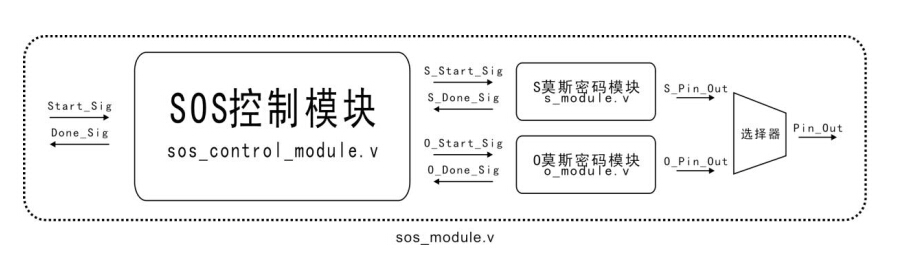
“Start_Sig”如同 C 语言中的调用指令,“Done_Sig”如同 C 语言的返回指令。这两个信号的存在就是为了控制模块的调用。
module sos_control_module

(

    CLK, RSTn,

     Start_Sig,

     S_Done_Sig, O_Done_Sig,

     S_Start_Sig, O_Start_Sig,

     Done_Sig

);

    input CLK;

     input RSTn;

     input Start_Sig;

     input S_Done_Sig, O_Done_Sig;

     output S_Start_Sig, O_Start_Sig;

     output Done_Sig;

     /*************************************/

     reg [:]i;

     reg isO;

     reg isS;

     reg isDone;

     always @ ( posedge CLK or negedge RSTn )

        if( !RSTn )

              begin

                  i <= 'd0;

                     isO <= 'b0;

                     isS <= 'b0;

                     isDone <= 'b0;

               end

          else if( Start_Sig )

              case( i )

                     'd0:

                     if( S_Done_Sig ) begin isS <= 'b0; i <= i + 1'b1; end

                     else isS <= 'b1;

                     'd1:

                     if( O_Done_Sig ) begin isO <= 'b0; i <= i + 1'b1; end

                     else isO <= 'b1;

                     'd2:

                     if( S_Done_Sig ) begin isS <= 'b0; i <= i + 1'b1; end

                     else isS <= 'b1;

                     'd3:

                begin isDone <= 'b1; i <= 4'd4; end

                     'd4:

                     begin isDone <= 'b0; i <= 4'd0; end

                endcase

    /*****************************************/

    assign S_Start_Sig = isS;

    assign O_Start_Sig = isO;

    assign Done_Sig = isDone;

     /*****************************************/

endmodule
module s_module

(

    CLK, RSTn,

     Start_Sig,

     Done_Sig,

     Pin_Out

);

     input CLK;

      input RSTn;

      input Start_Sig;

      output Done_Sig;

      output Pin_Out;

      /****************************************/

     parameter T1MS = 'd49_999;

     /***************************************/

     reg [:]Count1;

     always @ ( posedge CLK or negedge RSTn )

         if( !RSTn )

              Count1 <= 'd0;

          else if( Count1 == T1MS )

              Count1 <= 'd0;

          else if( isCount )

              Count1 <= Count1 + 'b1;

          else if( !isCount )

              Count1 <= 'd0;

    /****************************************/

    reg [:]Count_MS;

     always @ ( posedge CLK or negedge RSTn )

        if( !RSTn )

              Count_MS <= 'd0;

          else if( Count_MS == rTimes )

              Count_MS <= 'd0;

          else if( Count1 == T1MS )

              Count_MS <= Count_MS + 'b1;

    /******************************************/

    reg [:]i;

    reg rPin_Out;

    reg [:]rTimes;

    reg isCount;

    reg isDone;

    always @ ( posedge CLK or negedge RSTn )

        if( !RSTn )

             begin

                  i <= 'd0;

                 rPin_Out <= 'b0;

                    rTimes <= 'd1000;

                   isCount <= 'b0;

                   isDone <= 'b0;

              end

         else if( Start_Sig )

             case( i )

                  'd0, 4'd2, 'd4:

                  if( Count_MS == rTimes ) begin rPin_Out <= 'b0; isCount <= 1'b0; i <= i + 'b1; end

                   else begin isCount <= 'b1; rPin_Out <= 1'b1; rTimes <= 'd100; end

                    'd1, 4'd3, 'd5:

                    if( Count_MS == rTimes ) begin isCount <= 'b0; i <= i + 1'b1; end

                    else  begin isCount <= 'b1; rTimes <= 10'd50; end

                    'd6:

                    begin isDone <= 'b1; i <= 4'd7; end

                    'd7:

                    begin isDone <= 'b0; i <= 4'd0; end

              endcase

    /******************************************/

    assign Done_Sig = isDone;

    assign Pin_Out = !rPin_Out;

    /******************************************/

endmodule
module o_module

(

    CLK, RSTn,

     Start_Sig,

     Done_Sig,

     Pin_Out

);

     input CLK;

      input RSTn;

      input Start_Sig;

      output Done_Sig;

      output Pin_Out;

      /****************************************/

     parameter T1MS = 'd49_999;

     /***************************************/

     reg [:]Count1;

     always @ ( posedge CLK or negedge RSTn )

         if( !RSTn )

              Count1 <= 'd0;

          else if( Count1 == T1MS )

              Count1 <= 'd0;

          else if( isCount )

              Count1 <= Count1 + 'b1;

          else if( !isCount )

              Count1 <= 'd0;

    /****************************************/

    reg [:]Count_MS;

     always @ ( posedge CLK or negedge RSTn )

        if( !RSTn )

              Count_MS <= 'd0;

          else if( Count_MS == rTimes )

              Count_MS <= 'd0;

          else if( Count1 == T1MS )

              Count_MS <= Count_MS + 'b1;

    /******************************************/

    reg [:]i;

    reg rPin_Out;

    reg [:]rTimes;

    reg isCount;

    reg isDone;

    always @ ( posedge CLK or negedge RSTn )

        if( !RSTn )

             begin

                  i <= 'd0;

                 rPin_Out <= 'b0;

                    rTimes <= 'd1000;

                   isCount <= 'b0;

                   isDone <= 'b0;

              end

         else if( Start_Sig )

             case( i )

                  'd0, 4'd2, 'd4:

                  if( Count_MS == rTimes ) begin rPin_Out <= 'b0; isCount <= 1'b0; i <= i + 'b1; end

                   else begin isCount <= 'b1; rPin_Out <= 1'b1; rTimes <= 'd400; end

                    'd1, 4'd3, 'd5:

                    if( Count_MS == rTimes ) begin isCount <= 'b0; i <= i + 1'b1; end

                    else  begin isCount <= 'b1; rTimes <= 10'd50; end

                    'd6:

                    begin isDone <= 'b1; i <= 4'd7; end

                    'd7:

                    begin isDone <= 'b0; i <= 4'd0; end

              endcase

    /******************************************/

    assign Done_Sig = isDone;

    assign Pin_Out = !rPin_Out;

    /******************************************/

endmodule
module sos_module

(

    CLK, RSTn,

    Start_Sig,

     Done_Sig,

     Pin_Out

);

    input CLK;

     input RSTn;

     input Start_Sig;

     output Done_Sig;

     output Pin_Out;

     /*****************************/

     wire S_Done_Sig;

     wire S_Pin_Out;

     s_module U1

     (

         .CLK( CLK ),

          .RSTn( RSTn ),

          .Start_Sig( S_Start_Sig ),  // input - from U3

          .Done_Sig( S_Done_Sig ),    // output - to U3

          .Pin_Out( S_Pin_Out )       // output - to selector

      ) ;

     /*********************************/

     wire O_Done_Sig;

     wire O_Pin_Out;

     o_module U2

     (

         .CLK( CLK ),

          .RSTn( RSTn ),

          .Start_Sig( O_Start_Sig ),  // input - from U3

          .Done_Sig( O_Done_Sig ),    // output - to U3

          .Pin_Out( O_Pin_Out )       // output - to selector

     );

     /*********************************/

     wire S_Start_Sig;

     wire O_Start_Sig;

     sos_control_module U3

     (

         .CLK( CLK ),

          .RSTn( RSTn ),

          .Start_Sig( Start_Sig ),      // input - from top

          .S_Done_Sig( S_Done_Sig ),    // input - from U1

          .O_Done_Sig( O_Done_Sig ),    // input - from U2

          .S_Start_Sig( S_Start_Sig ),  // output - to U1

          .O_Start_Sig( O_Start_Sig ),  // output - to U2

          .Done_Sig( Done_Sig )         // output - to top

     );

     /*********************************/

     //selector

     reg Pin_Out;

     always @ ( * )

         if( S_Start_Sig ) Pin_Out = S_Pin_Out;      // select from U1

          else if( O_Start_Sig ) Pin_Out = O_Pin_Out;  // select from U2

          else Pin_Out = 'bx;

    /*********************************/

endmodule

Verilog之SOS信号-仿顺序操作的更多相关文章
- 【黑金教程笔记之006】【建模篇】【Lab 05 SOS信号之一】—笔记
sos_module.v是产生SOS信号的功能模块.即有次序的输出莫斯码:点.画.间隔.control_module.v是一个定时触发器,每一段时间使能sos_module.v. 模块: /***** ...
- 【黑金教程笔记之007】【建模篇】【Lab 06 SOS信号之二】—笔记
控制模块的协调角色. 实验六用到了实验四的按键消抖模块debounce_module.v和实验五的sos_module.v. 设计思路: debounce_module.v看成一个输入,sos_mod ...
- 【黑金教程笔记之001】veriloghdl 扫盲文—笔记&勘误
001_veriloghdl 扫盲文—笔记&勘误 2014/10/31 原文作者:akuei2 联系方式:blog.ednchina.con/akuei2 勘误001: Page 3 0.1 ...
- 【设计经验】1、Verilog中如何规范的处理inout信号
在FPGA的设计过程中,有时候会遇到双向信号(既能作为输出,也能作为输入的信号叫双向信号).比如,IIC总线中的SDA信号就是一个双向信号,QSPI Flash的四线操作的时候四根信号线均为双向信号. ...
- verilog实现中值滤波
前言 项目需要,想要实现算法中的其中一步即中值滤波,同时,因为图像处理部分中值滤波相对来说还是比较简单的,将中值滤波的硬件实现作为进入FPGA领域的第一次尝试.虽然说网上有较多关于中值滤波的文档,可是 ...
- 基于Proteus仿真的Arduino学习(1)——Arduino Uno最小系统及LED的简单使用
一.前言: A.Arduino简介 Arduino是由一个欧洲开发团队于2005年冬季开发.其成员包括Massimo Banzi.David Cuartielles.Tom Igoe.Gianluc ...
- SPI通信实验---verilog(FPGA作为从机,使用可读可写)
本实验讲究实用性,故设计思想为:主机先向从机发送地址,若是向从机写入数据,则向从机发送数据,若是读取从机数据,则向从机发送时钟,然后在时钟下降沿读取数据即可.cs信号上升沿作为SPI通信的结束信号.r ...
- SPI的通信试验 --verilog (从机-全双工)
SPI的 有关知识参考FPGA作为主机的通信实验. 本实验中FPGA作为从机通过SPI与MCU等通信的试验,可以在时钟上升沿接收数据并且在时钟下降沿发送数据,模仿全双工模式.接收的 数据作为地址,通过 ...
- 【接口时序】2、Verilog实现流水灯及与C语言的对比
一. 软件平台与硬件平台 软件平台: 1.操作系统:Windows-8.1 2.开发套件:ISE14.7 3.仿真工具:ModelSim-10.4-SE 硬件平台: 1.FPGA型号:XC6SLX45 ...
随机推荐
- ServletContext总结
今天我们学习的是ServletContext的应用. WEB容器在启动时,它会为每个WEB应用程序都创建一个对应的ServletContext对象,它代表当前web应用. ServletConfig对 ...
- 为什么要用Maven?
早期还在学怎么用Ant构建项目时,就有看到说Maven是Ant的替代品,但真正意义去了解Maven,还是因为以前的公司一老员工在做OpenJMS二次开发时,从网上下载了源码,然后用Maven构建它. ...
- PLSQL 逻辑多线程
PROCEDURE get_sheetid(i_topic IN VARCHAR2, o_newsheetid OUT VARCHAR2) IS PRAGMA AUTONOMOUS_TRANSA ...
- CPS冥想 - 1 重新审视CPS
这篇文章是在阅读Eric Lippert大神的MSDN Blog文章时同步写成的,其中主要是各种翻译,同时还混杂自己阅读文章的笔记和感想. 原博文地址 http://blogs.msdn.com/b/ ...
- django model 中class meta
class Meta: ordering = ['-num', 'length'] verbose_name = 'name' verbose_name_plural = 'names' orderi ...
- 使用Auto Layout中的VFL(Visual format language)--代码实现自动布局【转】
本文将通过简单的UI来说明如何用VFL来实现自动布局.在自动布局的时候避免不了使用代码来加以优化以及根据内容来实现不同的UI. 一:API介绍 NSLayoutConstraint API 1 2 3 ...
- android menu的问题
1.简单使用 @Override public boolean onCreateOptionsMenu(Menu menu) { getMenuInflater().inflate(R.menu.me ...
- Angular $http解析通过接口获得的json数据
刚接触angular不久,对很多东西都不了解,今天需要用angular通过接口得到json数据,折腾了好久,总算是能获取到数据了,下面是部分源码,仅供参考: HTML部分: <body ng-a ...
- C# 连接 Oracle 的几种方式
一:通过System.Data.OracleClient(需要安装Oracle客户端并配置tnsnames.ora)1. 添加命名空间System.Data.OracleClient引用2. usin ...
- 错误:Unsupported major.minor version 51.0(jdk版本错误)的解决方法
错误:Unsupported major.minor version 51.0(jdk版本错误)的解决方法 java.lang.UnsupportedClassVersionError: org/ap ...