
TensorFlow基础笔记(9) Tensorboard可视化显示以及查看pb meta模型文件的方法
参考: http://blog.csdn.net/l18930738887/article/details/55000008
http://www.jianshu.com/p/19bb60b52dad
http://blog.csdn.net/sinat_33761963/article/details/62433234
import tensorflow as tf

import numpy as np

def add_layer(inputs, in_size, out_size, n_layer, activation_function=None):

    # add one more layer and return the output of this layer

    layer_name = 'layer%s' % n_layer

    with tf.name_scope(layer_name):

        with tf.name_scope('weights'):

            Weights = tf.Variable(tf.random_normal([in_size, out_size]), name='W')

            tf.summary.histogram(layer_name + '/weights', Weights)

        with tf.name_scope('biases'):

            biases = tf.Variable(tf.zeros([1, out_size]) + 0.1, name='b')

            tf.summary.histogram(layer_name + '/biases', biases)

        with tf.name_scope('Wx_plus_b'):

            Wx_plus_b = tf.add(tf.matmul(inputs, Weights), biases)

        if activation_function is None:

            outputs = Wx_plus_b

        else:

            outputs = activation_function(Wx_plus_b, )

        tf.summary.histogram(layer_name + '/outputs', outputs)

    return outputs

# Make up some real data

x_data = np.linspace(-1,1,300)[:, np.newaxis]

noise = np.random.normal(0, 0.05, x_data.shape)

y_data = np.square(x_data) - 0.5 + noise

# define placeholder for inputs to network

with tf.name_scope('inputs'):

    xs = tf.placeholder(tf.float32, [None, 1],name='input_x')

    ys = tf.placeholder(tf.float32, [None, 1],name='input_y')

# add hidden layer

l1 = add_layer(xs, 1, 10, n_layer=1, activation_function=tf.nn.relu)

# add output layer

prediction = add_layer(l1, 10, 1, n_layer=2, activation_function=None)

# the error between prediciton and real data

with tf.name_scope('loss'):

    loss = tf.reduce_mean(tf.reduce_sum(tf.square(ys - prediction),

                                        reduction_indices=[1]))

    tf.summary.scalar('loss', loss)

with tf.name_scope('train'):

    train_step = tf.train.GradientDescentOptimizer(0.1).minimize(loss)

sess = tf.Session()

merged = tf.summary.merge_all()

# save the logs

writer = tf.summary.FileWriter("logs/", sess.graph)

sess.run(tf.global_variables_initializer())

for i in range(1000):

    # training

    sess.run(train_step, feed_dict={xs: x_data, ys: y_data})

    if i % 50 == 0:

        # to see the step improvement

        result = sess.run(merged,

                          feed_dict={xs: x_data, ys: y_data})

        writer.add_summary(result, i)
到运行python的所在目录下,打一下命令:
$ tensorboard --logdir="logs/"
再在网页中输入链接:127.0.1.1:6006 即可获得展示: 推荐使用friefox浏览器,我电脑上chrom浏览器打不开
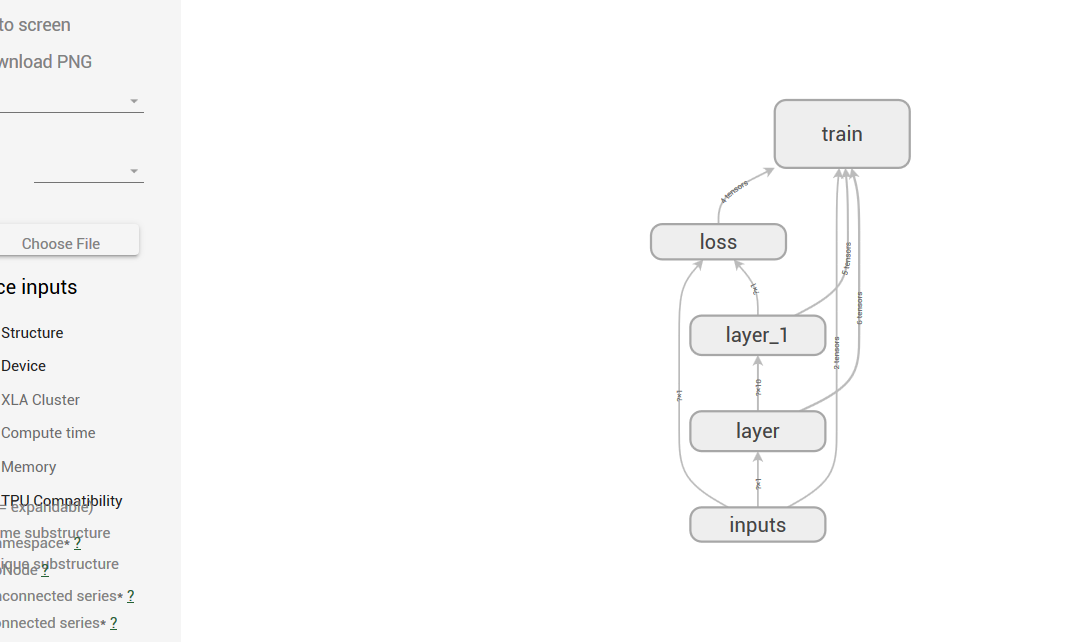
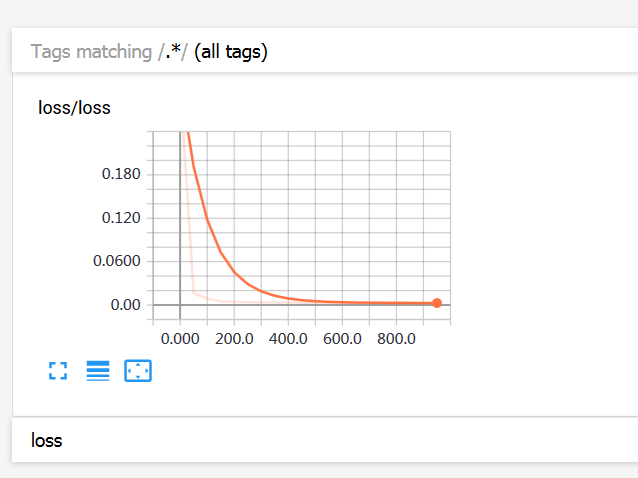
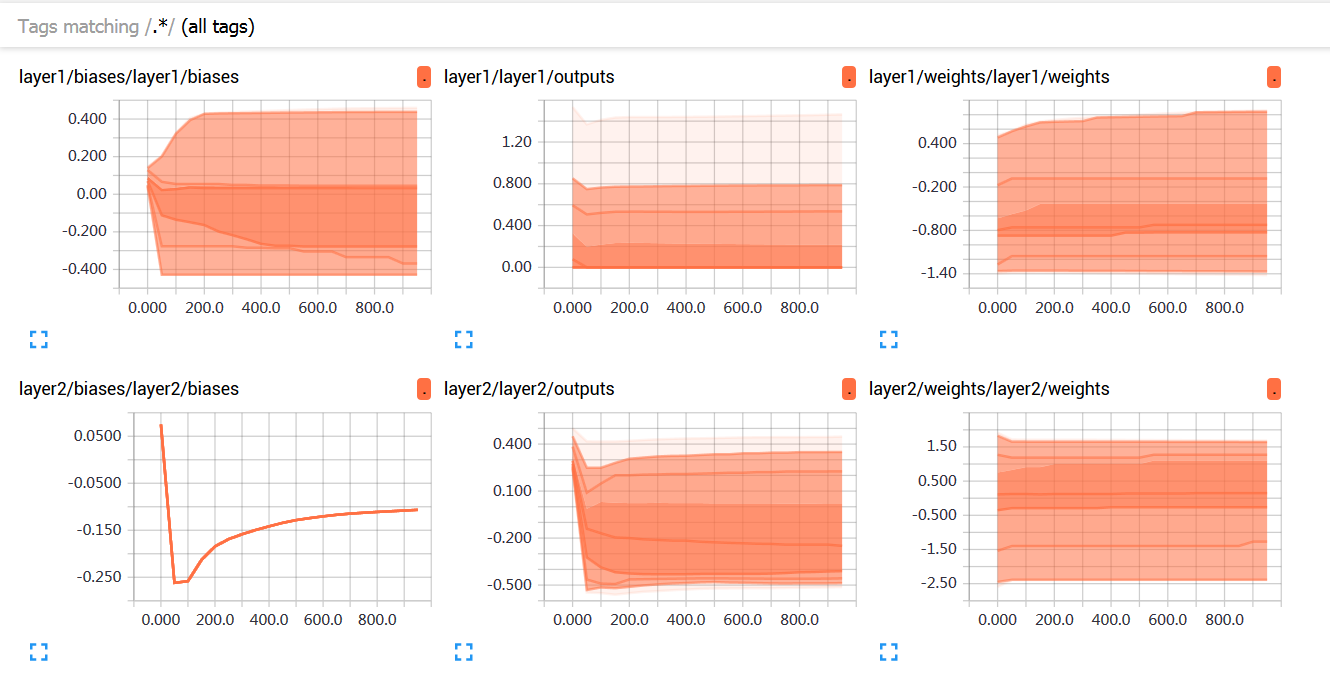
比如,从他人处获得一个Graph,想看看它的结构,怎么弄?
Google提供了一个工具,TensorBoard,它能以图表的方式分析你在训练过程中汇总的各种数据,其中包括Graph结构。
所以我们可以简单的写几行Pyhton,加载Graph,只在logdir里,输出Graph结构数据,并可以查看其图结构。
可参考:http://www.tensorfly.cn/tfdoc/how_tos/summaries_and_tensorboard.html
https://www.tensorflow.org/get_started/summaries_and_tensorboard
代码如下:
import tensorflow as tf

from tensorflow.python.platform import gfile

# 这是从二进制格式的pb文件加载模型

graph = tf.get_default_graph()

graphdef = graph.as_graph_def()

graphdef.ParseFromString(gfile.FastGFile("/data/TensorFlowAndroidMNIST/app/src/main/expert-graph.pb", "rb").read())

_ = tf.import_graph_def(graphdef, name="")
import tensorflow as tf

from tensorflow.python.platform import gfile

#这是从文件格式的meta文件加载模型

graph = tf.get_default_graph()

graphdef = graph.as_graph_def()

# graphdef.ParseFromString(gfile.FastGFile("/data/TensorFlowAndroidMNIST/app/src/main/expert-graph.pb", "rb").read())

# _ = tf.import_graph_def(graphdef, name="")

_ = tf.train.import_meta_graph("./InsightFace_iter_best_1950000.ckpt.meta")

summary_write = tf.summary.FileWriter("./" , graph)
然后再启动tensorboard:
tensorboard --logdir /data/TensorFlowAndroidMNIST/logdir --host 你的ip --port 你端口(默认6006)
一个打开pb文件的实例
import tensorflow as tf

from tensorflow.python.platform import gfile

graph = tf.get_default_graph()

graphdef = graph.as_graph_def()

graphdef.ParseFromString(gfile.FastGFile("./log/mtcnn.pb", "rb").read())

_ = tf.import_graph_def(graphdef, name="")

summary_write = tf.summary.FileWriter("./log" , graph)
TensorFlow基础笔记(9) Tensorboard可视化显示以及查看pb meta模型文件的方法的更多相关文章
- TensorFlow基础笔记(0) 参考资源学习文档
1 官方文档 https://www.tensorflow.org/api_docs/ 2 极客学院中文文档 http://www.tensorfly.cn/tfdoc/api_docs/python ...
- TensorFlow基础笔记(3) cifar10 分类学习
TensorFlow基础笔记(3) cifar10 分类学习 CIFAR-10 is a common benchmark in machine learning for image recognit ...
- 超简单tensorflow入门优化程序&&tensorboard可视化
程序1 任务描述: x = 3.0, y = 100.0, 运算公式 x×W+b = y,求 W和b的最优解. 使用tensorflow编程实现: #-*- coding: utf-8 -*-) im ...
- TensorFlow基础笔记(14) 网络模型的保存与恢复_mnist数据实例
http://blog.csdn.net/huachao1001/article/details/78502910 http://blog.csdn.net/u014432647/article/de ...
- 【转】从Shell脚本内部将所有标准输出及标准错误显示在屏幕并同时写入文件的方法
如果全部都要重定向的话每一条命令后面>>并不方便,可以这么做.在开头就声明 exec 1>>$log_file表示将脚本中所有的正确输出全部追加到$log_file,错误信息会 ...
- Tensorflow 搭建神经网络及tensorboard可视化
1. session对话控制 matrix1 = tf.constant([[3,3]]) matrix2 = tf.constant([[2],[2]]) product = tf.matmul(m ...
- TensorFlow基础笔记(5) VGGnet_test
参考 http://blog.csdn.net/jsond/article/details/72667829 资源: 1.相关的vgg模型下载网址 http://www.vlfeat.org/matc ...
- TensorFlow基础笔记(15) 编译TensorFlow.so,提供给C++平台调用
参考 http://blog.csdn.net/rockingdingo/article/details/75452711 https://www.cnblogs.com/hrlnw/p/700764 ...
- TensorFlow基础笔记(0) tensorflow的基本数据类型操作
import numpy as np import tensorflow as tf #build a graph print("build a graph") #生产变量tens ...
随机推荐
- lua——元表、元方法、继承
[元表] 元表中的键为事件(event),称值为元方法(metamethod). 通过函数getmetatable查询不论什么值的元表,通过函数setmetatable替换表的元表. setmetat ...
- t-sql的一些经验
1.存储过程的3种传回值: 1.以return传回整数 2.以output格式传回参数 3.recordset 2.字符串类型的变量需要初始化后再使用,不然永远是空 DECLARE @FieldsSq ...
- Firefox清空缓存的快捷键
有时候调试网页,需要清空缓存,常用的firefox清空缓存的快捷键: Shift+Ctrl+Delete
- 关于NavigationItem.rightBarButtonItem设置
转自:http://blog.csdn.net/zhuzhihai1988/article/details/7701998 第一种: UIImage *searchimage=[UIImage ima ...
- 按“块”的方式写dom以及代码注释
前言 首先这个文档中主要记述了自己在编写html代码时如何构建良好的dom结构的一些所思所想,在这一部分主要说明按“块”构建dom结构的思路.同时在这篇文档中也记述了自己对代码注释的理解,在这一部分主 ...
- 李洪强iOS开发之-sql数据库的使用
一,创建工程 二: 导入头文件 三:导入 四: 数据库增删改查 //因为是结构体类型,所以用assign //1.创建数据库(保存路径) @property(nonatomic,assign)sqli ...
- 解决老是提示找不到Mapper文件无法执行定义的方法问题!
尼玛,被mybatis的*Mapper.xml文件害惨了!整整两天都在围绕这个问题转圈! 先看问题长啥样吧!下面是通过逆向工程生成的Mapper.xml文件,包路径什么的都没有错! 但是每次调用Map ...
- js实现点击按钮实现上一张下一张相册滚动效果
/****判断图片是否构成滚动效果*/$(function(){ if($("#bar").find('img').size()*71<=$("#bar&qu ...
- SharePoint自动化系列——通过PowerShell创建SharePoint List Items
转载请注明出自天外归云的博客园:http://www.cnblogs.com/LanTianYou/ 代码如下(保存到本地ps1文件中,右键run with PowerShell即可): Add-PS ...
- FreeRTOS 事件标志组
以下转载自安富莱电子: http://forum.armfly.com/forum.php 为什么要使用事件标志事件标志组是实现多任务同步的有效机制之一.也许有不理解的初学者会问采用事件标志组多麻烦, ...