
Python——sklearn提供的自带的数据集
sklearn提供的自带的数据集
sklearn 的数据集有好多个种
- 自带的小数据集(packaged dataset):sklearn.datasets.load_<name>
- 可在线下载的数据集(Downloaded Dataset):sklearn.datasets.fetch_<name>
- 计算机生成的数据集(Generated Dataset):sklearn.datasets.make_<name>
- svmlight/libsvm格式的数据集:sklearn.datasets.load_svmlight_file(...)
- 从买了data.org在线下载获取的数据集:sklearn.datasets.fetch_mldata(...)
①自带的数据集
其中的自带的小的数据集为:sklearn.datasets.load_<name>
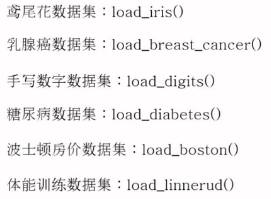
这些数据集都可以在官网上查到,以鸢尾花为例,可以在官网上找到demo,http://scikit-learn.org/stable/auto_examples/datasets/plot_iris_dataset.html

 from sklearn.datasets import load_iris

 #加载数据集

 iris=load_iris()

 iris.keys()  #dict_keys(['target', 'DESCR', 'data', 'target_names', 'feature_names'])

 #数据的条数和维数

 n_samples,n_features=iris.data.shape

 print("Number of sample:",n_samples)  #Number of sample: 150

 print("Number of feature",n_features)  #Number of feature 4

 #第一个样例

 print(iris.data[0])      #[ 5.1  3.5  1.4  0.2]

 print(iris.data.shape)    #(150, 4)

 print(iris.target.shape)  #(150,)

 print(iris.target)

 """

   [0 0 0 0 0 0 0 0 0 0 0 0 0 0 0 0 0 0 0 0 0 0 0 0 0 0 0 0 0 0 0 0 0 0 0 0 0

 0 0 0 0 0 0 0 0 0 0 0 0 1 1 1 1 1 1 1 1 1 1 1 1 1 1 1 1 1 1 1 1 1 1 1 1

 1 1 1 1 1 1 1 1 1 1 1 1 1 1 1 1 1 1 1 1 1 1 1 1 1 2 2 2 2 2 2 2 2 2 2 2

 2 2 2 2 2 2 2 2 2 2 2 2 2 2 2 2 2 2 2 2 2 2 2 2 2 2 2 2 2 2 2 2 2 2 2 2

 2]

 """

 import numpy as np

 print(iris.target_names)  #['setosa' 'versicolor' 'virginica']

 np.bincount(iris.target)  #[50 50 50]

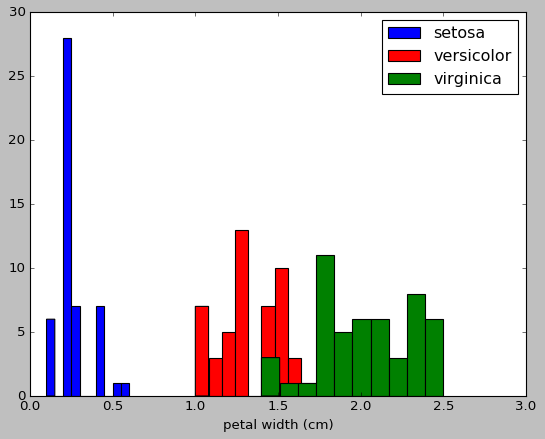
 import matplotlib.pyplot as plt

 #以第3个索引为划分依据,x_index的值可以为0,1,2,3

 x_index=3

 color=['blue','red','green']

 for label,color in zip(range(len(iris.target_names)),color):

     plt.hist(iris.data[iris.target==label,x_index],label=iris.target_names[label],color=color)

 plt.xlabel(iris.feature_names[x_index])

 plt.legend(loc="Upper right")

 plt.show()

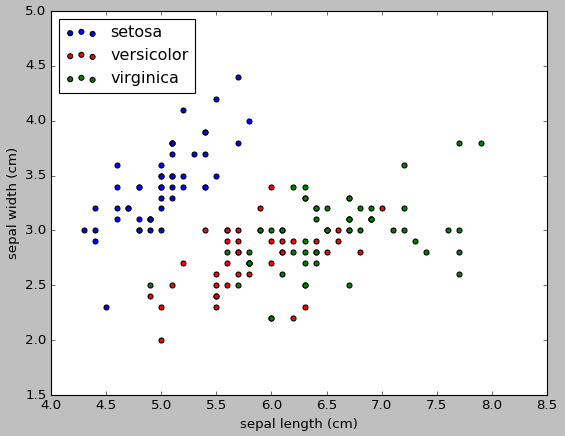
 #画散点图,第一维的数据作为x轴和第二维的数据作为y轴

 x_index=0

 y_index=1

 colors=['blue','red','green']

 for label,color in zip(range(len(iris.target_names)),colors):

     plt.scatter(iris.data[iris.target==label,x_index],

                 iris.data[iris.target==label,y_index],

                 label=iris.target_names[label],

                 c=color)

 plt.xlabel(iris.feature_names[x_index])

 plt.ylabel(iris.feature_names[y_index])

 plt.legend(loc='upper left')

 plt.show()
手写数字数据集load_digits():用于多分类任务的数据集
 from sklearn.datasets import load_digits

 digits=load_digits()

 print(digits.data.shape)

 import matplotlib.pyplot as plt

 plt.gray()

 plt.matshow(digits.images[0])

 plt.show()

 from sklearn.datasets import load_digits

 digits=load_digits()

 digits.keys()

 n_samples,n_features=digits.data.shape

 print((n_samples,n_features))

 print(digits.data.shape)

 print(digits.images.shape)

 import numpy as np

 print(np.all(digits.images.reshape((1797,64))==digits.data))

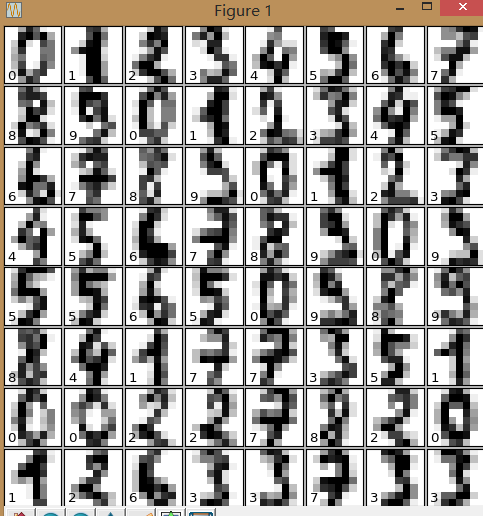
 fig=plt.figure(figsize=(6,6))

 fig.subplots_adjust(left=0,right=1,bottom=0,top=1,hspace=0.05,wspace=0.05)

 #绘制数字:每张图像8*8像素点

 for i in range(64):

     ax=fig.add_subplot(8,8,i+1,xticks=[],yticks=[])

     ax.imshow(digits.images[i],cmap=plt.cm.binary,interpolation='nearest')

     #用目标值标记图像

     ax.text(0,7,str(digits.target[i]))

 plt.show()

乳腺癌数据集load-barest-cancer():简单经典的用于二分类任务的数据集
糖尿病数据集:load-diabetes():经典的用于回归任务的数据集,值得注意的是,这10个特征中的每个特征都已经被处理成0均值,方差归一化的特征值
波士顿房价数据集:load-boston():经典的用于回归任务的数据集
体能训练数据集:load-linnerud():经典的用于多变量回归任务的数据集,其内部包含两个小数据集:Excise是对3个训练变量的20次观测(体重,腰围,脉搏),physiological是对3个生理学变量的20次观测(引体向上,仰卧起坐,立定跳远)
svmlight/libsvm的每一行样本的存放格式:
<label><feature-id>:<feature-value> <feature-id>:<feature-value> ....
这种格式比较适合用来存放稀疏数据,在sklearn中,用scipy sparse CSR矩阵来存放X,用numpy数组来存放Y
 from sklearn.datasets import load_svmlight_file

 x_train,y_train=load_svmlight_file("/path/to/train_dataset.txt","")#如果要加在多个数据的时候,可以用逗号隔开
②生成数据集
生成数据集:可以用来分类任务,可以用来回归任务,可以用来聚类任务,用于流形学习的,用于因子分解任务的
用于分类任务和聚类任务的:这些函数产生样本特征向量矩阵以及对应的类别标签集合
make_blobs:多类单标签数据集,为每个类分配一个或多个正太分布的点集
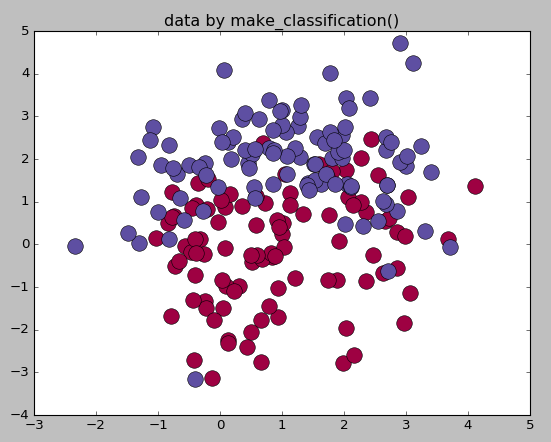
make_classification:多类单标签数据集,为每个类分配一个或多个正太分布的点集,提供了为数据添加噪声的方式,包括维度相关性,无效特征以及冗余特征等
make_gaussian-quantiles:将一个单高斯分布的点集划分为两个数量均等的点集,作为两类
make_hastie-10-2:产生一个相似的二元分类数据集,有10个维度
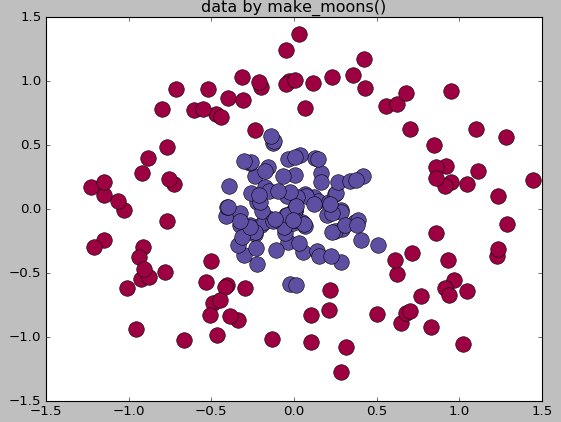
make_circle和make_moom产生二维二元分类数据集来测试某些算法的性能,可以为数据集添加噪声,可以为二元分类器产生一些球形判决界面的数据
 #生成多类单标签数据集

 import numpy as np

 import matplotlib.pyplot as plt

 from sklearn.datasets.samples_generator import make_blobs

 center=[[1,1],[-1,-1],[1,-1]]

 cluster_std=0.3

 X,labels=make_blobs(n_samples=200,centers=center,n_features=2,

                     cluster_std=cluster_std,random_state=0)

 print('X.shape',X.shape)

 print("labels",set(labels))

 unique_lables=set(labels)

 colors=plt.cm.Spectral(np.linspace(0,1,len(unique_lables)))

 for k,col in zip(unique_lables,colors):

     x_k=X[labels==k]

     plt.plot(x_k[:,0],x_k[:,1],'o',markerfacecolor=col,markeredgecolor="k",

              markersize=14)

 plt.title('data by make_blob()')

 plt.show()

 #生成用于分类的数据集

 from sklearn.datasets.samples_generator import make_classification

 X,labels=make_classification(n_samples=200,n_features=2,n_redundant=0,n_informative=2,

                              random_state=1,n_clusters_per_class=2)

 rng=np.random.RandomState(2)

 X+=2*rng.uniform(size=X.shape)

 unique_lables=set(labels)

 colors=plt.cm.Spectral(np.linspace(0,1,len(unique_lables)))

 for k,col in zip(unique_lables,colors):

     x_k=X[labels==k]

     plt.plot(x_k[:,0],x_k[:,1],'o',markerfacecolor=col,markeredgecolor="k",

              markersize=14)

 plt.title('data by make_classification()')

 plt.show()

 #生成球形判决界面的数据

 from sklearn.datasets.samples_generator import make_circles

 X,labels=make_circles(n_samples=200,noise=0.2,factor=0.2,random_state=1)

 print("X.shape:",X.shape)

 print("labels:",set(labels))

 unique_lables=set(labels)

 colors=plt.cm.Spectral(np.linspace(0,1,len(unique_lables)))

 for k,col in zip(unique_lables,colors):

     x_k=X[labels==k]

     plt.plot(x_k[:,0],x_k[:,1],'o',markerfacecolor=col,markeredgecolor="k",

              markersize=14)

 plt.title('data by make_moons()')

 plt.show()

Python——sklearn提供的自带的数据集的更多相关文章
- sklearn提供的自带的数据集
sklearn 的数据集有好多个种 自带的小数据集(packaged dataset):sklearn.datasets.load_<name> 可在线下载的数据集(Downloaded ...
- sklearn提供的自带数据集
sklearn 的数据集有好多个种 自带的小数据集(packaged dataset):sklearn.datasets.load_<name> 可在线下载的数据集(Downloaded ...
- 『Sklearn』框架自带数据集接口
自带数据集类型如下: # 自带小型数据集# sklearn.datasets.load_<name># 在线下载数据集# sklearn.datasets.fetch_<name&g ...
- Python: sklearn库——数据预处理
Python: sklearn库 —— 数据预处理 数据集转换之预处理数据: 将输入的数据转化成机器学习算法可以使用的数据.包含特征提取和标准化. 原因:数据集的标准化(服从均值为 ...
- 用python+sklearn(机器学习)实现天气预报数据 模型和使用
用python+sklearn机器学习实现天气预报 模型和使用 项目地址 系列教程 0.前言 1.建立模型 a.准备 引入所需要的头文件 选择模型 选择评估方法 获取数据集 b.建立模型 c.获取模型 ...
- 用python+sklearn(机器学习)实现天气预报数据 数据
用python+sklearn机器学习实现天气预报 数据 项目地址 系列教程 勘误表 0.前言 1.爬虫 a.确认要被爬取的网页网址 b.爬虫部分 c.网页内容匹配取出部分 d.写入csv文件格式化 ...
- 用python+sklearn(机器学习)实现天气预报 准备
用python+sklearn机器学习实现天气预报 准备 项目地址 系列教程 0.流程介绍 1. 环境搭建 a.python b.涉及到的机器学习相关库 sklearn panda seaborn j ...
- python+sklearn+kaggle机器学习
python+sklearn+kaggle机器学习 系列教程 0.kaggle 1. 初级线性回归模型机器学习过程 a. 提取数据 b.数据预处理 c.训练模型 d.根据数据预测 e.验证 今天是10 ...
- C#调用Oracle带输出数据集的存储过程
1.创建一个带输出数据集的Oracle存储过程 create or replace procedure PRO_test(in_top in number,cur_out out sys_refcur ...
随机推荐
- Spring的启动流程
spring的启动是建筑在servlet容器之上的,所有web工程的初始位置就是web.xml,它配置了servlet的上下文(context)和监听器(Listener),下面就来看看web.xml ...
- jQuery EasyUI简介
jQuery EasyUI 是一个基于 jQuery 的框架,集成了各种用户界面插件. jQuery EasyUI是一组基于jQuery的UI插件集合体,而jQuery EasyUI的目标就是帮助we ...
- Django安装和介绍
在CMD和pycharm的安装方法. 先说CMD的安装方法 1,使用pip3 install django 2,进入c:python\Scripts 3,django-admin.exe startp ...
- 关于JPype报FileNotFoundError: [Errno 2] No such file or directory: '/usr/lib/jvm'错误的解决
部署到线上的项目正常运行一年,今天早上突然报FileNotFoundError: [Errno 2] No such file or directory: '/usr/lib/jvm'错误. JPyp ...
- sql查询数据结果发送到邮箱
#!/bin/bash user=root password=xx dbname=xx DATE=`date +%F` #注意:此处mysql要用全路劲,否则计划任务会执行失败 /mydata/mys ...
- JavaScript 对象中this的指向问题
this运行在哪个对象下,就指向哪个对象.
- echarts自定义折线图横坐标时间间隔踩坑总结
折线图需求:横坐标为时间,要求按一定间隔展示,鼠标移至折线上间隔时间内的数据也可展示 其实很简单的一个配置就可搞定,但在不熟悉echarts配置的情况下,就很懵逼 xAxis: { boundaryG ...
- confluence配置搭建
1.环境准备:需要安装jdk.需要mysql5.7数据库,创建数据库confluence并创建用户和密码 CREATE DATABASE `confluence` DEFAULT CHARACTER ...
- CF311B Cats Transport(斜率优化)
题目描述 Zxr960115 是一个大农场主.他养了m只可爱的猫子,雇佣了p个铲屎官.这里有一条又直又长的道路穿过了农场,有n个山丘坐落在道路周围,编号自左往右从1到n.山丘i与山丘i-1的距离是Di ...
- 享元模式(Flyweight)---结构型
1 基础知识 定义:提供了减少对象数量从而改善应用所需的对象结构的方式.特征:运用共享技术有效支持大量细粒度的对象. 本质:分离与共享. 使用场景: (1)如果一个应用程序使用了大量的细粒度对象,可以 ...