
map、filter、reduce、lambda
一、map、filter、reduce
map(fuction , iterable) 映射 对可迭代对象中的每一项,使用函数去改变
filter(function, iterable) 过滤 可迭代对象中的每一项,放到函数中去计算,如何为真,则留下,构造成一个迭代器,为假则去除
reduce(fuction,iterable) 减少 把元素中的左边的合并到右边去。
1.1 map 映射
官方定义:Return an iterator that applies function to every item of iterable, yielding the results.
返回一个迭代器,它对每个迭代项应用函数,得到结果。
why:不使用for循环,就能将序列中的数据m--映射到给定的处理函数中。快速的对一个序列进行各种操作
numbers = [1, 3, 5, 7, 9]

# 改写成2,4,6,8,10

#普通做法

new_num = []

for x in numbers:

    new_num.append(x+1)

print(new_num)

# map版本

def addone(x):

    return x+1

print(list(map(addone, numbers)))

# 其他应用 改写字符串

str_list = ['lilei', 'hmm', 'de8ug']

def change(s: str):

    return s.upper()

print(list(map(change, str_list)))
1.2 filter 过滤、筛选
官方: Construct an iterator from those elements of iterable for which function returns true.
iterable may be either a sequence, a container which supports iteration, or an iterator.
If function is None, the identity function is assumed, that is, all elements of iterable that are false are removed.
从可迭代的元素中构造一个迭代器,函数返回true。iterable可以是一个序列,一个支持迭代的容器,
或者一个迭代器。如果函数为None,则假定标识函数为false,即为 false的所有元素都被删除。
why:不用for循环, 就能将序列中的数据一一映射到给定 的处理函数, 函数中添加了真假判断,
True则返回 相应数据,最终得到筛选后的序列。
'''

    查找大于30 小于50的数字列表

'''

my_list = [24,23,75,12,43,9,42,28,37]

# 普通版本

new_list = []

for i in my_list:

    if 30 < i < 50:

        new_list.append(i)

print(new_list)

# filter版本

def choose(x):

    # if 30 < i < 50:

    #     return True

    return 30 < x < 50  # < 操作的结果,已经是bool 类型了

print(list(filter(choose, my_list)))

# 字符串操作

import re

str_list = ['lilei', 'hmm', 'de8ug', 'debug1', 'de8ug2']

def lh(s: str):

    return re.search('de8ug', s)

print(list(filter(lh, str_list)))
1.3 reduce 减少,合并
官方:Apply function of two arguments cumulatively to the items of sequence, from left to right,
so as to reduce the sequence to a single value.
将两个参数的函数累积到序列的项上,从左到右,以便将序列减少到单个值。
why: 为了快速的进行累加,连乘的计算 使代码更简洁
需要注意:py3中吧reduce放到了fuctiontools这个模块下了
from functools import reduce

numbers = [1, 3, 5, 7, 9]

# 普通版本 累加

count = 0

for i in numbers:

    count += i

print(count)

# reduce版 累加

def add(x, y):

    return x+y

print(reduce(add, numbers))

# 普通版本 连乘

count = 1

for i in numbers:

    count *= i

print(count)

# reduce版本 连乘

def mul(x, y):

    return x*y

print(reduce(mul, numbers))
二、 lambda表达式
2.1 基本知识概览
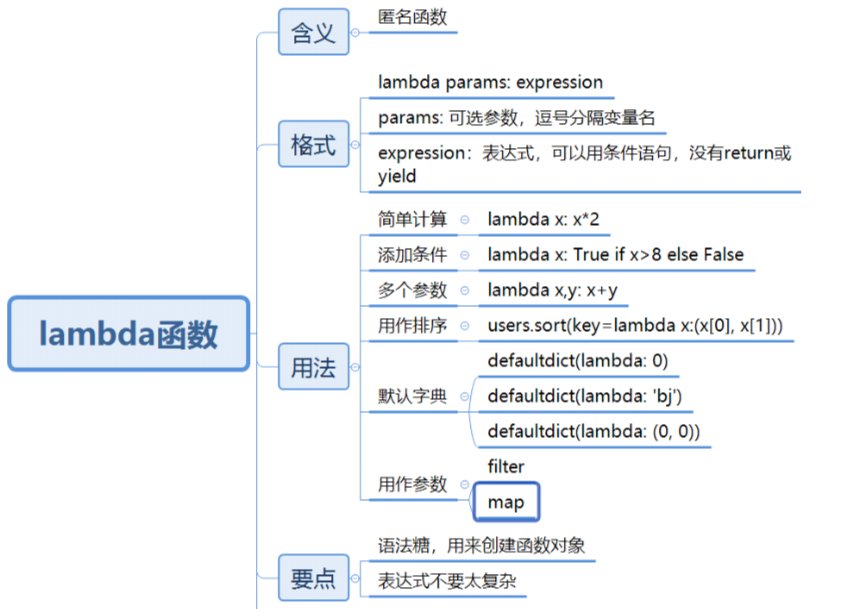
2.2 代码部分"1. 单参数 和 判断"
f = lambda x: x*2

f(2) #

f = lambda x: True if x>8 else False

print(f(9)) # True

"2. 多参数"

x = lambda x,y: x*y+2

print(x(2,3)) #

"3. 排序"

users = [('de8ug', 18, 1), ('lilei', 20, 2), ('hmm', 17, 3), ('zhangsan', 30, 4)]

users.sort(key=lambda x: x[1]) # x代表字典,每一个数组,要对谁排序,直接加上该位置
users.sort(key=lambda x:(x[1],x[2])) . # 双排序
print(users)

"4. 字典的默认值"

from collections import defaultdict

# 生成默认的数值

d = defaultdict(lambda :0)

d[1]

print(d) # defaultdict(<function <lambda> at 0x101ab9950>, {1: 0})

# 生成默认的字符串

d = defaultdict(lambda :'abc')

d[1]

print(d) # defaultdict(<function <lambda> at 0x101ab9950>, {1: 'abc'})

# 生成二元数组,给地理信息使用

point = defaultdict(lambda :(2,3))

point['p1']

print(point) # defaultdict(<function <lambda> at 0x105a89950>, {'p1': (2, 3)})

"5. 在map,reduce,filter中使用,可以减少函数的定义"

# 代码省略,看上面部分的代码
map、filter、reduce、lambda的更多相关文章
- ES6 数组遍历方法的实战用法总结(forEach,every,some,map,filter,reduce,reduceRight,indexOf,lastIndexOf)
目录 forEach every some map filter reduce && reduceRight indexOf lastIndexOf 前言 ES6原生语法中提供了非常多 ...
- python的map,filter,reduce学习
python2,python3中map,filter,reduce区别: 1,在python2 中,map,filter,reduce函数是直接输出结果. 2,在python3中做了些修改,输出前需要 ...
- Python 函数之lambda、map、filter和reduce
1.lambda函数 lambda()是Python里的匿名函数,其语法如下: lambda [arg1[, arg2, ... argN]]: expression 学习条件运算时,对于简单的 if ...
- python迭代和解析(3):range、map、zip、filter和reduce函数
解析.迭代和生成系列文章:https://www.cnblogs.com/f-ck-need-u/p/9832640.html range range()是一个内置函数,它返回一个数字序列,功能和Li ...
- python高阶函数,map,filter,reduce,ord,以及lambda表达式
为什么我突然扯出这么几个函数,是因为我今天在看流畅的python这本书的时候,里面有一部分内容看的有点懵逼. >>> symbols = '$¢£¥€¤' >>> ...
- 内置函数--map,filter,reduce
一.map class map(object): """ map(func, *iterables) --> map object Make an iterator ...
- python的 map,filter, reduce, enumerate
一, map #基本的map运用都可以用解析去替代,复杂的仍然需要定义函数,利用map去做 map(函数, 序列) 将序列的各项经过函数处理, 然后返回到一个新列表中. #itertools. ...
- Map、Filter和Reduce函数(Python)
Map map(function_to_apply, list_of_inputs) 设有以下代码: >>> items = [1, 2, 3, 4, 5] >>> ...
- 160909、Filter多方式拦截、禁用IE图片缓存、Filter设置字符编码
dispatcher多方式拦截 我们来看一个例子 我们定义一个index.jsp,里面有一个链接跳转到dispatcher.jsp页面 <body> <a href="di ...
- Servlet生命周期 、Filter生命周期、Listering(监听器)总结
Servlet生命周期简述 (1)加载和实例化 当Servlet容器启动或客户端发送一个请求时,Servlet容器会查找内存中是否存在该Servlet实例,若存在,则直接读取该实例响应请求:如果不存在 ...
随机推荐
- Leetcode 357
没用过Leetcode刷题,只能按照自己的想法随便写写了 思路:1.第一位数有9种(除了0)可能,第二位数有9种(除了第一位)可能,第三位数有8种(除了前两位)可能,以此类推...9*8*7*...( ...
- logstash安装
1.下载并安装公共签名密钥 rpm --import https://artifacts.elastic.co/GPG-KEY-elasticsearch 2.创建镜像源文件:/etc/yum.rep ...
- ruby中的可调用对象--proc和lamdba
ruby中将块转变成对象的三种方法 ruby中的大部分东西都是对象,但是块不是.那么,如果你想存下来一个块,方便以后使用,你就需要一个对象.ruby中有三种方法,把块转换成可以利用的对象. Proc. ...
- linux命令——chmod/chown
改变文件所有权chown 例如 sudo chown username myfile 1 myfile文件的所有权变为username. chown -R username /files/work 1 ...
- Java:出现错误提示(java.sql.SQLException:Value '0000-00-00' can not be represented as java.sql.Date)
Java:出现错误提示(java.sql.SQLException:Value '0000-00-00' can not be represented as java.sql.Date) 原因分析: ...
- SQL Server 对XML数据类型的SQL语句总结
--创建XMLTable , ) primary key, XMLCol xml); go ------------------------------------------------------ ...
- 如何用纯 CSS 创作一个跳动的字母 i
效果预览 在线演示 按下右侧的"点击预览"按钮可以在当前页面预览,点击链接可以全屏预览. https://codepen.io/comehope/pen/pZbrpJ 可交互视频 ...
- 20145324 Java实验一
北京电子科技学院(BESTI) 实 验 报 告 课程:JAVA 班级:1453 姓名:王嘉澜 学号:20145324 成绩: 指导教师:娄嘉鹏 实验日期:2016.4.8 实验密级: 预习程度: 实验 ...
- 20135302魏静静Linux内核分析第二周学习总结
操作系统是如何工作的 1. 小结:计算机是怎样工作的 三个法宝 存储程序计算机.函数调用堆栈.中断机制 两把宝剑 中断上下文.进程上下文的切换 2. 堆栈 堆栈是C语言程序运行时必须的一个记录调用路径 ...
- vSphere SDK for Java - 从模板部署虚拟机并配置IP地址
vSphere for Java类库:vijava 虚拟机配置类 package com.vmware.vcenter_event.VirtualMachine; import com.vmwa ...