
POJ 3463 Sightseeing 题解
题目
Tour operator Your Personal Holiday organises guided bus trips across the Benelux. Every day the bus moves from one city S to another city F. On this way, the tourists in the bus can see the sights alongside the route travelled. Moreover, the bus makes a number of stops (zero or more) at some beautiful cities, where the tourists get out to see the local sights.
Different groups of tourists may have different preferences for the sights they want to see, and thus for the route to be taken from S to F. Therefore, Your Personal Holiday wants to offer its clients a choice from many different routes. As hotels have been booked in advance, the starting city S and the final city F, though, are fixed. Two routes from S to F are considered different if there is at least one road from a city A to a city B which is part of one route, but not of the other route.
There is a restriction on the routes that the tourists may choose from. To leave enough time for the sightseeing at the stops (and to avoid using too much fuel), the bus has to take a short route from S to F. It has to be either a route with minimal distance, or a route which is one distance unit longer than the minimal distance. Indeed, by allowing routes that are one distance unit longer, the tourists may have more choice than by restricting them to exactly the minimal routes. This enhances the impression of a personal holiday.
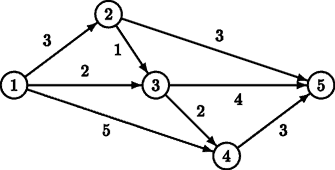
For example, for the above road map, there are two minimal routes from S = 1 to F = 5: 1 → 2 → 5 and 1 → 3 → 5, both of length 6. There is one route that is one distance unit longer: 1 → 3 → 4 → 5, of length 7.
Now, given a (partial) road map of the Benelux and two cities S and F, tour operator Your Personal Holiday likes to know how many different routes it can offer to its clients, under the above restriction on the route length.
输入格式
The first line of the input file contains a single number: the number of test cases to follow. Each test case has the following format:
One line with two integers N and M, separated by a single space, with \(2 ≤ N ≤ 1,000\) and \(1 ≤ M ≤ 10, 000\): the number of cities and the number of roads in the road map.
M lines, each with three integers A, B and L, separated by single spaces, with \(1 ≤ A, B ≤ N, A ≠ B\) and \(1 ≤ L ≤ 1,000\), describing a road from city \(A\) to city \(B\) with length \(L\).
The roads are unidirectional. Hence, if there is a road from \(A\) to \(B\), then there is not necessarily also a road from \(B\) to \(A\). There may be different roads from a city A to a city B.
One line with two integers \(S\) and \(F\), separated by a single space, with \(1 ≤ S, F ≤ N\) and \(S ≠ F\): the starting city and the final city of the route.
There will be at least one route from \(S\) to \(F\).
输出格式
For every test case in the input file, the output should contain a single number, on a single line: the number of routes of minimal length or one distance unit longer. Test cases are such, that this number is at most 109 = 1,000,000,000.
输入样例
2

5 8

1 2 3

1 3 2

1 4 5

2 3 1

2 5 3

3 4 2

3 5 4

4 5 3

1 5

5 6

2 3 1

3 2 1

3 1 10

4 5 2

5 2 7

5 2 7

4 1
输出样例
3

2
代码
实际上就是最短路, 但是增加了一个次长路, 也很好解决
在Dijkstra更新时, 每次构建一个新路径, 做一下判断, 不仅更新最短路, 还要更新次短路
记录源点到某点的最短路和次短路
如果新路径小于最短路, 那么新路径变成最短路, 原来的最短路变成次短路;
如果新路径等于最短路, 那么最短路方法数+1
如果新路径大于最短路小于次短路, 更新次短路
如果新路径等于次短路, 那么次短路方法数+1
代码
#include <cstdio>

#include <cstring>

using namespace std;

const int INF = 0x3f3f3f3f, VM = 1010, EM = 10010;

struct Edge { int to, next, w; } edges[EM << 1];

int dis[VM][2], head[VM], num[VM][2], n, m, cnt;

bool vis[VM][2];

void add(int u, int v, int w) { edges[++cnt] = (Edge){v, head[u], w}, head[u] = cnt; }

void Dijkstra(int s, int e) {

    memset(vis, false, sizeof(vis));

    memset(num, 0, sizeof(num));

    for (int i = 1; i <= n; i++) dis[i][0] = INF, dis[i][1] = INF;

    dis[s][0] = 0, num[s][0] = 1;

    int p, flag;

    for (int i = 1; i <= 2 * n - 1; i++) {

        int minn = INF;

        for (int j = 1; j <= n; j++) {

            if (!vis[j][0] && minn > dis[j][0]) {

                flag = 0;

                minn = dis[p = j][0];

            } else if (!vis[j][1] && minn > dis[j][1]) {

                flag = 1;

                minn = dis[p = j][1];

            }

        }

        if (minn == INF) break;

        vis[p][flag] = true;

        for (int j = head[p]; j; j = edges[j].next) {

            int v = edges[j].to;

            if (dis[v][0] > minn + edges[j].w) {

                dis[v][1] = dis[v][0];

                num[v][1] = num[v][0];

                dis[v][0] = minn + edges[j].w;

                num[v][0] = num[p][flag];

            } else if (dis[v][0] == minn + edges[j].w)

                num[v][0] += num[p][flag];

            else if (dis[v][1] > minn + edges[j].w) {

                dis[v][1] = minn + edges[j].w;

                num[v][1] = num[p][flag];

            } else if (dis[v][1] == minn + edges[j].w)

                num[v][1] += num[p][flag];

        }

    }

    if (dis[e][1] == dis[e][0] + 1) num[e][0] += num[e][1];

    printf("%d\n", num[e][0]);

}

int main() {

    int T;

    scanf("%d", &T);

    while (T--) {

        cnt = 0;

        memset(head, -1, sizeof(head));

        scanf("%d%d", &n, &m);

        int u, v, w;

        while (m--) {

            scanf("%d%d%d", &u, &v, &w);

            add(u, v, w);

        }

        int s, e;

        scanf("%d%d", &s, &e);

        Dijkstra(s, e);

    }

    return 0;

}
POJ 3463 Sightseeing 题解的更多相关文章
- poj 3463 Sightseeing( 最短路与次短路)
http://poj.org/problem?id=3463 Sightseeing Time Limit: 2000MS Memory Limit: 65536K Total Submissio ...
- POJ - 3463 Sightseeing 最短路计数+次短路计数
F - Sightseeing 传送门: POJ - 3463 分析 一句话题意:给你一个有向图,可能有重边,让你求从s到t最短路的条数,如果次短路的长度比最短路的长度多1,那么在加上次短路的条数. ...
- poj 3463 Sightseeing——次短路计数
题目:http://poj.org/problem?id=3463 当然要给一个点记最短路和次短路的长度和方案. 但往优先队列里放的结构体和vis竟然也要区分0/1,就像把一个点拆成两个点了一样. 不 ...
- POJ 3463 Sightseeing (次短路经数)
Sightseeing Time Limit: 2000MS Memory Limit: 65536K Total Submissions:10005 Accepted: 3523 Descr ...
- POJ 3463 Sightseeing 【最短路与次短路】
题目 Tour operator Your Personal Holiday organises guided bus trips across the Benelux. Every day the ...
- poj 3463 Sightseeing(次短路+条数统计)
/* 对dij的再一次理解 每个点依旧永久标记 只不过这里多搞一维 0 1 表示最短路还是次短路 然后更新次数相当于原来的两倍 更新的时候搞一下就好了 */ #include<iostream& ...
- POJ 3463 Sightseeing
最短路+次短路(Dijkstra+priority_queue) 题意是要求你找出最短路的条数+与最短路仅仅差1的次短路的条数. 開始仅仅会算最短路的条数,和次短路的长度.真是给次短路条数跪了.ORZ ...
- POJ 3463 Sightseeing (次短路)
题意:求两点之间最短路的数目加上比最短路长度大1的路径数目 分析:可以转化为求最短路和次短路的问题,如果次短路比最短路大1,那么结果就是最短路数目加上次短路数目,否则就不加. 求解次短路的过程也是基于 ...
- POJ 1637 Sightseeing tour(最大流)
POJ 1637 Sightseeing tour 题目链接 题意:给一些有向边一些无向边,问能否把无向边定向之后确定一个欧拉回路 思路:这题的模型很的巧妙,转一个http://blog.csdn.n ...
随机推荐
- Git Gui工具从远程克隆代码总是提示路径已经存在。问题完美解决!
最近使用Git Gui工具从远程克隆代码总是提示路径已经存在,提示如下图, 原因是使用Git Guii克隆代码时的路径不能是选择一个已经建好的目录(D盘的project下的test文件夹是我提前建好的 ...
- 为什么需要云IDE?
一.云 IDE?是新概念吗? 不不不,早在 2010 年就有成熟的产品了:Cloud9 IDE 时至如今,云 IDE 已经相当常见了,比如: Cloud9:亚马逊为其云计算服务提供的 IDE Ecli ...
- 【asp.net core 系列】6 实战之 一个项目的完整结构
0. 前言 在<asp.net core 系列>之前的几篇文章中,我们简单了解了路由.控制器以及视图的关系以及静态资源的引入,让我们对于asp.net core mvc项目有了基本的认识. ...
- Python快速入门文档
前言 此文本质为本人学习Python过程中的笔记,部分地方叙述表达可能不够清晰,欢迎留言. (本文适合有一定程序语言基础的读者阅读(最好是c语言)) 一.基本语法 1.框架: (1)以缩进表示层次所属 ...
- Spring源码之自动装配
我们使用Spring开发过程中经常会用到Autowired注解注入依赖的bean,这部分也是面试的热点问题之一.今天咱们一起来深入研究下自动注入的背后实现原理.首先上一个例子,如下所示: @RestC ...
- Mybatis反射修改SQL值
Mybatis反射修改SQL值 某一些情况下我们需要动态的改变Mybtis的执行的sql语句,有两种方法:1)使用拦截器,2)使用反射,拦截器的比较简单点,这里使用反射实现一次,有一点小坑,记录一下: ...
- Spring WebFlux 学习笔记 - (一) 前传:学习Java 8 Stream Api (2) - Stream的中间操作
Stream API Java8中有两大最为重要的改变:第一个是 Lambda 表达式:另外一个则是 Stream API(java.util.stream.*). Stream 是 Java8 中处 ...
- Edge浏览器现已支持Tampermonkey(油猴)
Tampermonkey,Greasemonkey,这种扩展可以让我们的浏览器自动运行我们自己定义的脚本,然后就出现了相关网站(比如https://greasyfork.org/zh-CN)让大家在上 ...
- 使用 Kafka + Spark Streaming + Cassandra 构建数据实时处理引擎
Apache Kafka 是一个可扩展,高性能,低延迟的平台,允许我们像消息系统一样读取和写入数据.我们可以很容易地在 Java 中使用 Kafka. Spark Streaming 是 Apache ...
- python批量发邮件
如果有一天,老板过来给你一个很大的邮箱列表,要你给每个人发邮件,你该如何去做,最简单的就是写一个 python 程序 # coding:utf-8import smtplibfrom email.mi ...