
[swarthmore cs75] Compiler 1 – Adder
课程回顾
Swarthmore学院16年开的编译系统课,总共10次大作业。本随笔记录了相关的课堂笔记以及第3次大作业。
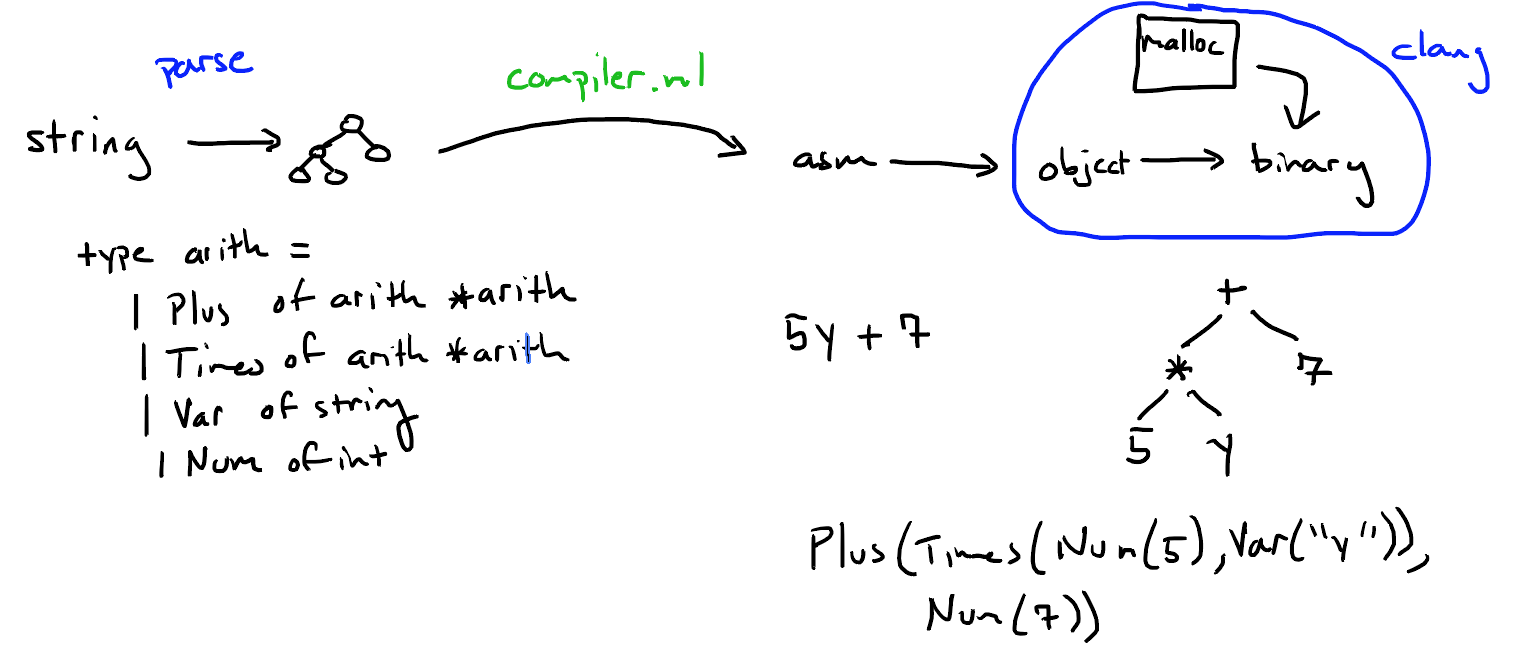
- 编译的过程:首先解析(parse)源代码,然后成抽象语法树(AST),再生成汇编代码(asm),最后用asm生成的目标文件(object)和其他库文件链接成一个可执行的二进制文件(binary)。其中从抽象语法树到生成汇编代码这个过程(complier.ml)工作量最大。
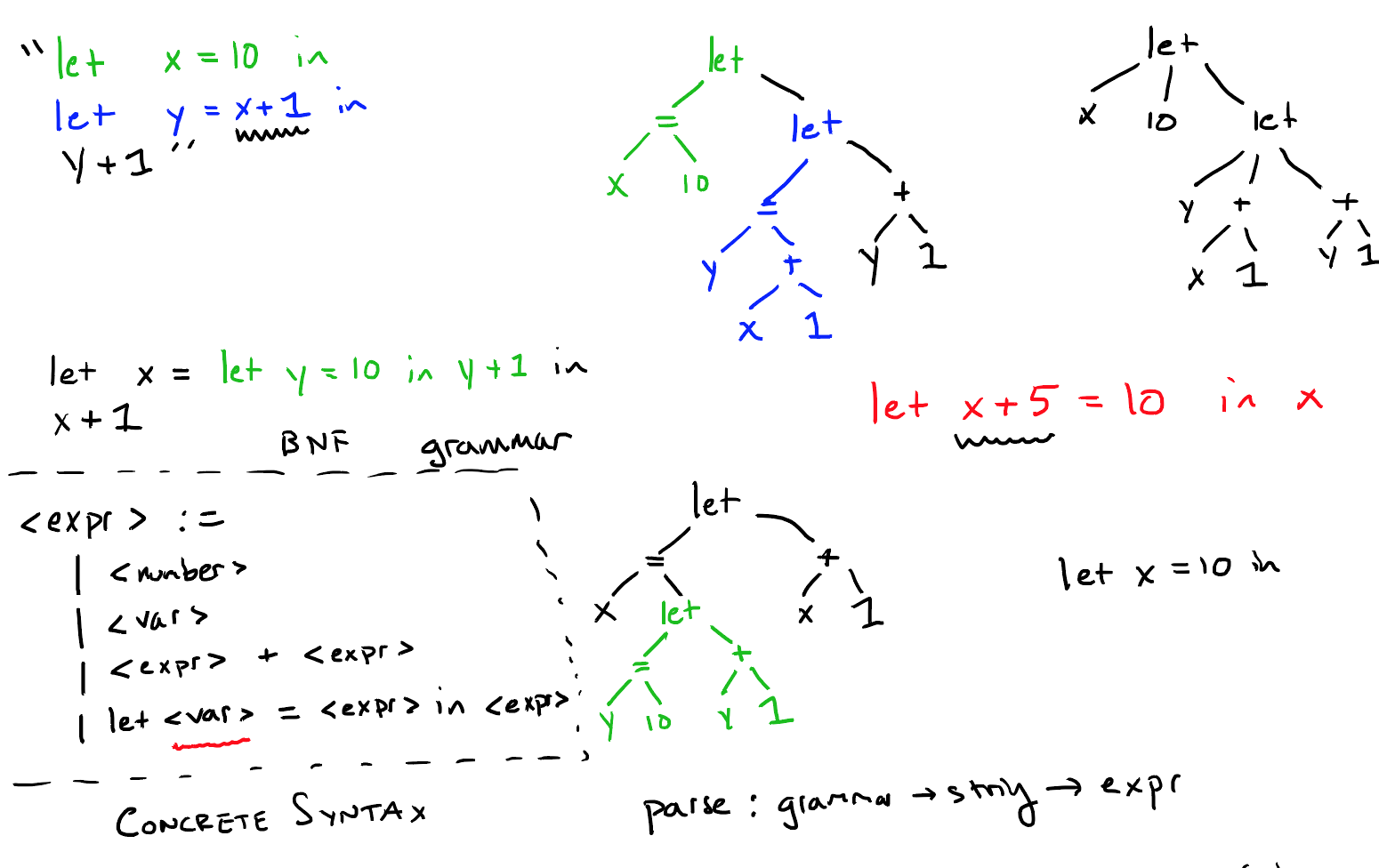
- 具体语法树(Concrete Syntax Tree):programmer写的就是具体语法,下图展示了某具体语法形象的表示。
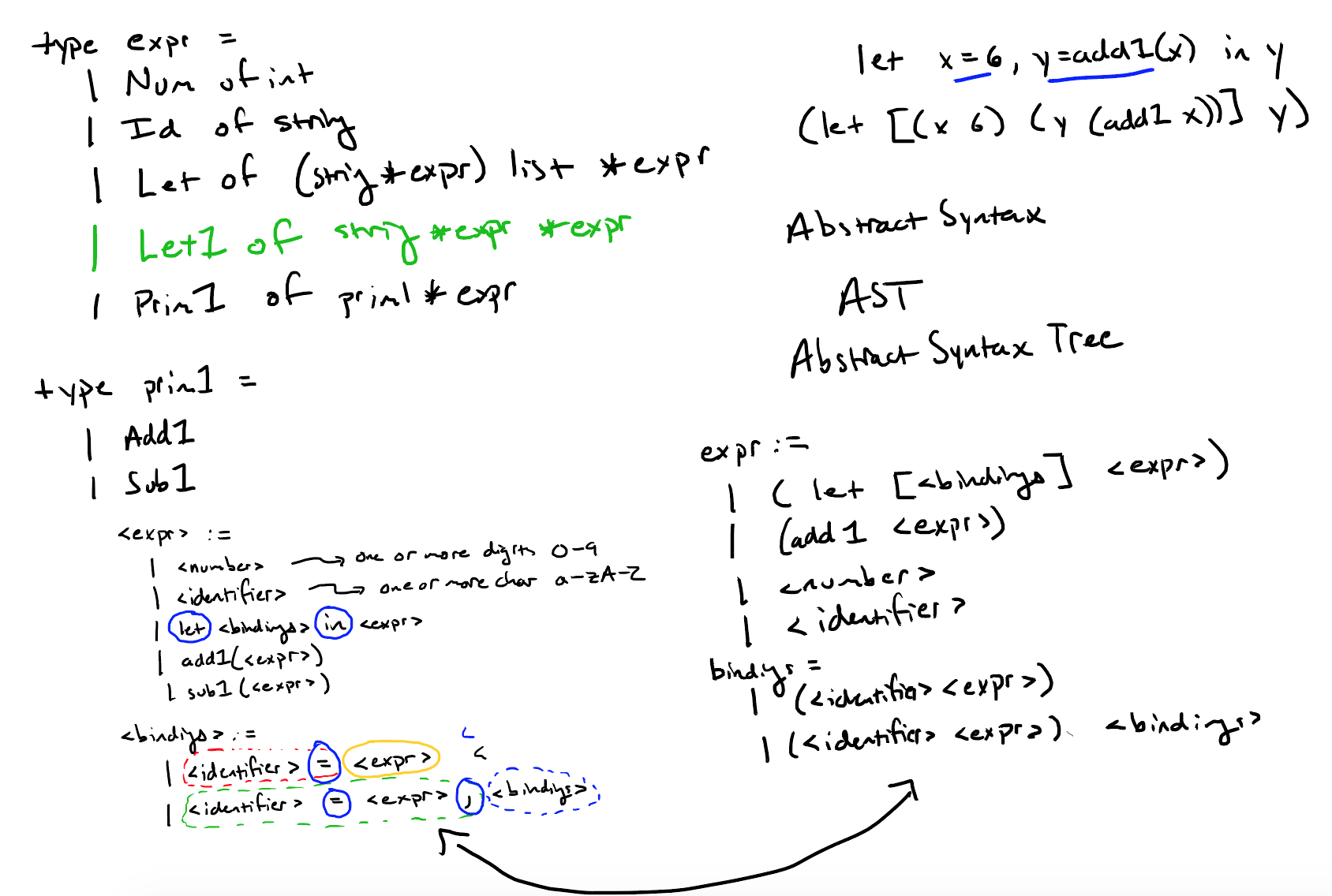
- 抽象语法树(Abstract Syntax Tree):一段具体语法,应该在内存中用何种数据结构来表示。所以根据具体语法的定义,有了抽象语法的概念。比如:let x=6, y=add1(x) in y; 在内存中可以表示为 Let([(x, 6), (Prim1(add1, Id("x")))], Id("y"))
- 汇编代码生成(Add1、Sub1):
- Add1:需要将操作数mov到eax寄存器,然后把eax加1即可,这里操作数可能是一个表达式的计算结果,所以需要递归求值。
- Sub1:同理

- 汇编代码生成(Let、Id):
- Id:检查当前env是否绑定了某变量的地址,如果绑定了,把操作数(esp[地址偏移量])移动到eax寄存器,否则抛出错误。
- Let:为了简化问题,假设let中的binding list只有一个元素,比如要计算:let ex in eb;首先要对ex=(x, value)中的value进行递归求值(参数使用env和si);然后为x绑定一个新地:-4 * si,添加到new_env中,并对eb进行递归求值(参数使用new_env并将si+1)。最后将两个递归所生成的指令拼接到一起。
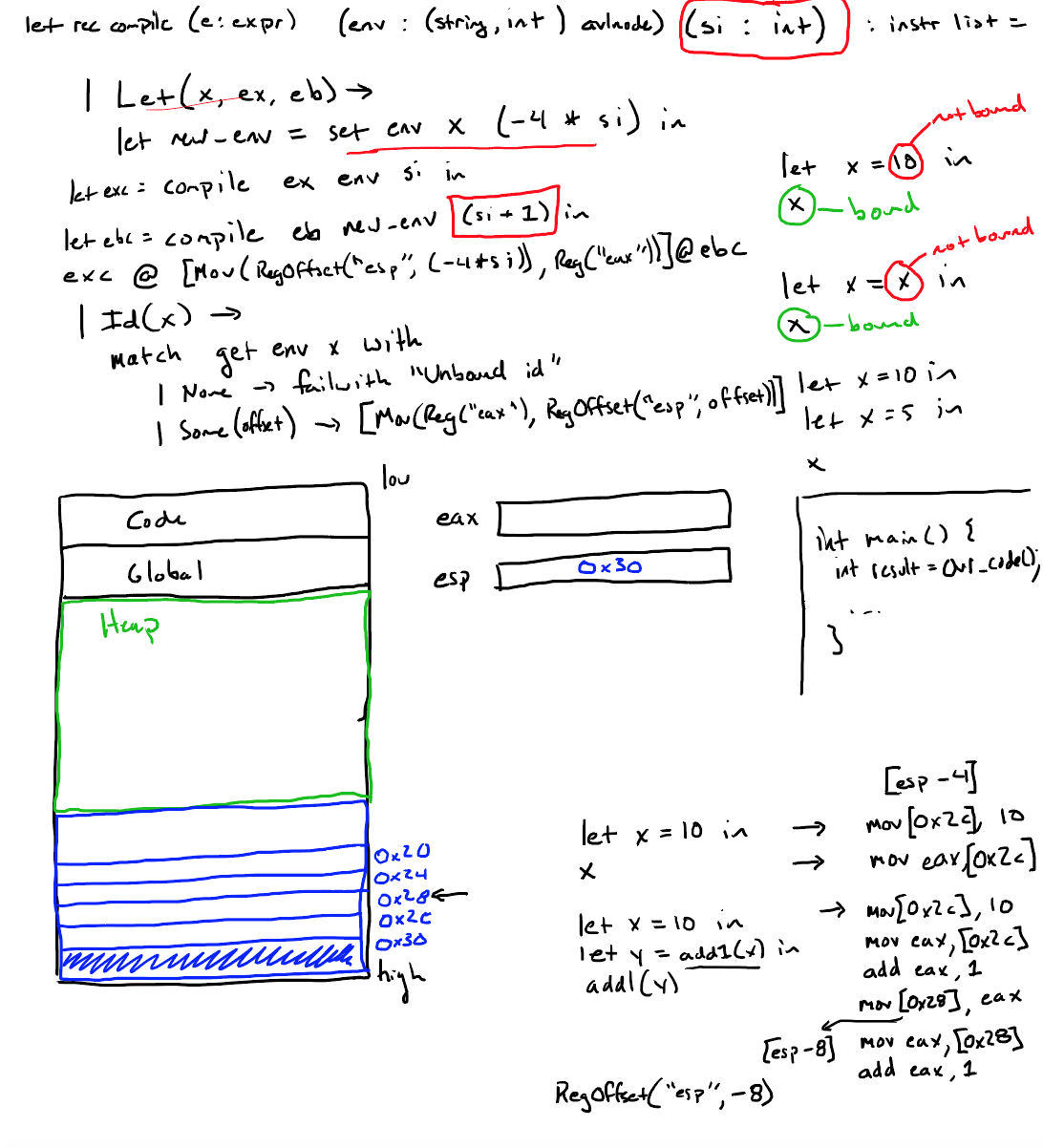
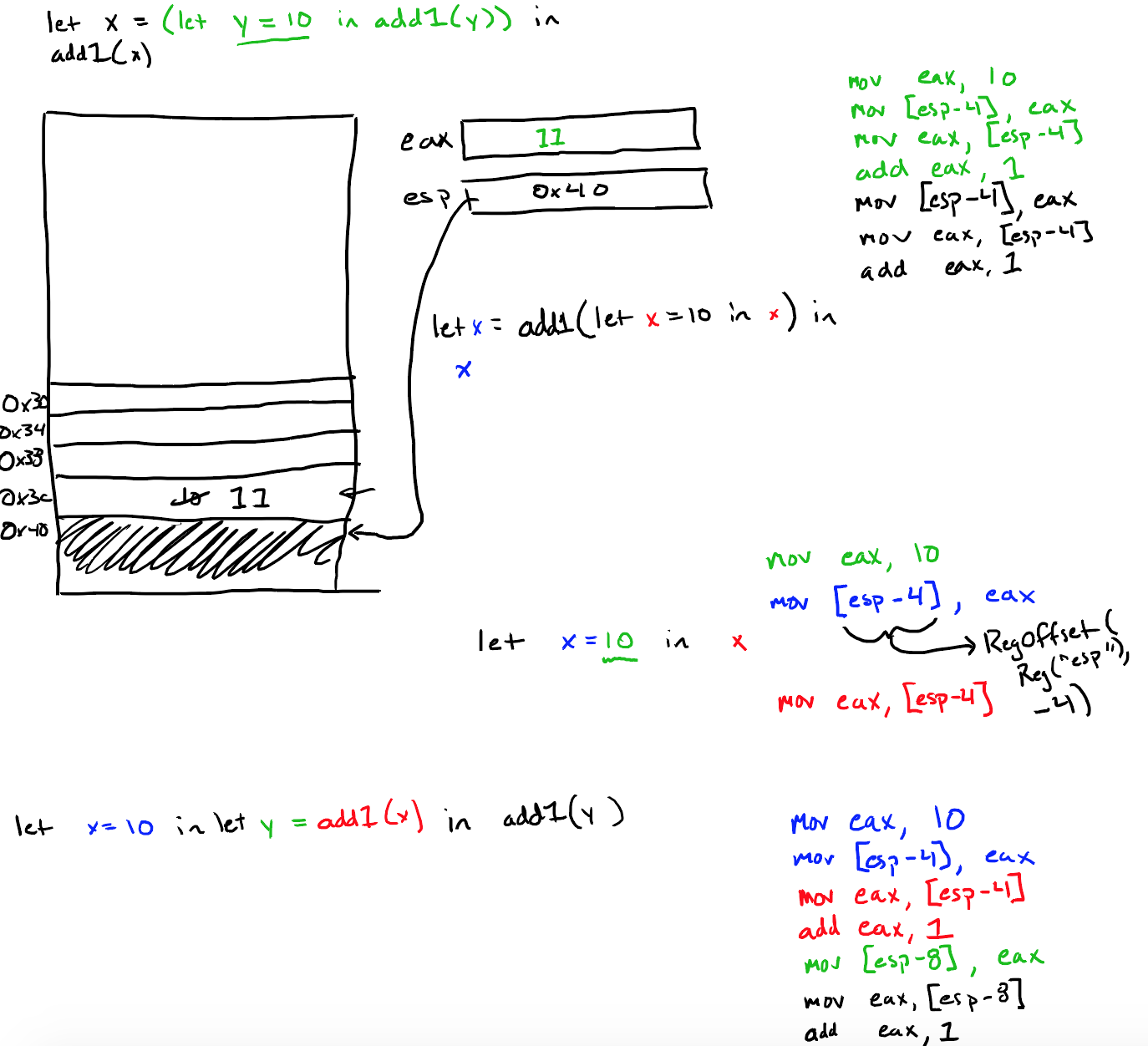
- 汇编代码生成(案例):注意下图第一个例子在对x进行赋值操作的时候,变量x并没有使用一个新的地址:esp-8,而是重复利用了变量y的地址:esp-4。因为变量y在外部无法引用。
编程作业
本次大作业是为Adder编程语言实现一个小型编译器,将Adder程序编译为X86_32汇编。
具体语法:
<expr> :=

  | <number>

  | <identifier>

  | let <bindings> in <expr>

  | add1(<expr>)

  | sub1(<expr>)

<bindings> :=

  | <identifier> = <expr>

  | <identifier> = <expr>, <bindings>
抽象语法:
type prim1 =

  | Add1

  | Sub1

type expr =

  | Number of int

  | Prim1 of prim1 * expr

  | Let of (string * expr) list * expr

  | Id of string
程序例子:
Concrete Syntax Abstract Syntax Answer 5 Number(5) 5 let x=(let y=10 in y) in x Let(["x", Let(["y", 10], Id("y"))], Id("x")) 10 let x=100 in let x=1 in x Let(["x", Number(100), Let(["x", 1], Id("x"))]) 1 let x = 5 in add1(x) Let([("x", Number(5))], Prim1(Add1, Id("x"))) 6 let x=1 in let y=add1(x) in y Let(["x", 1], Let(["y", Prim1(Add1, Id("x"))], Id("y"))) 2 sub1(add1(sub1(5))) Prim1(Sub1, Prim1(Add1, Prim1(Sub1, Number(5)))) 4 let x=10 in let y=add1(x) in add1(y) Let(["x", 10], Let(["y", Prime1(Add1, Id("x"))], Prime1(Add1, Id("y")))) 12 let x = 5, y = sub1(x) in sub1(y) Let([("x", Number(5)), ("y", Prim1(Sub1, Id("x")))], Prim1(Sub1, Id("y"))) 3 let x=1 in let x=add1(let x=6 in add1(x)) in x Let(["x", 1], Let(["x", Prim1(Add1, Let(["x", 6], Prim1(Add1, Id("x"))))], Id("x"))) 8 let y=sub1(add1(sub1(let x=5 in x))) in add1(add1(add1(y))) Let(["y", Prim1(Sub1, Prim1(Add1, Prim1(Sub1, Let(["x", Number(5)], Id("x")))))], Prim1(Add1, Prim1(Add1, Prim1(Add1, Id("y"))))) 7
| let x=1 in y|
-
|An identifier is unbound (there is no surrounding let binding for y)|
| let x=10, y=20, x=5, y=30, x=40 in x|
-
|There is a binding list containing two or more bindings with the same name|
实现一(Let使用尾递归):
分别实现Let、Id、Prim1的代码生成逻辑。因为Adder语法规定,不允许在一个binding list绑定两个相同的变量,所以这里简单的实现了一个has_unique_key方法,判断binding list的长度和去重后的长度是否相同。let rec compile_env
(p : expr)
(stack_index : int)
(env : (string * int) list)
: instruction list =
match p with
| Number(n) ->
[
IMov(Reg(EAX), Const(n))
]
| Let(binds, body) ->
let rec helper xs si env =
match xs with
| [] -> compile_env body (si + 1) env
| (id, expr)::rest ->
let new_env = (id, (-4) * si)::env in
(compile_env expr si env) @ [IMov(RegOffset((-4) * si, ESP), Reg(EAX))] @ helper rest (si + 1) new_env
in
if has_unique_key binds then
helper binds stack_index env
else
failwith "There is a binding list containing two or more bindings with the same name."
| Id(x) ->
[
match (find env x) with
| Some(n) -> IMov(Reg(EAX), RegOffset(n, ESP))
| None -> failwith ("An identifier is unbound (there is no surrounding let binding for " ^ x ^ " )")
]
| Prim1(op, e) ->
match op with
| Add1 -> (compile_env e stack_index env) @ [IAdd(Reg(EAX), Const(1))]
| Sub1 -> (compile_env e stack_index env) @ [ISub(Reg(EAX), Const(1))]
实现二(Let使用迭代):
本实现仅改写了Let的模式匹配逻辑,其他类型的pattern mathcing和上述代码一样。let new_env = List.mapi (fun si (x, _) -> x, (-4) * (stack_index + si)) binds @ env in
let f si (_, e) -> (compile_env e stack_index new_env) @ [IMov(RegOffset((-4) * (stack_index + si), ESP), Reg(EAX))] in
let exc = List.flatten (List.mapi f binds) in
let exb = compile_env body (stack_index + 1) (new_env) in
exc @ exb
有一个地方需要注意一下,比如在对表达式:
let x=10, y=sub1(x) in y
进行求值的时候,会执行上述代码并会返回:
new_env = [("x", -4); ("y", -8)]
exc = List.flatten (List.mapi f [("x", Number(10)), ("y", Prim1(Sub1, Id("x")))])在函数f中,使用的是new_env作为compile_env递归调用的参数。实际上:
- 在计算Number(10)的时候,compile_env只需要传入env,而不是 [("x", -4); ("y", -8)] @ env
- 在计算Prim1(Sub1, Id("x")))的时候,compile_env只需要传入("x", -4)::env,而不是 [("x", -4); ("y", -8)] @ env
- ...以此类推。
因为Adder语言不支持binding list出现重名的变量,所以这里直接传入new_env不会出现问题。当然要是改进可以用切片操作或使用实现一中的尾递归,这里就不详述了。
测试时可能出现的错误:
Error: This expression has type bytes but an expression was expected of type string
⤇ export OCAMLPARAM="safe-string=0,_"
参考资料
starter-adder
safe-string-error
[swarthmore cs75] Compiler 1 – Adder的更多相关文章
- [swarthmore cs75] Compiler 6 – Garbage Snake
课程回顾 Swarthmore学院16年开的编译系统课,总共10次大作业.本随笔记录了相关的课堂笔记以及第9次大作业. 赋值的副作用:循环元组 下面的代码展示了Python3是如何处理循环列表(pri ...
- [swarthmore cs75] Compiler 6 – Fer-de-lance
课程回顾 Swarthmore学院16年开的编译系统课,总共10次大作业.本随笔记录了相关的课堂笔记以及第8次大作业. First-class function: It treats function ...
- [swarthmore cs75] Compiler 5 – Egg-eater
课程回顾 Swarthmore学院16年开的编译系统课,总共10次大作业.本随笔记录了相关的课堂笔记以及第7次大作业. 抽象语法: 存储方式: 栈中的数据如果最后三位(tag bits)是001表示元 ...
- [swarthmore cs75] Compiler 4 – Diamondback
课程回顾 Swarthmore学院16年开的编译系统课,总共10次大作业.本随笔记录了相关的课堂笔记以及第6次大作业. 函数声明 增加函数声明.函数调用的抽象语法:在转换成anf之前还要检查函数声明和 ...
- [swarthmore cs75] Compiler 3 – Cobra
课程回顾 Swarthmore学院16年开的编译系统课,总共10次大作业.本随笔记录了相关的课堂笔记以及第5次大作业. 增加了bool数据表示和比较运算符的支持,具体语法参考下图: 第一种int和bo ...
- [swarthmore cs75] Compiler 2 – Boa
课程回顾 Swarthmore学院16年开的编译系统课,总共10次大作业.本随笔记录了相关的课堂笔记以及第4次大作业. A-Normal Form 在80年代,函数式语言编译器主要使用Continua ...
- [swarthmore cs75] inlab1 — Tiny Compiler
课程回顾 Swarthmore学院16年开的编译系统课,总共10次大作业.本随笔记录了inlab1的实践过程. tiny compiler 这个迷你的编译器可以将一个源文件,编译成可执行的二进制代码. ...
- [swarthmore cs75] Lab 1 — OCaml Tree Programming
课程回顾 Swarthmore学院16年开的编译系统课,总共10次大作业.本随笔记录了相关的课堂笔记以及第2大次作业. 比较两个lists的逻辑: let rec cmp l ll = match ( ...
- [swarthmore cs75] Lab 0 Warmup & Basic OCaml
课程回顾 Swarthmore学院16年开的编译系统课,总共10次大作业.本随笔记录了相关的课堂笔记以及第1次大作业. 什么是编译 编译就是执行Program->Program'转换的过程,如下 ...
随机推荐
- Java开发经常容易犯的错误
调用Set.addAll()方法时抛UnsupportedOperationException异常 上面的Set是Map中keySet的返回结果. 程序中这样两句代码运行时,抛UnsupportedO ...
- GitLab管理之 - Gitlab 用户管理
1. 移除用户 (1) 使用管理员登陆Gitlab服务器 (2) 点击管理区域 (3) 点击Users. (4)点击[Block User] 2. 添加用户(1)用root 管理员登陆.(2)点击[管 ...
- linux上安装Docker
https://blog.csdn.net/qq_36892341/article/details/73918672
- Freemaker隐藏手机号和判断长度
Freemaker隐藏手机号,用一个取巧的方法. <#if con.phone??> ${con.phone?substring(0,3)}xxxx${con.phone?substrin ...
- material palette
https://www.materialpalette.com/
- poj3250(单调栈模板题)
题目链接:https://vjudge.net/problem/POJ-3250 题意:求序列中每个点右边第一个>=自身的点的下标. 思路:简单介绍单调栈,主要用来求向左/右第一个小于/大于自身 ...
- vim matchit 自定义配对关键字之间的跳转
vim因其强大的扩展性一直深受linux程序员的喜爱,最近在用vim写verilog的时候,由于一个逻辑块中的begin end较多,常常会多写或者漏掉匹配关键字,很是苦恼,于是寻找匹配关键字间跳转的 ...
- paloalto防火墙内存使用率高
上述内存使用率是正常的,实际使用的是buffers.
- 总结一下我的dmp第一个版本 也是最后一个版本
刚刚接手了一个新项目-DMP,目前已经开发联调完成,等待测试上线,所以现在来总结一下. 本来是一个前辈在负责,四月底离职了,他离职前我花了一周把这个项目交接了过来,大致熟悉了项目的业务流程以及代码 ...
- php 积分抽奖活动(大转盘)
以下是项目代码(公众号,使用积分进行抽奖活动),只可做参考: public function Sncode(){ $tid = I('request.tid', 0, 'intval'); // 大转 ...