
pytorch --Rnn语言模型(LSTM,BiLSTM) -- 《Recurrent neural network based language model》
论文通过实现RNN来完成了文本分类。
论文地址:88888888
模型结构图:
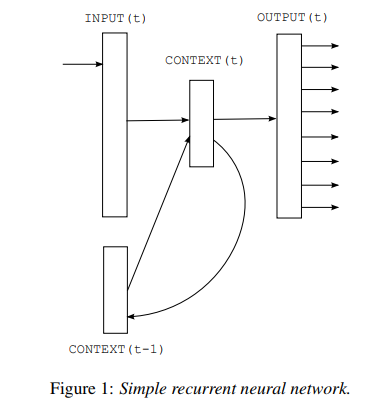
原理自行参考论文,code and comment(https://github.com/graykode/nlp-tutorial):
 # -*- coding: utf-8 -*-

 # @time : 2019/11/9  15:12

 import numpy as np

 import torch

 import torch.nn as nn

 import torch.optim as optim

 from torch.autograd import Variable

 dtype = torch.FloatTensor

 sentences = [ "i like dog", "i love coffee", "i hate milk"]

 word_list = " ".join(sentences).split()

 word_list = list(set(word_list))

 word_dict = {w: i for i, w in enumerate(word_list)}

 number_dict = {i: w for i, w in enumerate(word_list)}

 n_class = len(word_dict)

 # TextRNN Parameter

 batch_size = len(sentences)

 n_step = 2 # number of cells(= number of Step)

 n_hidden = 5 # number of hidden units in one cell

 def make_batch(sentences):

     input_batch = []

     target_batch = []

     for sen in sentences:

         word = sen.split()

         input = [word_dict[n] for n in word[:-1]]

         target = word_dict[word[-1]]

         input_batch.append(np.eye(n_class)[input])

         target_batch.append(target)

     return input_batch, target_batch

 # to Torch.Tensor

 input_batch, target_batch = make_batch(sentences)

 input_batch = Variable(torch.Tensor(input_batch))

 target_batch = Variable(torch.LongTensor(target_batch))

 class TextRNN(nn.Module):

     def __init__(self):

         super(TextRNN, self).__init__()

         self.rnn = nn.RNN(input_size=n_class, hidden_size=n_hidden,batch_first=True)

         self.W = nn.Parameter(torch.randn([n_hidden, n_class]).type(dtype))

         self.b = nn.Parameter(torch.randn([n_class]).type(dtype))

     def forward(self, hidden, X):

         if self.rnn.batch_first == True:

             # X [batch_size,time_step,word_vector]

             outputs, hidden = self.rnn(X, hidden)

             # outputs [batch_size, time_step, hidden_size*num_directions]

             output = outputs[:, -1, :]  # [batch_size, num_directions(=1) * n_hidden]

             model = torch.mm(output, self.W) + self.b  # model : [batch_size, n_class]

             return model

         else:

             X = X.transpose(0, 1) # X : [n_step, batch_size, n_class]

             outputs, hidden = self.rnn(X, hidden)

             # outputs : [n_step, batch_size, num_directions(=1) * n_hidden]

             # hidden : [num_layers(=1) * num_directions(=1), batch_size, n_hidden]

             output = outputs[-1,:,:] # [batch_size, num_directions(=1) * n_hidden]

             model = torch.mm(output, self.W) + self.b # model : [batch_size, n_class]

             return model

 model = TextRNN()

 criterion = nn.CrossEntropyLoss()

 optimizer = optim.Adam(model.parameters(), lr=0.001)

 # Training

 for epoch in range(5000):

     optimizer.zero_grad()

     # hidden : [num_layers * num_directions, batch, hidden_size]

     hidden = Variable(torch.zeros(1, batch_size, n_hidden))

     # input_batch : [batch_size, n_step, n_class]

     output = model(hidden, input_batch)

     # output : [batch_size, n_class], target_batch : [batch_size] (LongTensor, not one-hot)

     loss = criterion(output, target_batch)

     if (epoch + 1) % 1000 == 0:

         print('Epoch:', '%04d' % (epoch + 1), 'cost =', '{:.6f}'.format(loss))

     loss.backward()

     optimizer.step()

 # Predict

 hidden_initial = Variable(torch.zeros(1, batch_size, n_hidden))

 predict = model(hidden_initial, input_batch).data.max(1, keepdim=True)[1]

 print([sen.split()[:2] for sen in sentences], '->', [number_dict[n.item()] for n in predict.squeeze()])
LSTM unit的RNN模型:
 import numpy as np

 import torch

 import torch.nn as nn

 import torch.optim as optim

 from torch.autograd import Variable

 dtype = torch.FloatTensor

 char_arr = [c for c in 'abcdefghijklmnopqrstuvwxyz']

 word_dict = {n: i for i, n in enumerate(char_arr)}

 number_dict = {i: w for i, w in enumerate(char_arr)}

 n_class = len(word_dict)  # number of class(=number of vocab)

 seq_data = ['make', 'need', 'coal', 'word', 'love', 'hate', 'live', 'home', 'hash', 'star']

 # TextLSTM Parameters

 n_step = 3

 n_hidden = 128

 def make_batch(seq_data):

     input_batch, target_batch = [], []

     for seq in seq_data:

         input = [word_dict[n] for n in seq[:-1]]  # 'm', 'a' , 'k' is input

         target = word_dict[seq[-1]]  # 'e' is target

         input_batch.append(np.eye(n_class)[input])

         target_batch.append(target)

     return Variable(torch.Tensor(input_batch)), Variable(torch.LongTensor(target_batch))

 class TextLSTM(nn.Module):

     def __init__(self):

         super(TextLSTM, self).__init__()

         self.lstm = nn.LSTM(input_size=n_class, hidden_size=n_hidden)

         self.W = nn.Parameter(torch.randn([n_hidden, n_class]).type(dtype))

         self.b = nn.Parameter(torch.randn([n_class]).type(dtype))

     def forward(self, X):

         input = X.transpose(0, 1)  # X : [n_step, batch_size, n_class]

         hidden_state = Variable(

             torch.zeros(1, len(X), n_hidden))  # [num_layers(=1) * num_directions(=1), batch_size, n_hidden]

         cell_state = Variable(

             torch.zeros(1, len(X), n_hidden))  # [num_layers(=1) * num_directions(=1), batch_size, n_hidden]

         outputs, (_, _) = self.lstm(input, (hidden_state, cell_state))

         outputs = outputs[-1]  # [batch_size, n_hidden]

         model = torch.mm(outputs, self.W) + self.b  # model : [batch_size, n_class]

         return model

 input_batch, target_batch = make_batch(seq_data)

 model = TextLSTM()

 criterion = nn.CrossEntropyLoss()

 optimizer = optim.Adam(model.parameters(), lr=0.001)

 # Training

 for epoch in range(1000):

     output = model(input_batch)

     loss = criterion(output, target_batch)

     if (epoch + 1) % 100 == 0:

         print('Epoch:', '%04d' % (epoch + 1), 'cost =', '{:.6f}'.format(loss))

     optimizer.zero_grad()

     loss.backward()

     optimizer.step()

 inputs = [sen[:3] for sen in seq_data]

 predict = model(input_batch).data.max(1, keepdim=True)[1]

 print(inputs, '->', [number_dict[n.item()] for n in predict.squeeze()])
BiLSTM RNN model:
 import numpy as np

 import torch

 import torch.nn as nn

 import torch.optim as optim

 from torch.autograd import Variable

 import torch.nn.functional as F

 dtype = torch.FloatTensor

 sentence = (

     'Lorem ipsum dolor sit amet consectetur adipisicing elit '

     'sed do eiusmod tempor incididunt ut labore et dolore magna '

     'aliqua Ut enim ad minim veniam quis nostrud exercitation'

 )

 word_dict = {w: i for i, w in enumerate(list(set(sentence.split())))}

 number_dict = {i: w for i, w in enumerate(list(set(sentence.split())))}

 n_class = len(word_dict)

 max_len = len(sentence.split())

 n_hidden = 5

 def make_batch(sentence):

     input_batch = []

     target_batch = []

     words = sentence.split()

     for i, word in enumerate(words[:-1]):

         input = [word_dict[n] for n in words[:(i + 1)]]

         input = input + [0] * (max_len - len(input))

         target = word_dict[words[i + 1]]

         input_batch.append(np.eye(n_class)[input])

         target_batch.append(target)

     return Variable(torch.Tensor(input_batch)), Variable(torch.LongTensor(target_batch))

 class BiLSTM(nn.Module):

     def __init__(self):

         super(BiLSTM, self).__init__()

         self.lstm = nn.LSTM(input_size=n_class, hidden_size=n_hidden, bidirectional=True)

         self.W = nn.Parameter(torch.randn([n_hidden * 2, n_class]).type(dtype))

         self.b = nn.Parameter(torch.randn([n_class]).type(dtype))

     def forward(self, X):

         input = X.transpose(0, 1)  # input : [n_step, batch_size, n_class]

         hidden_state = Variable(torch.zeros(1*2, len(X), n_hidden))   # [num_layers(=1) * num_directions(=1), batch_size, n_hidden]

         cell_state = Variable(torch.zeros(1*2, len(X), n_hidden))     # [num_layers(=1) * num_directions(=1), batch_size, n_hidden]

         outputs, (_, _) = self.lstm(input, (hidden_state, cell_state))

         outputs = outputs[-1]  # [batch_size, n_hidden]

         model = torch.mm(outputs, self.W) + self.b  # model : [batch_size, n_class]

         return model

 input_batch, target_batch = make_batch(sentence)

 model = BiLSTM()

 criterion = nn.CrossEntropyLoss()

 optimizer = optim.Adam(model.parameters(), lr=0.001)

 # Training

 for epoch in range(10000):

     output = model(input_batch)

     loss = criterion(output, target_batch)

     if (epoch + 1) % 1000 == 0:

         print('Epoch:', '%04d' % (epoch + 1), 'cost =', '{:.6f}'.format(loss))

     optimizer.zero_grad()

     loss.backward()

     optimizer.step()

 predict = model(input_batch).data.max(1, keepdim=True)[1]

 print(sentence)

 print([number_dict[n.item()] for n in predict.squeeze()])
pytorch --Rnn语言模型(LSTM,BiLSTM) -- 《Recurrent neural network based language model》的更多相关文章
- 4.5 RNN循环神经网络(recurrent neural network)
自己开发了一个股票智能分析软件,功能很强大,需要的点击下面的链接获取: https://www.cnblogs.com/bclshuai/p/11380657.html 1.1 RNN循环神经网络 ...
- 论文笔记:ReNet: A Recurrent Neural Network Based Alternative to Convolutional Networks
ReNet: A Recurrent Neural Network Based Alternative to Convolutional Networks2018-03-05 11:13:05 ...
- 【NLP】Recurrent Neural Network and Language Models
0. Overview What is language models? A time series prediction problem. It assigns a probility to a s ...
- RNN循环神经网络(Recurrent Neural Network)学习
一.RNN简介 1.)什么是RNN? RNN是一种特殊的神经网络结构,考虑前一时刻的输入,且赋予了网络对前面的内容的一种'记忆'功能. 2.)RNN可以解决什么问题? 时间先后顺序的问题都可以使用RN ...
- Recurrent Neural Network系列1--RNN(循环神经网络)概述
作者:zhbzz2007 出处:http://www.cnblogs.com/zhbzz2007 欢迎转载,也请保留这段声明.谢谢! 本文翻译自 RECURRENT NEURAL NETWORKS T ...
- (zhuan) Recurrent Neural Network
Recurrent Neural Network 2016年07月01日 Deep learning Deep learning 字数:24235 this blog from: http:/ ...
- Recurrent neural network (RNN) - Pytorch版
import torch import torch.nn as nn import torchvision import torchvision.transforms as transforms # ...
- Recurrent Neural Network系列2--利用Python,Theano实现RNN
作者:zhbzz2007 出处:http://www.cnblogs.com/zhbzz2007 欢迎转载,也请保留这段声明.谢谢! 本文翻译自 RECURRENT NEURAL NETWORKS T ...
- Recurrent Neural Network系列4--利用Python,Theano实现GRU或LSTM
yi作者:zhbzz2007 出处:http://www.cnblogs.com/zhbzz2007 欢迎转载,也请保留这段声明.谢谢! 本文翻译自 RECURRENT NEURAL NETWORK ...
随机推荐
- cogs 1963. [HAOI 2015] 树上操作 树链剖分+线段树
1963. [HAOI 2015] 树上操作 ★★★☆ 输入文件:haoi2015_t2.in 输出文件:haoi2015_t2.out 简单对比时间限制:1 s 内存限制:256 M ...
- Educational Codeforces Round 80 (Rated for Div. 2)
A. Deadline 题目链接:https://codeforces.com/contest/1288/problem/A 题意: 给你一个 N 和 D,问是否存在一个 X , 使得 $x+\lce ...
- Java入门 - 面向对象 - 05.封装
原文地址:http://www.work100.net/training/java-encapsulation.html 更多教程:光束云 - 免费课程 封装 序号 文内章节 视频 1 概述 2 封装 ...
- Python的Excel操作及数据可视化
Excel表操作 python操作excel主要用到xlrd和xlwt这两个库,即xlrd是读excel,xlwt是写excel的库. 安装xlrd pip install xlrd 简单的表格读取 ...
- html恶搞之无限弹窗
啦啦啦啦啦 恶搞别人吗? 把下面代码做成html文件发给别人,用浏览器打开就可以看见效果了 <!DOCTYPE html> <html><head><meta ...
- Canny边缘检测算法(基于OpenCV的Java实现)
目录 Canny边缘检测算法(基于OpenCV的Java实现) 绪论 Canny边缘检测算法的发展历史 Canny边缘检测算法的处理流程 用高斯滤波器平滑图像 彩色RGB图像转换为灰度图像 一维,二维 ...
- C语言的安装及使用
安装 vc6.0 使用方法 new --- win32 Console Application --- ok-ok ------c++ Source File ------ ...
- java单例五种实现模式梳理
java单例五种实现模式 饿汉式(线程安全,调用效率高,但是不能延时加载) 一上来就把单例对象创建出来了,要用的时候直接返回即可,这种可以说是单例模式中最简单的一种实现方式.但是问题也比较明显.单例在 ...
- [GPU高性能编程CUDA实战].(桑德斯).聂雪军等.扫描版-百度云分享
链接:https://pan.baidu.com/s/1NkkDiyRgmfmhm9d2g_GBKQ 提取码:3usj
- Docker 代理脱坑指南
Docker 代理配置 由于公司 Lab 服务器无法正常访问公网,想要下载一些外部依赖包需要配置公司的内部代理.Docker 也是同理,想要访问公网需要配置一定的代理. Docker 代理分为两种,一 ...