
Python学习笔记3-string
More on Modules and their Namespaces
Suppose you've got a module "binky.py" which contains a "def foo()". The fully qualified name of that foo function is "binky.foo". In this way, various Python modules can name their functions and variables whatever they
want, and the variable names won't conflict — module1.foo is different from module2.foo. In the Python vocabulary, we'd say that binky, module1, and module2 each have their own "namespaces," which as you can guess are variable name-to-object bindings.
For example, we have the standard "sys" module that contains some standard system facilities, like the argv list, and exit() function. With the statement "import sys" you can then access the definitions in the sys module
and make them available by their fully-qualified name, e.g. sys.exit(). (Yes, 'sys' has a namespace too!)
import sys

# Now can refer to sys.xxx facilities

sys.exit(0)
There is another import form that looks like this: "from sys import argv, exit". That makes argv and exit() available by their short names; however, we recommend the original form with the fully-qualified names because it's
a lot easier to determine where a function or attribute came from.
import sys
# Now can refer to sys.xxx facilities
sys.exit(0)
Online help, help(), and dir()
dir(sys)—dir()is
likehelp()but just gives a quick list of its defined symbols, or "attributes"
The "print" operator prints out one or more python items followed by a newline (leave a trailing comma at the end of the items to inhibit the newline).
A "raw" string literal is prefixed by an 'r' and passes all the chars through without special treatment of backslashes, so r'x\nx' evaluates to
the length-4 string 'x\nx'. A 'u' prefix allows you to write a unicode string literal (Python has lots of other unicode support features -- see
the docs below).
raw = r'this\t\n and that'

print raw     ## this\t\n and that

multi = """It was the best of times.

It was the worst of times."""
String Methods
Here are some of the most common string methods:
- s.lower(), s.upper() -- returns the lowercase or uppercase version of the string
- s.strip() -- returns a string with whitespace removed from the start and end
- s.isalpha()/s.isdigit()/s.isspace()... -- tests if all the string chars are in the various character classes
"s.isalpha()"discriminate the string s whether contains only alphas. example:1. s='dfd24s',s.isalpha() returns false; 2. s='sdufjd',s.isalpha() returns Ture. - s.startswith('other'), s.endswith('other') -- tests if the string starts or ends with the given other string
- s.find('other') -- searches for the given other string (not a regular expression) within s, and returns the first index where it begins or -1 if not found
- s.replace('old', 'new') -- returns a string where all occurrences of 'old' have been replaced by 'new'
- s.split('delim') -- returns a list of substrings separated by the given delimiter. The delimiter is not a regular expression, it's just text. 'aaa,bbb,ccc'.split(',') -> ['aaa', 'bbb', 'ccc']. As a convenient special
case s.split() (with no arguments) splits on all whitespace chars. - s.join(list) -- opposite of split(), joins the elements in the given list together using the string as the delimiter. e.g. '---'.join(['aaa', 'bbb', 'ccc']) -> aaa---bbb---ccc
String Slices
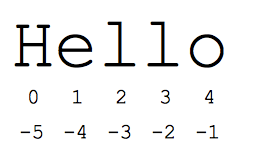
- s[1:4] is 'ell' -- chars starting at index 1 and extending up to but not including index 4
- s[1:] is 'ello' -- omitting either index defaults to the start or end of the string
- s[:] is 'Hello' -- omitting both always gives us a copy of the whole thing (this is the pythonic way to copy a sequence like a string or list)
- s[1:100] is 'ello' -- an index that is too big is truncated down to the string length
String %
Python has a printf()-like facility to put together a string. The % operator takes a printf-type format string on the left (%d int, %s string, %f/%g floating point), and the matching values in a tuple on the right (a tuple is made of values separated by commas,
typically grouped inside parentheses):
# % operator

text = "%d little pigs come out or I'll %s and %s and %s" % (3, 'huff', 'puff', 'blow down')
The above line is kind of long -- suppose you want to break it into separate lines. You cannot just split the line after the '%' as you might
in other languages, since by default Python treats each line as a separate statement (on the plus side, this is why we don't need to type semi-colons on each line). To fix this, enclose the whole expression in an outer set of parenthesis -- then the expression
is allowed to span multiple lines. This code-across-lines technique works with the various grouping constructs detailed below: ( ), [ ], { }.
# add parens to make the long-line work:

text = ("%d little pigs come out or I'll %s and %s and %s" %

    (3, 'huff', 'puff', 'blow down'))
在python中是没有&&及||这两个运算符的,取而代之的是英文and和or
reference:
https://developers.google.com/edu/python/
Python学习笔记3-string的更多相关文章
- Python学习笔记:String类型所有方法汇总
# 按字母表熟悉下string中的方法# A B C D E F G H I J K L M N O P Q R S T U V W X Y Z# 标红的为常用重点的方法!! str = " ...
- python学习笔记(五岁以下儿童)深深浅浅的副本复印件,文件和文件夹
python学习笔记(五岁以下儿童) 深拷贝-浅拷贝 浅拷贝就是对引用的拷贝(仅仅拷贝父对象) 深拷贝就是对对象的资源拷贝 普通的复制,仅仅是添加了一个指向同一个地址空间的"标签" ...
- Python学习笔记(十一)
Python学习笔记(十一): 生成器,迭代器回顾 模块 作业-计算器 1. 生成器,迭代器回顾 1. 列表生成式:[x for x in range(10)] 2. 生成器 (generator o ...
- Python学习笔记(十)
Python学习笔记(十): 装饰器的应用 列表生成式 生成器 迭代器 模块:time,random 1. 装饰器的应用-登陆练习 login_status = False # 定义登陆状态 def ...
- Python学习笔记,day5
Python学习笔记,day5 一.time & datetime模块 import本质为将要导入的模块,先解释一遍 #_*_coding:utf-8_*_ __author__ = 'Ale ...
- python学习笔记目录
人生苦短,我学python学习笔记目录: week1 python入门week2 python基础week3 python进阶week4 python模块week5 python高阶week6 数据结 ...
- Python学习笔记_Python对象
Python学习笔记_Python对象 Python对象 标准类型 其它内建类型 类型对象和type类型对象 Python的Null对象None 标准类型操作符 对象值的比較 对象身份比較 布尔类型 ...
- Python学习笔记之异常处理
1.概念 Python 使用异常对象来表示异常状态,并在遇到错误时引发异常.异常对象未被捕获时,程序将终止并显示一条错误信息 >>> 1/0 # Traceback (most re ...
- Python学习笔记之类与对象
这篇文章介绍有关 Python 类中一些常被大家忽略的知识点,帮助大家更全面的掌握 Python 中类的使用技巧 1.与类和对象相关的内置方法 issubclass(class, classinfo) ...
- Python学习笔记之函数
这篇文章介绍有关 Python 函数中一些常被大家忽略的知识点,帮助大家更全面的掌握 Python 中函数的使用技巧 1.函数文档 给函数添加注释,可以在 def 语句后面添加独立字符串,这样的注释被 ...
随机推荐
- vue:vuex详解
一.什么是Vuex? https://vuex.vuejs.org/zh-cn 官方说法:Vuex 是一个专为 Vue.js应用程序开发的状态管理模式.它采用集中式存储管理应用的所有组件的状态,并以相 ...
- python中的logger模块
logger 提供了应用程序可以直接使用的接口handler将(logger创建的)日志记录发送到合适的目的输出filter提供了细度设备来决定输出哪条日志记录formatter决定日志记录的最终输出 ...
- win10 +python3.6环境下安装opencv以及pycharm导入cv2有问题的解决办法
一.安装opencv 借鉴的这篇博客已经写得很清楚了--------https://blog.csdn.net/u011321546/article/details/79499598 ,这 ...
- 大数据自学6-Hue集成环境操作Hbase
上一章讲过,Hue集成环境是可以直接操作Hbase,但是公司的环境一直报错,虽然也可以透过写代码访问Hbase,但是看到Hue环境中无法访问,还是觉得不爽,因此决定再花些力气找找原因. 找原因要先查L ...
- WinCHM 制作开发知识库,So easy!!!
开发过程中可能需要一些团队需要相互参照的东西,如前后台开发中的接口定义,团队开发规范,公用的类库,开发FAQ等 ,可以考虑用WinCHM这种工具制作开发知识库,然后发布至一Web服务器上,这样开发人员 ...
- Python进阶【第三篇】Python中的基本数据类型
一.运算符 1.算术运算 2.比较运算 3.赋值运算 4.逻辑运算 5.成员运算 二.基本数据类型 1.数字 int(整型) 在32位机器上,整数的位数为32位,取值范围为-2**31-2**31-1 ...
- kivy 滑动
from kivy.uix.gridlayout import GridLayout from kivy.app import App from kivy.lang.builder import Bu ...
- socket - option编程:SO_REUSEADDR
网友vmstat多次提出了这个问题:SO_REUSEADDR有什么用处和怎么使用.而且很多网友在编写网络程序时也会遇到这个问题.所以特意写了这么一篇文章,希望能够解答一些人的疑难. 其实这个问题在Ri ...
- dubbo spring pom文件报错:提示no declaration can be found for element 'dubbo:service'.
pom文件报错:The matching wildcard is strict, but no declaration can be found for element 'dubbo:service ...
- 18位身份证验证(Java)加入身份证输入验证是否满足18位代码(修订稿)
package day20181016; /** * 身份证的验证 34052419800101001X * */ import java.util.Scanner; public class Zuo ...