
论文笔记:Diffusion-Convolutional Neural Networks (传播-卷积神经网络)
Diffusion-Convolutional Neural Networks (传播-卷积神经网络)
2018-04-09 21:59:02
1. Abstract:
我们提出传播-卷积神经网络(DCNNs),一种处理 graph-structured data 的新模型。随着 DCNNs 的介绍,我们展示如何从 graph structured data 中学习基于传播的表示(diffusion-based representations),然后作为节点分类的有效基础。DCNNs 拥有多个有趣的性质,包括:
1). a latent representation for graphical data that is invariant under isomorphism;
2). polynomial-time prediction;
3). learning that can be represented as tensor operations;
4). efficiently implemented on a GPU.
2. Introduction:
处理结构化的数据是非常有挑战的。一方面,找到合适的方法来展示和探索数据的结构可以获得预测精度的提升;另一方面,找到这样的结构可能很困难,在模型中添加结构会使得预测复杂度显著的提升。
这个工作的目标是:设计一个灵活的模型来处理 general 类型的结构化数据,使得在改善预测精度的同时,避免复杂度的提升。为了完成这个目标,我们通过引入一种“diffusion-convolution”的操作,拓展 CNN 到 general graph-structure data。简单的说,不像传统的卷积操作那样(scanning a "square" of parameters across a grid-structured input),the diffusion-convolution operation 通过在一个 graph-structured input 上处理每一个节点,来扫描一个传播过程,以此来构建一个隐层的表示(builds a latent representation by scanning a diffusion process across each node in a graph-strucured input)。
这个模型是受到下面的启发:a representation that encapsulates (压缩) graph diffusion can provide a better basis for prediction than a graph itself. 图的传播可以表示为:a matrix power series, 提供了一个直观的机制来包含 entities 的内容信息(providing a straightforward mechansim for including contextual information about entities that can be computed in polynomial time and efficiently implemented on a GPU)。
在本文中,我们提供了一个 diffusion-convolutional neural network (DCNNs),并且在 graphical data 的不同任务上做了验证。许多技术,包括:分类任务的结构化信息,DCNNs 提供了一种互补的方法,在节点分类任务上取得了显著的提升。
3. Model:
假设我们有 T 个 graphs g。每个 graph $G_t = (V_t, E_t)$ 是由顶点和边构成的。
顶点:$N_t * F$,其中 $N_t$ 是 graph 中节点的个数;
边:$N_t * N_t$ 的邻接矩阵 At;由此我们可以计算一个 degree-normalized transition matrix $P_t$,表示了从节点 i 到 节点 j 之间跳跃的概率(that gives the probability of jumping from node i to node j in one step)。
这个图可以是加权的,也可以是不加权的;有向的或者无向的。节点也可以包含 labels Y。
我们对学习预测 Y 很感兴趣;即:来预测每一个 graph 中的每一个节点的标签;或者 每一个图的 label。在每种情况下,我们可以访问一些已标注的实例(some labeled entities),我们的工作是预测剩下无标签实例的 label(our task is predict the values of the remaining unlabeled entities)。
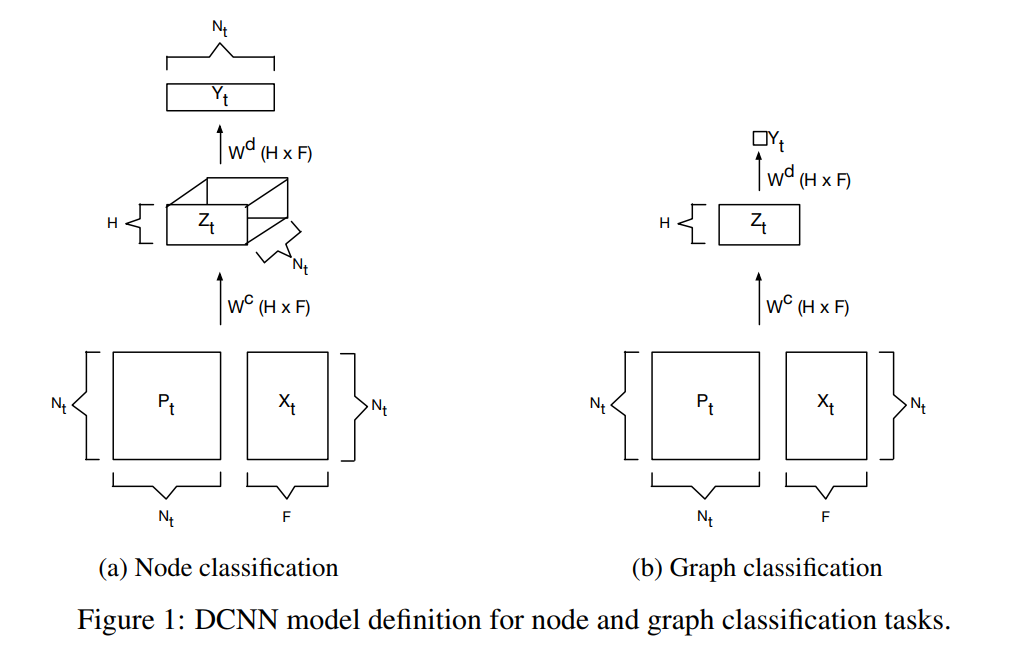
DCNNs 被设计用来执行符合这种形式的任意任务。DCNN 将 graph g 作为输入,然后输出 一个 hard prediction for Y 或者 一个条件分布 P(Y|X)。每一个感兴趣的 entity 被转换为一个 传播-卷积表示,which is a H*F real matrix defined by H hops of graph diffusion over F features, and it is defined by an H*F real-valued weight tensor $W^c$ and a nonliner differentiable function f that computes the activations. 所以,对于节点分类来说,graph t 的传播-卷积表示,$Z_t$,将会是 $N_t *H * F$ tensor, 如图1(a)所示。
该模型是基于一个 diffusion kernel 的,可以认为是:a measure of the level of connectivity between any two nodes in a graph when considering all paths between them, with longer paths being discounted more than shorter paths. DCNNs 没有 pooling operation.
Node Classfication.
考虑节点分类的任务,在 graph 中的每一个输入节点,都会进行标签的估计(a label Y is predicted for each input node in a graph)。
我们用 $P^*_t$ 表示为 $N_t * H * N_t$ tensor containing the power series of $P_t$,定义为:

传播-卷积激活 $Z_{tijk}$ for node i, hop j, and feature k of graph t is given by:

激活可以用 tensor 的形式更加精确的进行表达:

其中,圆圈这个符号代表 element-wise multiplication.
该模型可以由 dense layer 来完成(the model is completed by a dense layer that connects Z to Y)。对于 Y 的 hard prediction,表示为 $\hat{Y}$,可以通过取最大的 activiation 来获得;and a conditional probability distribution P(X|Y) can be found by applying the softmax function:

This keeps the same function in the following extensions.

论文笔记:Diffusion-Convolutional Neural Networks (传播-卷积神经网络)的更多相关文章
- 论文笔记——Factorized Convolutional Neural Networks
1. 论文思想 将3D卷积分解为spatial convolution in each channel and linear projection across channels. (spatial ...
- Deep Learning论文笔记之(四)CNN卷积神经网络推导和实现(转)
Deep Learning论文笔记之(四)CNN卷积神经网络推导和实现 zouxy09@qq.com http://blog.csdn.net/zouxy09 自己平时看了一些论文, ...
- Deep Learning论文笔记之(四)CNN卷积神经网络推导和实现
https://blog.csdn.net/zouxy09/article/details/9993371 自己平时看了一些论文,但老感觉看完过后就会慢慢的淡忘,某一天重新拾起来的时候又好像没有看过一 ...
- 论文笔记(1)-Dropout-Improving neural networks by preventing co-adaptation of feature detectors
Improving neural networks by preventing co-adaptation of feature detectors 是Hinton在2012年6月份发表的,从这篇文章 ...
- 【论文笔记】Progressive Neural Networks 渐进式神经网络
Progressive NN Progressive NN是第一篇我看到的deepmind做这个问题的.思路就是说我不能忘记第一个任务的网络,同时又能使用第一个任务的网络来做第二个任务. 为了不忘记之 ...
- 【RS】Automatic recommendation technology for learning resources with convolutional neural network - 基于卷积神经网络的学习资源自动推荐技术
[论文标题]Automatic recommendation technology for learning resources with convolutional neural network ( ...
- 论文笔记—Flattened convolution neural networks for feedforward acceleration
1. 论文思想 一维滤过器.将三维卷积分解成三个一维卷积.convolution across channels(lateral), vertical and horizontal direction ...
- [Neural Networks] (Convolutional Neural Networks)CNN-卷积神经网络学习
参考:http://blog.csdn.net/zouxy09/article/details/8781543 ( 但其中有部分错误) http://ufldl.stanford.edu/wiki/i ...
- AlexNet论文翻译-ImageNet Classification with Deep Convolutional Neural Networks
ImageNet Classification with Deep Convolutional Neural Networks 深度卷积神经网络的ImageNet分类 Alex Krizhevsky ...
随机推荐
- EasyUI表格DataGrid获取数据的方式
第一种方式:直接返回JSON数据 package com.easyuijson.util; import java.text.SimpleDateFormat; import net.sf.js ...
- zookeeper开发
环境 虚拟机:VMware 10 Linux版本:CentOS-6.5-x86_64 客户端:Xshell4 FTP:Xftp4 jdk8 zookeeper-3.4.11 ZK客户端操作命令: #登 ...
- maven 核心概念
1). 项目构建过程中的各个环节 . 清理 . 编译 . 测试 . 报告 . 打包 . 安装 . 部署 2). 配置环境变量 . 配置 JDK 配置 JAVA_HOME + PATH maven 需要 ...
- Set接口——LinkedHashSet集合
底层是由哈希表+链表:
- 新做了块avr开发板--tft屏研究用
2010-05-04 14:03:00 测试效果不错,使用也方便.
- SharePoint入门——创建一个网站
1.首先安装SP相关环境,可以百度到具体操作步骤: (以下步骤基于本人环境:本人用的Win10自带的Hyper-V虚拟机.Windows Server2012R2.SQL2014以及SharePoin ...
- Docker学习笔记之docker volume 容器卷的那些事(一)
预览目录 volume 方式 相关用例 使用方式 使用 volume driver bind mount 方式 相关用例 使用方式 配置selinux标签 配置macOS的安装一致性 tmpfs 方式 ...
- oracle 9i/10gR2所有版本下载地址
Oracle 9i Oracle9i Database Release 2 Enterprise/Standard/Personal Edition for Windows NT/2000/XP ht ...
- Tsung压力测试工具安装使用
工具安装 1)unixODBC ./configure; make; make install 或者yum安装 2)ncurses-devel ./configure; make; make inst ...
- keepalived与zookeeper
keepalived与zookeeper都可以用来实现高可用,高可用一般跟负载均衡会一起考虑,所以通常也会考虑到相应的负载均衡能力, 1.概括对比: 1.1.Keepalived: 优点:简单,基本不 ...