
THE OVERARCHING PROCESS OF TEST DESIGN
THE OVERARCHING PROCESS OF TEST DESIGN
-Test note of “Essential Software Test Design”
2015-08-27
Content:
8.1 Preparation – Get the Big Picture
8.2 Step One – Creating a Model of the Requirements
8.3 Step Two – Covering the Model, Creating Base Test Cases
8.4 Step Three – Supplementing With Test Data
8.5 Step Four – Advanced Testing
Since test design is complicated, and contains many different approaches, it is appropriate to divide the work up into several steps.

Figure 8.1: Process for test design in four steps
8.1 Preparation – Get the Big Picture
Before you begin to develop test cases, it is a good idea to compile an overview of what is to be tested. Often, the test strategy contains some form of overview of the test coverage.
Find out which documents and other test basis are available to you to work from. This can be anything from business plans to technical models and program specifications with database descriptions. Go through the test basis and try to identify which requirements you are affected by. If the requirements are not written down, you need to conduct a dialogue with those placing the order, and the developer, in order to obtain the test basis you need.
All the requirements we have identified, and all the requirements we can assume exist, even if they are not written down, must now be tested. As a test designer, you must find a way of arriving at the right questions to ask.
8.2 Step One – Creating a Model of the Requirements
When the overview is complete, it is time to build test cases. Your first step is to model the requirements in a form which you will cover by test cases in the next step.
There are many types of model to use and, in the majority of projects, you must use several different types in order to give as good a variation as possible to the test cases. Common models are tables, flow graphs and state diagrams.
Remember that you must have early involvement in the project. You must develop your models in parallel with the requirements being written. By compiling the models, you will contribute to the quality assurance of both the requirements and the design.
Here, you have the opportunity to contribute genuinely to the common good, by asking important questions at such an early stage that they can be answered in time before the coding gets under way. On the other hand, do not try to develop all your test cases in detail before you have had your models examined and accepted by the rest of the project team. It is obviously a good thing to think like a tester and question almost everything, but do not be too hard in your criticism, since your job is to be an asset to the project team, and not to run down the other team members.
What you actually do is the part known as analysis in many project models, which often contains the steps requirements-analysis-design-coding-testing. It can be argued that those who compile the requirements, or those who design the system, should carry out this analysis but, in my experience, this is seldom the case. Also, even if those who write the requirements, or design the system, carry out this analysis, they do not ask the same questions as you do as a tester.
8.3 Step Two – Covering the Model, Creating Base Test Cases
Step two is to cover the model with test cases. In this way, you get a measure of which test coverage you have. Graphic models are filled in through writing test cases which encompass all the rectangles and circles in place, and the arrows linking them up. For formulae or sets of rules, it is a question of all the parameters involved being tested, as well as the most important combinations of them.
8.4 Step Three – Supplementing With Test Data
The base test cases we have generated in step two must now be run once or several times with different data in order to achieve a greater depth of testing.
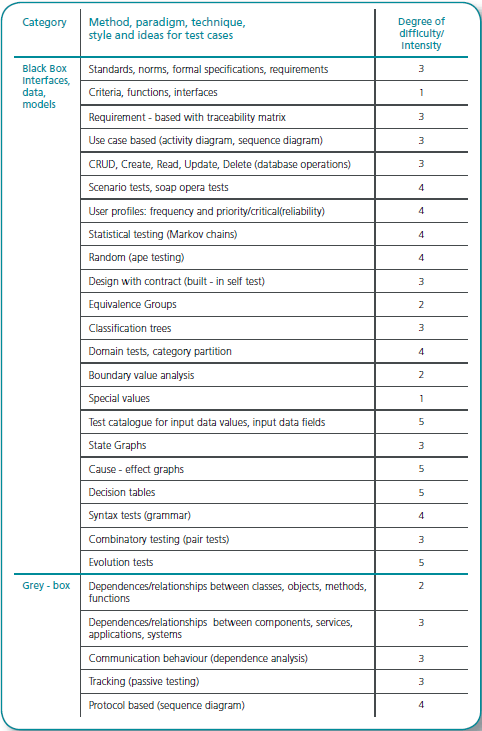
Equivalence partitioning of each parameter and boundary value analysis provides you with relevant values for dividing up the test data. When
8.5 Step Four – Advanced Testing

THE OVERARCHING PROCESS OF TEST DESIGN的更多相关文章
- Content of "Essential Software Test Design"
Content of "Essential Software Test Design" 2015-11-16 PART I 7 TEST DESIGN TECHNIQUES: AN ...
- Quality in the Test Automation Review Process and Design Review Template
About this document Prerequisite knowledge/experience: Software Testing, Test Automation Applicable ...
- Architecture Design Process
Architecture Design Process The architecture design process focuses on the decomposition of a system ...
- Effective API Design
Effective API Design */--> div.org-src-container { font-size: 85%; font-family: monospace; } Tabl ...
- How to Design a Good API and Why it Matters
前谷歌首席 Java 架构师谈如何设优秀的 API – 码农网 http://www.codeceo.com/article/google-java-good-api.html 2015-11-24 ...
- PatentTips - OpenCL compilation
BACKGROUND The present disclosure relates generally to integrated circuits, such as field programmab ...
- (转) [it-ebooks]电子书列表
[it-ebooks]电子书列表 [2014]: Learning Objective-C by Developing iPhone Games || Leverage Xcode and Obj ...
- (转) Summary of NIPS 2016
转自:http://blog.evjang.com/2017/01/nips2016.html Eric Jang Technology, A.I., Careers ...
- 11 Clever Methods of Overfitting and how to avoid them
11 Clever Methods of Overfitting and how to avoid them Overfitting is the bane of Data Science in th ...
随机推荐
- Linux使用tcpdump命令抓包并使用wireshark分析
Linux使用tcpdump命令抓包并使用wireshark分析 介绍 有时分析客户端和服务器网络交互的问题时,为了查找问题,需要分别在客户端和服务器上抓包,我们的客户端一般是windows上的,抓包 ...
- 不要再用if(xxx != null)或者try catch NullPointerException了,Optional可以帮你解决
public static void testIfPresent() { Map<String, Map<String, String>> map = new HashMap& ...
- go语言学习-接口
Go语言中虽然没有传统面向对象语言中类.集成的概念,不过提供了接口的支持,可以使用接口来使用一些面向对象的特性. 在 go 语言中,的接口有下面几个特点: 可以包含0个或多个方法的签名 只定义方法的签 ...
- java 利用Future做超时任务处理
Callable<String> task = new Callable<String>() { @Override public String call() throws E ...
- 使用OutputStream向屏幕上输出内容
使用OutputStream向屏幕上输出内容 /** * 使用OutputStream向屏幕上输出内容 */ import java.io.*; class hello { public static ...
- Android二维码学习
http://www.cnblogs.com/liuan/category/347622.html http://blog.csdn.net/xiaanming/article/details/101 ...
- python处理转义字符
python2 #1. import HTMLParser HTMLParser.HTMLParser().unescape('Suzy & John') #2. from xml.sax.s ...
- c#操作数据库的增删改查语句及DataGridView简单使用
下面是要用户名和密码连接数据库的操作: 一.定义连接字符串,用来链接SQL Server string str_con = "server=.(服务器名称一般为 . );database=W ...
- BZOJ.4589.Hard Nim(FWT)
题目链接 FWT 题意即,从所有小于\(m\)的质数中,选出\(n\)个数,使它们异或和为\(0\)的方案数. 令\(G(x)=[x是质数]\),其实就是对\(G(x)\)做\(n\)次异或卷积后得到 ...
- node+koa2获取请求参数
1.get方式: http://localhost:3000/?user=000001&body=0002&age=26 const router = require('koa-rou ...