
深入浅出Alljoyn——实例分析之远程调用(Method)篇
深入浅出就是很深入的学习了很久,还是只学了毛皮,呵呵!
服务端完整代码:
 #include <qcc/platform.h>

 #include <assert.h>

 #include <signal.h>

 #include <stdio.h>

 #include <vector>

 #include <qcc/String.h>

 #include <alljoyn/BusAttachment.h>

 #include <alljoyn/DBusStd.h>

 #include <alljoyn/AllJoynStd.h>

 #include <alljoyn/BusObject.h>

 #include <alljoyn/MsgArg.h>

 #include <alljoyn/version.h>

 #include <alljoyn/Status.h>

 using namespace std;

 using namespace qcc;

 using namespace ajn;

 /*constants*/

 static const char* INTERFACE_NAME = "org.alljoyn.Bus.sample";

 static const char* SERVICE_NAME = "org.alljoyn.Bus.sample";

 static const char* SERVICE_PATH = "/sample";

 static const SessionPort SERVICE_PORT = ;

 static volatile sig_atomic_t s_interrupt = false;

 static void SigIntHandler(int sig)

 {

     s_interrupt = true;

 }

 class BasicSampleObject : public BusObject {

   public:

     BasicSampleObject(BusAttachment& bus, const char* path) :

         BusObject(path)

     {

         /** Add the test interface to this object */

         const InterfaceDescription* exampleIntf = bus.GetInterface(INTERFACE_NAME);

         assert(exampleIntf);

         AddInterface(*exampleIntf);

         /** Register the method handlers with the object */

         const MethodEntry methodEntries[] = {

             { exampleIntf->GetMember("cat"), static_cast<MessageReceiver::MethodHandler>(&BasicSampleObject::Cat) }

         };

         QStatus status = AddMethodHandlers(methodEntries, sizeof(methodEntries) / sizeof(methodEntries[]));

         if (ER_OK != status) {

             printf("Failed to register method handlers for BasicSampleObject.\n");

         }

     }

     void ObjectRegistered()

     {

         BusObject::ObjectRegistered();

         printf("ObjectRegistered has been called.\n");

     }

     void Cat(const InterfaceDescription::Member* member, Message& msg)

     {

         /* Concatenate the two input strings and reply with the result. */

         qcc::String inStr1 = msg->GetArg()->v_string.str;

         qcc::String inStr2 = msg->GetArg()->v_string.str;

         qcc::String outStr = inStr1 + inStr2;

         MsgArg outArg("s", outStr.c_str());

         QStatus status = MethodReply(msg, &outArg, );

         if (ER_OK != status) {

             printf("Ping: Error sending reply.\n");

         }

     }

 };

 class MyBusListener : public BusListener, public SessionPortListener {

     void NameOwnerChanged(const char* busName, const char* previousOwner, const char* newOwner)

     {

         if (newOwner && ( == strcmp(busName, SERVICE_NAME))) {

             printf("NameOwnerChanged: name=%s, oldOwner=%s, newOwner=%s.\n",

                    busName,

                    previousOwner ? previousOwner : "<none>",

                    newOwner ? newOwner : "<none>");

         }

     }

     bool AcceptSessionJoiner(SessionPort sessionPort, const char* joiner, const SessionOpts& opts)

     {

         if (sessionPort != SERVICE_PORT) {

             printf("Rejecting join attempt on unexpected session port %d.\n", sessionPort);

             return false;

         }

         printf("Accepting join session request from %s (opts.proximity=%x, opts.traffic=%x, opts.transports=%x).\n",

                joiner, opts.proximity, opts.traffic, opts.transports);

         return true;

     }

 };

 /** The bus listener object. */

 static MyBusListener s_busListener;

 /** Top level message bus object. */

 static BusAttachment* s_msgBus = NULL;

 /** Create the interface, report the result to stdout, and return the result status. */

 QStatus CreateInterface(void)

 {

     /* Add org.alljoyn.Bus.method_sample interface */

     InterfaceDescription* testIntf = NULL;

     QStatus status = s_msgBus->CreateInterface(INTERFACE_NAME, testIntf);

     if (status == ER_OK) {

         printf("Interface created.\n");

         testIntf->AddMethod("cat", "ss",  "s", "inStr1,inStr2,outStr", );

         testIntf->Activate();

     } else {

         printf("Failed to create interface '%s'.\n", INTERFACE_NAME);

     }

     return status;

 }

 /** Register the bus object and connect, report the result to stdout, and return the status code. */

 QStatus RegisterBusObject(BasicSampleObject* obj)

 {

     QStatus status = s_msgBus->RegisterBusObject(*obj);

     if (ER_OK == status) {

         printf("RegisterBusObject succeeded.\n");

     } else {

         printf("RegisterBusObject failed (%s).\n", QCC_StatusText(status));

     }

     return status;

 }

 /** Connect, report the result to stdout, and return the status code. */

 QStatus ConnectBusAttachment(void)

 {

     QStatus status = s_msgBus->Connect();

     if (ER_OK == status) {

         printf("Connect to '%s' succeeded.\n", s_msgBus->GetConnectSpec().c_str());

     } else {

         printf("Failed to connect to '%s' (%s).\n", s_msgBus->GetConnectSpec().c_str(), QCC_StatusText(status));

     }

     return status;

 }

 /** Start the message bus, report the result to stdout, and return the status code. */

 QStatus StartMessageBus(void)

 {

     QStatus status = s_msgBus->Start();

     if (ER_OK == status) {

         printf("BusAttachment started.\n");

     } else {

         printf("Start of BusAttachment failed (%s).\n", QCC_StatusText(status));

     }

     return status;

 }

 /** Create the session, report the result to stdout, and return the status code. */

 QStatus CreateSession(TransportMask mask)

 {

     SessionOpts opts(SessionOpts::TRAFFIC_MESSAGES, false, SessionOpts::PROXIMITY_ANY, mask);

     SessionPort sp = SERVICE_PORT;

     QStatus status = s_msgBus->BindSessionPort(sp, opts, s_busListener);

     if (ER_OK == status) {

         printf("BindSessionPort succeeded.\n");

     } else {

         printf("BindSessionPort failed (%s).\n", QCC_StatusText(status));

     }

     return status;

 }

 /** Advertise the service name, report the result to stdout, and return the status code. */

 QStatus AdvertiseName(TransportMask mask)

 {

     QStatus status = s_msgBus->AdvertiseName(SERVICE_NAME, mask);

     if (ER_OK == status) {

         printf("Advertisement of the service name '%s' succeeded.\n", SERVICE_NAME);

     } else {

         printf("Failed to advertise name '%s' (%s).\n", SERVICE_NAME, QCC_StatusText(status));

     }

     return status;

 }

 /** Request the service name, report the result to stdout, and return the status code. */

 QStatus RequestName(void)

 {

     const uint32_t flags = DBUS_NAME_FLAG_REPLACE_EXISTING | DBUS_NAME_FLAG_DO_NOT_QUEUE;

     QStatus status = s_msgBus->RequestName(SERVICE_NAME, flags);

     if (ER_OK == status) {

         printf("RequestName('%s') succeeded.\n", SERVICE_NAME);

     } else {

         printf("RequestName('%s') failed (status=%s).\n", SERVICE_NAME, QCC_StatusText(status));

     }

     return status;

 }

 /** Wait for SIGINT before continuing. */

 void WaitForSigInt(void)

 {

     while (s_interrupt == false) {

 #ifdef _WIN32

         Sleep();

 #else

         usleep( * );

 #endif

     }

 }

 /** Main entry point */

 int main(int argc, char** argv, char** envArg)

 {

     printf("AllJoyn Library version: %s.\n", ajn::GetVersion());

     printf("AllJoyn Library build info: %s.\n", ajn::GetBuildInfo());

     /* Install SIGINT handler */

     signal(SIGINT, SigIntHandler);

     QStatus status = ER_OK;

     /* Create message bus */

     s_msgBus = new BusAttachment("myApp", true);

     if (!s_msgBus) {

         status = ER_OUT_OF_MEMORY;

     }

     if (ER_OK == status) {

         status = CreateInterface();

     }

     if (ER_OK == status) {

         s_msgBus->RegisterBusListener(s_busListener);

     }

     if (ER_OK == status) {

         status = StartMessageBus();

     }

     BasicSampleObject testObj(*s_msgBus, SERVICE_PATH);

     if (ER_OK == status) {

         status = RegisterBusObject(&testObj);

     }

     if (ER_OK == status) {

         status = ConnectBusAttachment();

     }

     /*

      * Advertise this service on the bus.

      * There are three steps to advertising this service on the bus.

      * 1) Request a well-known name that will be used by the client to discover

      *    this service.

      * 2) Create a session.

      * 3) Advertise the well-known name.

      */

     if (ER_OK == status) {

         status = RequestName();

     }

     const TransportMask SERVICE_TRANSPORT_TYPE = TRANSPORT_ANY;

     if (ER_OK == status) {

         status = CreateSession(SERVICE_TRANSPORT_TYPE);

     }

     if (ER_OK == status) {

         status = AdvertiseName(SERVICE_TRANSPORT_TYPE);

     }

     /* Perform the service asynchronously until the user signals for an exit. */

     if (ER_OK == status) {

         WaitForSigInt();

     }

     /* Clean up msg bus */

     delete s_msgBus;

     s_msgBus = NULL;

     printf("Basic service exiting with status 0x%04x (%s).\n", status, QCC_StatusText(status));

     return (int) status;

 }
服务端主流程解析:
int main(int argc, char** argv, char** envArg)

{

    /* 注册系统信号回调函数*/

    signal(SIGINT, SigIntHandler);

    /* 创建Bus连接器 */

    s_msgBus = new BusAttachment("myApp", true);

    /* 创建object 的接口*/

        status = CreateInterface();

    /*绑定总线监听器*/

        s_msgBus->RegisterBusListener(s_busListener);

    /*开启总线*/

        status = StartMessageBus();

    /*实例化对象*/

    BasicSampleObject testObj(*s_msgBus, SERVICE_PATH);

    /*总线附件上注册对象*/

        status = RegisterBusObject(&testObj);

    /*连接到总线上*/

        status = ConnectToDaemon();

    /*请求一个服务名即wellknow name*/

        status = RequestName();

    const TransportMask SERVICE_TRANSPORT_TYPE = TRANSPORT_ANY;

    /*创建一个会话*/

        status = CreateSession(SERVICE_TRANSPORT_TYPE);

    /*在总线上广播服务名*/

        status = AdvertiseName(SERVICE_TRANSPORT_TYPE);

    /* 等待用户终止 */

        WaitForSigInt();

    /* 释放资源 */

    delete s_msgBus;

    s_msgBus = NULL;

    return (int) status;

}
客户端完整代码:
 #include <qcc/platform.h>

 #include <assert.h>

 #include <signal.h>

 #include <stdio.h>

 #include <vector>

 #include <qcc/String.h>

 #include <alljoyn/BusAttachment.h>

 #include <alljoyn/version.h>

 #include <alljoyn/AllJoynStd.h>

 #include <alljoyn/Status.h>

 using namespace std;

 using namespace qcc;

 using namespace ajn;

 /** Static top level message bus object */

 static BusAttachment* g_msgBus = NULL;

 /*constants*/

 static const char* INTERFACE_NAME = "org.alljoyn.Bus.sample";

 static const char* SERVICE_NAME = "org.alljoyn.Bus.sample";

 static const char* SERVICE_PATH = "/sample";

 static const SessionPort SERVICE_PORT = ;

 static bool s_joinComplete = false;

 static SessionId s_sessionId = ;

 static volatile sig_atomic_t s_interrupt = false;

 static void SigIntHandler(int sig)

 {

     s_interrupt = true;

 }

 /** AllJoynListener receives discovery events from AllJoyn */

 class MyBusListener : public BusListener, public SessionListener {

   public:

     void FoundAdvertisedName(const char* name, TransportMask transport, const char* namePrefix)

     {

         if ( == strcmp(name, SERVICE_NAME)) {

             printf("FoundAdvertisedName(name='%s', prefix='%s')\n", name, namePrefix);

             /* We found a remote bus that is advertising basic service's well-known name so connect to it. */

             /* Since we are in a callback we must enable concurrent callbacks before calling a synchronous method. */

             g_msgBus->EnableConcurrentCallbacks();

             SessionOpts opts(SessionOpts::TRAFFIC_MESSAGES, false, SessionOpts::PROXIMITY_ANY, TRANSPORT_ANY);

             QStatus status = g_msgBus->JoinSession(name, SERVICE_PORT, this, s_sessionId, opts);

             if (ER_OK == status) {

                 printf("JoinSession SUCCESS (Session id=%d).\n", s_sessionId);

             } else {

                 printf("JoinSession failed (status=%s).\n", QCC_StatusText(status));

             }

         }

         s_joinComplete = true;

     }

     void NameOwnerChanged(const char* busName, const char* previousOwner, const char* newOwner)

     {

         if (newOwner && ( == strcmp(busName, SERVICE_NAME))) {

             printf("NameOwnerChanged: name='%s', oldOwner='%s', newOwner='%s'.\n",

                    busName,

                    previousOwner ? previousOwner : "<none>",

                    newOwner ? newOwner : "<none>");

         }

     }

 };

 /** Create the interface, report the result to stdout, and return the result status. */

 QStatus CreateInterface(void)

 {

     /* Add org.alljoyn.Bus.method_sample interface */

     InterfaceDescription* testIntf = NULL;

     QStatus status = g_msgBus->CreateInterface(INTERFACE_NAME, testIntf);

     if (status == ER_OK) {

         printf("Interface '%s' created.\n", INTERFACE_NAME);

         testIntf->AddMethod("cat", "ss",  "s", "inStr1,inStr2,outStr", );

         testIntf->Activate();

     } else {

         printf("Failed to create interface '%s'.\n", INTERFACE_NAME);

     }

     return status;

 }

 /** Start the message bus, report the result to stdout, and return the result status. */

 QStatus StartMessageBus(void)

 {

     QStatus status = g_msgBus->Start();

     if (ER_OK == status) {

         printf("BusAttachment started.\n");

     } else {

         printf("BusAttachment::Start failed.\n");

     }

     return status;

 }

 /** Handle the connection to the bus, report the result to stdout, and return the result status. */

 QStatus ConnectToBus(void)

 {

     QStatus status = g_msgBus->Connect();

     if (ER_OK == status) {

         printf("BusAttachment connected to '%s'.\n", g_msgBus->GetConnectSpec().c_str());

     } else {

         printf("BusAttachment::Connect('%s') failed.\n", g_msgBus->GetConnectSpec().c_str());

     }

     return status;

 }

 /** Register a bus listener in order to get discovery indications and report the event to stdout. */

 void RegisterBusListener(void)

 {

     /* Static bus listener */

     static MyBusListener s_busListener;

     g_msgBus->RegisterBusListener(s_busListener);

     printf("BusListener Registered.\n");

 }

 /** Begin discovery on the well-known name of the service to be called, report the result to

    stdout, and return the result status. */

 QStatus FindAdvertisedName(void)

 {

     /* Begin discovery on the well-known name of the service to be called */

     QStatus status = g_msgBus->FindAdvertisedName(SERVICE_NAME);

     if (status == ER_OK) {

         printf("org.alljoyn.Bus.FindAdvertisedName ('%s') succeeded.\n", SERVICE_NAME);

     } else {

         printf("org.alljoyn.Bus.FindAdvertisedName ('%s') failed (%s).\n", SERVICE_NAME, QCC_StatusText(status));

     }

     return status;

 }

 /** Wait for join session to complete, report the event to stdout, and return the result status. */

 QStatus WaitForJoinSessionCompletion(void)

 {

     unsigned int count = ;

     while (!s_joinComplete && !s_interrupt) {

         if ( == (count++ % )) {

             printf("Waited %u seconds for JoinSession completion.\n", count / );

         }

 #ifdef _WIN32

         Sleep();

 #else

         usleep( * );

 #endif

     }

     return s_joinComplete && !s_interrupt ? ER_OK : ER_ALLJOYN_JOINSESSION_REPLY_CONNECT_FAILED;

 }

 /** Do a method call, report the result to stdout, and return the result status. */

 QStatus MakeMethodCall(void)

 {

     ProxyBusObject remoteObj(*g_msgBus, SERVICE_NAME, SERVICE_PATH, s_sessionId);

     const InterfaceDescription* alljoynTestIntf = g_msgBus->GetInterface(INTERFACE_NAME);

     assert(alljoynTestIntf);

     remoteObj.AddInterface(*alljoynTestIntf);

     Message reply(*g_msgBus);

     MsgArg inputs[];

     inputs[].Set("s", "Hello ");

     inputs[].Set("s", "World!");

     QStatus status = remoteObj.MethodCall(SERVICE_NAME, "cat", inputs, , reply, );

     if (ER_OK == status) {

         printf("'%s.%s' (path='%s') returned '%s'.\n", SERVICE_NAME, "cat",

                SERVICE_PATH, reply->GetArg()->v_string.str);

     } else {

         printf("MethodCall on '%s.%s' failed.", SERVICE_NAME, "cat");

     }

     return status;

 }

 /** Main entry point */

 int main(int argc, char** argv, char** envArg)

 {

     printf("AllJoyn Library version: %s.\n", ajn::GetVersion());

     printf("AllJoyn Library build info: %s.\n", ajn::GetBuildInfo());

     /* Install SIGINT handler. */

     signal(SIGINT, SigIntHandler);

     QStatus status = ER_OK;

     /* Create message bus. */

     g_msgBus = new BusAttachment("myApp", true);

     /* This test for NULL is only required if new() behavior is to return NULL

      * instead of throwing an exception upon an out of memory failure.

      */

     if (!g_msgBus) {

         status = ER_OUT_OF_MEMORY;

     }

     if (ER_OK == status) {

         status = CreateInterface();

     }

     if (ER_OK == status) {

         status = StartMessageBus();

     }

     if (ER_OK == status) {

         status = ConnectToBus();

     }

     if (ER_OK == status) {

         RegisterBusListener();

         status = FindAdvertisedName();

     }

     if (ER_OK == status) {

         status = WaitForJoinSessionCompletion();

     }

     if (ER_OK == status) {

         status = MakeMethodCall();

     }

     /* Deallocate bus */

     delete g_msgBus;

     g_msgBus = NULL;

     printf("Basic client exiting with status 0x%04x (%s).\n", status, QCC_StatusText(status));

     return (int) status;

 }
客户端主流程解析:
int main(int argc, char** argv, char** envArg)

{

    printf("AllJoyn Library version: %s.\n", ajn::GetVersion());

    printf("AllJoyn Library build info: %s.\n", ajn::GetBuildInfo());

    /* 注册系统信号回调函数*/

    signal(SIGINT, SigIntHandler);

    QStatus status = ER_OK;

    /* 创建Bus连接器 */

    g_msgBus = new BusAttachment("myApp", true);

    /* This test for NULL is only required if new() behavior is to return NULL

     * instead of throwing an exception upon an out of memory failure.

     */

    if (!g_msgBus) {

        status = ER_OUT_OF_MEMORY;

    }

    /* 创建object 的接口*/

    if (ER_OK == status) {

        status = CreateInterface();

    }

    /*开启总线*/

    if (ER_OK == status) {

        status = StartMessageBus();

    }

    /*连接到总线上*/

    if (ER_OK == status) {

        status = ConnectToBus();

    }

    if (ER_OK == status) {

        RegisterBusListener();/*绑定总线监听器*/

        status = FindAdvertisedName();/*在总线上发现服务名*/

    }

    if (ER_OK == status) {

        status = WaitForJoinSessionCompletion();

    }

    /*远程调用方法*/

    if (ER_OK == status) {

        status = MakeMethodCall();

    }

    /* 释放资源 */

    delete g_msgBus;

    g_msgBus = NULL;

    printf("Basic client exiting with status 0x%04x (%s).\n", status, QCC_StatusText(status));

    return (int) status;

}
通信过程中比较重要的几点:
1、 接口由bus连接器创建和保存所以创建的实例
2、 对象具体实现接口的属性(方法,属性和信号),与具体接口绑定,作为对象对外的接口。(可以含有多个接口)
3、连接总线s_msgBus->Connect()是通过dbus方式实现的,利用了dbus中现存的方法和消息。
用下面的图可能表达的更清楚:
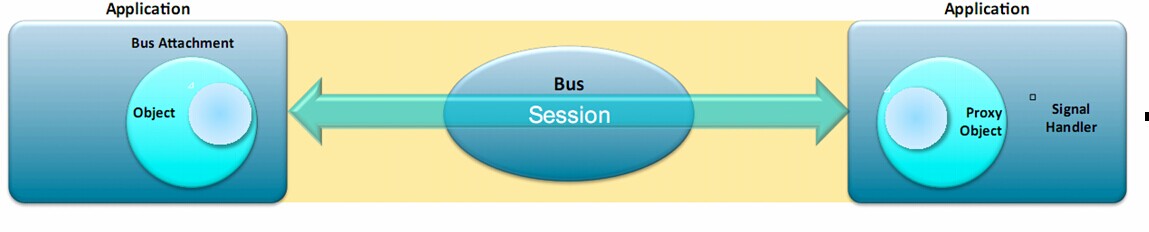
通过Bus建立好连接后,服务端的object提供接口比如说方法, 那么客户端的object只需产生一个object的代理,即可调用服务端的object提供接口,是不是比较好玩。
服务端方法调用的代码:
服务端:通过接受客户端提供的参数,并通过MethodReply()给客户端返回结果

void Cat(const InterfaceDescription::Member* member, Message& msg)

    {

        /* Concatenate the two input strings and reply with the result. */

        qcc::String inStr1 = msg->GetArg()->v_string.str;

        qcc::String inStr2 = msg->GetArg()->v_string.str;

        qcc::String outStr = inStr1 + inStr2;

        MsgArg outArg("s", outStr.c_str());

        QStatus status = MethodReply(msg, &outArg, );

        if (ER_OK != status) {

            printf("Ping: Error sending reply.\n");

        }

}
客户端方法调用的代码:
QStatus status = remoteObj.MethodCall(SERVICE_NAME, "cat", inputs, , reply, );
说了这么多,这个代码的作用是干嘛呢,就是服务端提供一个连接字符串(str1+str2)的方法,并将结果返回给客户端。当然这只是一个很简单sample,如果你将你家电视定义了换台方法的话,用手机就可以通过调用这个方法进行控制了,当然前提是你的电视和手机在一个网内!
一个人学习有时挺没意思的,那就加入q群49073007一起交流讨论吧。
深入浅出Alljoyn——实例分析之远程调用(Method)篇的更多相关文章
- Openstack Nova 源码分析 — RPC 远程调用过程
目录 目录 Nova Project Services Project 的程序入口 setuppy Nova中RPC远程过程调用 nova-compute RPC API的实现 novacompute ...
- Delphi实例分析:远程传输数据和文件
在Windows操作系统的平台上,WinSock是首选的网络编程接口,用于在网络上传输数据和交换信息,它构成了Windows操作系统进行网络编程的基础.对于编写网络应用程序来说,WinSock是一门非 ...
- 《Spring技术内幕》学习笔记17——Spring HTTP调用器实现远程调用
1.Spring中,HTTPInvoker(HTTP调用器)是通过基于HTTP协议的分布式远程调用解决方案,和java RMI一样,HTTP调用器也需要使用java的对象序列化机制完成客户端和服务器端 ...
- 【spring源码学习】spring的远程调用实现源码分析
[一]spring的远程调用提供的基础类 (1)org.springframework.remoting.support.RemotingSupport ===>spring提供实现的远程调用客 ...
- Android 学习笔记之WebService实现远程调用+内部原理分析...
PS:终于可以抽出时间写写博客了,忙着学校的三周破实训外加替考...三周了,没怎么学习...哎... 学习内容: 1.WebService 实现远程方法的调用 什么是WebService... ...
- RPC原理及RPC实例分析
在学校期间大家都写过不少程序,比如写个hello world服务类,然后本地调用下,如下所示.这些程序的特点是服务消费方和服务提供方是本地调用关系. 1 2 3 4 5 6 public class ...
- RPC-原理及RPC实例分析
还有就是:RPC支持的BIO,NIO的理解 (1)BIO: Blocking IO;同步阻塞: (2)NIO:Non-Blocking IO, 同步非阻塞; 参考:IO多路复用,同步,异步,阻塞和非阻 ...
- Dubbo源码学习总结系列二 dubbo-rpc远程调用模块
dubbo本质是一个RPC框架,我们首先讨论这个骨干中的骨干,dubbo-rpc模块. 主要讨论一下几部分内容: 一.此模块在dubbo整体框架中的作用: 二.此模块需要完成的需求功能点及接口定义: ...
- RPC原理及RPC实例分析(转)
出处:https://my.oschina.net/hosee/blog/711632 在学校期间大家都写过不少程序,比如写个hello world服务类,然后本地调用下,如下所示.这些程序的特点是服 ...
随机推荐
- SOUI与WTL
如果你想使用SOUI最好有点WTL基础,一点点就行了. SOUI不依赖于WTL,但是SOUI的编码风格基本和WTL一样的:SOUI抄袭了WTL的消息处理形式,SOUI的事件处理也是模仿了WTL的消息映 ...
- Andriod学习笔记5:通过NDK在C++中实现日志输出
开发环境 android studio 1.5.1 实现步骤 新建android项目 项目名称为AndroidCLog,选择Empty Activity模板,其他默认即可. 下载配置ndk 在项目上右 ...
- Project Euler欧拉计划
1 If we list all the natural numbers below 10 that are multiples of 3 or 5, we get 3, 5, 6 and 9. Th ...
- java时间计算,获取某月第一天和最后一天
//获取前月的第一天 SimpleDateFormat sdf = new SimpleDateFormat("yyyy/MM/dd"); //获取当前月第一天: Calendar ...
- 【多线程】java多线程 测试例子 详解wait() sleep() notify() start() join()方法 等
java实现多线程,有两种方法: 1>实现多线程,继承Thread,资源不能共享 2>实现多线程 实现Runnable接口,可以实现资源共享 *wait()方法 在哪个线程中调用 则当前 ...
- Chrome 中的彩蛋,一款小游戏,你知道吗?
今天看到一篇文章,介绍chrome中的彩蛋,带着好奇心进去看了一眼,没想到发现了一款小游戏,个人觉得还不错,偶尔可以玩一下,放松放松心情!^_^ 当 Chrome 无法连接到互联网时, 或者上着网突然 ...
- Linux学习笔记(16)-多线程
什么是多线程?或者说,什么是线程? 按照书本上的描述,所谓线程,便是包含在进程内部的顺序执行流,是进程中实际运作的单位,也是操作系统能够进行调度的最小单位. 一个进程中可以并发多条线程,每条线程并行执 ...
- (转) Android开发性能优化简介
作者:贺小令 随着技术的发展,智能手机硬件配置越来越高,可是它和现在的PC相比,其运算能力,续航能力,存储空间等都还是受到很大的限制,同时用户对手机的体验要求远远高于PC的桌面应用程序.以上理由,足以 ...
- css3clock.js - 一个用CSS3与纯js实现的简单时钟
前言 项目代码明细可以查看我Github上的源码:https://github.com/nelsonkuang/css3clock.js 实现思路 主要是用CSS3控制时针.分针和秒针旋转:时针每12 ...
- [资料分享]ACCESS2013 零基础到精通
Microsoft Office Access是由微软发布的关系数据库管理系统.它结合了 MicrosoftJet Database Engine 和 图形用户界面两项特点,是 Microsoft O ...