
Tips for writing a paper
Tips for writing a paper
- 1. Tips for Paper Writing
- 2.• Before you write a paper • When you are writing a paper • The expression
- 3.Before you start writing a paper • State your Contribution • Organize your paper structure, See Everything as a Facet on the Contribution
- 4.Before you start writing a paper: state your contribution • Think very clearly about what is your contribution in the paper, WHAT MAKES YOUR WORK DIFFERS FROM PRIOR WORK • you won’t want to claim your contribution bigger than it is. This might require you to know pretty well about other people’s work.
- 5.Before you start writing a paper • State your Contribution • Organize your paper structure, See Everything as a Facet on the Contribution
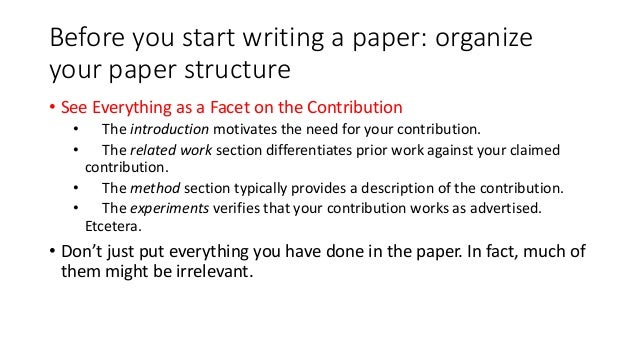
- 6.Before you start writing a paper: organize your paper structure • See Everything as a Facet on the Contribution • The introduction motivates the need for your contribution. • The related work section differentiates prior work against your claimed contribution. • The method section typically provides a description of the contribution. • The experiments verifies that your contribution works as advertised. Etcetera. • Don’t just put everything you have done in the paper. In fact, much of them might be irrelevant.
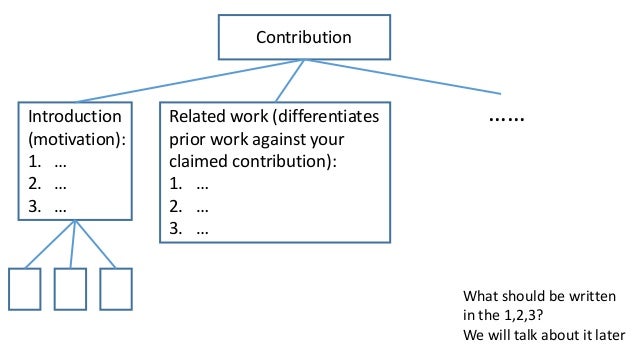
- 7.Contribution Introduction (motivation): 1. … 2. … 3. … Related work (differentiates prior work against your claimed contribution): 1. … 2. … 3. … …… What should be written in the 1,2,3? We will talk about it later
- 8.When you are writing • A formal writing pattern • Provide Continuation Markers • Ideal Structure of a Paragraph
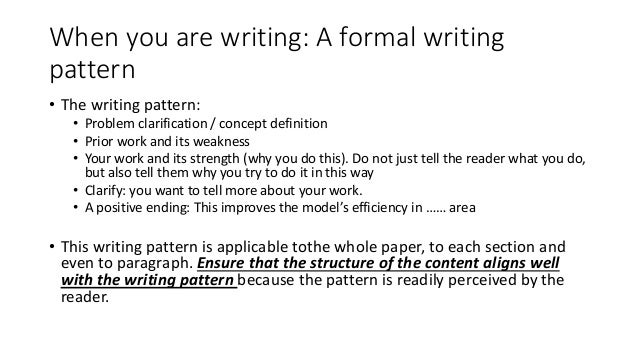
- 9.When you are writing: A formal writing pattern • The writing pattern: • Problem clarification / concept definition • Prior work and its weakness • Your work and its strength (why you do this). Do not just tell the reader what you do, but also tell them why you try to do it in this way • Clarify: you want to tell more about your work. • A positive ending: This improves the model’s efficiency in …… area • This writing pattern is applicable tothe whole paper, to each section and even to paragraph. Ensure that the structure of the content aligns well with the writing pattern because the pattern is readily perceived by the reader.
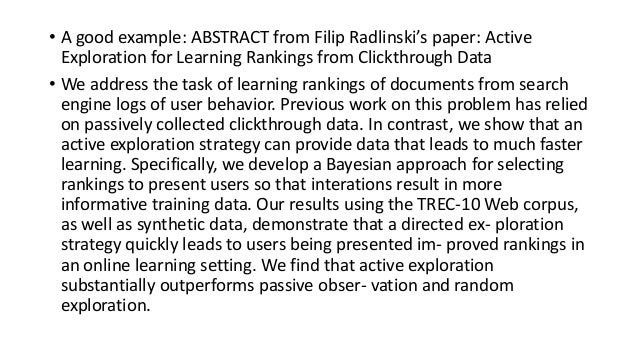
- 10.• A good example: ABSTRACT from Filip Radlinski’s paper: Active Exploration for Learning Rankings from Clickthrough Data • We address the task of learning rankings of documents from search engine logs of user behavior. Previous work on this problem has relied on passively collected clickthrough data. In contrast, we show that an active exploration strategy can provide data that leads to much faster learning. Specifically, we develop a Bayesian approach for selecting rankings to present users so that interations result in more informative training data. Our results using the TREC-10 Web corpus, as well as synthetic data, demonstrate that a directed ex- ploration strategy quickly leads to users being presented im- proved rankings in an online learning setting. We find that active exploration substantially outperforms passive obser- vation and random exploration.
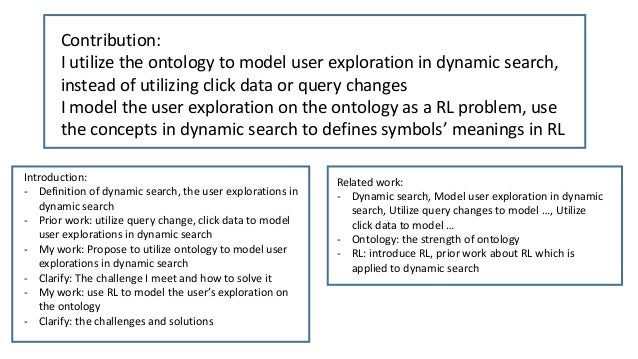
- 11.Contribution: I utilize the ontology to model user exploration in dynamic search, instead of utilizing click data or query changes I model the user exploration on the ontology as a RL problem, use the concepts in dynamic search to defines symbols’ meanings in RL Introduction: - Definition of dynamic search, the user explorations in dynamic search - Prior work: utilize query change, click data to model user explorations in dynamic search - My work: Propose to utilize ontology to model user explorations in dynamic search - Clarify: The challenge I meet and how to solve it - My work: use RL to model the user’s exploration on the ontology - Clarify: the challenges and solutions Related work: - Dynamic search, Model user exploration in dynamic search, Utilize query changes to model …, Utilize click data to model … - Ontology: the strength of ontology - RL: introduce RL, prior work about RL which is applied to dynamic search
- 12.When you are writing • A formal writing pattern • Provide Continuation Markers • Ideal Structure of a Paragraph
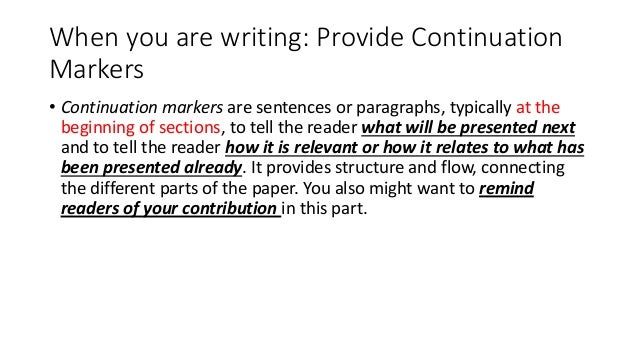
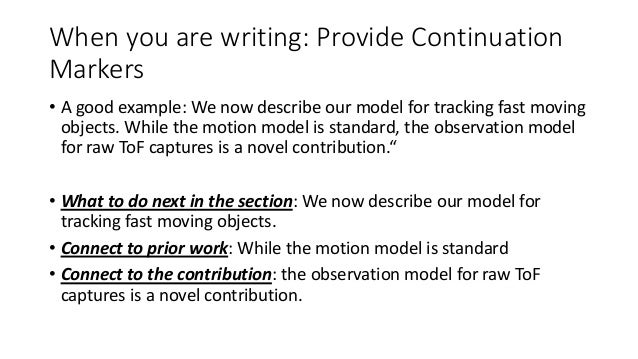
- 13.When you are writing: Provide Continuation Markers • Continuation markers are sentences or paragraphs, typically at the beginning of sections, to tell the reader what will be presented next and to tell the reader how it is relevant or how it relates to what has been presented already. It provides structure and flow, connecting the different parts of the paper. You also might want to remind readers of your contribution in this part.
- 14.• A good example: We now describe our model for tracking fast moving objects. While the motion model is standard, the observation model for raw ToF captures is a novel contribution.“ • What to do next in the section: We now describe our model for tracking fast moving objects. • Connect to prior work: While the motion model is standard • Connect to the contribution: the observation model for raw ToF captures is a novel contribution. When you are writing: Provide Continuation Markers
- 15.When you are writing • A formal writing pattern • Provide Continuation Markers • Ideal Structure of a Paragraph
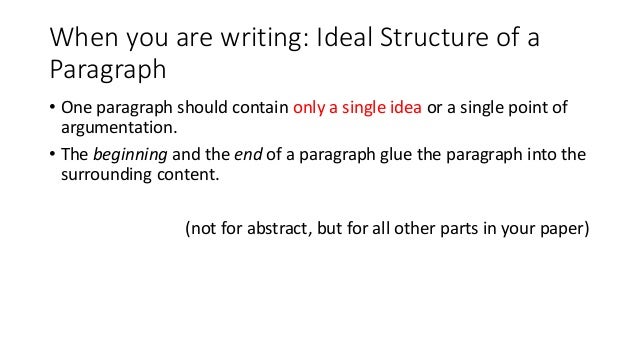
- 16.When you are writing: Ideal Structure of a Paragraph • One paragraph should contain only a single idea or a single point of argumentation. • The beginning and the end of a paragraph glue the paragraph into the surrounding content. (not for abstract, but for all other parts in your paper)
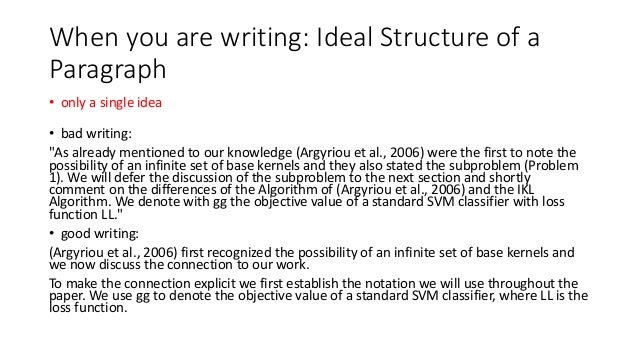
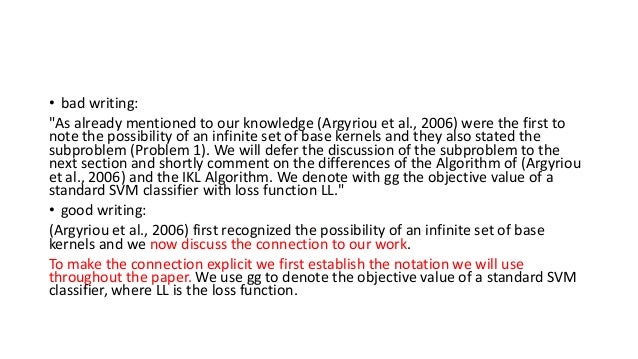
- 17.When you are writing: Ideal Structure of a Paragraph • only a single idea • bad writing: "As already mentioned to our knowledge (Argyriou et al., 2006) were the first to note the possibility of an infinite set of base kernels and they also stated the subproblem (Problem 1). We will defer the discussion of the subproblem to the next section and shortly comment on the differences of the Algorithm of (Argyriou et al., 2006) and the IKL Algorithm. We denote with gg the objective value of a standard SVM classifier with loss function LL." • good writing: (Argyriou et al., 2006) first recognized the possibility of an infinite set of base kernels and we now discuss the connection to our work. To make the connection explicit we first establish the notation we will use throughout the paper. We use gg to denote the objective value of a standard SVM classifier, where LL is the loss function.
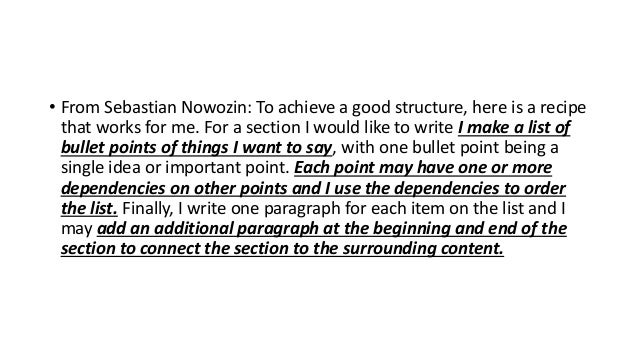
- 18.• From Sebastian Nowozin: To achieve a good structure, here is a recipe that works for me. For a section I would like to write I make a list of bullet points of things I want to say, with one bullet point being a single idea or important point. Each point may have one or more dependencies on other points and I use the dependencies to order the list. Finally, I write one paragraph for each item on the list and I may add an additional paragraph at the beginning and end of the section to connect the section to the surrounding content.
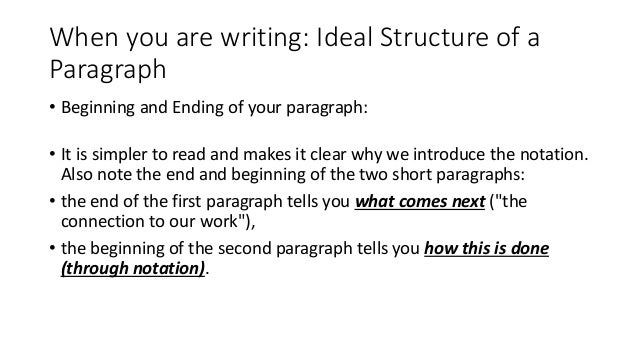
- 19.When you are writing: Ideal Structure of a Paragraph • Beginning and Ending of your paragraph: • It is simpler to read and makes it clear why we introduce the notation. Also note the end and beginning of the two short paragraphs: • the end of the first paragraph tells you what comes next ("the connection to our work"), • the beginning of the second paragraph tells you how this is done (through notation).
- 20.• bad writing: "As already mentioned to our knowledge (Argyriou et al., 2006) were the first to note the possibility of an infinite set of base kernels and they also stated the subproblem (Problem 1). We will defer the discussion of the subproblem to the next section and shortly comment on the differences of the Algorithm of (Argyriou et al., 2006) and the IKL Algorithm. We denote with gg the objective value of a standard SVM classifier with loss function LL." • good writing: (Argyriou et al., 2006) first recognized the possibility of an infinite set of base kernels and we now discuss the connection to our work. To make the connection explicit we first establish the notation we will use throughout the paper. We use gg to denote the objective value of a standard SVM classifier, where LL is the loss function.
- 21.Pay attention to your expression • Use Simple Language • Avoid Ambiguous Relative Pronouns (This, These, That, Which)
- 22.Use Simple Language • Concepts and ideas in scientific papers can at times be complex but the writing used to describe them should remain simple. Simple writing has short sentences, a clear logical structure, and uses minimal jargon. Writing papers is not poetry but still requires you to pay attention to the language you use. Use Simple Language
- 23.Avoid Ambiguous Relative Pronouns (This, These, That, Which) • When used properly, a relative pronoun, such as "this", "these", "that", "which", can effectively refer to a previously mentioned noun, and that has to be remembered by the reader. • In the previous sentence, which entity did "that" refer to? Is it "a previously mentioned noun"? Or is it "a relative pronoun"? Or is it the proper use?
Tips for writing a paper的更多相关文章
- 写出完美论文的十个技巧10 Tips for Writing the Perfect Paper
10 Tips for Writing the Perfect Paper Like a gourmet meal or an old master painting, the perfect col ...
- Ten Tips for Writing CS Papers, Part 2
Ten Tips for Writing CS Papers, Part 2 This continues the first part on tips to write computer scien ...
- Ten Tips for Writing CS Papers, Part 1
Ten Tips for Writing CS Papers, Part 1 As a non-native English speaker I can relate to the challenge ...
- 10 Tips for Writing Better Code (阅读理解)
出发点 http://www.tuicool.com/articles/A7VrE33 阅读中文版本<编写质优代码的十个技巧>,对于我编码十年的经验,也有相同感受, 太多的坑趟过,太多的经 ...
- 17 Tips For Writing An Excellent Email Subject Line
Out of the billions of emails that are sent every day, how can you make sure that yours stands out? ...
- 10 Useeful Tips for Writing Effective Bash Scripts in Linux
1.Always Use Comments in Scripts2.Make a Scripts exit When Fails Sometimes bash may continue to e ...
- Writing your first academic paper
Writing your first academic paper If you are working in academics (and you are if you are working wi ...
- Writing buffer overflow exploits - a tutorial for beginners
Buffer overflows in user input dependent buffers have become one of the biggest security hazards on ...
- 科学论文写作 Tips
感觉还是课程中给的英文描述会比较好,所以笔记大多数还是以老师的原英文 PPT 为主 1 Steps in the Writing Process 如何开展论文写作以及各个步骤的时间分配 1-1 Pre ...
随机推荐
- SpringMVC学习--数据回显
简介 表单提交失败需要再回到表单页面重新填写,原来提交的数据需要重新在页面上显示. 简单数据类型 对于简单数据类型,如:Integer.String.Float等使用Model将传入的参数再放到req ...
- Shell命令_case
语法: case "变量" in "变量1") ... ;; #输出两个分号 "变量2") ...
- Html-Css标签lable中定义宽度需要其他的支持
lable的标签如果定义了width,如果要使起生效,则需要定义display width: 130px; display: inline-block;
- java基础1.0::Java面向对象、面向对象封装、抽象类、接口、static、final
一.前言 一直以来都是拿来主义,向大神学习,从网上找资料,现在就把自己在工作中和学习中的所理解的知识点写出来,好记星不如烂笔头,一来可以作为笔记自己温习,二来也可以给走在求学之路的同学们一点参考意见, ...
- iPhone SDK 包含哪些东西?
iPhone SDK 包含哪些东西? 本文转载自:http://www.cnblogs.com/jy578154186/archive/2013/02/27/2934881.html 第一部分: 在使 ...
- Struts2拦截器模拟
前言: 接触Struts2已经有一段时间,Student核心内容就是通过拦截器对接Action,实现View层的控制跳转.本文根据自身理解对Struts2进行一个Java实例的模拟,方便大家理解! 示 ...
- shell 常用小命令总结
1. 重命名 1) 较简单的处理命令:mv 原文件名 新文件名 如:mv myFile newName ### 将MyFile重命名为newN ...
- BZOJ 4325: NOIP2015 斗地主
4325: NOIP2015 斗地主 Time Limit: 30 Sec Memory Limit: 1024 MBSubmit: 684 Solved: 456[Submit][Status] ...
- 【poj1177】 Picture
http://poj.org/problem?id=1177 (题目链接) 题意 求矩形周长并. Solution 转自:http://www.cnblogs.com/Booble/archive/2 ...
- CLR/.NET/C#/Visual Studio/ASP.NET各版本之间的关系(转)
由于这篇文章记录的是2015年7月,那时.net core还是叫做.net core 5 名词定义 下列这些名词,写.NET 的人一定都不陌生,但你是否有真正理解呢?如果看了我的摘要文字说明还无法理解 ...