
Bounded Context
From http://martinfowler.com/bliki/BoundedContext.html
Bounded Context is a central pattern in Domain-Driven Design. It is the focus of DDD's strategic design section which is all about dealing with large models and teams. DDD deals with large models by dividing them into different Bounded Contexts and being explicit about their interrelationships.
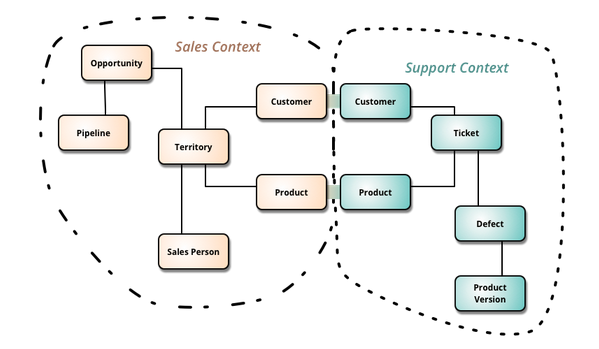
DDD is about designing software based on models of the underlying domain. A model acts as a UbiquitousLanguage to help communication between software developers and domain experts. It also acts as the conceptual foundation for the design of the software itself - how it's broken down into objects or functions. To be effective, a model needs to unified - that is to be internally consistent so that there are no contradictions within it.
As you try to model a larger domain, it gets progressively harder to build a single unified model. Different groups of people will use subtly different vocabularies in different parts of a large organization. The precision of modeling rapidly runs into this, often to leading to a lot of confusion. Typically this confusion focuses on the central concepts of the domain. Early in my career I worked with a electricity utility - here the word "meter" meant subtly different things to different parts of the organization: was it the connection between the grid and a location, the grid and a customer, the physical meter itself (which could be replaced if faulty). These subtle polysemes could be smoothed over in conversation but not in the precise world of computers. Time and time again I see this confusion recur with polysemes like "Customer" and "Product".
In those younger days we were advised to build a unified model of the entire business, but DDD recognizes that we've learned that "total unification of the domain model for a large system will not be feasible or cost-effective" [1]. So instead DDD divides up a large system into Bounded Contexts, each of which can have a unified model - essentially a way of structuringMultipleCanonicalModels.
Bounded Contexts have both unrelated concepts (such as a support ticket only existing in a customer support context) but also share concepts (such as products and customers). Different contexts may have completely different models of common concepts with mechanisms to map between these polysemic concepts for integration. Several DDD patterns explore alternative relationships between contexts.
Various factors draw boundaries between contexts. Usually the dominant one is human culture, since models act as Ubiquitous Language, you need a different model when the language changes. You also find multiple contexts within the same domain context, such as the separation between in-memory and relational database models in a single application. This boundary is set by the different way we represent models.
DDD's strategic design goes on to describe a variety of ways that you have relationships between Bounded Contexts. It's usually worthwhile to depict these using a context map.
Further Reading
The canonical source for DDD is Eric Evans's book
Vaughn Vernon's Implementing Domain-Driven Design
I love software books that are both old and still-relevant. One of my favorite such books is William Kent's Data and Reality
Eric Evans describes how an explicit use of a bounded context can allow teams to graft new functionality in legacy systems using a bubble context. The example illustrates how related Bounded Contexts have similar yet distinct models and how you can map between them.
Notes
1: Eric Evans in Domain-Driven Design
Bounded Context的更多相关文章
- 区分DDD中的Domain, Subdomain, Bounded Context, Problem/Solution Space
区分DDD中的Domain, Subdomain, Bounded Context, Problem/Solution Space 译自: Domain, Subdomain, Bounded Con ...
- DDD:Strategic Domain Driven Design with Context Mapping
Introduction Many approaches to object oriented modeling tend not to scale well when the application ...
- 浅谈我对DDD领域驱动设计的理解
从遇到问题开始 当人们要做一个软件系统时,一般总是因为遇到了什么问题,然后希望通过一个软件系统来解决. 比如,我是一家企业,然后我觉得我现在线下销售自己的产品还不够,我希望能够在线上也能销售自己的产品 ...
- DDD 领域驱动设计-商品建模之路
最近在做电商业务中,有关商品业务改版的一些东西,后端的架构设计采用现在很流行的微服务,有关微服务的简单概念: 微服务是一种架构风格,一个大型复杂软件应用由一个或多个微服务组成.系统中的各个微服务可被独 ...
- DDD实践切入点(二)
最近发现下面关于上下文的理解有些问题,不太好改,暂时先不改了 承前:大型系统的支撑,应用系统开发思想的变迁,DDD实践切入点(一) 从大比例结构入手已经开始了系统的建设,大家都知道需求是会不断变化不断 ...
- DDD实践切入点(一)
前两篇:大型系统的支撑,应用系统开发思想的变迁 之前大致说了使用DDD的前期准备,现在可以真正开始实践了,以我刚刚结束的一个简单的经典DDD方式的项目为例子,当然由于比较简单,所以很多时候会脱离它来介 ...
- IDDD 实现领域驱动设计-理解限界上下文
上一篇:<IDDD 实现领域驱动设计-理解领域和子域> <实现领域驱动设计>前两章内容,基本上读完了,和<领域驱动设计>不同的是,它把很多的概念都放在前面进行讲述了 ...
- CloudNotes之领域建模篇:领域模型简介
CloudNotes领域模型还是相对简单的,并不一定需要采用面向领域驱动的设计方法来解决CloudNotes的领域问题.但出于以下几个方面的原因,我还是采用了面向领域驱动的方式来开发CloudNote ...
- 微服务(Microservices)—Martin Fowler【翻译】
本文转载自:http://www.cnblogs.com/liuning8023/p/4493156.html -------------------------------------------- ...
随机推荐
- js获取url参数,操作url参数
function getParam(key) { var tmp = location.search; tmp = decodeURIComponent(tmp); var index = tmp.i ...
- cocos2d Programming Guide
http://python.cocos2d.org/doc/programming_guide/index.html The cocos2d Programming Guide provides in ...
- C 语言中char* 和const char*的区别
const char *p = "123"; p[1] = '3'; // 会报错p = "456"; // 不会报错 const char * 只是说指针指向 ...
- [Oracle] oracle统计信息
Oracle统计信息 Oracle数据库里的统计信息可以分为6种类型: 表的统计信息 索引的统计信息 列的统计信息 系统统计信息 数据字典统计信息 内部对象统计信息 图 1: Oracle统计信息 基 ...
- 转 Scrapy笔记(5)- Item详解
Item是保存结构数据的地方,Scrapy可以将解析结果以字典形式返回,但是Python中字典缺少结构,在大型爬虫系统中很不方便. Item提供了类字典的API,并且可以很方便的声明字段,很多Scra ...
- windwos grpc 编译
此文档是windwos grpc c++ 编译 ,基于 vs2015 编译完成 获取gRPC源码 gRPC是开源框架,项目代码在github上,所以首先要安装github.github安装后,在指定文 ...
- 携程ELK
http://www.360doc.com/content/15/1203/00/26186435_517522477.shtml
- (5)C#运算符
运算符 参照javase (7)java基础知识-原码.反码.补码.运算符
- 用SparkSQL构建用户画像
用SparkSQL构建用户画像 二. 前言 大数据时代已经到来,企业迫切希望从已经积累的数据中分析出有价值的东西,而用户行为的分析尤为重要. 利用大数据来分析用户的行为与消费习惯,可以预测商品的发展 ...
- 多层代理获取用户真实IP
1. 几个概念remote_addr:如果中间没有代理,这个就是客户端的真实IP,如果有代理,这就是上层代理的IP.X-Forwarded-For:一个HTTP扩展头,格式为 X-Forwarded- ...