
9.3AspectJ
1.1 介绍
AspectJ是一个基于Java语言的AOP框架
Spring2.0以后新增了对AspectJ切点表达式支持
@AspectJ 是AspectJ1.5新增功能,通过JDK5注解技术,允许直接在Bean类中定义切面
新版本Spring框架,建议使用AspectJ方式来开发AOP
主要用途:自定义开发
切入点表达式【掌握】
1.execution() 用于描述方法 【掌握】
语法:execution(修饰符 返回值 包.类.方法名(参数) throws异常)
修饰符,一般省略
public 公共方法
* 任意
返回值,不能省略
void 返回没有值
String 返回值字符串
* 任意
包,[省略]
com.itheima.crm 固定包
com.itheima.crm.*.service crm包下面子包任意 (例如:com.itheima.crm.staff.service)
com.itheima.crm.. crm包下面的所有子包(含自己)
com.itheima.crm.*.service.. crm包下面任意子包,固定目录service,service目录任意包
类,[省略]
UserServiceImpl 指定类
*Impl 以Impl结尾
User* 以User开头
* 任意
方法名,不能省略
addUser 固定方法
add* 以add开头
*Do 以Do结尾
* 任意
(参数)
() 无参
(int) 一个整型
(int ,int) 两个
(..) 参数任意
throws ,可省略,一般不写。
综合1
execution(* com.itheima.crm.*.service..*.*(..))
综合2
<aop:pointcut expression="execution(* com.itheima.*WithCommit.*(..)) ||
execution(* com.itheima.*Service.*(..))" id="myPointCut"/>
2.within:匹配包或子包中的方法(了解)
within(com.itheima.aop..*)
3.this:匹配实现接口的代理对象中的方法(了解)
this(com.itheima.aop.user.UserDAO)
4.target:匹配实现接口的目标对象中的方法(了解)
target(com.itheima.aop.user.UserDAO)
5.args:匹配参数格式符合标准的方法(了解)
args(int,int)
6.bean(id) 对指定的bean所有的方法(了解)
bean('userServiceId')
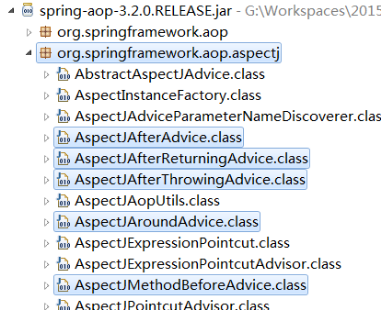
1.3 AspectJ 通知类型
laop联盟定义通知类型,具有特性接口,必须实现,从而确定方法名称。
laspectj 通知类型,只定义类型名称。已经方法格式。
个数:6种,知道5种,掌握1中。
before:前置通知(应用:各种校验)
在方法执行前执行,如果通知抛出异常,阻止方法运行
afterReturning:后置通知(应用:常规数据处理)
方法正常返回后执行,如果方法中抛出异常,通知无法执行
必须在方法执行后才执行,所以可以获得方法的返回值。
around:环绕通知(应用:十分强大,可以做任何事情)
方法执行前后分别执行,可以阻止方法的执行
必须手动执行目标方法
afterThrowing:抛出异常通知(应用:包装异常信息)
方法抛出异常后执行,如果方法没有抛出异常,无法执行
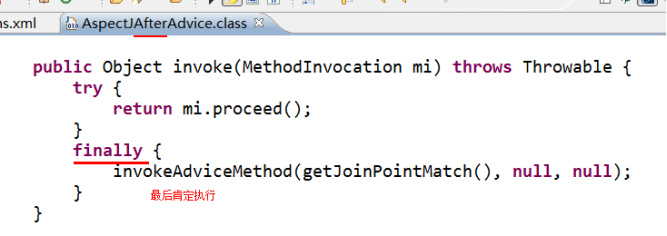
after:最终通知(应用:清理现场)
方法执行完毕后执行,无论方法中是否出现异常
环绕

try{

     //前置:before

    //手动执行目标方法

    //后置:afterRetruning

} catch(){

    //抛出异常 afterThrowing

} finally{

    //最终 after

}


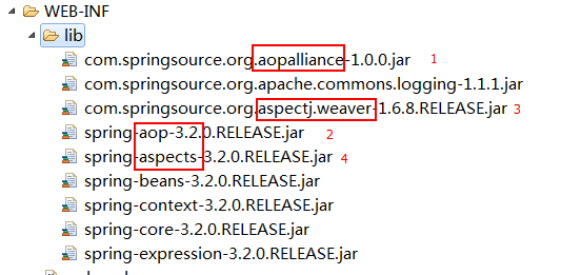
1.1 导入jar包
l 4个:
aop联盟规范
spring aop 实现
aspect 规范
spring aspect 实现
一、 基于xml
1.目标类:接口 + 实现
2.切面类:编写多个通知,采用aspectj 通知名称任意(方法名任意)
3.aop编程,将通知应用到目标类
4.测试
切面类
MyAspect.java
package com.jd.proxy.aspect.xml;

import org.aspectj.lang.JoinPoint;
import org.aspectj.lang.ProceedingJoinPoint;

/**
 * 切面类,含有多个通知
 */
public class MyAspect {

   public void myBefore(JoinPoint joinPoint){
      System.out.println("前置通知 : " + joinPoint.getSignature().getName());
   }

   public void myAfterReturning(JoinPoint joinPoint,Object ret){
      System.out.println("后置通知 : " + joinPoint.getSignature().getName() + " , -->" + ret);
   }

   public Object myAround(ProceedingJoinPoint joinPoint) throws Throwable{
      System.out.println("前");
      //手动执行目标方法
      Object obj = joinPoint.proceed();

      System.out.println("后");
      return obj;
   }

   public void myAfterThrowing(JoinPoint joinPoint,Throwable e){
      System.out.println("抛出异常通知 : " + e.getMessage());
   }

   public void myAfter(JoinPoint joinPoint){
      System.out.println("最终通知");
   }

}
spring配置
beans.xml
<?xml version="1.0" encoding="UTF-8"?>

<beans xmlns="http://www.springframework.org/schema/beans"

       xmlns:xsi="http://www.w3.org/2001/XMLSchema-instance"

       xmlns:aop="http://www.springframework.org/schema/aop"

       xsi:schemaLocation="http://www.springframework.org/schema/beans

                              http://www.springframework.org/schema/beans/spring-beans.xsd

                              http://www.springframework.org/schema/aop

                              http://www.springframework.org/schema/aop/spring-aop.xsd">

    <!--  创建目标类 -->

    <bean id="userServiceId" class="com.jd.proxy.aspect.xml.UserServiceImpl"></bean>

    <!--  创建切面类(通知) -->

    <bean id="myAspectId" class="com.jd.proxy.aspect.xml.MyAspect"></bean>

    <!--  aop编程

        <aop:aspect> 将切面类 声明“切面”,从而获得通知(方法)

            ref 切面类引用

        <aop:pointcut> 声明一个切入点,所有的通知都可以使用。

            expression 切入点表达式

            id 名称,用于其它通知引用

    -->

    <aop:config>

        <aop:aspect ref="myAspectId">

            <aop:pointcut expression="execution(* com.jd.proxy.aspect.xml.UserServiceImpl.*(..))" id="myPointCut"/>

            <!-- 3.1 前置通知

                <aop:before method="" pointcut="" pointcut-ref=""/>

                    method : 通知,及方法名

                    pointcut :切入点表达式,此表达式只能当前通知使用。

                    pointcut-ref : 切入点引用,可以与其他通知共享切入点。

                通知方法格式:public void myBefore(JoinPoint joinPoint){

                    参数1:org.aspectj.lang.JoinPoint  用于描述连接点(目标方法),获得目标方法名等

                例如:

            <aop:before method="myBefore" pointcut-ref="myPointCut"/>

            -->

            <!-- .2后置通知  ,目标方法后执行,获得返回值

                <aop:after-returning method="" pointcut-ref="" returning=""/>

                    returning 通知方法第二个参数的名称

                通知方法格式:public void myAfterReturning(JoinPoint joinPoint,Object ret){

                    参数1:连接点描述

                    参数2:类型Object,参数名 returning="ret" 配置的

                例如:

            <aop:after-returning method="myAfterReturning" pointcut-ref="myPointCut" returning="ret" />

            -->

            <!-- 3.3 环绕通知

                <aop:around method="" pointcut-ref=""/>

                通知方法格式:public Object myAround(ProceedingJoinPoint joinPoint) throws Throwable{

                    返回值类型:Object

                    方法名:任意

                    参数:org.aspectj.lang.ProceedingJoinPoint

                    抛出异常

                执行目标方法:Object obj = joinPoint.proceed();

                例如:

            <aop:around method="myAround" pointcut-ref="myPointCut"/>

            -->

            <!-- 3.4 抛出异常

                <aop:after-throwing method="" pointcut-ref="" throwing=""/>

                    throwing :通知方法的第二个参数名称

                通知方法格式:public void myAfterThrowing(JoinPoint joinPoint,Throwable e){

                    参数1:连接点描述对象

                    参数2:获得异常信息,类型Throwable ,参数名由throwing="e" 配置

                例如:

            <aop:after-throwing method="myAfterThrowing" pointcut-ref="myPointCut" throwing="e"/>

            -->

            <!-- 3.5 最终通知 -->

            <aop:after method="myAfter" pointcut-ref="myPointCut"/>

        </aop:aspect>

    </aop:config>

</beans>
UserService.java
package com.jd.proxy.aspect.xml;

public interface UserService {

    public void addUser();

    public String updateUser();

    public void deleteUser();

}
UserServiceImpl.java
package com.jd.proxy.aspect.xml;

public class UserServiceImpl implements UserService {

    @Override

    public void addUser() {

        System.out.println("d_aspect.a_xml addUser");

    }

    @Override

    public String updateUser() {

        System.out.println("d_aspect.a_xml updateUser");

//        int i = 1/ 0;

        return "阳志就是屌";

    }

    @Override

    public void deleteUser() {

        System.out.println("d_aspect.a_xml deleteUser");

    }

}
TestAspectXml.java
package com.jd.proxy.aspect.xml;

import org.junit.Test;

import org.springframework.context.ApplicationContext;

import org.springframework.context.support.ClassPathXmlApplicationContext;

public class TestAspectXml {

    @Test

    public void demoAspect(){

        String xmlPath = "com/jd/proxy/aspect/xml/beans.xml";

        ApplicationContext applicationContext = new ClassPathXmlApplicationContext(xmlPath);

        //获得目标类

        UserService userService = (UserService) applicationContext.getBean("userServiceId");

        userService.addUser();

        userService.updateUser();

        userService.deleteUser();

    }

}
二、 基于注解
1.1.1 替换bean
<!--  创建目标类 -->

<bean id="userServiceId" class="com.itheima.d_aspect.b_anno.UserServiceImpl"></bean>

<!--  创建切面类(通知) -->

<bean id="myAspectId" class="com.itheima.d_aspect.b_anno.MyAspect"></bean>
注意:扫描
<beans xmlns="http://www.springframework.org/schema/beans"

       xmlns:xsi="http://www.w3.org/2001/XMLSchema-instance"

       xmlns:context="http://www.springframework.org/schema/context"

       xmlns:aop="http://www.springframework.org/schema/aop"

       xsi:schemaLocation="http://www.springframework.org/schema/beans

          http://www.springframework.org/schema/beans/spring-beans.xsd

          http://www.springframework.org/schema/aop

          http://www.springframework.org/schema/aop/spring-aop.xsd

          http://www.springframework.org/schema/context

          http://www.springframework.org/schema/context/spring-context.xsd">

<!-- .扫描 注解类 -->

<context:component-scan base-package="com.itheima.d_aspect.b_anno"></context:component-scan>
替换aop
必须进行aspectj 自动代理
<!-- .确定 aop注解生效 -->

<aop:aspectj-autoproxy></aop:aspectj-autoproxy>
声明切面
<aop:aspect ref="myAspectId">
替换前置通知
<aop:before method="myBefore" pointcut="execution(* com.itheima.d_aspect.b_anno.UserServiceImpl.*(..))"/>
//切入点当前有效
@Before("execution(* com.itheima.d_aspect.b_anno.UserServiceImpl.*(..))")
public void myBefore(JoinPoint joinPoint){
System.out.println("前置通知 : " + joinPoint.getSignature().getName());
}
替换 公共切入点
<aop:pointcut expression="execution(* com.itheima.d_aspect.b_anno.UserServiceImpl.*(..))" id="myPointCut"/>
//声明公共切入点

@Pointcut("execution(* com.itheima.d_aspect.b_anno.UserServiceImpl.*(..))")

private void myPointCut(){

}
替换后置
<aop:after-returning method="myAfterReturning" pointcut-ref="myPointCut" returning="ret" />
@AfterReturning(value="myPointCut()" ,returning="ret")

public void myAfterReturning(JoinPoint joinPoint,Object ret){

System.out.println("后置通知 : " + joinPoint.getSignature().getName() + " , -->" + ret);

}
替换环绕
<aop:around method="myAround" pointcut-ref="myPointCut"/>
@Around(value = "myPointCut()")

public Object myAround(ProceedingJoinPoint joinPoint) throws Throwable{

System.out.println("前");

//手动执行目标方法

Object obj = joinPoint.proceed();

System.out.println("后");

return obj;

}
替换抛出异常
<aop:after-throwing method="myAfterThrowing" pointcut="execution(* com.itheima.d_aspect.b_anno.UserServiceImpl.*(..))" throwing="e"/>
@AfterThrowing(value="execution(* com.itheima.d_aspect.b_anno.UserServiceImpl.*(..))" ,throwing="e")

public void myAfterThrowing(JoinPoint joinPoint,Throwable e){

System.out.println("抛出异常通知 : " + e.getMessage());

}
整体代码
UserServiceImpl.java
package com.jd.proxy.aspect.anno;

import org.springframework.stereotype.Service;

@Service("userServiceId")

public class UserServiceImpl implements UserService {

    @Override

    public void addUser() {

        System.out.println("d_aspect.b_anno addUser");

    }

    @Override

    public String updateUser() {

        System.out.println("d_aspect.b_anno updateUser");

        int i = / ;

        return "阳志就是屌";

    }

    @Override

    public void deleteUser() {

        System.out.println("d_aspect.b_anno deleteUser");

    }

}
UserService.java
package com.jd.proxy.aspect.anno;

public interface UserService {

    public void addUser();

    public String updateUser();

    public void deleteUser();

}
MyAspect.java
package com.jd.proxy.aspect.anno;

import org.aspectj.lang.JoinPoint;

import org.aspectj.lang.ProceedingJoinPoint;

import org.aspectj.lang.annotation.After;

import org.aspectj.lang.annotation.AfterReturning;

import org.aspectj.lang.annotation.AfterThrowing;

import org.aspectj.lang.annotation.Around;

import org.aspectj.lang.annotation.Aspect;

import org.aspectj.lang.annotation.Before;

import org.aspectj.lang.annotation.Pointcut;

import org.springframework.stereotype.Component;

/**

 * 切面类,含有多个通知

 */

@Component

@Aspect

public class MyAspect {

    //切入点当前有效

//    @Before("execution(* com.jd.proxy.aspect.anno.UserServiceImpl.*(..))")

    public void myBefore(JoinPoint joinPoint){

        System.out.println("前置通知 : " + joinPoint.getSignature().getName());

    }

    //声明公共切入点

    @Pointcut("execution(* com.jd.proxy.aspect.anno.UserServiceImpl.*(..))")

    private void myPointCut(){

    }

//    @AfterReturning(value="myPointCut()" ,returning="ret")

    public void myAfterReturning(JoinPoint joinPoint,Object ret){

        System.out.println("后置通知 : " + joinPoint.getSignature().getName() + " , -->" + ret);

    }

//    @Around(value = "myPointCut()")

    public Object myAround(ProceedingJoinPoint joinPoint) throws Throwable{

        System.out.println("前");

        //手动执行目标方法

        Object obj = joinPoint.proceed();

        System.out.println("后");

        return obj;

    }

//    @AfterThrowing(value="execution(* com.jd.proxy.aspect.anno.UserServiceImpl.*(..))" ,throwing="e")

    public void myAfterThrowing(JoinPoint joinPoint,Throwable e){

        System.out.println("抛出异常通知 : " + e.getMessage());

    }

    @After("myPointCut()")

    public void myAfter(JoinPoint joinPoint){

        System.out.println("最终通知");

    }

}
beans.xml
<?xml version="1.0" encoding="UTF-8"?>

<beans xmlns="http://www.springframework.org/schema/beans"

       xmlns:xsi="http://www.w3.org/2001/XMLSchema-instance"

       xmlns:context="http://www.springframework.org/schema/context"

       xmlns:aop="http://www.springframework.org/schema/aop"

       xsi:schemaLocation="http://www.springframework.org/schema/beans

                              http://www.springframework.org/schema/beans/spring-beans.xsd

                              http://www.springframework.org/schema/aop

                              http://www.springframework.org/schema/aop/spring-aop.xsd

                              http://www.springframework.org/schema/context

                              http://www.springframework.org/schema/context/spring-context.xsd">

    <!-- .扫描 注解类 -->

    <context:component-scan base-package="com.jd.proxy.aspect.anno"></context:component-scan>

    <!-- .确定 aop注解生效 -->

    <aop:aspectj-autoproxy></aop:aspectj-autoproxy>

</beans>
TestAspectAnno.java
package com.jd.proxy.aspect.anno;

import org.junit.Test;

import org.springframework.context.ApplicationContext;

import org.springframework.context.support.ClassPathXmlApplicationContext;

public class TestAspectAnno {

    @Test

    public void demoAnno(){

        String xmlPath = "com/jd/proxy/aspect/anno/beans.xml";

        ApplicationContext applicationContext = new ClassPathXmlApplicationContext(xmlPath);

        //获得目标类

        UserService userService = (UserService) applicationContext.getBean("userServiceId");

        userService.addUser();

        userService.updateUser();

        userService.deleteUser();

    }

}
JdbcTemplate
l spring 提供用于操作JDBC工具类,类似:DBUtils。
l 依赖 连接池DataSource (数据源)
1.1 环境搭建
1.1.1 创建表
create database ee19_spring_day02;

use ee19_spring_day02;

create table t_user(

  id int primary key auto_increment,

  username varchar(),

  password varchar()

);

insert into t_user(username,password) values('jack','');

insert into t_user(username,password) values('rose','');
1.1.2 导入jar包
1.1.3 javabean
package com.itheima.domain;

public class User {

private Integer id;

private String username;

private String password;
1.2 使用api(了解)
public static void main(String[] args) {

//1 创建数据源(连接池) dbcp

BasicDataSource dataSource = new BasicDataSource();

// * 基本4项

dataSource.setDriverClassName("com.mysql.jdbc.Driver");

dataSource.setUrl("jdbc:mysql://localhost:3306/ee19_spring_day02");

dataSource.setUsername("root");

dataSource.setPassword("");

//2  创建模板

JdbcTemplate jdbcTemplate = new JdbcTemplate();

jdbcTemplate.setDataSource(dataSource);

//3 通过api操作

jdbcTemplate.update("insert into t_user(username,password) values(?,?);", "tom","");

}
1.3 配置DBCP
<!-- 创建数据源 -->

<bean id="dataSourceId" class="org.apache.commons.dbcp.BasicDataSource">

<property name="driverClassName" value="com.mysql.jdbc.Driver"></property>

<property name="url" value="jdbc:mysql://localhost:3306/ee19_spring_day02"></property>

<property name="username" value="root"></property>

<property name="password" value=""></property>

</bean>

<!-- 创建模板 ,需要注入数据源-->

<bean id="jdbcTemplateId" class="org.springframework.jdbc.core.JdbcTemplate">

<property name="dataSource" ref="dataSourceId"></property>

</bean>

<!-- 配置dao -->

<bean id="userDaoId" class="com.itheima.c_dbcp.UserDao">

<property name="jdbcTemplate" ref="jdbcTemplateId"></property>

</bean>
1.4 配置C3P0
<!-- 创建数据源 c3p0-->

<bean id="dataSourceId" class="com.mchange.v2.c3p0.ComboPooledDataSource">

<property name="driverClass" value="com.mysql.jdbc.Driver"></property>

<property name="jdbcUrl" value="jdbc:mysql://localhost:3306/ee19_spring_day02"></property>

<property name="user" value="root"></property>

<property name="password" value=""></property>

</bean>
1.5 使用JdbcDaoSupport
1.5.1 dao层
1.5.2 spring配置文件
<!-- 配置dao

* dao 继承 JdbcDaoSupport,之后只需要注入数据源,底层将自动创建模板

-->

<bean id="userDaoId" class="com.itheima.e_jdbcdaosupport.UserDao">

<property name="dataSource" ref="dataSourceId"></property>

</bean>
1.5.3 源码分析
1.6 配置properties
1.6.1 properties文件
jdbc.driverClass=com.mysql.jdbc.Driver

jdbc.jdbcUrl=jdbc:mysql://localhost:3306/ee19_spring_day02

jdbc.user=root

jdbc.password=
1.6.2 spring配置
<!-- 加载配置文件

"classpath:"前缀表示 src下

在配置文件之后通过  ${key} 获得内容

-->

<context:property-placeholder location="classpath:com/itheima/f_properties/jdbcInfo.properties"/>

<!-- 创建数据源 c3p0-->

<bean id="dataSourceId" class="com.mchange.v2.c3p0.ComboPooledDataSource">

<property name="driverClass" value="${jdbc.driverClass}"></property>

<property name="jdbcUrl" value="${jdbc.jdbcUrl}"></property>

<property name="user" value="${jdbc.user}"></property>

<property name="password"  value="${jdbc.password}"></property>

</bean>
2 要求
properties + JdbcDaoSupport + c3p0
UserDao --> api ( update / query / queryForObject)
1.1.5 aop注解总结
@Aspect 声明切面,修饰切面类,从而获得 通知。
通知
@Before 前置
@AfterReturning 后置
@Around 环绕
@AfterThrowing 抛出异常
@After 最终
切入点
@PointCut ,修饰方法 private void xxx(){}
之后通过“方法名”获得切入点引用
9.3AspectJ的更多相关文章
- Spring(二)
1.1 AOP概述 1.1.1什么是AOP AOP(Aspect Oriented Programing) 面向切面编程. AOP采取横向抽取机制,取代了传统纵向继承体系重复性代码(性能监视.事务管理 ...
- Spring基础入门(二)
一.AOP 1.AOP概念 aop:面向切面编程,扩展功能不修改源代码实现. AOP采取横向抽取机制,取代了传统纵向继承体系重复性代码. 2.AOP原理 (1)第一种情况,有接口情况,使用动态代理创建 ...
随机推荐
- Maven CXF wsdl2Java List<Xxx>生成ArrayOfXxx包装对象 解决方法
添加-xjc-Xxew解决,同时还要给插件添加相应的jar包,如下: <plugin> <groupId>org.apache.cxf</groupId> < ...
- kettle 无法正常启动问题
Java环境配置后,双击spoon.bat无法打开 修改spoon.bat里内存配置: if "%PENTAHO_DI_JAVA_OPTIONS%"=="" s ...
- openvpn通过ldap或ad统一认证解决方案思路分享
原创作品,允许转载,转载时请务必以超链接形式标明文章 原始出处 .作者信息和本声明.否则将追究法律责任.http://oldboy.blog.51cto.com/2561410/986933 缘起:成 ...
- jmeter 连接 MySql
1.连接 mysql 驱动包安装下载 1)首先需要安装 mysql 驱动包,下载地址:https://dev.mysql.com/downloads/connector/j/5.1.html 2)下载 ...
- JSON数据的解析和生成(C++)
安装 "JSON for Modern C++" $ brew tap nlohmann/json $ brew install nlohmann_json 安装之后将/usr/l ...
- 使用jQuery+huandlebars循环中索引(@index)使用技巧(访问父级索引)
兼容ie8(很实用,复制过来,仅供技术参考,更详细内容请看源地址:http://www.cnblogs.com/iyangyuan/archive/2013/12/12/3471227.html) & ...
- pymysql 读取数据库没有字段
import pymysql # 打开数据库连接db = pymysql.connect("localhost", "root", "root&quo ...
- 引用计数——深拷贝&浅拷贝
下面是用代码实现: private: char *data; size_t use_count; public: //构造函数 String_rep() { if(str == NULL) { dat ...
- python 网络编程 缓冲和粘包
tcp:属于长连接,与一个客户端进行连接了以后,其他的客户端要等待,要连接另外一个,必须优雅的断开前面这个客户端的连接. 允许地址重用:在bind IP地址和端口之前加上,# server.setso ...
- 36. Valid Sudoku 判断九九有效的数独
[抄题]: Determine if a 9x9 Sudoku board is valid. Only the filled cells need to be validated according ...