
SSL握手步骤【收藏】
http://www.codeweblog.com/ssl-handshake-process-of-interaction-and/
SSL to send a message in the following order:
1.Client Hello
Client sends the server information including passwords group it supports. Password set in cryptographic algorithms and key sizes;
2.Server Hello
The server choose the client and server support the password set to the client.
3.Certificate
Server sends a certificate or a certificate chain to the client, a certificate chain, starting at the end of the server public key certificate and the root certificate authority in the show. This information is optional, but the server certificate as necessary, to use it.
4.Certificate request
When the server needs to identify clients, it sends a certificate request to the client. In web applications, very little to send the message.
5.Server key exchange
When the server sends to the public key of the key exchange is not very good when a server key exchange message to send.
6.Server hello done
Server to tell clients to complete its initialization flow of information.
7.Certificate
If the server requires a client certificate, the client sends a certificate chain. (Only when the server requires client certificate)
8.Client key exchange
Customers generate a key for the symmetric algorithm. Customers with a server on the RSA public key cryptography this key information and send it to the server.
9.Certificate verify
In web applications, very few send this message, it is primarily used to allow the server to handle the end of the customer identification. When using this information, the client sends a password function of the digital signature information to the server, when the service ended with a public key to decrypt the message, the server can identify clients.
10.Change cipher spec
Client sends a message to tell the server to change the encryption mode.
11.Finished
Client tells the server it is ready to secure data communication.
12.Change cipher spec
Server sends a message to the client and tell clients modify encrypted mode.
13.Finished
Server tells the client that it is ready to secure data communication. This is a client-server handshake protocol the last step.
14.Encrypted data
Client with the server using a symmetric encryption algorithm and cryptographic functions, and with the client to the server secret key encrypted communication.
SSL handshake process:
Extracted from the "SSL and TLS"
Objective:
1. The client and server need to protect data on a set of algorithms for consensus;
2. They need to establish a set of algorithms that are used by the encryption key;
3. Handshake can also choose to authenticate the client.
Process:
1. Client list and its support for the algorithm used to generate a random number key sent to the server;
2. Server list from the algorithm to choose a encryption algorithm, and it contains the server public key and a certificate sent to the client; The certificate also contains the server ID for authentication purposes, the server also provides a generate random numbers for keys;
3. Client-side validation on the server's certificate (certificate of verification, can refer to the digital signature), and to take the server's public key; then, and then generate a random password string called pre_master_secret, and use the server's public key pair The encrypted (refer to non-symmetric encryption / decryption), and encrypted information is sent to the server;
4. Client-side and server-side and under the pre_master_secret client and server calculate a random value independent encryption and MAC keys (see DH key exchange algorithm).
5. Client MAC values of all handshake messages sent to the server;
6. Server MAC values of all handshake messages sent to the client.
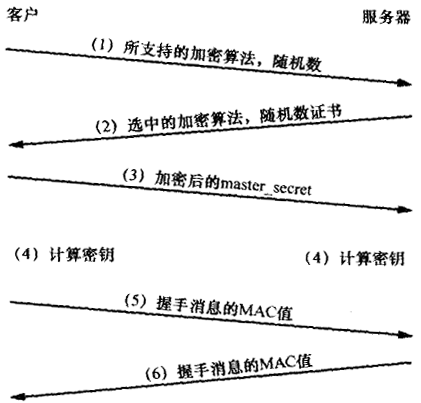
Step 5 and 6 to prevent themselves from being tampered with shaking hands. Envisaged an attacker wants to control the use of client and server algorithms. Client offers a variety of algorithms are quite common, some of the strength of weak and some strong intensity, in order to be able to support the weak intensity algorithm with only the server to communicate. An attacker can remove the client provided in step 1 all the high-intensity algorithm, so they force the server to choose a weak strength of the algorithm. Step 5 and Step 6 of the MAC be able to prevent the exchange of such attacks, because the client's MAC is calculated according to the original message, but the server's MAC is modified according to the news of the attacker is calculated, so that after inspection will find do not match. As provided by the client and server random number key generation process, and so the hands will not be replay attacks. The message is the first in a new encryption algorithm and key messages encrypted under.
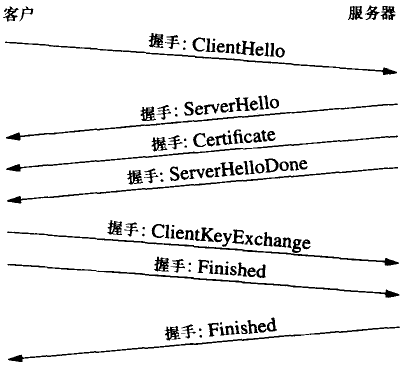
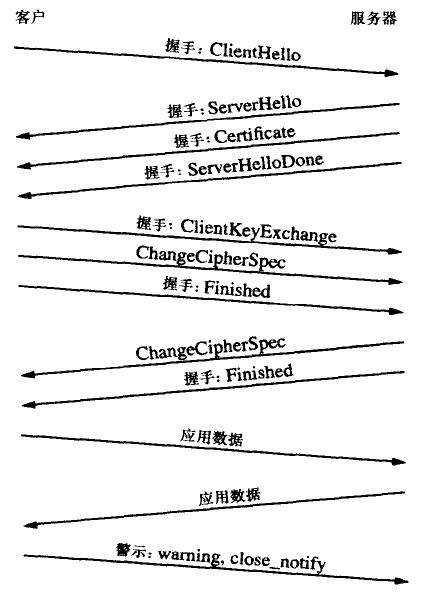
Just described every step through one or more handshake messages to achieve. In this first message with a brief description of which corresponds to what steps, then a detailed description of the contents of each message. The following diagram describes the messages:
Step 1 corresponds to a single handshake message, ClientHello.
Step 2 corresponds to a SSL handshake message, the server sends the first message to ServerHello, which contains its chosen method, then again in the Certificate message send their certificates. Finally, the server sends a message to indicate ServerHelloDone the completion of the handshake stage. Need ServerHelloDone because some of the more complex variants would also like to shake hands after the Certifacate send other messages. When the client receives ServerHelloDone message, it knows there will be no other similar news coming, so he can continue it on this side of the handshake.
Step 3 corresponds to ClientKeyExchange news.
Step 5 and 6 corresponding Finished message. The news is just negotiated the first algorithm used to protect the information. In order to prevent the handshake has been tampered with, the contents of the message to all the previous stage handshake message MAC. However, the Finished message is a good method of protection, consultations, so they will have consultations with the new MAC key - a message from the calculation of the value of their MAc.
Note that the image above omits two ChangeCipherSpec news.
SSL Record Protocol:
In SSL, the actual data transmission is to use the SSL record protocol to achieve. SSL record protocol is divided by the data stream into a series of clips and transfer them to work, in which each fragment separately protection and transmission. In the receiver, each record on a separate decryption and verification. This program has resulted in the figures have been ready to be sent from one end to connect to the other end, and received instantly be addressed.
In the transmission segment, you must prevent attacks. MAC can be calculated to provide data integrity protection. MAC transmitted together with the fragment, verified by the receiver to achieve. The MAC appended to the fragment of the tail, and data and integrate the contents of the MAC is encrypted to form encrypted Load (Payload). Finally on top of information to the load equipment. Header information and encrypted links to known records of load (record), record the actual transfer of the content is. The following diagram describes the transfer process:
1. Recorded the first message:
Record header information is to receive the work to achieve (receiving implementation) to explain the records provided the necessary information. In practice, it refers to three types of information: content type, length, and SSL version. Length field can the receiver is aware that he was taken from the line Duoshao octet processing the message, version number, Zhi Shi 1 to ensure that each party use the consultation version of the redundancy check. Content-Type field indicates the message type.
2. SSL Record Type:
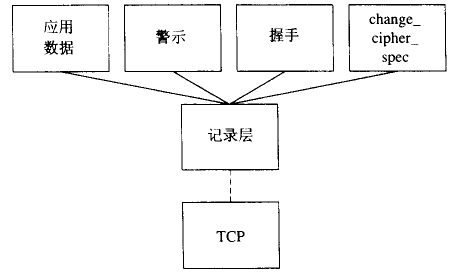
SSL support for the four content types: application_data, alert, handshake and change_cipher_spec.
Use SSL, software to send and receive all the data are based on application_data type to send, the other three kinds of Neirongleixing used on communications Jinxingguanli, Ruwan Cheng handshake and reporting Cuowu so.
Content type alert is mainly used for reporting all types of errors. Most of the alert (warning) for reporting handshake Chuxian problems, but there are some instructions to try to Jin Xing Ji Lu Zai right or Renzheng decryption errors that occur, alert messages to other Yongtu yes instructions would be Guanbi Lian Jie.
Used to carry content type handshake handshake message. Even if the initial connection handshake message is formed by the recording layer in order to handshake types of records to load the. As the encryption key has not yet established, these initial message was not encrypted or authentication, but the other process is the same. Possible existing connections on a new handshake initialization, in this case, the new record is like shaking hands, like other data, to go through encryption and authentication.
change_cipher_spec recorded message said to change the encryption and authentication. Once the handshake agreed on a new set of keys, the send change_cipher_spec to indicate at this point will enable the new key.
Work with a variety of sources:
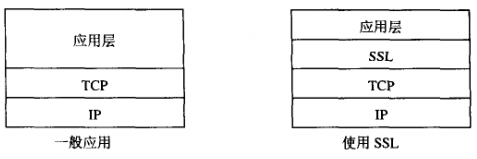
As we have seen, SSL is a layered protocol, it is a recording layer and recording layer of a CD bearing the same message type composition. And the recording layer will by some reliable transport protocol such as TCP to carry. The following diagram describes the structure of the Association to:
The complete process a ssl connection:
SSL握手步骤【收藏】的更多相关文章
- SSL握手过程
原文地址: http://my.oschina.net/u/1188877/blog/164982 一.SSL握手有三个目的:1. 客户端与服务器需要就一组用于保护数据的算法达成一致:2. 它们需要确 ...
- SSL握手流程
一.SSL是什么? 安全套接字(SSL)协议是Web浏览器和Web服务器之间安全交换信息的协议. SSL介于应用层和TCP层之间,应用层数据不再直接传递给传输层,而是传递给SSL层,SSL层对从应用层 ...
- ssl握手数据结构
ssl握手 SSL记录头(5字节) 字节0:记录内容的类型 Content Type Hex Code Description Change_Cipher_Spec 0x14 指示加密方式的更改 Al ...
- HTTPS和SSL握手过程(转载)
https介绍 HTTPS = HTTP + 一组对称.非对称和基于证书的加密技术 HTTPS是最常见的HTTP安全版本.它得到了很广泛的应用,所有主要的商业浏览器和服务器都提供HTTPS.HTTPS ...
- 加密、签名和SSL握手机制细节
openssl系列文章:http://www.cnblogs.com/f-ck-need-u/p/7048359.html 1.1 背景知识 对称加密 :加密解密使用同一密钥,加解密速度快.随 ...
- SSL握手通信详解及linux下c/c++ SSL Socket代码举例
SSL握手通信详解及linux下c/c++ SSL Socket代码举例 摘自:http://www.169it.com/article/3215130236.html 分享到:8 发布时 ...
- SSL握手通信详解及linux下c/c++ SSL Socket代码举例(另附SSL双向认证客户端代码)
SSL握手通信详解及linux下c/c++ SSL Socket代码举例(另附SSL双向认证客户端代码) 摘自: https://blog.csdn.net/sjin_1314/article/det ...
- SSL 重点SSL会话步骤
SSL.TLS协议 在wiki百科查看下,两者的区别 实现SSL协议的软件 OpenSSL开源软件 SSL会话步骤 1:客户端向服务端索取CA证书,然后验证证书 2:客户端与服务端约定一个通信中使 ...
- linux apache Tomcat配置SSL(https)步骤
https简介 它是由Netscape开发并内置于其浏览器中,用于对数据进行压缩和解压操作,并返回网络上传送回的结果.HTTPS实际上应用了Netscape的安全套接字层(SSL)作为HTTP应用层的 ...
随机推荐
- 结合Domino打造全功能的Grid
1. 需求说明: 在domino开发中我们经常会遇到表单上需要一个类似table的组件,你可以增删改等.比如我有一个张报核单据,上面需要详细列出每项金额的明细,我们先看完成后的效果: 上面 ...
- HDU 5914 Triangle 数学找规律
Triangle 题目连接: http://acm.hdu.edu.cn/showproblem.php?pid=5914 Description Mr. Frog has n sticks, who ...
- VC++ 学习笔记(一):如何开始
毫无疑问,学习C++是一件痛苦的事情. 我大概十年前接触C++.那是在学校里,准备考研究生,某学校要求考C++.我就开始一点一点学习,学习的过程还是比较舒服的.不得不说,就古典C++的理论,钱老讲的还 ...
- denyhost防止SSH暴力破解
参考: http://blog.sina.com.cn/s/blog_593af2a70102vjnf.html denyhost 官网: http://denyhosts.sourceforge.n ...
- Spring3系列6 - Spring 表达式语言(Spring EL)
Spring3系列6-Spring 表达式语言(Spring EL) 本篇讲述了Spring Expression Language —— 即Spring3中功能丰富强大的表达式语言,简称SpEL.S ...
- windows server 2003 ODBC数据源配置错误
1.ODBC 数据源链接失败,错误 :STATE hy000, 不能产生SSPI上下文, 2.文件服务器,TCP/IP协议属性中,DNS没有填写,填入DNS即可解决.
- DVI-A、DVI-D、DVI-I接口定义、DVI接口图和DVI接口标准介绍
http://blog.csdn.net/cd520yy/article/details/16993179
- 对已经add的文件不在跟踪
记录每次更新到仓库 现在我们手上已经有了一个真实项目的 Git 仓库,并从这个仓库中取出了所有文件的工作拷贝.接下来,对这些文件作些修改,在完成了一个阶段的目标之后,提交本次更新到仓库. 请记住,工作 ...
- 一个方法告诉你as3的removeChild性能有多烂
其实as3这个坑我早就踩过,不过那时没太注意,最近把项目的removeChild干掉换成了visible=false,发现效率质的提升…… 先贴一下代码吧 private function testR ...
- 网络安装archlinux(2012.8.20)笔记
周末闲极无聊,把烂笔记本翻出来想装个Archlinux,发现USB不能启动,光驱也挂了,只好网络安装. 我先后试了两种安装方式,一种纯互联网启动,安装,一种局域网启动,再互联网安装.分别说说. 不管哪 ...