
How a stack frame works 栈帧的要素与构建步骤
http://en.citizendium.org/wiki/Stack_frame
To use a stack frame, a thread keeps two pointers, often called the Stack Pointer (SP), and the Frame (FP) or Base Pointer (BP). SP always points to the "top" of the stack, and FP always points to the "top" of the frame. Additionally, the thread also maintains a program counter (PC) which points to the next instruction to be executed. Then, whenever a function call takes place, the following steps take place in roughly this order:
- The caller saves local variables and temporaries, by pushing them onto the stack.
- The caller pushes the callee's actual parameters onto the stack.
- The caller branches to the callee, pushing PC onto the stack (on most architectures, this is a single instruction called CALL). When on the stack, the saved PC is called the return address.
- The callee pushes the value of FP onto the stack.
- The callee copies SP to FP.
- The callee adjusts SP, creating storage locations for local variables and local temporaries on the stack.
Steps 4--6 above are referred to as the function prologue, since they are the beginning of every function.
Within the body of the callee function, formal parameters and local variables can all be accessed at an address relative to the frame pointer. Because of this, a function may recurse, and automatically create a different storage location for each of its local variables.
Upon exit from the function, those steps are performed in reverse:
- The callee restores SP, and in doing so destroys the storage locations reserved for locals and temporaries.
- The callee restores FP, and in doing so returns to the previous frame.
- The callee branches back to caller by popping PC off of the stack (on most architectures, this is a single instruction called RETURN).
- The caller removes the actual parameters from the stack.
- The caller resotres local variables and temporaries, by popping them from the stack.
Steps 1--3 are referred to as the function epilogue, since they are at the end of every function
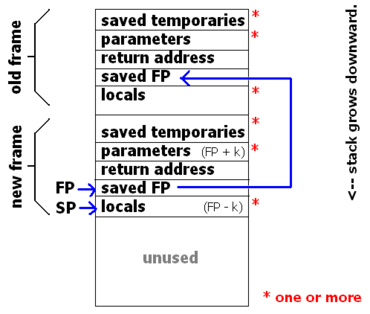
Contents of a stack frame from a SPARC system (Sun Solaris). Shown are two frames (a function that has called another function). Blue arrows are pointers. Parameters and locals can be addressed as FP ± k. NOTE: Intel/Windows stacks grow upward[4].
How a stack frame works 栈帧的要素与构建步骤的更多相关文章
- Java-JVM 栈帧(Stack Frame)
一.概述 栈帧位置 JVM 执行 Java 程序时需要装载各种数据到内存中,不同的数据存放在不同的内存区中(逻辑上),这些数据内存区称作运行时数据区(Run-Time Data Areas). 其中 ...
- 栈帧 2.6. Frames 虚拟机内存模型
https://docs.oracle.com/javase/specs/jvms/se11/html/jvms-2.html#jvms-2.6 小结: 1. https://docs.oracle. ...
- x86-64栈帧中的“红色区域” red zone of stack frame on x86-64
前几天看System V AMD64 ABI标准的时候发现栈帧的顶部后面有一块"red zone",在学cs:app3e/深入理解操作系统的时候并没有遇到这个,总结一下. 引用标准 ...
- 栈帧示意图:stack pointer、frame pointer
更多参考:http://www.embeddedrelated.com/usenet/embedded/show/31646-1.php 一: The calling convention descr ...
- 栈帧的内部结构--操作数栈(Opreand Stack)
每个栈帧中包含: 局部变量表(Local Variables) 操作数栈(Opreand Stack) 或表达式栈 动态链接 (Dynamic Linking) (或指向运行时常量的方法引用) 动态返 ...
- FUNCTION CALL STACK FRAME
function call stack frame 两个寄存器 esp 栈顶指针寄存器,指向调用栈的栈顶(始终指向,意味着栈分配到哪里了,从当前栈往高地址是已经分配了的) ebp 基址指针寄存器,指向 ...
- Linux - 函数的栈帧
栈帧(stack frame),机器用栈来传递过程参数,存储返回信息,保存寄存器用于以后恢复,以及本地存储.为单个过程(函数调用)分配的那部分栈称为栈帧.栈帧其实是两个指针寄存器, 寄存器%ebp为帧 ...
- JAVA栈帧
简介 Java栈是一块线程私有的内存空间.java堆和程序数据相关,java栈就是和线程执行密切相关的,线程的执行的基本行为是函数调用,每次函数调用的数据都是通过java栈来传递的. Java栈与数据 ...
- Java虚拟机运行时栈帧结构--《深入理解Java虚拟机》学习笔记及个人理解(二)
Java虚拟机运行时栈帧结构(周志明书上P237页) 栈帧是什么? 栈帧是一种数据结构,用于虚拟机进行方法的调用和执行. 栈帧是虚拟机栈的栈元素,也就是入栈和出栈的一个单元. 2018.1.2更新(在 ...
随机推荐
- vux 实现多栏滚动
1.PopupPicker 组件 <!-- vux-ui --> <template> <div> <!-- 标题栏 --> <x-header ...
- datatables对于某一特定的列进行自定义排序
首先说下里边的api,其中第一个是order,这个里边是设置哪些排序哪些不排序的,比如:$('#example').dataTable( { "order": (funct ...
- 【bzoj3609】[Heoi2014]人人尽说江南好
可以算出合并多少次. #include<algorithm> #include<iostream> #include<cstdlib> #include<cs ...
- 编译android framework的例子【转】
本文转载自:http://blog.csdn.net/brucexu1978/article/details/7610358 在开发过程中,尤其是Framework相关开发时,有时候需要重新编译资源文 ...
- Android编译详解之lunch命令 【转】
本文转载自: Android编译详解之lunch命令 (2012-10-08 10:27:55) 转载▼ 标签: it 分类: android内核剖析 Android的优势就在于其开源,手机和 ...
- 利用JFreeChart生成折线图 (4) (转自 JSP开发技术大全)
利用JFreeChart生成折线图 (4) (转自 JSP开发技术大全) 14.4 利用JFreeChart生成折线图 通过JFreeChart插件,既可以生成普通效果的折线图,也可以生成3D效果的折 ...
- 【Codevs 3115】高精度练习之减法
http://codevs.cn/problem/3115/ 板子题~ // <H.cpp> - Sun Oct 9 12:58:23 2016 // This file is made ...
- POJ 3294 UVA 11107 Life Forms 后缀数组
相同的题目,输出格式有区别. 给定n个字符串,求最长的子串,使得它同时出现在一半以上的串中. 不熟悉后缀数组的童鞋建议先去看一看如何用后缀数组计算两个字符串的最长公共子串 Ural1517 这道题的思 ...
- Objective-C程序
创建: 2018/01/17 完成: 2018/01/19 对象(object)与信息 信息式 声明实例变量 id obj; 向对象变量发送信息 [obj msg] //这就是信息式 例: [ ...
- Python基础 — Matplotlib
Matplotlib -- 简介 matplotlib是Python优秀的数据可视化第三方库: matplotlib库的效果可参考官网:http://matplotlib ...