
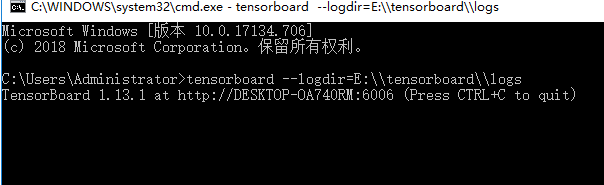
吴裕雄 PYTHON 神经网络——TENSORFLOW 单隐藏层自编码器设计处理MNIST手写数字数据集并使用TensorBord描绘神经网络数据
import os

import numpy as np

import tensorflow as tf

import matplotlib.pyplot as plt

from tensorflow.examples.tutorials.mnist import input_data

os.environ['TF_CPP_MIN_LOG_LEVEL'] = ''

learning_rate = 0.01                          # 学习率

training_epochs = 20                          # 训练轮数,1轮等于n_samples/batch_size

batch_size = 128                              # batch容量

display_step = 1                              # 展示间隔

example_to_show = 10                          # 展示图像数目

n_hidden_units = 256

n_input_units = 784

n_output_units = n_input_units

def WeightsVariable(n_in, n_out, name_str):

    return tf.Variable(tf.random_normal([n_in, n_out]), dtype=tf.float32, name=name_str)

def biasesVariable(n_out, name_str):

    return tf.Variable(tf.random_normal([n_out]), dtype=tf.float32, name=name_str)

def encoder(x_origin, activate_func=tf.nn.sigmoid):

    with tf.name_scope('Layer'):

        Weights = WeightsVariable(n_input_units, n_hidden_units, 'Weights')

        biases = biasesVariable(n_hidden_units, 'biases')

        x_code = activate_func(tf.add(tf.matmul(x_origin, Weights), biases))

    return x_code

def decode(x_code, activate_func=tf.nn.sigmoid):

    with tf.name_scope('Layer'):

        Weights = WeightsVariable(n_hidden_units, n_output_units, 'Weights')

        biases = biasesVariable(n_output_units, 'biases')

        x_decode = activate_func(tf.add(tf.matmul(x_code, Weights), biases))

    return x_decode

with tf.Graph().as_default():

    with tf.name_scope('Input'):

        X_input = tf.placeholder(tf.float32, [None, n_input_units])

    with tf.name_scope('Encode'):

        X_code = encoder(X_input)

    with tf.name_scope('decode'):

        X_decode = decode(X_code)

    with tf.name_scope('loss'):

        loss = tf.reduce_mean(tf.pow(X_input - X_decode, 2))

    with tf.name_scope('train'):

        Optimizer = tf.train.RMSPropOptimizer(learning_rate)

        train = Optimizer.minimize(loss)

    init = tf.global_variables_initializer()

    writer = tf.summary.FileWriter(logdir='logs', graph=tf.get_default_graph())

    writer.flush()

learning_rate = 0.01  # 学习率

training_epochs = 20  # 训练轮数,1轮等于n_samples/batch_size

batch_size = 128  # batch容量

display_step = 1  # 展示间隔

example_to_show = 10  # 展示图像数目

n_hidden_units = 256

n_input_units = 784

n_output_units = n_input_units

def WeightsVariable(n_in, n_out, name_str):

    return tf.Variable(tf.random_normal([n_in, n_out]), dtype=tf.float32, name=name_str)

def biasesVariable(n_out, name_str):

    return tf.Variable(tf.random_normal([n_out]), dtype=tf.float32, name=name_str)

def encoder(x_origin, activate_func=tf.nn.sigmoid):

    with tf.name_scope('Layer'):

        Weights = WeightsVariable(n_input_units, n_hidden_units, 'Weights')

        biases = biasesVariable(n_hidden_units, 'biases')

        x_code = activate_func(tf.add(tf.matmul(x_origin, Weights), biases))

    return x_code

def decode(x_code, activate_func=tf.nn.sigmoid):

    with tf.name_scope('Layer'):

        Weights = WeightsVariable(n_hidden_units, n_output_units, 'Weights')

        biases = biasesVariable(n_output_units, 'biases')

        x_decode = activate_func(tf.add(tf.matmul(x_code, Weights), biases))

    return x_decode

with tf.Graph().as_default():

    with tf.name_scope('Input'):

        X_input = tf.placeholder(tf.float32, [None, n_input_units])

    with tf.name_scope('Encode'):

        X_code = encoder(X_input)

    with tf.name_scope('decode'):

        X_decode = decode(X_code)

    with tf.name_scope('loss'):

        loss = tf.reduce_mean(tf.pow(X_input - X_decode, 2))

    with tf.name_scope('train'):

        Optimizer = tf.train.RMSPropOptimizer(learning_rate)

        train = Optimizer.minimize(loss)

    init = tf.global_variables_initializer()

    writer = tf.summary.FileWriter(logdir='E:\\tensorboard\\logs', graph=tf.get_default_graph())

    writer.flush()

    mnist = input_data.read_data_sets("E:\\MNIST_data\\", one_hot=True)

    with tf.Session() as sess:

        sess.run(init)

        total_batch = int(mnist.train.num_examples / batch_size)

        for epoch in range(training_epochs):

            for i in range(total_batch):

                batch_xs, batch_ys = mnist.train.next_batch(batch_size)

                _, Loss = sess.run([train, loss], feed_dict={X_input: batch_xs})

                Loss = sess.run(loss, feed_dict={X_input: batch_xs})

            if epoch % display_step == 0:

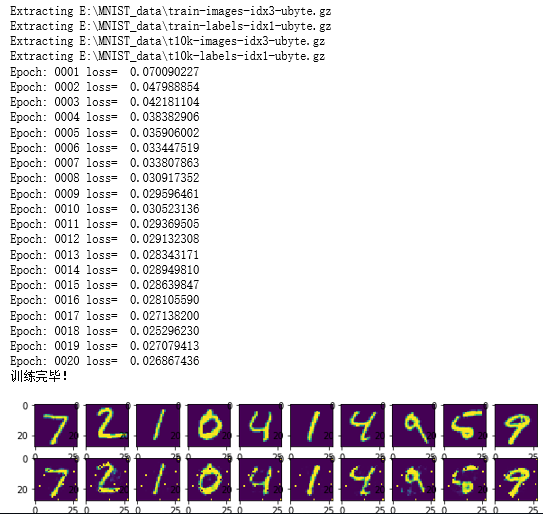
                print('Epoch: %04d' % (epoch + 1), 'loss= ', '{:.9f}'.format(Loss))

        writer.close()

        print('训练完毕!')

        '''比较输入和输出的图像'''

        # 输出图像获取

        reconstructions = sess.run(X_decode, feed_dict={X_input: mnist.test.images[:example_to_show]})

        # 画布建立

        f, a = plt.subplots(2, 10, figsize=(10, 2))

        for i in range(example_to_show):

            a[0][i].imshow(np.reshape(mnist.test.images[i], (28, 28)))

            a[1][i].imshow(np.reshape(reconstructions[i], (28, 28)))

        f.show()  # 渲染图像

        plt.draw()  # 刷新图像

        # plt.waitforbuttonpress()
吴裕雄 PYTHON 神经网络——TENSORFLOW 单隐藏层自编码器设计处理MNIST手写数字数据集并使用TensorBord描绘神经网络数据的更多相关文章
- 吴裕雄 PYTHON 神经网络——TENSORFLOW 双隐藏层自编码器设计处理MNIST手写数字数据集并使用TENSORBORD描绘神经网络数据2
import os import tensorflow as tf from tensorflow.examples.tutorials.mnist import input_data os.envi ...
- Android+TensorFlow+CNN+MNIST 手写数字识别实现
Android+TensorFlow+CNN+MNIST 手写数字识别实现 SkySeraph 2018 Email:skyseraph00#163.com 更多精彩请直接访问SkySeraph个人站 ...
- 基于tensorflow的MNIST手写数字识别(二)--入门篇
http://www.jianshu.com/p/4195577585e6 基于tensorflow的MNIST手写字识别(一)--白话卷积神经网络模型 基于tensorflow的MNIST手写数字识 ...
- TensorFlow——MNIST手写数字识别
MNIST手写数字识别 MNIST数据集介绍和下载:http://yann.lecun.com/exdb/mnist/ 一.数据集介绍: MNIST是一个入门级的计算机视觉数据集 下载下来的数据集 ...
- Tensorflow实现MNIST手写数字识别
之前我们讲了神经网络的起源.单层神经网络.多层神经网络的搭建过程.搭建时要注意到的具体问题.以及解决这些问题的具体方法.本文将通过一个经典的案例:MNIST手写数字识别,以代码的形式来为大家梳理一遍神 ...
- mnist手写数字识别——深度学习入门项目(tensorflow+keras+Sequential模型)
前言 今天记录一下深度学习的另外一个入门项目——<mnist数据集手写数字识别>,这是一个入门必备的学习案例,主要使用了tensorflow下的keras网络结构的Sequential模型 ...
- 用tensorflow搭建RNN(LSTM)进行MNIST 手写数字辨识
用tensorflow搭建RNN(LSTM)进行MNIST 手写数字辨识 循环神经网络RNN相比传统的神经网络在处理序列化数据时更有优势,因为RNN能够将加入上(下)文信息进行考虑.一个简单的RNN如 ...
- Tensorflow可视化MNIST手写数字训练
简述] 我们在学习编程语言时,往往第一个程序就是打印“Hello World”,那么对于人工智能学习系统平台来说,他的“Hello World”小程序就是MNIST手写数字训练了.MNIST是一个手写 ...
- 基于TensorFlow的MNIST手写数字识别-初级
一:MNIST数据集 下载地址 MNIST是一个包含很多手写数字图片的数据集,一共4个二进制压缩文件 分别是test set images,test set labels,training se ...
随机推荐
- Centsos7 aria2
wget -N --no-check-certificate https://raw.githubusercontent.com/ToyoDAdoubi/doubi/master/aria2.sh & ...
- 注解 - @Deprecated
意思是说此方法已过时,过时的原因就是有新的API的类替代了次方法. 这个被划去的方法仍然是可以正常使用的,就是一个提示而已. Java内在的File类中有如下方法 @Deprecated public ...
- codeforces 1282B2. K for the Price of One (Hard Version) (dp)
链接 https://codeforces.com/contest/1282/problem/B2 题意: 商店买东西,商店有n个物品,每个物品有自己的价格,商店有个优惠活动,当你买恰好k个东西时可以 ...
- 用控制台编译和运行,输出HelloWorld
HelloWorld 建立一个Java文件,文件后缀为.java(Hello.java) public class Hello{ public static void main(String[ ...
- python+selenium:浏览器webdriver操作(0)
1.浏览器最大化 启动的浏览器不是全屏的,这样不会影响脚本的执行,但是有时候会影响我们“观看”脚本的执行. #coding=utf-8 from selenium import webdriver i ...
- spring注解注入:<context:component-scan>以及其中的context:include-filter>和 <context:exclude-filter>的是干什么的?
转自:https://www.cnblogs.com/vanl/p/5733655.html spring注解注入:<context:component-scan>使用说明 sprin ...
- SSG (slow global), TTG (typical global) and FFG (fast global)
https://semiwiki.com/x-subscriber/clk-design-automation/4481-variation-alphabet-soup/ n response, fo ...
- <meta name="viewport" content="width=device-width,initial-scale=1,minimum-scale=1,maximum-scale=1,user-scalable=no"/>
<meta name="viewport" content="width=device-width,initial-scale=1,minimum-scale=1, ...
- Java正则表达式提取String字符串中的IP地址
/** * 正则提前字符串中的IP地址 * @param ipString * @return */ public static List<String> getIps(String ip ...
- css之变形(transform)
<!DOCTYPE html> <html lang="en"> <head> <meta charset="UTF-8&quo ...