
Spark RDDs vs DataFrames vs SparkSQL
简介
Spark的 RDD、DataFrame 和 SparkSQL的性能比较。
2方面的比较
单条记录的随机查找
aggregation聚合并且sorting后输出
使用以下Spark的三种方式来解决上面的2个问题,对比性能。
Using RDD’s
Using DataFrames
Using SparkSQL
数据源
在HDFS中3个文件中存储的9百万不同记录
- 每条记录11个字段
总大小 1.4 GB
实验环境
HDP 2.4
Hadoop version 2.7
Spark 1.6
HDP Sandbox
测试结果
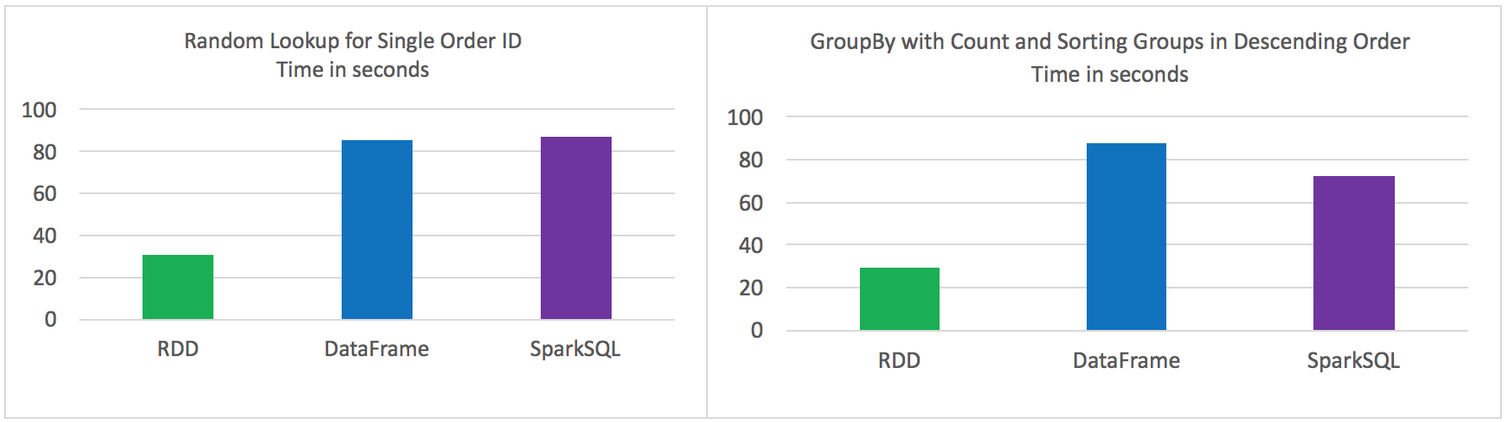
原始的RDD 比 DataFrames 和 SparkSQL性能要好
DataFrames 和 SparkSQL 性能差不多
使用DataFrames 和 SparkSQL 比 RDD 操作更直观
Jobs都是独立运行,没有其他job的干扰
2个操作
Random lookup against 1 order ID from 9 Million unique order ID's
GROUP all the different products with their total COUNTS and SORT DESCENDING by product name
代码
RDD Random Lookup
#!/usr/bin/env python

from time import time

from pyspark import SparkConf, SparkContext

conf = (SparkConf()

  .setAppName("rdd_random_lookup")

  .set("spark.executor.instances", "")

  .set("spark.executor.cores", 2)

  .set("spark.dynamicAllocation.enabled", "false")

  .set("spark.shuffle.service.enabled", "false")

  .set("spark.executor.memory", "500MB"))

sc = SparkContext(conf = conf)

t0 = time()

path = "/data/customer_orders*"

lines = sc.textFile(path)

## filter where the order_id, the second field, is equal to 96922894

print lines.map(lambda line: line.split('|')).filter(lambda line: int(line[1]) == 96922894).collect()

tt = str(time() - t0)

print "RDD lookup performed in " + tt + " seconds"
DataFrame Random Lookup
#!/usr/bin/env python

from time import time

from pyspark.sql import *

from pyspark import SparkConf, SparkContext

conf = (SparkConf()

  .setAppName("data_frame_random_lookup")

  .set("spark.executor.instances", "")

  .set("spark.executor.cores", 2)

  .set("spark.dynamicAllocation.enabled", "false")

  .set("spark.shuffle.service.enabled", "false")

  .set("spark.executor.memory", "500MB"))

sc = SparkContext(conf = conf)

sqlContext = SQLContext(sc)

t0 = time()

path = "/data/customer_orders*"

lines = sc.textFile(path)

## create data frame

orders_df = sqlContext.createDataFrame( \

lines.map(lambda l: l.split("|")) \

.map(lambda p: Row(cust_id=int(p[0]), order_id=int(p[1]), email_hash=p[2], ssn_hash=p[3], product_id=int(p[4]), product_desc=p[5], \

country=p[6], state=p[7], shipping_carrier=p[8], shipping_type=p[9], shipping_class=p[10]  ) ) )

## filter where the order_id, the second field, is equal to 96922894

orders_df.where(orders_df['order_id'] == 96922894).show()

tt = str(time() - t0)

print "DataFrame performed in " + tt + " seconds"
SparkSQL Random Lookup
#!/usr/bin/env python

from time import time

from pyspark.sql import *

from pyspark import SparkConf, SparkContext

conf = (SparkConf()

  .setAppName("spark_sql_random_lookup")

  .set("spark.executor.instances", "")

  .set("spark.executor.cores", 2)

  .set("spark.dynamicAllocation.enabled", "false")

  .set("spark.shuffle.service.enabled", "false")

  .set("spark.executor.memory", "500MB"))

sc = SparkContext(conf = conf)

sqlContext = SQLContext(sc)

t0 = time()

path = "/data/customer_orders*"

lines = sc.textFile(path)

## create data frame

orders_df = sqlContext.createDataFrame( \

lines.map(lambda l: l.split("|")) \

.map(lambda p: Row(cust_id=int(p[0]), order_id=int(p[1]), email_hash=p[2], ssn_hash=p[3], product_id=int(p[4]), product_desc=p[5], \

country=p[6], state=p[7], shipping_carrier=p[8], shipping_type=p[9], shipping_class=p[10]  ) ) )

## register data frame as a temporary table

orders_df.registerTempTable("orders")

## filter where the customer_id, the first field, is equal to 96922894

print sqlContext.sql("SELECT * FROM orders where order_id = 96922894").collect()

tt = str(time() - t0)

print "SparkSQL performed in " + tt + " seconds"
RDD with GroupBy, Count, and Sort Descending
#!/usr/bin/env python

from time import time

from pyspark import SparkConf, SparkContext

conf = (SparkConf()

  .setAppName("rdd_aggregation_and_sort")

  .set("spark.executor.instances", "")

  .set("spark.executor.cores", 2)

  .set("spark.dynamicAllocation.enabled", "false")

  .set("spark.shuffle.service.enabled", "false")

  .set("spark.executor.memory", "500MB"))

sc = SparkContext(conf = conf)

t0 = time()

path = "/data/customer_orders*"

lines = sc.textFile(path)

counts = lines.map(lambda line: line.split('|')) \

.map(lambda x: (x[5], 1)) \

.reduceByKey(lambda a, b: a + b) \

.map(lambda x:(x[1],x[0])) \

.sortByKey(ascending=False)

for x in counts.collect():

  print x[1] + '\t' + str(x[0])

tt = str(time() - t0)

print "RDD GroupBy performed in " + tt + " seconds"
DataFrame with GroupBy, Count, and Sort Descending
#!/usr/bin/env python

from time import time

from pyspark.sql import *

from pyspark import SparkConf, SparkContext

conf = (SparkConf()

  .setAppName("data_frame_aggregation_and_sort")

  .set("spark.executor.instances", "")

  .set("spark.executor.cores", 2)

  .set("spark.dynamicAllocation.enabled", "false")

  .set("spark.shuffle.service.enabled", "false")

  .set("spark.executor.memory", "500MB"))

sc = SparkContext(conf = conf)

sqlContext = SQLContext(sc)

t0 = time()

path = "/data/customer_orders*"

lines = sc.textFile(path)

## create data frame

orders_df = sqlContext.createDataFrame( \

lines.map(lambda l: l.split("|")) \

.map(lambda p: Row(cust_id=int(p[0]), order_id=int(p[1]), email_hash=p[2], ssn_hash=p[3], product_id=int(p[4]), product_desc=p[5], \

country=p[6], state=p[7], shipping_carrier=p[8], shipping_type=p[9], shipping_class=p[10]  ) ) )

results = orders_df.groupBy(orders_df['product_desc']).count().sort("count",ascending=False)

for x in results.collect():

  print x

tt = str(time() - t0)

print "DataFrame performed in " + tt + " seconds"
SparkSQL with GroupBy, Count, and Sort Descending
#!/usr/bin/env python

from time import time

from pyspark.sql import *

from pyspark import SparkConf, SparkContext

conf = (SparkConf()

  .setAppName("spark_sql_aggregation_and_sort")

  .set("spark.executor.instances", "")

  .set("spark.executor.cores", 2)

  .set("spark.dynamicAllocation.enabled", "false")

  .set("spark.shuffle.service.enabled", "false")

  .set("spark.executor.memory", "500MB"))

sc = SparkContext(conf = conf)

sqlContext = SQLContext(sc)

t0 = time()

path = "/data/customer_orders*"

lines = sc.textFile(path)

## create data frame

orders_df = sqlContext.createDataFrame(lines.map(lambda l: l.split("|")) \

.map(lambda r: Row(product=r[5])))

## register data frame as a temporary table

orders_df.registerTempTable("orders")

results = sqlContext.sql("SELECT product, count(*) AS total_count FROM orders GROUP BY product ORDER BY total_count DESC")

for x in results.collect():

  print x

tt = str(time() - t0)

print "SparkSQL performed in " + tt + " seconds"
原文:https://community.hortonworks.com/articles/42027/rdd-vs-dataframe-vs-sparksql.html
Spark RDDs vs DataFrames vs SparkSQL的更多相关文章
- Spark 官方文档(5)——Spark SQL,DataFrames和Datasets 指南
Spark版本:1.6.2 概览 Spark SQL用于处理结构化数据,与Spark RDD API不同,它提供更多关于数据结构信息和计算任务运行信息的接口,Spark SQL内部使用这些额外的信息完 ...
- Effective Spark RDDs with Alluxio【转】
转自:http://kaimingwan.com/post/alluxio/effective-spark-rdds-with-alluxio 1. 介绍 2. 引言 3. Alluxio and S ...
- Spark(十二)SparkSQL简单使用
一.SparkSQL的进化之路 1.0以前: Shark 1.1.x开始:SparkSQL(只是测试性的) SQL 1.3.x: SparkSQL(正式版本)+Datafram ...
- Spark入门实战系列--6.SparkSQL(上)--SparkSQL简介
[注]该系列文章以及使用到安装包/测试数据 可以在<倾情大奉送--Spark入门实战系列>获取 .SparkSQL的发展历程 1.1 Hive and Shark SparkSQL的前身是 ...
- Spark入门实战系列--6.SparkSQL(中)--深入了解SparkSQL运行计划及调优
[注]该系列文章以及使用到安装包/测试数据 可以在<倾情大奉送--Spark入门实战系列>获取 1.1 运行环境说明 1.1.1 硬软件环境 线程,主频2.2G,10G内存 l 虚拟软 ...
- Spark入门实战系列--6.SparkSQL(下)--Spark实战应用
[注]该系列文章以及使用到安装包/测试数据 可以在<倾情大奉送--Spark入门实战系列>获取 .运行环境说明 1.1 硬软件环境 线程,主频2.2G,10G内存 l 虚拟软件:VMwa ...
- 一个spark SQL和DataFrames的故事
package com.lin.spark import org.apache.spark.sql.{Row, SparkSession} import org.apache.spark.sql.ty ...
- Apache Spark 2.2.0 中文文档 - Spark SQL, DataFrames and Datasets Guide | ApacheCN
Spark SQL, DataFrames and Datasets Guide Overview SQL Datasets and DataFrames 开始入门 起始点: SparkSession ...
- Spark记录-SparkSql官方文档中文翻译(部分转载)
1 概述(Overview) Spark SQL是Spark的一个组件,用于结构化数据的计算.Spark SQL提供了一个称为DataFrames的编程抽象,DataFrames可以充当分布式SQL查 ...
随机推荐
- Vue解析四之注册变量
判断监听的变量,如果undefined可以用$set来注册一个变量. 另外click可以是表达式,不一定必须是一个方法.
- python自学日志--基础篇(1)
从认识python,到学习python,中间经历了挺长一段时间的心理挣扎.人总是对未知的事物有着天生的恐惧感,但是,人又是对未知充斥好奇.所以在最后,还是推开了这扇门,开始学习python. pyth ...
- 关于synchronized与volatile的小析
简单点说:synchronized很强大,既可以保证原子性,也可以保证可见性,而volatile不能保证原子性: 可见性:一个线程对共享变量值的修改,能够及时的被其它线程看到. 共享变量:如果一个变量 ...
- STL --> list用法
List介绍 Lists将元素按顺序储存在链表中.与 向量(vectors)相比, 它允许快速的插入和删除,但是随机访问却比较慢. assign() // 给list赋值 back() // 返回最后 ...
- oracle 11g数据库 DMP还原数据库
-------------------------- jd :表空间 -------------------------- --本地登陆 cmd下直接执行 sqlplus/as sysdba; --修 ...
- eclipse中svn的各种状态图标详解
- 已忽略版本控制的文件.可以通过Window → Preferences → Team → Ignored Resources.来忽略文件. A file ignored by version co ...
- Leetcode 12——Integer to Roman
12.Integer to Roman Given an integer, convert it to a roman numeral. Input is guaranteed to be withi ...
- win7开启wifi
在启用本地共享连接时,出现的错误! 我已经建了一个无线临时网络,来启用共享用来上网的!Internet连接共享访问被启用时,出现了一个错误(null)?而且这错误也会在系统日志里留下记录,都是些莫名其 ...
- 201421123042 《Java程序设计》第8周学习总结
1. 本周学习总结 以你喜欢的方式(思维导图或其他)归纳总结集合相关内容. 2. 书面作业 1. ArrayList代码分析 1.1 解释ArrayList的contains源代码 源代码: 答:查找 ...
- 搭建vue项目环境
前言 在开发本项目之前,我对vue,react,angular等框架了解,仅限于知道它们是什么框架,他们的核心是什么,但是并没有实际使用过(angular 1.0版本用过,因为太难用,所以对这类框架都 ...