
POJ3020 Antenna Placement(二分图最小路径覆盖)
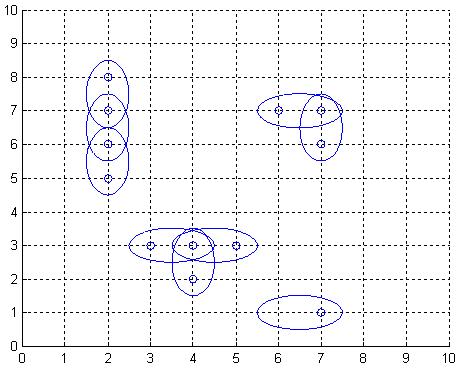
Obviously, it is desirable to use as few antennas as possible, but still provide coverage for each place of interest. We model the problem as follows: Let A be a rectangular matrix describing the surface of Sweden, where an entry of A either is a point of interest, which must be covered by at least one antenna, or empty space. Antennas can only be positioned at an entry in A. When an antenna is placed at row r and column c, this entry is considered covered, but also one of the neighbouring entries (c+1,r),(c,r+1),(c-1,r), or (c,r-1), is covered depending on the type chosen for this particular antenna. What is the least number of antennas for which there exists a placement in A such that all points of interest are covered?
Input
Output
Sample Input
2

7 9

ooo**oooo

**oo*ooo*

o*oo**o**

ooooooooo

*******oo

o*o*oo*oo

*******oo

10 1

*

*

*

o

*

*

*

*

*

*
Sample Output
17

5
题意:一个n*m的平面内有一些点,有1*2的纸条,可以横放或竖放,求最少用多少张纸条才能覆盖所有点?
题解:纸条相当于一条边,上道题求得为覆盖所有边的最小点数,这道题则逆其道而行,可转化为覆盖所有点的最小边数,即最小路径覆盖
二分图中最小路径覆盖=点数-最小边覆盖
然后就可以用匈牙利跑了~
代码如下:
#include<vector>

#include<cstdio>

#include<cstring>

#include<iostream>

#include<algorithm>

using namespace std;

vector<int> g[];

int vis[],link[];

int map[][],n,m,cnt,ttt;

char c[][];

int dfs(int x)

{

    int sz=g[x].size();

    for(int k=;k<sz;k++)

    {

        int y=g[x][k];

        if(!vis[y])

        {

            vis[y]=;

            if(!link[y]||dfs(link[y]))

            {

                link[y]=x;

                return ;

            }

        }

    }

    return ;

}

int search()

{

    memset(link,,sizeof(link));

    int tmp=;

    for(int i=;i<=cnt;i++)

    {

        if(dfs(i))

        {

            memset(vis,,sizeof(vis));

            tmp++;

        }

    }

    return tmp;

}

int main()

{

    scanf("%d",&ttt);

    while(ttt--)

    {

        cnt=;

        scanf("%d%d",&n,&m);

        memset(map,,sizeof(map));

        for(int i=;i<=;i++)

        {

            g[i].clear();

        }

        for(int i=;i<=n;i++)

        {

            scanf("%s",c[i]);

            for(int j=;j<m;j++)

            {

                if(c[i][j]=='o')

                {

                    map[i][j+]=;

                }

                else

                {

                    map[i][j+]=++cnt;

                }

            }

        }

        for(int i=;i<=n;i++)

        {

            for(int j=;j<=m;j++)

            {

                if(map[i][j])

                {

                    if(map[i][j+])

                    {

                        g[map[i][j]].push_back(map[i][j+]);

                    }

                    if(map[i][j-])

                    {

                        g[map[i][j]].push_back(map[i][j-]);

                    }

                    if(map[i+][j])

                    {

                        g[map[i][j]].push_back(map[i+][j]);

                    }

                    if(map[i-][j])

                    {

                        g[map[i][j]].push_back(map[i-][j]);

                    }

                }

            }

        }

        int ans=search();

        int x=cnt-ans/;

        printf("%d\n",x);

    }

}
POJ3020 Antenna Placement(二分图最小路径覆盖)的更多相关文章
- POJ 3020 Antenna Placement (二分图最小路径覆盖)
<题目链接> 题目大意:一个矩形中,有N个城市’*’,现在这n个城市都要覆盖无线,每放置一个基站,至多可以覆盖相邻的两个城市.问至少放置多少个基站才能使得所有的城市都覆盖无线? 解题分析: ...
- poj 3020 Antenna Placement(最小路径覆盖 + 构图)
http://poj.org/problem?id=3020 Antenna Placement Time Limit: 1000MS Memory Limit: 65536K Total Sub ...
- POJ 3020——Antenna Placement——————【 最小路径覆盖、奇偶性建图】
Antenna Placement Time Limit:1000MS Memory Limit:65536KB 64bit IO Format:%I64d & %I64u S ...
- poj 3020 Antenna Placement (最小路径覆盖)
二分图题目 当时看到网上有人的博客写着最小边覆盖,也有人写最小路径覆盖,我就有点方了,斌哥(kuangbin)的博客上只给了代码,没有解释,但是现在我还是明白了,这是个最小路径覆盖(因为我现在还不知道 ...
- [bzoj2150]部落战争_二分图最小路径覆盖
部落战争 bzoj-2150 题目大意:题目链接. 注释:略. 想法: 显然是最小路径覆盖,我们知道:二分图最小路径覆盖等于节点总数-最大匹配. 所以我们用匈牙利或者dinic跑出最大匹配,然后用总结 ...
- Taxi Cab Scheme POJ - 2060 二分图最小路径覆盖
Running a taxi station is not all that simple. Apart from the obvious demand for a centralised coord ...
- POJ3020Antenna Placement(最小路径覆盖+重在构图)
Antenna Placement Time Limit: 1000MS Memory Limit: 65536K Total Submissions: 7788 Accepted: 3880 ...
- 【HDU3861 强连通分量缩点+二分图最小路径覆盖】
题目链接:http://acm.hdu.edu.cn/showproblem.php?pid=3861 题目大意:一个有向图,让你按规则划分区域,要求划分的区域数最少. 规则如下:1.有边u到v以及有 ...
- hdu 1151 Air Raid(二分图最小路径覆盖)
http://acm.hdu.edu.cn/showproblem.php?pid=1151 Air Raid Time Limit: 1000MS Memory Limit: 10000K To ...
随机推荐
- UiAutomator viewer 在tools下启动、资源jar包在platforms下(如android22)
1.UiAutomator viewer 在tools下启动. 2.资源jar包在platforms下(如android22):android.jar/ uiautomator.jar
- Effective java笔记3--类和接口2
三.接口优于抽象类 java提供两种机制,可以用来定义一个允许多个实现的类型:接口和抽象类.由于java只允许单继承,所以,抽象类作为类型定义受到了极大的限制. 已有的类可以很容易被更新,以实现新的接 ...
- 杂项-公司:摩根大通百科-un
ylbtech-杂项-公司:摩根大通百科 摩根大通集团(JPMorgan Chase & Co,NYSE:JPM:),2000年12月由J.P.摩根公司和大通-曼哈顿公司合并而成,是美国主要的 ...
- AngularJS:Scope(作用域)
ylbtech-AngularJS:Scope(作用域) 1.返回顶部 1. AngularJS Scope(作用域) Scope(作用域) 是应用在 HTML (视图) 和 JavaScript ( ...
- 1140 Look-and-say Sequence
题意:略 思路:第1个数是1(读作“1有1个”),因此第2个数就是11(读作“1有2个”),因此第3个数就是12(读作“1有1个,2有1个”),因此第4个数是1121(读作“1有2个,2有1个,1有1 ...
- python开发模块基础:re正则
一,re模块的用法 #findall #直接返回一个列表 #正常的正则表达式 #但是只会把分组里的显示出来#search #返回一个对象 .group()#match #返回一个对象 .group() ...
- springboot成神之——log4j2的使用
本文介绍如何在spring-boot中使用log4j2 说明 依赖 日志记录语句 log4j2配置文件 本文介绍如何在spring-boot中使用log4j2 说明 log4j2本身使用是非常简单的, ...
- nginx keepalive 双机
Nginx+keepalived双机热备(主从模式) 负载均衡技术对于一个网站尤其是大型网站的web服务器集群来说是至关重要的!做好负载均衡架构,可以实现故障转移和高可用环境,避免单点故障,保证网 ...
- Vue 简单的总结一
let 变量 1. 局部作用域 2. 不会存在变量提升 3. 变量不能重复声明 const 变量 1. 局部作用域 2. 不会存在变量提升 3. 变量不能重复声明 4. 只能声明常量,不可变得量 th ...
- ffmpeg码率控制
一.VBR与CBR的含义和区别 VBR是动态码率.CBR是静态码率. VBR(Variable Bitrate)动态比特率.也就是没有固定的比特率,压缩软件在压缩时根据音频数据即时确定使用什么比特率, ...