
python fuzzy c-means demo
摘自:http://pythonhosted.org/scikit-fuzzy/auto_examples/plot_cmeans.html#example-plot-cmeans-py,加入了自己的理解!
# coding: utf-8

from __future__ import division, print_function

import numpy as np

import matplotlib.pyplot as plt

import skfuzzy as fuzz

colors = ['b', 'orange', 'g', 'r', 'c', 'm', 'y', 'k', 'Brown', 'ForestGreen']

#plt.figure(1)

# Define three cluster centers

centers = [[4, 2],

           [1, 7],

           [5, 6]]

# Define three cluster sigmas in x and y, respectively

sigmas = [[0.8, 0.3],

          [0.3, 0.5],

          [1.1, 0.7]]

# Generate test data

np.random.seed(42)  # Set seed for reproducibility

xpts = np.zeros(1)

ypts = np.zeros(1)

labels = np.zeros(1)

# 伪造3个高斯分布,以u和sigma作为特征分布

for i, ((xmu, ymu), (xsigma, ysigma)) in enumerate(zip(centers, sigmas)):

    xpts = np.hstack((xpts, np.random.standard_normal(200) * xsigma + xmu))

    ypts = np.hstack((ypts, np.random.standard_normal(200) * ysigma + ymu))

    labels = np.hstack((labels, np.ones(200) * i))

# Visualize the test data

fig0, ax0 = plt.subplots()

for label in range(3):

    ax0.plot(xpts[labels == label], ypts[labels == label], '.',

             color=colors[label])

ax0.set_title('Test data: 200 points x3 clusters.')

#plt.show()

# Set up the loop and plot

alldata = np.vstack((xpts, ypts))

#print alldata

# Regenerate fuzzy model with 3 cluster centers - note that center ordering

# is random in this clustering algorithm, so the centers may change places

# 使用FCM的模型训练,注意,聚集的结果在cntr里,我的机器上运行结果为:

'''

[ 5.26724628  6.14961671]

[ 1.01594428  6.98518109]

[ 3.95895105  2.05785626]

'''

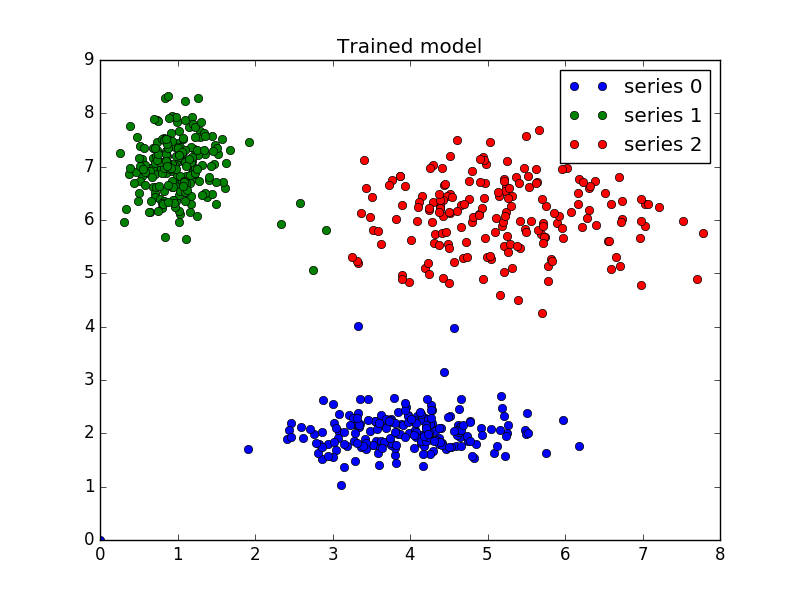
cntr, u_orig, _, _, _, _, _ = fuzz.cluster.cmeans(

    alldata, 3, 2, error=0.005, maxiter=1000)

# Show 3-cluster model

fig2, ax2 = plt.subplots()

ax2.set_title('Trained model')

for j in range(3):

    ax2.plot(alldata[0, u_orig.argmax(axis=0) == j],

             alldata[1, u_orig.argmax(axis=0) == j], 'o',

             label='series ' + str(j))

# 将聚类的中心点标记在图上

for pt in cntr:

    print (pt)

    ax2.plot(pt[0], pt[1], 's')

ax2.legend()

# Generate uniformly sampled data spread across the range [0, 10] in x and y

newdata = np.random.uniform(0, 1, (1100, 2)) * 10

# Predict new cluster membership with `cmeans_predict` as well as

# `cntr` from the 3-cluster model

u, u0, d, jm, p, fpc = fuzz.cluster.cmeans_predict(newdata.T, cntr, 2, error=0.005, maxiter=1000)

# Plot the classified uniform data. Note for visualization the maximum

# membership value has been taken at each point (i.e. these are hardened,

# not fuzzy results visualized) but the full fuzzy result is the output

# from cmeans_predict.

'''

按照行求max的index,index范围为0~2

u长成这样子:

[[ 0.54256489  0.0631068   0.00291562 ...,  0.15580619  0.17543005

   0.15652909]

 [ 0.35176643  0.02712891  0.99530463 ...,  0.2065651   0.31637093

   0.22570475]

 [ 0.10566868  0.90976429  0.00177975 ...,  0.63762871  0.50819901

   0.61776617]]

最后返回像:

[0 2 1 ..., 2 2 2]

其实,u就是聚类的概率啊,特定列的行数值求和就是1哇!

下面返回的cluster_membership 其实就是聚类的结果,0表示聚在类别0,2表示聚集在类别2,...!

补充:(np.argmax([[1,2,3],[4,1,4],[2,8,9]], axis=0)) == [1,2,2]

'''

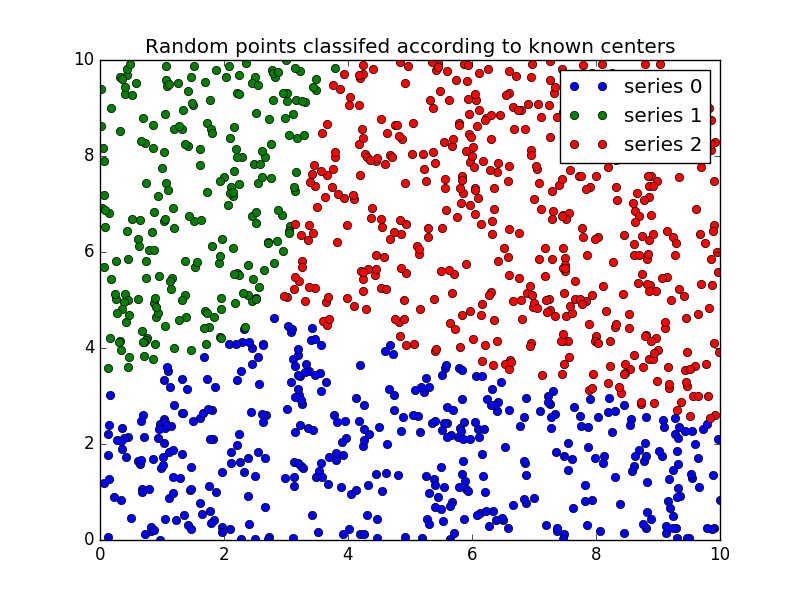
cluster_membership = np.argmax(u, axis=0)  # Hardening for visualization

fig3, ax3 = plt.subplots()

ax3.set_title('Random points classifed according to known centers')

# 将聚类预测的三类结果绘图

for j in range(3):

    ax3.plot(newdata[cluster_membership == j, 0],

             newdata[cluster_membership == j, 1], 'o',

             label='series ' + str(j))

ax3.legend()

plt.show()
预测:
经过测试,是可以处理三维数据聚类的:
    centers = [[4, 2, 100],

           [1, 7, 200],

           [5, 6, 300]]

    sigmas = [[0.8, 0.3, 0.1],

              [0.3, 0.5, 0.2],

              [1.1, 0.7, 0.9]]

    # Generate test data

    np.random.seed(42)  # Set seed for reproducibility

    xpts = np.zeros(1)

    ypts = np.zeros(1)

    zpts = np.zeros(1)

    labels = np.zeros(1)

    print "*********************"

    for i, ((xmu, ymu, zmu), (xsigma, ysigma, zsigma)) in enumerate(zip(centers, sigmas)):

        xpts = np.hstack((xpts, np.random.standard_normal(200) * xsigma + xmu))

        ypts = np.hstack((ypts, np.random.standard_normal(200) * ysigma + ymu))

        zpts = np.hstack((zpts, np.random.standard_normal(200) * zsigma + zmu))

        labels = np.hstack((labels, np.ones(200) * i))

    alldata = np.vstack((xpts, ypts, zpts))

    cntr, u_orig, _, _, _, _, _ = fuzz.cluster.cmeans(alldata, 3, 2, error=0.005, maxiter=1000)

    print "*********************"

    for pt in cntr:

        print (pt)

    print "*********************"
结果为:
*********************

*********************

[  3.95666441   2.02029976  99.72164117]

[   5.00568412    6.05765152  300.09246382]

[   1.00252037    7.06293498  199.99320473]

*********************
python fuzzy c-means demo的更多相关文章
- Fuzzy C Means 算法及其 Python 实现——写得很清楚,见原文
Fuzzy C Means 算法及其 Python 实现 转自:http://note4code.com/2015/04/14/fuzzy-c-means-%E7%AE%97%E6%B3%95%E5% ...
- appium+Python真机运行测试demo的方法
appium+Python真机运行测试demo的方法 一, 打开手机的USB调试模式 二, 连接手机到电脑 将手机用数据线连接到电脑,并授权USB调试模式.查看连接的效果,在cmd下运行命 ...
- Python caffe.TEST Example(Demo)
下面提供了caffe python的六个测试demo,大家可以根据自己的需求进行修改. Example 1 From project FaceDetection_CNN-master, under d ...
- 第一个 Python 程序 - Email Manager Demo
看了一些基础的 Python 新手教程后,深深感觉到 Python 的简洁与强大,这是我的第一个 Python Demo.下面是完整代码与执行截图. 代码: # encoding: utf-8 ''' ...
- python 词云小demo
词云小demo jiebawordcloud 一 什么是词云? 由词汇组成类似云的彩色图形.“词云”就是对网络文本中出现频率较高的“关键词”予以视觉上的突出,形成“关键词云层”或“关键词渲染”,从而过 ...
- Python实例---简单购物车Demo
简单购物车Demo # version: python3.2.5 # author: 'FTL1012' # time: 2017/12/7 09:16 product_list = ( ['Java ...
- python spark 决策树 入门demo
Refer to the DecisionTree Python docs and DecisionTreeModel Python docs for more details on the API. ...
- Python 2.7.9 Demo - 获取调用的参数
#coding=utf-8 #!/usr/bin/python import sys; print("The command line parameters are : "); f ...
- Python 2.7.9 Demo - ini文件的读、写
ini文件 [weixin_info] hello = Nick Huang #coding=utf-8 #!/usr/bin/python import ConfigParser; cp = Con ...
随机推荐
- DataTable转Json就是这么简单(Json.Net DLL (Newtonsoft))
之前JSON转DataTable可以见我之前的随笔 链接Json转换成DataTable 之前没有用过DataTable,之后随着需求的叠加发现需要将DataTable转换成Json.因为之前都是用的 ...
- asp.net 字符串过滤
/// <summary> /// 去除HTML标记 /// </summary> /// <param name="Htmlstring">包 ...
- CI中的文件上传
//首先在控制器中装载url类和view视图: //在view视图中创建一个表单,注:在做文件上传一定要写encype=“multipart/form-data”: //form表单的提交页面应该使用 ...
- 【MFC】模态、非模态对话框
MFC 点击按钮,弹出另一个对话框 方法一:模态对话框 资源视图–Dialog–右键–添加资源–新建–对话框-,然后在已经生成的对话框中(解决资源视图中的dialog下的新生成的那个)右键–添加类.例 ...
- APP开发中,如何从UI设计上提升APP用户体验
设计中有很多细微的东西要注意,就如UI设计中,元素的统一性,图标风格.段落的排版等等,只有能注意这些细节,你的 APP UI 才算合格. 干货君总结了17个提升用户体验的 UI 设计小技巧,也是我们日 ...
- MemCached总结一:Unbutu操作系统下memcached服务器安装和telnet方式连接memcache
1.在Unbutu上安装memcached服务器 sudo apt-get update sudo apt-get install memcached 2. 确认memcached是否安装 要确认me ...
- Spring DATA MongoDB @DBref查询,or和and联合查询
@DBref文档关联,在按该类型查询的时候,在字段名后加上关联表的字段名即可,如: Criteria.where("bloggroup.$id"), $id代表关联表的oid字段. ...
- Windows Phone - 按钮/button 控件
System.Windows.Controls.Button button控件一.button控件的各种样式的展示可以通过 …… 来给控件定义公共的样式调用样式的方法:在Button控件上添加样式 ...
- 关于 Windows 10 如何扩展分区与合并分区
前言 相信大部分人都遇见磁盘不够用的问题吧,然后都在后悔当初为什么就给 x 盘分了 10G 的容量吧. 不过没关系,自从 Windows 7 开始( xp 我也不知道有毛有),Windows 自带的磁 ...
- C# 解析 j s 三元运算符
private void button1_Click(object sender, EventArgs e) { //转换 string str1 = "表达式1?表达式2:表达式3&quo ...