
vtk旋转扫描实体示例:vtkQuadRotationalExtrusionFilter、vtkRotationalExtrusionFilter
一、vtkQuadRotationalExtrusionFilter
Detailed Description
sweep polygonal data creating "skirt" from free edges and lines, and lines from vertices
vtkQuadRotationalExtrusionFilter is a modeling filter. It takes polygonal data as input and generates polygonal data on output. The input dataset is swept around the z-axis to create new polygonal primitives. These primitives form a "skirt" or swept surface. For example, sweeping a line results in a cylindrical shell, and sweeping a circle creates a torus.
There are a number of control parameters for this filter. You can control whether the sweep of a 2D object (i.e., polygon or triangle strip) is capped with the generating geometry via the "Capping" instance variable. Also, you can control the angle of rotation, and whether translation along the z-axis is performed along with the rotation. (Translation is useful for creating "springs".) You also can adjust the radius of the generating geometry using the "DeltaRotation" instance variable.
The skirt is generated by locating certain topological features. Free edges (edges of polygons or triangle strips only used by one polygon or triangle strips) generate surfaces. This is true also of lines or polylines. Vertices generate lines.
This filter can be used to model axisymmetric objects like cylinders, bottles, and wine glasses; or translational/rotational symmetric objects like springs or corkscrews.
- Warning:
- If the object sweeps 360 degrees, radius does not vary, and the object does not translate, capping is not performed. This is because the cap is unnecessary.
- Some polygonal objects have no free edges (e.g., sphere). When swept, this will result in two separate surfaces if capping is on, or no surface if capping is off.
- Thanks:
- This class was initially developed by Daniel Aguilera, CEA/DIF Ported and modified by Philippe Pebay, Kitware, 2011
Definition at line 74 of file vtkQuadRotationalExtrusionFilter.h.
示例代码:
#ifndef INITIAL_OPENGL

#define INITIAL_OPENGL

#include <vtkAutoInit.h>

VTK_MODULE_INIT(vtkRenderingOpenGL)

VTK_MODULE_INIT(vtkInteractionStyle)

#endif

#include <iostream>

using namespace std;

#include "vtkCamera.h"

#include "vtkInformation.h"

#include "vtkLineSource.h"

#include "vtkMultiBlockDataSet.h"

#include "vtkNew.h"

#include "vtkPolyDataMapper.h"

#include "vtkPolyDataNormals.h"

#include "vtkProperty.h"

#include "vtkRegressionTestImage.h"

#include "vtkRenderer.h"

#include "vtkRenderWindow.h"

#include "vtkRenderWindowInteractor.h"

#include "vtkQuadRotationalExtrusionFilter.h"

#include "vtkTestUtilities.h"

int main()

{

    // Create a line source

    vtkNew<vtkLineSource> line;

    line->SetPoint1( ., ., . );

    line->SetPoint2( ., ., . );

    line->SetResolution(  );

    line->Update();

    // Create mapper for line segment

    vtkNew<vtkPolyDataMapper> lineMapper;

    lineMapper->SetInputConnection( line->GetOutputPort() );

    // Create actor for line segment

    vtkNew<vtkActor> lineActor;

    lineActor->SetMapper( lineMapper.GetPointer() );

    lineActor->GetProperty()->SetLineWidth(  );

    lineActor->GetProperty()->SetColor( ., ., . ); // deep sky blue

    // Create multi-block data set for quad-based sweep

    vtkNew<vtkMultiBlockDataSet> lineMB;

    lineMB->SetNumberOfBlocks(  );

    lineMB->GetMetaData( static_cast<unsigned>(  ) )->Set( vtkCompositeDataSet::NAME(), "Line" );

    lineMB->SetBlock( , line->GetOutput() );

    // Create 3/4 of a cylinder by rotational extrusion

    vtkNew<vtkQuadRotationalExtrusionFilter> lineSweeper;

    lineSweeper->SetResolution(  );

    lineSweeper->SetInputData( lineMB.GetPointer() );

    lineSweeper->SetDefaultAngle(  );

    lineSweeper->Update();

    // Retrieve polydata output

    vtkMultiBlockDataSet* cylDS = vtkMultiBlockDataSet::SafeDownCast( lineSweeper->GetOutputDataObject(  ) );

    vtkPolyData* cyl = vtkPolyData::SafeDownCast( cylDS->GetBlock(  ) );

    // Create normals for smooth rendering

    vtkNew<vtkPolyDataNormals> normals;

    normals->SetInputData( cyl );

    // Create mapper for surface representation

    vtkNew<vtkPolyDataMapper> cylMapper;

    cylMapper->SetInputConnection( normals->GetOutputPort() );

    cylMapper->SetResolveCoincidentTopologyToPolygonOffset();

    // Create mapper for wireframe representation

    vtkNew<vtkPolyDataMapper> cylMapperW;

    cylMapperW->SetInputData( cyl );

    cylMapperW->SetResolveCoincidentTopologyToPolygonOffset();

    // Create actor for surface representation

    vtkNew<vtkActor> cylActor;

    cylActor->SetMapper( cylMapper.GetPointer() );

    cylActor->GetProperty()->SetRepresentationToSurface();

    cylActor->GetProperty()->SetInterpolationToGouraud();

    cylActor->GetProperty()->SetColor( ., 0.3882, . ); // tomato

    // Create actor for wireframe representation

    vtkNew<vtkActor> cylActorW;

    cylActorW->SetMapper( cylMapperW.GetPointer() );

    cylActorW->GetProperty()->SetRepresentationToWireframe();

    cylActorW->GetProperty()->SetColor( ., ., .);

    cylActorW->GetProperty()->SetAmbient( . );

    cylActorW->GetProperty()->SetDiffuse( . );

    cylActorW->GetProperty()->SetSpecular( . );

    // Create a renderer, add actors to it

    vtkNew<vtkRenderer> ren1;

    ren1->AddActor( lineActor.GetPointer() );

    ren1->AddActor( cylActor.GetPointer() );

    ren1->AddActor( cylActorW.GetPointer() );

    ren1->SetBackground( ., ., . );

    // Create a renderWindow

    vtkNew<vtkRenderWindow> renWin;

    renWin->AddRenderer( ren1.GetPointer() );

    renWin->SetSize( ,  );

    renWin->SetMultiSamples(  );

    // Create a good view angle

    vtkNew<vtkCamera> camera;

    camera->SetClippingRange( 0.576398, 28.8199 );

    camera->SetFocalPoint( 0.0463079, -0.0356571, 1.01993 );

    camera->SetPosition( -2.47044, 2.39516, -3.56066 );

    camera->SetViewUp( 0.607296, -0.513537, -0.606195 );

    ren1->SetActiveCamera( camera.GetPointer() );

    // Create interactor

    vtkNew<vtkRenderWindowInteractor> iren;

    iren->SetRenderWindow( renWin.GetPointer() );

    // Render and test

    renWin->Render();

        iren->Start();

    return ;

}
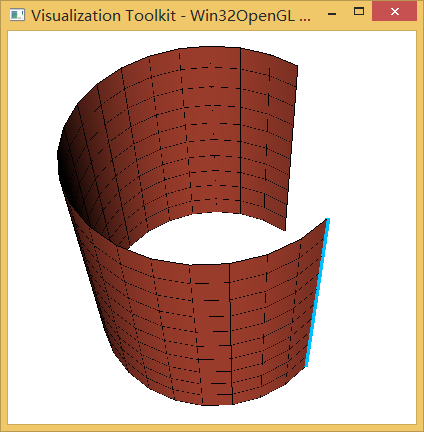
运行显示结果:
2、vtkRotationalExtrusionFilter
Detailed Description
sweep polygonal data creating "skirt" from free edges and lines, and lines from vertices
vtkRotationalExtrusionFilter is a modeling filter. It takes polygonal data as input and generates polygonal data on output. The input dataset is swept around the z-axis to create new polygonal primitives. These primitives form a "skirt" or swept surface. For example, sweeping a line results in a cylindrical shell, and sweeping a circle creates a torus.
There are a number of control parameters for this filter. You can control whether the sweep of a 2D object (i.e., polygon or triangle strip) is capped with the generating geometry via the "Capping" instance variable. Also, you can control the angle of rotation, and whether translation along the z-axis is performed along with the rotation. (Translation is useful for creating "springs".) You also can adjust the radius of the generating geometry using the "DeltaRotation" instance variable.
The skirt is generated by locating certain topological features. Free edges (edges of polygons or triangle strips only used by one polygon or triangle strips) generate surfaces. This is true also of lines or polylines. Vertices generate lines.
This filter can be used to model axisymmetric objects like cylinders, bottles, and wine glasses; or translational/rotational symmetric objects like springs or corkscrews.
- Warning:
- If the object sweeps 360 degrees, radius does not vary, and the object does not translate, capping is not performed. This is because the cap is unnecessary.
- Some polygonal objects have no free edges (e.g., sphere). When swept, this will result in two separate surfaces if capping is on, or no surface if capping is off.
- See also:
- vtkLinearExtrusionFilter
- Examples:
- vtkRotationalExtrusionFilter (Examples)
示例代码:
#include <iostream>

#ifndef INITIAL_OPENGL

#define INITIAL_OPENGL

#include <vtkAutoInit.h>

VTK_MODULE_INIT(vtkRenderingOpenGL)

VTK_MODULE_INIT(vtkInteractionStyle)

#endif

using namespace std;

// .SECTION Thanks

// This test was written by Philippe Pebay, Kitware SAS 2011

#include "vtkCamera.h"

#include "vtkLineSource.h"

#include "vtkNew.h"

#include "vtkPolyDataMapper.h"

#include "vtkPolyDataNormals.h"

#include "vtkProperty.h"

#include "vtkRegressionTestImage.h"

#include "vtkRenderer.h"

#include "vtkRenderWindow.h"

#include "vtkRenderWindowInteractor.h"

#include "vtkRotationalExtrusionFilter.h"

int main()

{

    // Create a line source

    vtkNew<vtkLineSource> line;

    line->SetPoint1( ., ., . );

    line->SetPoint2( ., ., . );

    line->SetResolution(  );

    // Create mapper for line segment

    vtkNew<vtkPolyDataMapper> lineMapper;

    lineMapper->SetInputConnection( line->GetOutputPort() );

    // Create actor for line segment

    vtkNew<vtkActor> lineActor;

    lineActor->SetMapper( lineMapper.GetPointer() );

    lineActor->GetProperty()->SetLineWidth(  );

    lineActor->GetProperty()->SetColor( ., ., . ); // deep sky blue

    // Create 3/4 of a cylinder by rotational extrusion

    vtkNew<vtkRotationalExtrusionFilter> lineSweeper;

    lineSweeper->SetResolution(  );

    lineSweeper->SetInputConnection( line->GetOutputPort() );

    lineSweeper->SetAngle(  );

    // Create normals for smooth rendering

    vtkNew<vtkPolyDataNormals> normals;

    normals->SetInputConnection( lineSweeper->GetOutputPort() );

    // Create mapper for surface representation

    vtkNew<vtkPolyDataMapper> cylMapper;

    cylMapper->SetInputConnection( normals->GetOutputPort() );

    cylMapper->SetResolveCoincidentTopologyToPolygonOffset();

    // Create mapper for wireframe representation

    vtkNew<vtkPolyDataMapper> cylMapperW;

    cylMapperW->SetInputConnection( lineSweeper->GetOutputPort() );

    cylMapperW->SetResolveCoincidentTopologyToPolygonOffset();

    // Create actor for surface representation

    vtkNew<vtkActor> cylActor;

    cylActor->SetMapper( cylMapper.GetPointer() );

    cylActor->GetProperty()->SetRepresentationToSurface();

    cylActor->GetProperty()->SetInterpolationToGouraud();

    cylActor->GetProperty()->SetColor( ., ., . ); // tomato

    // Create actor for wireframe representation

    vtkNew<vtkActor> cylActorW;

    cylActorW->SetMapper( cylMapperW.GetPointer() );

    cylActorW->GetProperty()->SetRepresentationToWireframe();

    cylActorW->GetProperty()->SetColor( ., ., .);

    cylActorW->GetProperty()->SetAmbient( . );

    cylActorW->GetProperty()->SetDiffuse( . );

    cylActorW->GetProperty()->SetSpecular( . );

    // Create a renderer, add actors to it

    vtkNew<vtkRenderer> ren1;

    ren1->AddActor( lineActor.GetPointer() );

    ren1->AddActor( cylActor.GetPointer() );

    ren1->AddActor( cylActorW.GetPointer() );

    ren1->SetBackground( ., ., . );

    // Create a renderWindow

    vtkNew<vtkRenderWindow> renWin;

    renWin->AddRenderer( ren1.GetPointer() );

    renWin->SetSize( ,  );

    renWin->SetMultiSamples(  );

    // Create a good view angle

    vtkNew<vtkCamera> camera;

    camera->SetClippingRange( 0.576398, 28.8199 );

    camera->SetFocalPoint( 0.0463079, -0.0356571, 1.01993 );

    camera->SetPosition( -2.47044, 2.39516, -3.56066 );

    camera->SetViewUp( 0.607296, -0.513537, -0.606195 );

    ren1->SetActiveCamera( camera.GetPointer() );

    // Create interactor

    vtkNew<vtkRenderWindowInteractor> iren;

    iren->SetRenderWindow( renWin.GetPointer() );

    // Render and test

    renWin->Render();

    iren->Start();

    return ;

}
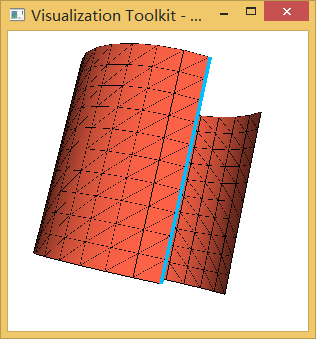
代码运行结果:
vtk旋转扫描实体示例:vtkQuadRotationalExtrusionFilter、vtkRotationalExtrusionFilter的更多相关文章
- 应用程序框架实战三十四:数据传输对象(DTO)介绍及各类型实体比较
本文将介绍DDD分层架构中广泛使用的数据传输对象Dto,并且与领域实体Entity,查询实体QueryObject,视图实体ViewModel等几种实体进行比较. 领域实体为何不能一统江湖? 当你阅读 ...
- 数据传输对象(DTO)介绍及各类型实体比较
数据传输对象(DTO)介绍及各类型实体比较 本文将介绍DDD分层架构中广泛使用的数据传输对象Dto,并且与领域实体Entity,查询实体QueryObject,视图实体ViewModel等几种实体进行 ...
- Rookey.Frame之实体类
上周跟大家分享了Rookey.Frame框架的初始化功能,今天继续给大家介绍实体类的设计. 先看下下面菜单实体示例代码: using Rookey.Frame.EntityBase; using Ro ...
- ABP框架 - 数据过滤
文档目录 本节内容: 简介 预定义过滤 ISoftDelete 何时可用? IMustHaveTenant 何时可用? IMayHaveTenant 何时可用? 禁用过滤 关于using声明 关于多租 ...
- EF CodeFirst EntityTypeConfiguration 自关联映射配置
实体示例代码: public class Message { public Message() { } public int ID { get; private set; } public strin ...
- c# SqlHelper Class
using System;using System.Collections;using System.Collections.Generic;using System.Data;using Syste ...
- WPF学习之路初识
WPF学习之路初识 WPF 介绍 .NET Framework 4 .NET Framework 3.5 .NET Framework 3.0 Windows Presentation Found ...
- Entity Framework Core 2.0 全局查询过滤器
不定时更新翻译系列,此系列更新毫无时间规律,文笔菜翻译菜求各位看官老爷们轻喷,如觉得我翻译有问题请挪步原博客地址 本博文翻译自: http://gunnarpeipman.com/2017/08/ef ...
- 基于EF Core的Code First模式的DotNetCore快速开发框架
前言 最近接了几个小单子,因为是小单子,项目规模都比较小,业务相对来说,也比较简单.所以在选择架构的时候,考虑到效率方面的因素,就采取了asp.net+entity framework中的code f ...
随机推荐
- PropertyPlaceholderConfigurer implements BeanFactoryPostProcessor
BeanFactoryPostProcessor的应用 最常用的一个应用就是org.springframework.beans.factory.config.PropertyPlaceholderCo ...
- 读取web.xml中设置的参数
以获取Filer元素里设置的参数为例 先在web.xml文件中配置如下 <?xml version="1.0" encoding="UTF-8"?> ...
- vue设置全局query参数
router.beforeEach((to, from, next) => { // 设置全局店铺ID shopid const shopid = from.query.shopid // 如果 ...
- qt5--QPainter绘图
需要 #include <QPainter> #include "win.h" #include "ui_win.h" #include <Q ...
- qt5-QPushButton按钮
Win::Win(QWidget *parent) //构造函数体 : QWidget(parent) //执行父类初始化操作 { //创建按钮方式一 ,);//重置窗口大小 this->set ...
- Session中的方法
Session 管理一个数据库的任务单元,即管理数据库中的增删改查操作,提交事务. 方法CRUD:save(),delete(),load(),get(),update(),saveOrUpdate( ...
- 【leetcode】1233. Remove Sub-Folders from the Filesystem
题目如下: Given a list of folders, remove all sub-folders in those folders and return in any order the f ...
- Windows环境下MySQL面试技巧
对话一: 面试官:重新安装mysql卡在最后一步,怎么解决? 应聘者:第一次安装完mysql,由于各种原因需要重新安装是经常遇到的问题,解决方案如下. 1)在注册表里搜索my ...
- [Flask]celery异步任务队列的使用
Celery异步任务队列 目录结构树: 配置文件config.py: # 设置中间人地址 broker_url = 'redis://127.0.0.1:6379/1' 主main.py: impor ...
- ERROR: An HTTP request took too long to complete. Retry with --verbose to obtain debug information.
docker-compose 的问题 要改环境变量 xed ~/.profile export COMPOSE_HTTP_TIMEOUT=500 export DOCKER_CLIENT_TIMEOU ...