
15.C++-操作符重载、并实现复数类
首先回忆下以前学的函数重载
函数重载
- 函数重载的本质为相互独立的不同函数
- 通过函数名和函数参数来确定函数调用
- 无法直接通过函数名得到重载函数的入口地址
- 函数重载必然发生在同一个作用域中
类中的函数重载
- 静态成员函数能与普通成员函数建立重载关系
- 全局函数和成员函数不能构成重载关系
操作符重载(operator)
什么是操作符重载?
大家都知道,在C里,有'+,-,*,/'这些操作符,且它们的功能就是实现普通变量运算。
由于C++是面向对象的,遇到的变量大多都是对象,所以优化了C里的操作符,使它们拥有了重载能力.能通过一定方式,使对象能进行'+,-,*,/'等运算.
操作符的重载是以函数的方式进行.
操作符重载定义
操作符重载,通过operator关键字在函数前定义:
[返回类型]  operator  [需要重载的操作符](函数参数)

{

       //......

}
操作符重载有几种方式 : 全局操作符重载函数、全局操作符重载函数
编译器首先会判断运算的若是对象,就会先从类里寻找成员操作符重载函数,若没找到,就会再去全局里寻找全局操作符重载函数.
注意事项:
- 操作符重载不能改变原操作符的优先级
- 操作符重载不能改变操作数的个数
- 操作符重载的参数一般设为const class_name &类型(若只设为const class_name,会产生临时对象)
- 在C++中,有些操作符必须需要有对象支持,所以只能为成员函数.这种被称为一元操作符
比如赋值(=)、下标([])、下标([])、调用(())和成员访问箭头(->):
Test t3=t2; //相当于调用了: Test t3.operator =(t2); 里面会通过this指针来代替左侧数t3
- 有些操作符既可以当做成员操作符重载函数,也可以当做全局操作符重载函数,由于函数参数可以多个,便称为二元操作符
比如加法(+),与(&&),或(||),逗号(,)等:
以加法(+)为例,当设为全局操作符重载函数时,执行
Test t3=t1+t2; //相当于调用了: Test t3 = operator +(t1,t2);
以加法(+)为例,当设为成员操作符重载函数时,执行
Test t3=t1+t2; //相当于调用了: Test t3 =t1.operator +(t2); //里面会通过this指针来代替左侧数t1
多个重载的操作符重载函数
由于操作符重载函数带参数,所以可以存在多个相同的操作符重载函数
例如:
class Test

{

double  x;

double  y;

public:

Test operator +(const Test& t);                //实现Test t3=t1+t2

Test operator +(int i);                        //实现Test t3=t1+1

Test operator +(double d);                     //实现Test t3=t1+1.25

//... ...

};
初步试验
1.接下来,来个全局操作符重载函数例子:
#include "stdio.h"

class Test{

       int x;

       int y;

public:

       Test(int x=0,int y=0)

       {

              this->x=x;

              this->y=y;

       }

       int getx()

       {

              return x;

       }

       int gety()

       {

              return y;

       }

       friend Test operator + (const Test& t1,const Test& t2);

                                                 //声明友元函数,可以使用私有成员变量

};

Test operator + (const Test& t1,const Test& t2)              //重载

{

       Test ret;

       ret.x=t1.x+t2.x;

       ret.y=t1.y+t2.y;

       return ret;

}

int main()

{

       Test t1(1,3);

       Test t2(2,4);

       Test t3= t1 + t2;           // 其实就是调用: Test t3 = operator +(t1,t2);

       printf("t3.x:%d  t3.y:%d\n",t3.getx(),t3.gety());

       Test t4 =operator +(t1,t3);   // t4 =t1 +t3

       printf("t4.x:%d  t4.y:%d\n",t4.getx(),t4.gety());

       return 0;

}
打印结果:
t3.x:3  t3.y:7

t4.x:4  t4.y:10
2.换成成员操作符重载函数例子:
#include "stdio.h"

class Test{

       int x;

       int y;

public:

       Test(int x=0,int y=0)

       {

         this->x =x;

         this->y =y;

       }

       int getx()

       {

              return x;

       }

       int gety()

       {

              return y;

       }

    Test operator + (const Test& t2)

       {

              Test ret;

              ret.x = this->x + t2.x;

              ret.y = this->y + t2.y;

              return ret;

       }

};

int main()

{

       Test t1(1,3);

       Test t2(2,4);

       Test t3= t1 + t2;           // 其实就是调用: Test t3 =t1.operator +(t2);

       printf("t3.x:%d  t3.y:%d\n",t3.getx(),t3.gety());

       Test t4 =t1.operator +(t3);   // t4 =t1 +t3

       printf("t4.x:%d  t4.y:%d\n",t4.getx(),t4.gety());

       return 0;

}
打印结果:
t3.x:3  t3.y:7

t4.x:4  t4.y:10
加深理解
由于C++里,没有复数的慨念,而在刚刚又学习了操作符重载,所以接下来便通过操作符重载来实现复数类
复数类应该具有
两个成员
实部a 、虚部b
运算操作符
+ - : 结果 = 两个实部进行加减,两个虚部进行加减
* : 结果 = (a1+b1)(a2+b2)= (a1*a2 - b1*b2 )+( a2*b1 + a1*b2);
/ : 结果 =(a1+b1)/(a2+b2)= (a1*a2+b1*b2)/(a2* a2+b2* b2) +(b1*a2-a1*b2)/(a2* a2+b2* b2)
比较操作符:== ,!=
赋值操作符: =
求模成员函数 : 等于a^2+b^2的算术平方根
所以复数类的操作符重载共有以下几个:
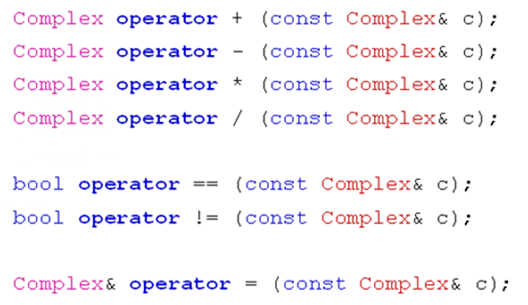
1.写头文件Complex.h:
#ifndef __COMPLEX_H

#define __COMPLEX_H

class Complex{

private:

       double a;

       double b;

public:

       Complex(int a=0,int b=0);

       Complex operator + (const Complex& t);

       Complex operator - (const Complex& t);

       Complex operator * (const Complex& t);

       Complex operator / (const Complex& t);

       bool operator == (const Complex& t);

       bool operator != (const Complex& t);

       Complex& operator = (const Complex& t);

       double getModulus();

       double getA();

       double getB();

};

#endif
2.写源文件Complex.cpp
#include "Complex.h"

#include "math.h"

Complex::Complex(int a,int b)

{

       this->a = a;

       this->b = b;

}

Complex Complex::operator + (const Complex& t)

{

       Complex ret;

       ret.a = a + t.a;

       ret.b = b + t.b;

       return ret;

}

Complex Complex::operator - (const Complex& t)

{

       Complex ret;

       ret.a = a - t.a;

       ret.b = b - t.b;

       return ret;

}

Complex Complex::operator * (const Complex& t)

{

       Complex ret;

       ret.a = (a* t.a - b* t.b );

       ret.b = (t.a *b + a* t.b );

       return ret;

}

Complex Complex::operator / (const Complex& t)

{

       Complex ret;

       ret.a = (a* t.a + b* t.b)/(t.a * t.a + t.b * t.b);

       ret.b = (b* t.a - a* t.b)/(t.a * t.a + t.b * t.b);

       return ret;

}

bool Complex::operator == (const Complex& t)

{

       if((a== t.a)&&(b== t.b))

        return true;

       else

        return false;

}

bool Complex::operator != (const Complex& t)

{

       if((a!= t.a)||(b!= t.b))

        return true;

       else

        return false;

}

Complex& Complex::operator = (const Complex& t)

{

       if(this != &t)

       {

         a = t.a;

         b = t.b;

       }

       return *this;

}

double Complex::getModulus()

{

       return sqrt( a*a + b*b);

}

double Complex::getA()

{

       return a;

}

double Complex::getB()

{

       return b;

}
3.写测试文件test.cpp
#include "stdio.h"

#include "Complex.h"

int main()

{

       Complex t1(1,3);

       Complex t2(2,6);

       Complex t3=t1+t2;

       printf("t3.a=%f  t3.b=%f\n",t3.getA(),t3.getB());

       printf("t3 Modulus:%f\n",t3.getModulus());

       Complex t4=t3;

       printf("t4==t3: %d\n",t4==t3);

       printf("t4!=t3: %d\n",t4!=t3);

       printf("t3==t1: %d\n",t3==t1);

       return 0;

}
4.编译运行
t3.a=3.000000  t3.b=9.000000

t3 Modulus:9.486833

t4==t3: 1                                   //为真

t4!=t3: 0                                   //为假

t3==t1: 0                                   //为假
15.C++-操作符重载、并实现复数类的更多相关文章
- 15.C++-操作符重载
首先回忆下以前学的函数重载 函数重载 函数重载的本质为相互独立的不同函数 通过函数名和函数参数来确定函数调用 无法直接通过函数名得到重载函数的入口地址 函数重载必然发生在同一个作用域中 类中的函数重载 ...
- C++学习笔记15:操作符重载的函数原型列表(推荐)
//普通四则运算 friend A operator +(const A & lhs, const A & rhs); friend A operator -(const A & ...
- [GeekBand] C++学习笔记(1)——以复数类为例
本篇笔记以复数类(不含指针的类)为例进行面向对象的学习 ========================================================= 复数类的声明: class ...
- 5.1 C++基本操作符重载
参考:http://www.weixueyuan.net/view/6379.html 总结: 操作符重载指的是将C++提供的操作符进行重新定义,使之满足我们所需要的一些功能. 长度运算符“sizeo ...
- C++解析(17):操作符重载
0.目录 1.操作符重载 2.完善的复数类 3.小结 1.操作符重载 下面的复数解决方案是否可行? 示例1--原有的解决方案: #include <stdio.h> class Compl ...
- C++中操作符重载的概念
1,下面的复数解决方案是否可行? 1,代码示例: class Comples { public: int a; int b; }; int main() { Complex c1 = {, }; Co ...
- C++ operator overload -- 操作符重载
C++ operator overload -- 操作符重载 2011-12-13 14:18:29 分类: C/C++ 操作符重载有两种方式,一是以成员函数方式重载,另一种是全局函数. 先看例子 # ...
- C++ 操作符重载 (operator)
重载不能改变操作符的优先级 如果一个内建操作符是一元的,那么所有对它的重载仍是一元的.如果是二元的重载后也是二元的 下面看一个有代表性的例子:: 头文件Complex.h: #includeusing ...
- C++ 数组操作符重载、函数对象分析、赋值操作符
string类型访问单个字符 #include <iostream> #include <string> #include <sstream> using name ...
随机推荐
- Python 学习第一章
学习内容如下: Python 介绍 Python 3 VS Python 2 软件的安装 第一个 Python 程序 变量与字符编码 用户输入与注释 一.Python 介绍 python的创始人为吉多 ...
- C#之简易计算器设计
在学完了C#的方法和数据类型之后,写了一个简易的计算器的界面.本次界面具备加减乘除求余等五项运算.不过存在一点缺陷就是无法判断输入数据的类型,是整数还是小数,由于目前所学知识有限,等学到以后再进行完善 ...
- WPF Adorner
之前做项目时,为了实现类似微信消息数目的效果 image.png ,我之前是修改的ControlTemplate.类似于将一个带数字的控件,放在另一个控件的右上角,来实现的这个效果. 原来WPF有 ...
- 【转】PowerDesigner code、name显示设置 及 同时显示办法
原文地址:http://blog.csdn.net/fy_hanxu/article/details/52468927 菜单->Tool->Model Options->Name C ...
- 【转】 js数组 Array 交集 并集 差集 去重
原文:http://blog.csdn.net/ma_jiang/article/details/52672762 最劲项目需要用到js数组去重和交集的一些运算,我的数组元素个数可能到达1000以上, ...
- Android开发教程 - 使用Data Binding(七)使用BindingAdapter简化图片加载
本系列目录 使用Data Binding(一)介绍 使用Data Binding(二)集成与配置 使用Data Binding(三)在Activity中的使用 使用Data Binding(四)在Fr ...
- JQuery的页面操作
window.location = "http://www.xxxxxxxx.net" 跳转后有后退功能 其实应该是 window.location.hrefwindow.loca ...
- 浏览器标识ua
# LinuxLinux / Firefox 29: Mozilla/5.0 (X11; Linux x86_64; rv:29.0) Gecko/20100101 Firefox/29.0Linux ...
- Shell - 简明Shell入门11 - 调用脚本(CallTheScript)
示例脚本及注释 主脚本: CallTheScript.sh #!/bin/bash . ./11-subscript.sh # 调用其他脚本;注意点号"."和文件路径之间有一空格; ...
- 善用Intellij插件可大幅提升我们的效率
转自 :https://www.jianshu.com/p/686ba0ae4ac2 1. .ignore 生成各种ignore文件,一键创建git ignore文件的模板,免得自己去写 截图: 2. ...