
Apache Kafka for Item Setup
At Walmart.com in the U.S. and at Walmart’s 11 other websites around the world, we provide seamless shopping experience where products are sold by:
- Own Merchants for Walmart.com & Walmart Stores
- Suppliers for Online & Stores
- Sellers on Walmart’s marketplaces

Product sold on walmart.com - Online, Stores by Walmart & by 3 marketplace sellers
The Process is referred to internally as “Item Setup” and the visitors to the sites see Product listings after data processing for Products, Offers, Price,Inventory & Logistics. These entities are comprised of data from multiple sources in different formats & schemas. They have different characteristics around data processing:
- Products requires more of data preparation around:
- Normalization — This is standardization of attributes & values, aids in search and discovery
- Matching — This is a slightly complex problem to match duplicates with imperfect data
- Classification — This involves classification against Categories & Taxonomies
- Content — This involves scoring data quality on attributes like Title, Description, Specifications etc. , finding & filling the “gaps” through entity extraction techniques
- Images — This involves selecting best resolution, deriving attributes, detecting watermark
- Grouping — This involves matching, grouping products based on variations, like shoes varying on Colors & Sizes
- Merging — This involves selection of the best sources and data aggregation from multiple sources
- Reprocessing — The Catalog needs to be reprocessed to pickup daily changes
2. Offers are made by Multiple sellers for same products & need to checked for correctness on:
- Identifiers
- Price variance
- Shipping
- Quantity
- Condition
- Start & End Dates
3. Pricing & Inventory adjustments many times of the day which need to be processed with very low latency & strict time constraints
4. Logistics has a strong requirement around data correctness to optimize cost & delivery
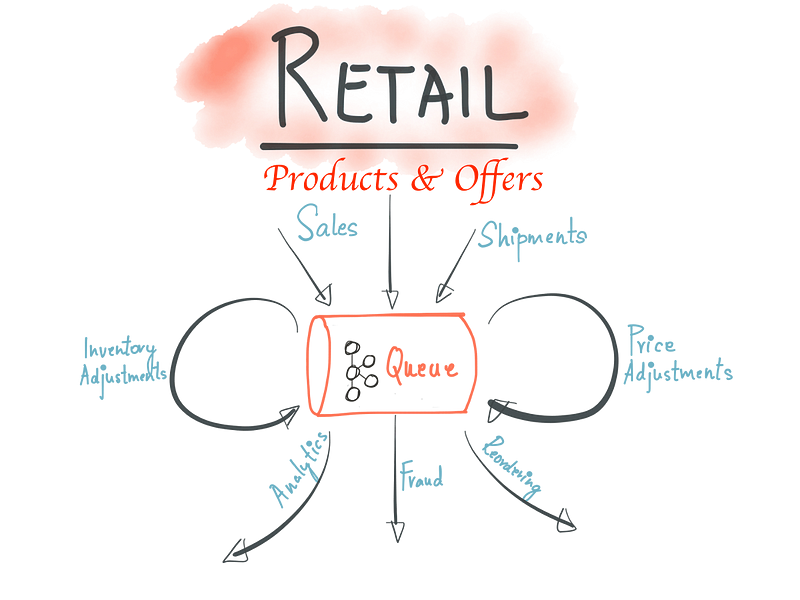
Modified Original with permission from Neha Narkhede
This yields architecturally to lots of decentralized autonomous services, systems & teams which handle the data “Before & After” listing on the site. As part of redesign around 2014 we started looking into building scalable data processing systems. I was personally influenced by this famous blog post “The Log: What every software engineer should know about real-time data’s unifying abstraction” where Kafka could provide good abstraction to connect hundreds of Microservices, Teams, and evolve to company-wide multi-tenant data hub. We started modeling changes as event streams recorded in Kafka before processing. The data processing is performed using a variety of technologies like:
- Stream Processing using Apache Storm, Apache Spark
- Plain Java Program
- Reactive Micro services
- Akka Streams
The new data pipelines which was rolled out in phases since 2015 has enabled business growth where we are on boarding sellers quicker, setting up product listings faster. Kafka is also the backbone for our New Near Real Time (NRT) Search Index, where changes are reflected on the site in seconds.
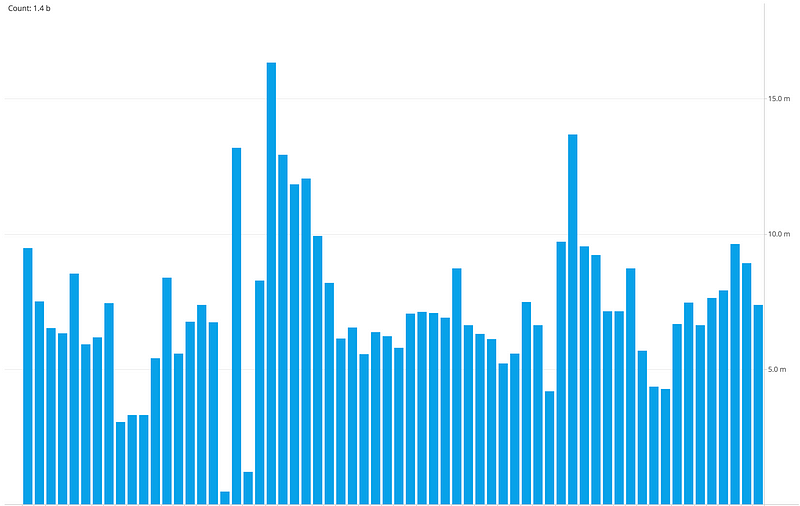
Message Rate filtered for a Day, split Hourly
The usage of Kafka continues to grow with new topics added everyday, we have many small clusters with hundreds of topics, processing billions of updates per day mostly driven by Pricing & Inventory adjustments. We built operational tools for tracking flows, SLA metrics, message send/receive latencies for producers and consumers, alerting on backlogs, latency and throughput. The nice thing of capturing all the updates in Kafka is that we can process the same data for Reprocessing of the catalog, sharing data between environments, A/B Testing, Analytics & Data warehouse.
The shift to Kafka enabled fast processing but has also introduced new challenges like managing many service topologies & their data dependencies, schema management for thousands of attributes, multi-DC data balancing, and shielding consumer sites from changes which may impact business.
The core tenant which drove Kafka adoption where “Item Setup” teams in different geographical locations can operate autonomously has definitely enabled agile development. I have personally witnessed this over the last couple of years since introduction. The next steps are to increase awareness of Kafka internally for New & (Re)architecting existing data processing applications, and evaluate exciting new streaming technologies like Kafka Streams and Apache Flink. We will also engage with the Kafka open source community and the surrounding ecosystem to make contributions.
Apache Kafka for Item Setup的更多相关文章
- Putting Apache Kafka To Use: A Practical Guide to Building a Stream Data Platform-part 1
转自: http://www.confluent.io/blog/stream-data-platform-1/ These days you hear a lot about "strea ...
- How-to: Do Real-Time Log Analytics with Apache Kafka, Cloudera Search, and Hue
Cloudera recently announced formal support for Apache Kafka. This simple use case illustrates how to ...
- 实践部署与使用apache kafka框架技术博文资料汇总
前一篇Kafka框架设计来自英文原文(Kafka Architecture Design)的翻译及整理文章,非常有借鉴性,本文是从一个企业使用Kafka框架的角度来记录及整理的Kafka框架的技术资料 ...
- Apache Kafka: Next Generation Distributed Messaging System---reference
Introduction Apache Kafka is a distributed publish-subscribe messaging system. It was originally dev ...
- Install and Configure Apache Kafka on Ubuntu 16.04
https://devops.profitbricks.com/tutorials/install-and-configure-apache-kafka-on-ubuntu-1604-1/ by hi ...
- Benchmarking Apache Kafka: 2 Million Writes Per Second (On Three Cheap Machines)
I wrote a blog post about how LinkedIn uses Apache Kafka as a central publish-subscribe log for inte ...
- Flafka: Apache Flume Meets Apache Kafka for Event Processing
The new integration between Flume and Kafka offers sub-second-latency event processing without the n ...
- Install and Configure Apache Kafka
I. Installation The installation environment must have JDK, verify that you enter: java -version 1. ...
- Apache Kafka源码分析 – Broker Server
1. Kafka.scala 在Kafka的main入口中startup KafkaServerStartable, 而KafkaServerStartable这是对KafkaServer的封装 1: ...
随机推荐
- Kafka单机环境部署
前面说过Kafka集群环境的部署,现在主要说一下在本地测试中Kafka单机环境的部署,和前面一样首先保证zookeeper服务的正常运行,然后解压并释放kafka安装包,并放到指定位置: tar -x ...
- java web 学习 --第六天(Java三级考试)
第五天学习在这:http://www.cnblogs.com/tobecrazy/p/3458592.html session对象 当某个用户首次访问web应用系统时,jsp会自动创建出一个sessi ...
- 2106 Problem F Shuffling Along 中石油-未提交-->已提交
题目描述 Most of you have played card games (and if you haven’t, why not???) in which the deck of cards ...
- 【leetcode】Maximum Gap(hard)★
Given an unsorted array, find the maximum difference between the successive elements in its sorted f ...
- 【python】解压文件
参考:http://essen.iteye.com/blog/1941489 tarfile模块 具体使用方法: https://docs.python.org/2/library/tarfile.h ...
- 在JAVA中如何跳出当前的多重嵌套循环
可以使用return,但使用return后,会跳出整个函数,多重循环后面的代码无法执行. public static void main(String[] args) { // TODO Auto-g ...
- 在Eclipse中手动安装pydev插件,eclipse开发python环境配置
最近在学习Python,因为我是做java的,用惯了eclipse,所以就想用eclipse开发python,但是配置开发环境的时候发现按照网上的配置大多不行,而且都是用的在线安装,很垃圾,没办法,自 ...
- XP/Win7下QTP11循环试用30天的破解方法
XP/Win7下QTP11循环试用30天的破解方法. XP下:1.找到以下路径:C:\Documents and Settings\All Users\Application Data\SafeNet ...
- LinkIssue: Error 'LINK : fatal error LNK1123: failure during conversion to COFF: file invalid or cor
参考:http://blog.csdn.net/junjiehe/article/details/16888197 使用VisualStudio 编译链接中可能出现如下错误: LINK : fatal ...
- spring整合httpclient
<beans xmlns="http://www.springframework.org/schema/beans" xmlns:context="http://w ...