
cJSON序列化工具解读一(结构剖析)
cJSON简介
JSON基本信息
JSON(JavaScript Object Notation)是一种轻量级的数据交换格式。易于人阅读和编写。同时易于机器解析和生成。是一种很好地数据交换语言。
JSON构建:基于两种结构
“名称/值”对 的集合。
值得有序列表。
JSON具体结构表示
对象:一个”名称/值"对的集合 {名称:值,名称:值}
数组:值得有序集合[值,值]
值:str,num,true,false,null,object,array。可嵌套
字符串:由双引号包围的任意数量Unicode字符的集合,反斜杠转义
数值:类似C,java:没有8进制和具体的编码细节
cJSON源码解读
首先给出cJSON文件中头文件函数列表
我们将根据此进行模块化解读
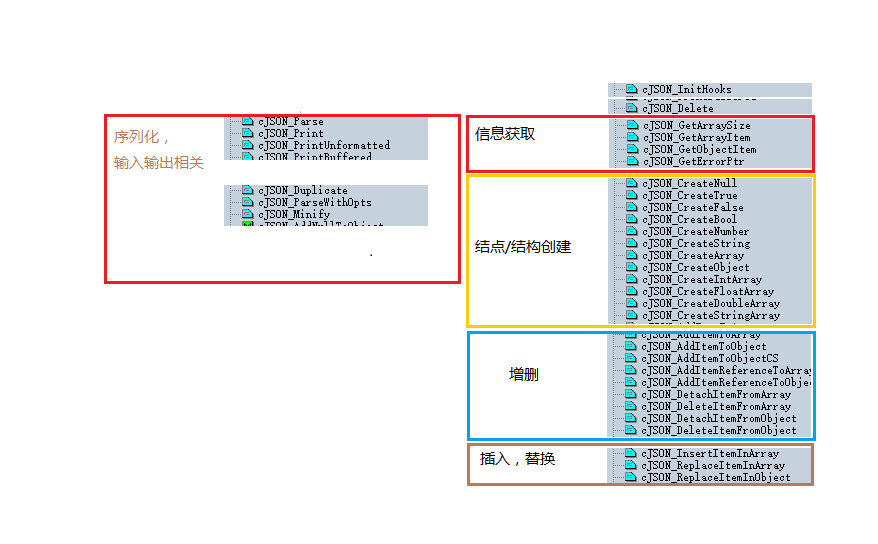
①结构描述
关于具体的结构图解描述,请参考官方描述
    /* cJSON Types: */

#define cJSON_False 0

#define cJSON_True 1

#define cJSON_NULL 2

#define cJSON_Number 3

#define cJSON_String 4

#define cJSON_Array 5

#define cJSON_Object 6

#define cJSON_IsReference 256

#define cJSON_StringIsConst 512
以上是具体的类型区分描述,可以改进为使用enum实现更加安全
    /* The cJSON structure: */

    typedef struct cJSON {

        struct cJSON *next, *prev;    /* 如果是同一级别类型元素,使用双项链方式实现 */

        struct cJSON *child;        /* 如果是具体结构或者数组,第一个指针指向内部链 */

        int type;                    /*根据以上定义描述所保存对象类型*/

        char *valuestring;            /* The item's string, if type==cJSON_String */

        int valueint;                /* The item's number, if type==cJSON_Number */

        double valuedouble;            /* The item's number, if type==cJSON_Number */

        char *string;                /* 对于key-value映射结构,表示其key/名称 */

    }cJSON;
②关于内存管理
    typedef struct cJSON_Hooks {

        void *(*malloc_fn)(size_t sz);

        void(*free_fn)(void *ptr);

    } cJSON_Hooks;
注:cJSON的内存管理,提供了用户自主方式的接口。可以通过方法InitHooks来设置自己的内存管理,默认使用malloc,free
static void *(*cJSON_malloc)(size_t sz) = malloc;

static void(*cJSON_free)(void *ptr) = free;

void cJSON_InitHooks(cJSON_Hooks* hooks)

{

    if (!hooks) { /* Reset hooks */

        cJSON_malloc = malloc;

        cJSON_free = free;

        return;

    }

    cJSON_malloc = (hooks->malloc_fn) ? hooks->malloc_fn : malloc;

    cJSON_free = (hooks->free_fn) ? hooks->free_fn : free;

}
③结点创建,删除结点
/* Internal constructor. */

static cJSON *cJSON_New_Item(void)

{

    cJSON* node = (cJSON*)cJSON_malloc(sizeof(cJSON));

    if (node) memset(node, , sizeof(cJSON));

    return node;

}

/* Delete a cJSON structure. */
//删除节点很简单, 先删除儿子,然后清理内存即可。
//总结一下就是对于 object 和 array 需要先删除儿子,然后删除自己。
//对于 字符串, 需要先释放字符串的内存, 再释放自己这块内存。
//对于其他节点,直接释放自己这块内存。
void cJSON_Delete(cJSON *c)

{

    cJSON *next;

    while (c)

    {

        next = c->next;

        if (!(c->type&cJSON_IsReference) && c->child) cJSON_Delete(c->child);  //

        if (!(c->type&cJSON_IsReference) && c->valuestring) cJSON_free(c->valuestring);

        if (!(c->type&cJSON_StringIsConst) && c->string) cJSON_free(c->string);

        cJSON_free(c);

        c = next;

    }

}
有了结点设置,那么下面就是具体类型结点的实现了:设置类型,设置具体类型的值
    /* These calls create a cJSON item of the appropriate type. */

    extern cJSON *cJSON_CreateNull(void);

    extern cJSON *cJSON_CreateTrue(void);

    extern cJSON *cJSON_CreateFalse(void);

    extern cJSON *cJSON_CreateBool(int b);

    extern cJSON *cJSON_CreateNumber(double num);

    extern cJSON *cJSON_CreateString(const char *string);

    extern cJSON *cJSON_CreateArray(void);

    extern cJSON *cJSON_CreateObject(void);

    /* These utilities create an Array of count items. */

    extern cJSON *cJSON_CreateIntArray(const int *numbers, int count);

    extern cJSON *cJSON_CreateFloatArray(const float *numbers, int count);

    extern cJSON *cJSON_CreateDoubleArray(const double *numbers, int count);

    extern cJSON *cJSON_CreateStringArray(const char **strings, int count);
/* Create basic types: */

cJSON *cJSON_CreateNull(void)

{

    cJSON *item = cJSON_New_Item();

    if (item)

        item->type = cJSON_NULL;

    return item;

}

/* Create Arrays: */

cJSON *cJSON_CreateIntArray(const int *numbers, int count)

{

    int i; cJSON *n = , *p = ,

        *a = cJSON_CreateArray();

    for (i = ; a && i < count; i++)

    {

        n = cJSON_CreateNumber(numbers[i]); //申请N个几点

        if (!i)

            a->child = n;//第一个结点链接使用child

        else

            suffix_object(p, n);//其他结点 :连接prev next

        p = n;

    }return a;

}
④结点操作
    /* Append item to the specified array/object. */

    extern void cJSON_AddItemToArray(cJSON *array, cJSON *item);

    extern void cJSON_AddItemToObject(cJSON *object, const char *string, cJSON *item);

    extern void cJSON_AddItemToObjectCS(cJSON *object, const char *string, cJSON *item);    /* Use this when string is definitely const (i.e. a literal, or as good as), and will definitely survive the cJSON object */

/* Append reference to item to the specified array/object. Use this when you want to add an existing cJSON to a new cJSON,
but don't want to corrupt your existing cJSON. */

    extern void cJSON_AddItemReferenceToArray(cJSON *array, cJSON *item);

    extern void cJSON_AddItemReferenceToObject(cJSON *object, const char *string, cJSON *item);

    /* Remove/Detatch items from Arrays/Objects. */
  //Detatch脱离,使item从arr链中脱离,便于delete

    extern cJSON *cJSON_DetachItemFromArray(cJSON *array, int which);

    extern void   cJSON_DeleteItemFromArray(cJSON *array, int which);

    extern cJSON *cJSON_DetachItemFromObject(cJSON *object, const char *string);

    extern void   cJSON_DeleteItemFromObject(cJSON *object, const char *string);

    /* Update array items. */

    extern void cJSON_InsertItemInArray(cJSON *array, int which, cJSON *newitem);    /* Shifts pre-existing items to the right. */

    extern void cJSON_ReplaceItemInArray(cJSON *array, int which, cJSON *newitem);

    extern void cJSON_ReplaceItemInObject(cJSON *object, const char *string, cJSON *newitem);
注:①
Detach 是什么东西呢?
我们把一个节点从 json 树中删除, 但是不释放内存,而是先保留这个节点的指针, 这样储存在这个节点的信息都保留了下来。
接下来我们就可以做很多事了, 合适的时候添加到其他对象中, 合适的时候释放内存。
比如上面的 delete 函数, 就需要真实的删除了, 这个时候我们删除即可。
而 detach 实现也比较简单, 只是少了一步删除操作。
//将结点从结构中脱离

cJSON *cJSON_DetachItemFromArray(cJSON *array, int which)

{

    cJSON *c = array->child;

    while (c && which>)

        c = c->next, which--;

    if (!c)

        return ;

    if (c->prev)

        c->prev->next = c->next;

    if (c->next)

        c->next->prev = c->prev;

    if (c == array->child)

        array->child = c->next;

    c->prev = c->next = ;

    return c;

}

void   cJSON_DeleteItemFromArray(cJSON *array, int which)

{

    cJSON_Delete(cJSON_DetachItemFromArray(array, which));

}
②关于以上相关方法,简单的增加结点就是个链表操作了,然后对于
cJSON_AddItemReferenceToArray这个方法说明
cJSON除了实现简单的增加结点到结构之外,还有简单考虑效率问题。
比如同时增加一个结点到两棵树中,那么如果有深浅拷贝问题时,cJSON做法是,增加一个结点为Reference类型,在另一棵树中。这里的做法可以是引用计数,写实拷贝等
我们来看看cJSON实现吧
/* Utility for handling references. */

static cJSON *create_reference(cJSON *item)

{

    cJSON *ref = cJSON_New_Item();

    if (!ref)

        return ;

    memcpy(ref, item, sizeof(cJSON)); //浅拷贝所有值-->最终保存了结点的value部分

    ref->string = ; //k-v中的值清空,以便于重新设置

    ref->type |= cJSON_IsReference;  //结点类性是具体item类型的同时也是reference

    ref->next = ref->prev = ;  //只是当前节点的引用,去除引用的链接

    return ref;

}

void    cJSON_AddItemReferenceToArray(cJSON *array, cJSON *item)

{

    cJSON_AddItemToArray(array, create_reference(item)); //创建应用结点之后加入目的数组

}
void   cJSON_ReplaceItemInArray(cJSON *array, int which, cJSON *newitem)

{

    cJSON *c = array->child;

    while (c && which>)

        c = c->next, which--;   //找到具体位置

    if (!c)

        return;

    newitem->next = c->next;

    newitem->prev = c->prev; //连入结构中

    if (newitem->next)

        newitem->next->prev = newitem;//修改后指针

    if (c == array->child)  //如果是个孩子,

        array->child = newitem;

    else

        newitem->prev->next = newitem;  //修改后指针

    c->next = c->prev = ;//释放被代替的结点

    cJSON_Delete(c);

}
⑤查找相关
/* Get Array size/item / object item. */

int    cJSON_GetArraySize(cJSON *array)

{

    cJSON *c = array->child;

    int i = ;

    while (c)

        i++, c = c->next;

    return i;

}

cJSON *cJSON_GetArrayItem(cJSON *array, int item)

{

    cJSON *c = array->child;

    while (c && item>)

        item--, c = c->next;

    return c;

}

//结构中结点的设置,需要通过变量名来查找

cJSON *cJSON_GetObjectItem(cJSON *object, const char *string)

{

    cJSON *c = object->child;

    while (c && cJSON_strcasecmp(c->string, string))

        c = c->next;

    return c;

}
⑥总结部分:
通过以上对于cJSON结构的简单学习和剖析,我们不难联想到广义表。其实这个结构的实现就是类似广义表实现:由child递归为广义结构
关于具体的cJSON数据解析部分,请参考博客《cJONS序列化工具解读②(数据解析)》
cJSON序列化工具解读一(结构剖析)的更多相关文章
- cJONS序列化工具解读二(数据解析)
cJSON数据解析 关于数据解析部分,其实这个解析就是个自动机,通过递归或者解析栈进行实现数据的解析 /* Utility to jump whitespace and cr/lf *///用于跳过a ...
- cJONS序列化工具解读三(使用案例)
cJSON使用案例 由了解了cJSON的数据结构,接口以及实现之后,那么我们来举例说明其使用. 本例子是一个简单的学生信息表格管理,我们通过键值对的方式向json中增加元素信息. 然后可以格式化输出结 ...
- 网络传输数据序列化工具Protostuff
一直在物色比较好用的网络传输数据序列化工具,看了诸如marshalling,protobuff等,但是均有一个共同特点,使用起来异常繁杂,有没有比较好用同时性能又不会太差的组件呢?答案当然是有的,那就 ...
- 数据序列化工具——flatbuffer
flatbuffer是一款类似于protobuf的数据序列化工具.所有数据序列化,简单来说,就是将某程数据结构按照一定的格式进行编码与解码,以方便在不同的进程间传递后,能够正确的还原成之前的数据结构. ...
- UNDO内存结构剖析
UNDO内存结构剖析 一.场景 Oracle的 C事物从早上9:00开始读取A表全部10w行数据,这个而读取需要经历5分钟.在9:01的时候,B事物将A表删除100条记录,那么,当9:05的时候,事物 ...
- spring-data-redis注册fastjson序列化工具
使用spring-data-redis的时候,其序列化工具自带:
- Google FlatBuffers——开源、跨平台的新一代序列化工具
前段时间刚试用了一个序列化工具cereal,请看cereal:C++实现的开源序列化库,打算再总结下我对google proto buf序列化库的使用呢, 结果还没动手,大Google又出了一个新的. ...
- $.ajax、$.post、from表单序列化工具
$.ajax\$.post <script type="text/javascript" language="javascript" src=" ...
- 用序列化工具写入xml
标本: <?xml version="1.0" encoding="UTF-8" standalone="true"?> //文 ...
随机推荐
- Linux mount Windows目录
[问题描述] Windows 机器192.168.1.103共享了 /share/yasi 目录,并且赋予了写的权限,在Windows机器下可以用 yasi/pass 登录.在一台CentOS 6.3 ...
- php处理restful请求的路由(转载 http://www.jb51.net/article/47333.htm)
<?php class Router { // 路由表 private $routers = array( array("nam ...
- JDK环境变量配置目录jre,jvm
类路径 :CLASSPATH= .;%JAVA_HOME%/lib/dt.jar;%JAVA_HOME%/lib/tools.jar JDK的路径:JAVA_HOME = C:/Program F ...
- 简单封装get和jsonp
/** * 向服务器发送GET请求. * * @param {type} url * @param {type} async 是否异步调用 * @param {type} fnCallback 回调 ...
- 2 安装企业wiki:confluence
jira sudo /etc/init.d/jira start 启动 jiarsudo /etc/init.d/jira stop 停止 jiar 方法一:$ sudo /etc/init.d/co ...
- context.Request方法总结
Request.Params为获取的包含上述两种集合外,还包括当前运行环境变量,COOKIES等的集合.Request.QueryString["param"] getReques ...
- STC12C系列单片机PWM脉宽调制
最近给别人做了一个小东西,MCU选的是STC12C5A60S2 ,需要用到PWM控制功能. 在网上找了一下,发现解释的不尽人意,无奈之下自己琢磨数据手册弄明白了. 首先,STC12C5A60S2内置有 ...
- [NOI2014]动物园(kmp)
题目 https://www.luogu.org/problemnew/show/P2375 做法 查找多少个前缀与后缀配对,其实就是\(fail\)树的深度 而不可重叠,其实\(i\)不可用的,\( ...
- BIOS/MBR UEFI/GPT关系与区别-资料整理
---恢复内容开始--- 关于 BIOS/MBR UEFI/GPT他们之间的关系一直比较疑惑, 首先一点前提 BIOS UEFI 是一类,是控制硬件,引导启动的:MBR GPT是硬盘的分区定义.. 后 ...
- 20145331《Java程序设计》课程总结
20145331<Java程序设计>课程总结 每周读书笔记链接汇总 •20145331<Java程序设计>第一周学习总结 •20145331<Java程序设计>第二 ...