
Fixed DC-DC Regulator Output Uses A Digitally Controlled Potentiometer
Digitally controlled potentiometers (DCPs) have become very popular in a wide variety of applications, including control, parameter adjustment, and signal processing. The digital pots replace mechanical potentiometers and provide advantages such as remote operation and programmability, higher resolution, a much smaller form factor, increased reliability, the ability to store multiple wiper positions, and lower total system cost.
A DCP can be used in many high-end and low-end applications to provide flexibility. For example, a dc-dc regulator can be implemented with a resistor divider in the feedback path to set up VOUT. Some high-end applications need to adjust the voltage to optimize the application’s performance, and that’s where the DCP comes in.
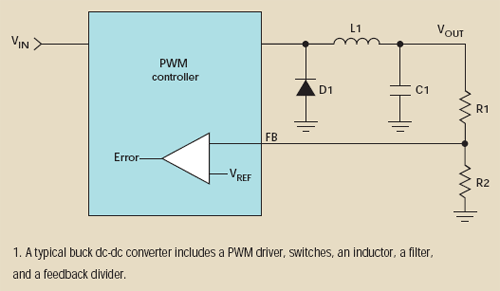
A typical buck dc-dc converter scheme includes a pulse-width modulation (PWM) driver, switches, an inductor, a filter, and a feedback divider (Fig. 1). The feedback voltage (FB) from the resistor divider R1 and R2 is a negative input for the error amplifier of the voltage control loop. In addition to the point-of-load regulation, the feedback divider also sets up the desired output voltage, VOUT. In other words, VOUT is programmable through an external resistor divider based on:

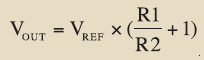
where VREF is a reference voltage and a positive input for the error amplifier.
The minimum output voltage can be set as low as VREF, according to Equation 1. The resistor divider ratio, the input voltage, and the maximum duty cycle determine the maximum output. The reference voltage, VREF, can be obtained from the PWM controller datasheet. Thus, making the feedback divider adjustable makes the dc-dc regulator also adjustable (Fig. 2).


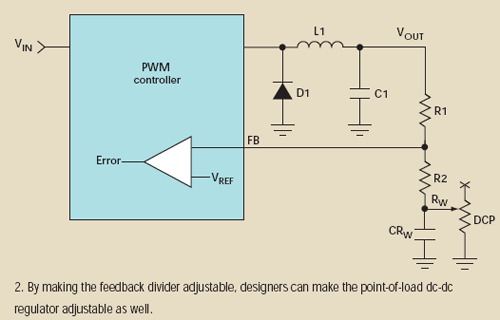
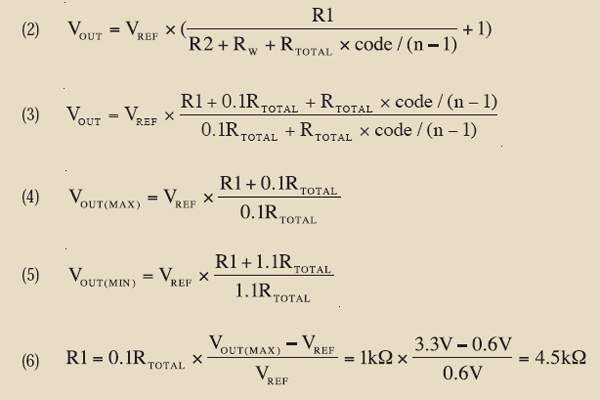
The adjustable output voltage of the dc-dc regulator can be expressed by Equation 2, where R1 and R2 are fixed resistors, RW is the wiper resistance, RTOTAL is the total resistance of the DCP, code is a decimal code of wiper position, and n is the total number of wiper taps.

The advantage of having the DCP in serial with the R2 resistor, rather than in parallel, is easier calculation of dc-dc output. It also prevents the bandwidth limitation that’s specific for the DCP. The DCP terminals have a parasitic capacitance of 10 to 25 pF, shown in Figure 2 as CRW. Connecting any of the DCP terminals to the FB node will cause phase shift and may decrease dc-dc regulator performance, such as transient response and stability.
The right DCP should be chosen to meet the application requirements based on knowing the VOUT adjusting range and desired resolution. For example, we would like to adjust the VOUT output voltage of a dc-dc regulator, built on the ISL85001 PWM controller, from 0.8 to 3.3 V.
The values of the DCP total resistance (RTOTAL) and resistors R1 and R2 can be derived from Equation 2. For simplicity it can be overwritten as Equation 3, where the wiper resistance is counted together with the R2 serial resistor. The suggested value of the R2 resistor should be less or equal to 0.1 × RTOTAL to have a bigger adjusting range (Equation 3, again). The maximum VOUT will be at code = 0 (Equation 4) and the minimum VOUT will be at max code = n – 1 (Equation 5).
According to a sample datasheet (from the ISL85001), the internal VREF = 0.6 V and the recommended value for the R1 resistor is from 1 to 10 kΩ. Since the number of RTOTAL values of the DCPs are limited, let’s select the RTOTAL = 10 kΩ first and then find R1 and R2 (Equation 6):
R1= 4.5k
R2 = 1 kΩ
Thus, the ideal DCP for this example should have an RTOTAL resistance of 10 kΩ and minimum wiper resistance.
Other features should be considered in choosing the appropriate DCP, such as the digital interface, nonvolatile programmability, RTOTAL tolerance, and temperature coefficient (TCr). Most of the available DCPs on the market have ±20% RTOTAL tolerance from part to part. That means each dc-dc regulator requires calibration, and the calibrated value of the wiper position can be stored in nonvolatile memory.
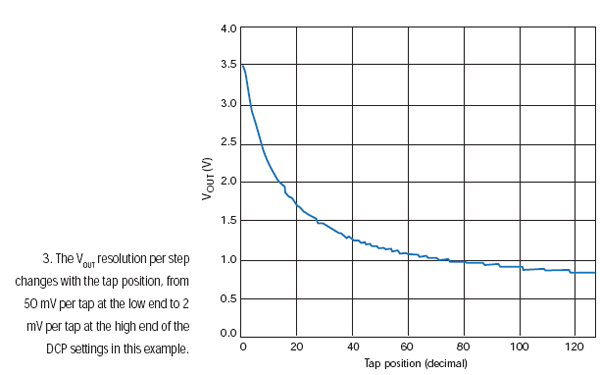
The perfect solution for dc-dc margining uses a 1% precision DCP, like the ISL22317, which eliminates the necessity of individual calibration and provides 0 Ω of wiper resistance and low TCr. Figure 3shows the VOUT curve versus the ISL22317W tap position. Since Equation 2 is a hyperbola, the VOUT resolution per step changes with the tap position, from 50 mV per tap at the low end to 2 mV per tap at the high end of the DCP settings in our example.

The ISL22317 features low TCr and 0 Ω of wiper resistance, complementing Intersil’s compensation scheme while also providing precision resistance settings from –40°C to 125°C.
Fixed DC-DC Regulator Output Uses A Digitally Controlled Potentiometer的更多相关文章
- PID DC/DC Converter Controller Using a PICmicro Microcontroller
http://www.microchip.com/stellent/idcplg?IdcService=SS_GET_PAGE&nodeId=1824&appnote=en011794 ...
- DC/DC与LDO的差别
转自:http://bbs.eetop.cn/thread-459121-1-1.html 在平时的学习中,我们都有接触LDO和DC/DC这一类的电源产品,但作为学生的我们队这些东西可能了解不够深刻, ...
- Simple dc/dc converter increases available power in dual-voltage system
The schematic in Figure 1 shows a way to increase the power available from a current-limited 5V supp ...
- Add margining capability to a dc/dc converter
You can easily add margining capability—that is, the ability to digitally adjust the output voltage— ...
- [专业名词·硬件] 2、DC\DC、LDO电源稳压基本常识(包含基本原理、高效率模块设计、常见问题、基于nRF51822电源管理模块分析等)·长文
综述先看这里 第一节的1.1简单介绍了DC/DC是什么: 第二节是关于DC/DC的常见的疑问答疑,非常实用: 第三节是针对nRF51822这款芯片电源管理部分的DC/DC.LDO.1.8的详细分析,对 ...
- Practice safe dc/dc converter
Short-circuit protection is an obvious requirement for a power supply, especially when its load conn ...
- LT1946A-- Transformerless dc/dc converter produces bipolar outputs
Dual-polarity supply provides ±12V from one IC VC (Pin 1): Error Amplifier Output Pin. Tie external ...
- DC DC降壓變換器ic 工作原理
目前DC/DC轉化器大致可分為:升壓型dc dc變化器.降壓型dc dc變化器及可升壓又可降壓dc dc變換器.我們今天主要提一下降壓型dc dc變換器的原理: 見下圖降壓變換器原理圖如圖1所示, 當 ...
- DC DC電路電感的選擇
注:只有充分理解電感在DC/DC電路中發揮的作用,才能更優的設計DC/DC電路.本文還包括對同步DC/DC及異步DC/DC概念的解釋. DCDC電路電感的選擇 簡介 在開關電源的設計中電感的設計為 ...
随机推荐
- ASP.NET Core 2.0 MVC 发布部署--------- IIS 具体操作
.Net Core 部署到 IIS系统中的步骤 一.IIS 配置 启用 Web 服务器 (IIS) 角色并建立角色服务. 1.Windows Ddesktop 桌面操作系统(win7及更高版本) 导航 ...
- java基础3 循环语句:While 循环语句、do while 循环语句、 for 循环语句 和 break、continue关键字
一.While循环语句 1.格式 while(条件表达式){ 执行语句: } 2.要点 1,先判断后执行 2,循环次数不定 3,避免死循环 3.举例 题目1:输出0-100之间的所有数 class D ...
- (MHA+MYSQL-5.7增强半同步)高可用架构设计与实现
架构使用mysql5.7版本基于GTD增强半同步并行复制配置 reploication 一主两从,使用MHA套件管理整个复制架构,实现故障自动切换高可用 优势: ...
- Regular Expression Matching——没理解的动态规划
Implement regular expression matching with support for '.' and '*'. '.' Matches any single character ...
- pandas 数据结构的基本功能
操作Series和DataFrame中的数据的常用方法: 导入python库: import numpy as np import pandas as pd 测试的数据结构: Series: > ...
- 邀请用户进TestFlight 体验 App 的测试版本
iphone手机用户,在工作中常见到,APP版本现在是Beta阶段(iOS版本),需要邀请一些用户来体验新版本,在版本上线前提出更好的建议及时进行修改,此时用到了testflight,很方便的通过邀请 ...
- Java经典设计模式之七大结构型模式
转载: Java经典设计模式之七大结构型模式 博主在大三的时候有上过设计模式这一门课,但是当时很多都基本没有听懂,重点是也没有细听,因为觉得没什么卵用,硬是要搞那么复杂干嘛.因此设计模式建议工作半年以 ...
- HDU 6186 CS Course
保存前缀后缀. 保存一下前缀和后缀,去掉第$i$个位置,就是$L[i-1]$和$R[i+1]$进行运算. #include<bits/stdc++.h> using namespace s ...
- Python并发编程-进程的几个方法
join()方法 from multiprocessing import Process import time def func(arg1,arg2): print('*'*arg1) time.s ...
- Redux学习之我对于其工作流程的理解和实践
目录 1 工作流程图 2 各部位职责 3 Demo 1 工作流程图 2 各部位职责 我在理解这个流程图的时候,采用的是一种容易记住的办法,并且贴切实际工作职责. 我们可以把整个Redux工 ...