
Codeforces Round #385 (Div. 2)A B C 模拟 水 并查集
2 seconds
256 megabytes
standard input
standard output
Hongcow is learning to spell! One day, his teacher gives him a word that he needs to learn to spell. Being a dutiful student, he immediately learns how to spell the word.
Hongcow has decided to try to make new words from this one. He starts by taking the word he just learned how to spell, and moves the last character of the word to the beginning of the word. He calls this a cyclic shift. He can apply cyclic shift many times. For example, consecutively applying cyclic shift operation to the word "abracadabra" Hongcow will get words "aabracadabr", "raabracadab" and so on.
Hongcow is now wondering how many distinct words he can generate by doing the cyclic shift arbitrarily many times. The initial string is also counted.
The first line of input will be a single string s (1 ≤ |s| ≤ 50), the word Hongcow initially learns how to spell. The string s consists only of lowercase English letters ('a'–'z').
Output a single integer equal to the number of distinct strings that Hongcow can obtain by applying the cyclic shift arbitrarily many times to the given string.
abcd
4
bbb
1
yzyz
2
For the first sample, the strings Hongcow can generate are "abcd", "dabc", "cdab", and "bcda".
For the second sample, no matter how many times Hongcow does the cyclic shift, Hongcow can only generate "bbb".
For the third sample, the two strings Hongcow can generate are "yzyz" and "zyzy".
题意:给你一个字符串 每次可以把最尾部的一个字符放到最前面 问形成的字符串有多少种?
题解:模拟
 #include <iostream>

 #include <cstdio>

 #include <cstdlib>

 #include <cstring>

 #include <algorithm>

 #include <stack>

 #include <queue>

 #include <cmath>

 #include <map>

 #define ll  __int64

 #define mod 1000000007

 #define dazhi 2147483647

 #define bug() printf("!!!!!!!")

 #define M 100005

 using namespace  std;

 char s[];

 map<string,int>mp;

 int main()

 {

     scanf("%s",s);

     string str;

     str.assign(s);

     mp[s]=;

     int ans=;

     int len=strlen(s);

     int last=len-;

     len--;

     while(len)

     {

         len--;

         char exm=s[last];

         for(int i=last;i>=;i--)

         {

             s[i]=s[i-];

         }

         s[]=exm;

         str.assign(s);

         if(mp[str]==)

         {

             mp[str]++;

             ans++;

         }

     }

     cout<<ans<<endl;

     return ;

 }
2 seconds
256 megabytes
standard input
standard output
Hongcow likes solving puzzles.
One day, Hongcow finds two identical puzzle pieces, with the instructions "make a rectangle" next to them. The pieces can be described by an n by m grid of characters, where the character 'X' denotes a part of the puzzle and '.' denotes an empty part of the grid. It is guaranteed that the puzzle pieces are one 4-connected piece. See the input format and samples for the exact details on how a jigsaw piece will be specified.
The puzzle pieces are very heavy, so Hongcow cannot rotate or flip the puzzle pieces. However, he is allowed to move them in any directions. The puzzle pieces also cannot overlap.
You are given as input the description of one of the pieces. Determine if it is possible to make a rectangle from two identical copies of the given input. The rectangle should be solid, i.e. there should be no empty holes inside it or on its border. Keep in mind that Hongcow is not allowed to flip or rotate pieces and they cannot overlap, i.e. no two 'X' from different pieces can share the same position.
The first line of input will contain two integers n and m (1 ≤ n, m ≤ 500), the dimensions of the puzzle piece.
The next n lines will describe the jigsaw piece. Each line will have length m and will consist of characters '.' and 'X' only. 'X' corresponds to a part of the puzzle piece, '.' is an empty space.
It is guaranteed there is at least one 'X' character in the input and that the 'X' characters form a 4-connected region.
Output "YES" if it is possible for Hongcow to make a rectangle. Output "NO" otherwise.
2 3
XXX
XXX
YES
2 2
.X
XX
NO
5 5
.....
..X..
.....
.....
.....
YES
For the first sample, one example of a rectangle we can form is as follows
111222
111222
For the second sample, it is impossible to put two of those pieces without rotating or flipping to form a rectangle.
In the third sample, we can shift the first tile by one to the right, and then compose the following rectangle:
.....
..XX.
.....
.....
.....

题意:给你一个n*m的矩阵  由‘X’形成一个图形 问你是否可以用两个相同的图形拼成一个矩形(不可以旋转和翻折)
题解:确定给你的图形是否为一个矩形即可
 #include <iostream>

 #include <cstdio>

 #include <cstdlib>

 #include <cstring>

 #include <algorithm>

 #include <stack>

 #include <queue>

 #include <cmath>

 #include <map>

 #define ll  __int64

 #define mod 1000000007

 #define dazhi 2147483647

 #define bug() printf("!!!!!!!")

 #define M 100005

 using namespace  std;

 int n,m;

 char a[][];

 int main()

 {

     scanf("%d %d",&n,&m);

     getchar();

     for(int i=;i<n;i++)

       scanf("%s",a[i]);

     int l=m-,r=,u=n-,d=;

     for(int i=;i<n;i++)

     {

         for(int j=;j<m;j++)

         {

             if(a[i][j]=='X')

             {

                 l=min(l,j);

                 r=max(r,j);

                 u=min(u,i);

                 d=max(d,i);

             }

         }

     }

     for(int i=u;i<=d;i++)

     {

         for(int j=l;j<=r;j++)

         {

             if(a[i][j]=='.')

             {

                 printf("NO\n");

                 return ;

             }

         }

     }

     printf("YES\n");

     return ;

 }
2 seconds
256 megabytes
standard input
standard output
Hongcow is ruler of the world. As ruler of the world, he wants to make it easier for people to travel by road within their own countries.
The world can be modeled as an undirected graph with n nodes and m edges. k of the nodes are home to the governments of the k countries that make up the world.
There is at most one edge connecting any two nodes and no edge connects a node to itself. Furthermore, for any two nodes corresponding to governments, there is no path between those two nodes. Any graph that satisfies all of these conditions is stable.
Hongcow wants to add as many edges as possible to the graph while keeping it stable. Determine the maximum number of edges Hongcow can add.
The first line of input will contain three integers n, m and k (1 ≤ n ≤ 1 000, 0 ≤ m ≤ 100 000, 1 ≤ k ≤ n) — the number of vertices and edges in the graph, and the number of vertices that are homes of the government.
The next line of input will contain k integers c1, c2, ..., ck (1 ≤ ci ≤ n). These integers will be pairwise distinct and denote the nodes that are home to the governments in this world.
The following m lines of input will contain two integers ui and vi (1 ≤ ui, vi ≤ n). This denotes an undirected edge between nodes ui and vi.
It is guaranteed that the graph described by the input is stable.
Output a single integer, the maximum number of edges Hongcow can add to the graph while keeping it stable.
4 1 2
1 3
1 2
2
3 3 1
2
1 2
1 3
2 3
0
For the first sample test, the graph looks like this:
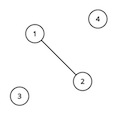 Vertices 1 and 3 are special. The optimal solution is to connect vertex 4 to vertices 1 and 2. This adds a total of 2 edges. We cannot add any more edges, since vertices 1 and 3 cannot have any path between them.
For the second sample test, the graph looks like this:
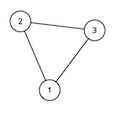 We cannot add any more edges to this graph. Note that we are not allowed to add self-loops, and the graph must be simple.
 #include <iostream>

 #include <cstdio>

 #include <cstdlib>

 #include <cstring>

 #include <algorithm>

 #include <stack>

 #include <queue>

 #include <cmath>

 #include <map>

 #define ll  __int64

 #define mod 1000000007

 #define dazhi 2147483647

 #define bug() printf("!!!!!!!")

 #define M 100005

 using namespace  std;

 int n,m,k;

 int a[];

 int fa[];

 int l,r;

 map<int,int>mp;

 map<int,int>mpp;

 int find(int root)

 {

     if(root!=fa[root])

         return fa[root]=find(fa[root]);

     else

         return root;

 }

 void unio(int a,int b)

 {

     int aa=find(a);

     int bb=find(b);

     if(aa!=bb)

     {

         fa[aa]=bb;

     }

 }

 int main()

 {

     scanf("%d %d %d",&n,&m,&k);

     for(int i=;i<=k;i++)

         scanf("%d",&a[i]);

     for(int i=;i<=n;i++)

         fa[i]=i;

     for(int i=;i<=m;i++)

     {

         scanf("%d %d",&l,&r);

         unio(l,r);

     }

     for(int i=;i<=n;i++)

     {

         int x=find(i);

         mp[fa[i]]++;

     }

     int maxn=;

     int sum=;

     int re=;

     for(int i=;i<=k;i++)

     {

         maxn=max(maxn,mp[fa[a[i]]]);

         sum+=mp[fa[a[i]]];

         mpp[fa[a[i]]]=;

         re=re+ mp[fa[a[i]]]*(mp[fa[a[i]]]-)/;

     }

     int b[];

     int jishu=;

     int ans=;

     for(int i=;i<=n;i++)

     {

         if(mpp[fa[i]]==)

         {

             b[jishu++]=mp[fa[i]];

             re=re+mp[fa[i]]*(mp[fa[i]]-)/;

             mpp[fa[i]]=;

         }

     }

     for(int i=;i<jishu;i++)

     {

         for(int j=i+;j<jishu;j++)

         {

             ans+=(b[i]*b[j]);

         }

     }

     printf("%d\n",re-m+(n-sum)*maxn+ans);

     return ;

 }
Codeforces Round #385 (Div. 2)A B C 模拟 水 并查集的更多相关文章
- Codeforces Round #396 (Div. 2) D. Mahmoud and a Dictionary 并查集
D. Mahmoud and a Dictionary 题目连接: http://codeforces.com/contest/766/problem/D Description Mahmoud wa ...
- Codeforces Round #250 (Div. 1) B. The Child and Zoo 并查集
B. The Child and Zoo Time Limit: 20 Sec Memory Limit: 256 MB 题目连接 http://codeforces.com/contest/438/ ...
- Codeforces Round #360 (Div. 1) D. Dividing Kingdom II 暴力并查集
D. Dividing Kingdom II 题目连接: http://www.codeforces.com/contest/687/problem/D Description Long time a ...
- Codeforces Round #212 (Div. 2) D. Fools and Foolproof Roads 并查集+优先队列
D. Fools and Foolproof Roads You must have heard all about the Foolland on your Geography lessons. ...
- Codeforces Round #254 (Div. 2) B. DZY Loves Chemistry (并查集)
题目链接 昨天晚上没有做出来,刚看题目的时候还把题意理解错了,当时想着以什么样的顺序倒,想着就饶进去了, 也被题目下面的示例分析给误导了. 题意: 有1-n种化学药剂 总共有m对试剂能反应,按不同的 ...
- Codeforces Round #260 (Div. 1) C. Civilization 树的中心+并查集
题目链接: 题目 C. Civilization time limit per test1 second memory limit per test256 megabytes inputstandar ...
- Codeforces Round #250 (Div. 2) D. The Child and Zoo 并查集
D. The Child and Zoo time limit per test 2 seconds memory limit per test 256 megabytes input standar ...
- Codeforces Round #329 (Div. 2) D. Happy Tree Party(LCA+并查集)
题目链接 题意:就是给你一颗这样的树,用一个$y$来除以两点之间每条边的权值,比如$3->7$,问最后的y的是多少,修改操作是把权值变成更小的. 这个$(y<=10^{18})$除的权值如 ...
- Codeforces Round #368 (Div. 2) B. Bakery (模拟)
Bakery 题目链接: http://codeforces.com/contest/707/problem/B Description Masha wants to open her own bak ...
随机推荐
- HP Vitrual Connect 配置快速参考
使用任意浏览器,在地址栏输入VC的管理地址(如果不知道VC的管理地址请从OA中进入) 输入用户名和密码登入VC,验证成功后将进入VM的配置向导 点击"Next"继续,将先进行Dom ...
- react native组件的创建
react native组件的创建 react文件加载顺序: react项目启动后,先加载index.js.在index.js中可以指向首页. import { AppRegistry } from ...
- Java中的多态,引用类型的转换
1.多态分为引用多态和方法多态,见测试类 package com.wangcf; //父类 public class Animal { public void eat(){ System.out.pr ...
- 福大软工1816:Beta(1/7)
Beta 冲刺 (1/7) 队名:第三视角 组长博客链接 本次作业链接 团队部分 团队燃尽图 工作情况汇报 张扬(组长) 过去两天完成了哪些任务 文字/口头描述 答辩 组织会议 复习课本 展示GitH ...
- URL相关Web APIs
参考文档:MDN> Web API接口 > URLUtils MDN > Web API接口 > URL MDN > Web API接口 > Location MD ...
- QThread安全的结束线程
版权声明:若无来源注明,Techie亮博客文章均为原创. 转载请以链接形式标明本文标题和地址: 本文标题:QThread安全的结束线程 本文地址:http://techieliang.com/ ...
- $(document).click() 在苹果手机上不能正常运行解决方案
本来是如下一段跳转代码,发现在安卓和微信开发者工具上都能正常运行,但是苹果手机就不行了. $(document).on('click', '.url', function(){ location.hr ...
- egret 开发总结
用egret快两年了,开发过两款成功的游戏.<<妖怪修走 |诸神的黄昏>><<损友圈|我的地盘>> 妖怪修走是个重度游戏,付费率超高.也比较成功. 损友 ...
- javascript之容易出错的地方
1: 不是所有的非空对象都有toString()方法的 var obj = Object.create(null); console.log(obj.toString()); // false; ...
- 虚拟机中安装 centOS,本地安装 SSH 连接 - 01
下面把自己安装 centOS 的过程记录下,选取的版本是 centOS6.8 ,下载地址在脚本之家 down 的 : 阿里云 x64 http://mirrors.aliyun.com/centos/ ...