
dda的fpga实现(转载)
The general approach using DDAs will be to simulate a system of first-order differential equations, which can be nonlinear. Analog computers use operational amplifiers to do mathematical integration. We will use digital summers and registers. For any set of differential equations with state variables v1 to vm:
dv1/dt = f1(t,v1,v2,v3,...vm)
dv2/dt = f2(t,v1,v2,v3,...vm)
dv3/dt = f3(t,v1,v2,v3,...vm)
...dvm/dt = fm(...)
We will build the following circuitry to perform an Euler integration approximation to these equations in the form
v1(n+1) = v1(n) + dt*(f1(t,v1(n),v2(n),v3(n),...vm(n))
v2(n+1) = v2(n) + dt*(f2(t,v1(n),v2(n),v3(n),...vm(n))
v3(n+1) = v3(n) + dt*(f3(t,v1(n),v2(n),v3(n),...vm(n))
...
vm(n+1) = vm(n) + dt*(fm(...))
Where the variable values at time step n are updated to form the values at time step n+1. Each equation will require one integrator. The multiply may be replaced by a shift-right if dt is chosen to be a power of two. Most of the design complexity will be in calculating F(t,V(n)). 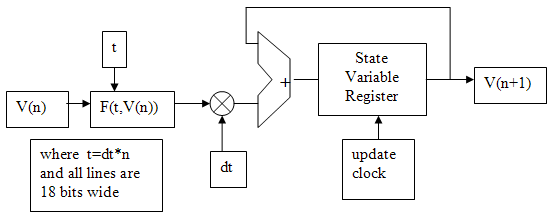
We also need a number representation. I chose 18-bit 2's complement with the binary point between bits 15 and 16 (with bit zero being the least significant). Bit 17 is the sign bit. The number range is thus -2.0 to +1.999985. This range fits well with the Audio codec which requires 16-bit 2's complement for output to the DAC. Conversion from the 18-bit to 16-bit just requires truncating the least significant two bits ([1:0]). A few numbers are shown in the table below. Note that the underscore character in the hexidecimal form is allowed in verilog to improve readability.
|
Decimal number
|
18-bit 2's comp |
|
1.0
|
18'h1_0000
|
|
0.5
|
18'h0_8000
|
|
0.25
|
18'h0_4000
|
|
0
|
18'h0_0000
|
|
-0.25
|
18'h3_c000
|
|
-0.5
|
18'h3_8000
|
|
-1.0
|
18'h3_0000
|
|
-1.5
|
18'h2_8000
|
|
-2.0
|
18'h2_0000
|
Second order system (damped spring-mass oscillator):
As an example, consider the linear, second-order differential equation resulting from a damped spring-mass system:
d2x/dt2 = -k/m*x-d/m*(dx/dt)
where k is the spring constant, d the damping coefficient, m the mass, and x the displacement. We will simulate this by converting the second-order system into a coupled first-order system. If we let v1=x and v2=dx/dt then the second order equation is equivalent to
dv1/dt = v2
dv2/dt = -k/m*v1-d/m*v2
These equations can be solved by wiring together two integrators, two multipliers and an adder as shown below. In the past this would have been done by using operational amplifiers to compute each mathematical operation. Each integrator must be supplied with an initial condition.
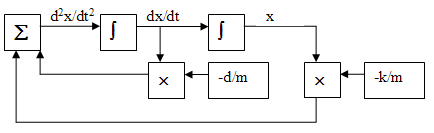
Converting this diagram to Verilog, the top-level module verilog code defines the 18-bit, signed, state variables and a clock divider variable (count). The clocked section resets and updates the state variables. The combinatorial statements compute the Euler approximation to the F(t,V(n)). The separate multiply module ensures that the multiplies will be instantiated as hardware multipliers. The Audio_DAC_ADC module was modifed to allow either ADC-to-DAC passthru or to connect the computation output to the DAC, depending on the position of SW17. SW17 up connects the computation.
/state variables

reg signed [17:0] v1, v2 ;

wire signed [17:0] v1new, v2new ;

//signed mult output

wire signed [17:0] v1xK_M, v2xD_M ;

// the clock divider

reg [4:0] count;

//Update state variables of simulation of spring- mass

	always @ (posedge CLOCK_50)

	begin

		count <= count + 1;

		if (KEY[3]==0) //reset

		begin

			v1 <= 32'h10000 ; //

			v2 <= 32'h00000 ;

			//count <= 0;

		end

		else if (count==0)

		begin

			v1 <= v1new ;

			v2 <= v2new ;

		end

	end

	// Compute new F(t,v) with dt = 2>>9

	// v1(n+1) = v1(n) + dt*v2(n)

	assign v1new = v1 + (v2>>>9);

	// v2(n+1) = v2(n) + dt*(-k/m*v1(n) - d/m*v2(n))

	signed_mult K_M(v1xK_M, v1, 18'h10000);

	signed_mult D_M(v2xD_M, v2, 18'h00800);

	assign v2new = v2 - ((v1xK_M + v2xD_M)>>>9);

module signed_mult (out, a, b);

	output 		[17:0]	out;

	input 	signed	[17:0] 	a;

	input 	signed	[17:0] 	b;

	wire	signed	[17:0]	out;

	wire 	signed	[35:0]	mult_out;

	assign mult_out = a * b;

	assign out = {mult_out[35], mult_out[32:16]};

endmodule
Time scaling the solution requires consideration of the value of dt and the update rate (CLOCK_50/(clock divider)) of the state variables. As shown in the code, the clock divider variable (count) is 5-bits wide, so it will overflow and cause an update every 32 CLOCK_50 cycles. If the time step, dt=2-9, then 29 steps must equal one time unit. 29 steps at an update rate of 5*107/32 yields a time unit of 0.328 mSec. A k/m=1 implies a period of 6.28 time units per cycle, so one cycle in this case would be 2.06 mSec. corresponding to 486 Hz.
If the calculation is scaled in time to be in the audio range, then the audio DAC may be used to watch waveforms on an oscilloscope. For the damped spring-mass oscillator with a k/m=1, d/m=1/16, dt=2-8, and a clock rate of 5*108/64 I got the figure below. The top trace is v1 and the bottom is v2. The frequency computed from the time scaling considerations is 486 Hz, while the measured was 475 Hz. Reducing dt to dt=2-9 (see paragraph above) and the clock divider to 32 made the measured frequency 486, matching the computed value. The better match with smaller dt illustrates that the integration is approximate. 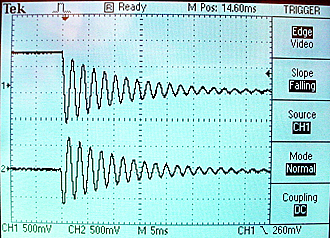
The whole project is zipped here. The design consumed 2% of the logic resources of the FPGA, 1% of the memory, and 4 out of 70 9-bit multipliers. You could threfore expect to put up to 50 integrators and 35 multipilers in a bigger design.
dda的fpga实现(转载)的更多相关文章
- 优化基于FPGA的深度卷积神经网络的加速器设计
英文论文链接:http://cadlab.cs.ucla.edu/~cong/slides/fpga2015_chen.pdf 翻译:卜居 转载请注明出处:http://blog.csdn.net/k ...
- 【转载】FPGA算法映射要点
近期一直在学习利用FPGA完成算法的定点运算,转载些相关的博客方面回顾查找.本博文原文链接为:https://blog.csdn.net/u013989284/article/details/7899 ...
- FPGA功耗那些事儿(转载)
在项目设计初期,基于硬件电源模块的设计考虑,对FPGA设计中的功耗估计是必不可少的.笔者经历过一个项目,整个系统的功耗达到了100w,而单片FPGA的功耗估计得到为20w左右,有点过高了,功耗过高则会 ...
- FPGA静态时序分析——IO口时序(Input Delay /output Delay)(转载)
转载地址:http://www.cnblogs.com/linjie-swust/archive/2012/03/01/FPGA.html 1.1 概述 在高速系统中FPGA时序约束不止包括内部时钟 ...
- [转载]克服FPGA I/O引脚分配挑战--xilinx系列
转载走,放到自己的分类中好了 原文地址:I/O引脚分配挑战--xilinx系列">克服FPGA I/O引脚分配挑战--xilinx系列作者:方槍槍 http://www.eefocus ...
- 【转载】FPGA功耗的那些事儿
在项目设计初期,基于硬件电源模块的设计考虑,对FPGA设计中的功耗估计是必不可少的. 笔者经历过一个项目,整个系统的功耗达到了100w,而单片FPGA的功耗估计得到为20w左右, 有点过高了,功耗过高 ...
- 【转载】FPGA静态时序分析——IO口时序
转自:http://www.cnblogs.com/linjie-swust/archive/2012/03/01/FPGA.html 1.1 概述 在高速系统中FPGA时序约束不止包括内部时钟约束 ...
- 【转载】如何在FPGA设计环境中添加加时序约束
转自:http://bbs.ednchina.com/BLOG_ARTICLE_198929.HTM 如何在FPGA设计环境中加时序约束 在给FPGA做逻辑综合和布局布线时,需要在工具中设定时序 ...
- FPGA设计思想与技巧(转载)
题记:这个笔记不是特权同学自己整理的,特权同学只是对这个笔记做了一下完善,也忘了是从那DOWNLOAD来的,首先对整理者表示感谢.这些知识点确实都很实用,这些设计思想或者也可以说是经验吧,是很值得每一 ...
随机推荐
- jshint options
jshint -W032 忽略if代码块后有多余的分号的提示 地址:jslinterrors.com/unnecessary-semicolon asi 忽略函数定义后必须加分号的提示 c ...
- MySQL设置某一字段默认为0,但是插入数据化却显示为null
1.MySQL字段默认的含义:在插入时不指定该字段的值:2.以mybatis举例,如果是插入实体,那么为空的字段就会插入空:3.如果不想mybatis等持久化工具插入空,可以尝试insertSelec ...
- 【IIS转】:解决IIS下localhost访问需要输入用户名和密码的问题
[摘要]安装完IIS后,我们可能会发现浏览器输入localhost访问时提示我们输入用户名和密码,本文介绍了这种问题的解决方法,方便站长们调试自己的程序. 在我们的WIN XP系统中安装了IIS,但是 ...
- 1-23-shell脚本之-if流程控制语句和for循环语句的使用
大纲: 1.逻辑判断 2.if流程控制语句 3.for循环控制语句 ---------------------------------------------- 在开始之前,先了解一下逻辑判断符号 ...
- DRUID连接池的使用
DRUID介绍 DRUID是阿里巴巴开源平台上一个数据库连接池实现,它结合了C3P0.DBCP.PROXOOL等DB池的优点,同时加入了日志监控,可以很好的监控 DB池连接和SQL的执行情况,可 ...
- Java复习7.输入输出流
Java复习7.输入输出流 20131005 前言: Java中涉及数据的读写,都是基于流的,这一块的知识相当重要,而且在Java中的数据,char字符是16bit的,所以存在字节流和字符流的区别.如 ...
- PHP回调函数call_user_func()和call_user_func_array()的使用
call_user_func():把第一个参数作为回调函数调用 用法:call_user_func ( callable $callback [, mixed $parameter [, mixed ...
- Java虚拟机访问读写其他进程的数据--RandomAccessFile
RandomAccessFile 是Java输入/输出流体系中功能最丰富的文件内容访问类,它提供了众多的方法来访问文件内容,它既可以读取文件内容,也可以向文件输出数据.并且它支持“任意访问”的方式,程 ...
- 数据仓库(Data Warehouse)建设
数据仓库初体验 数据库仓库架构以前弄的很简单:将各种源的数据统一汇聚到DW中,DW没有设计,只是将所有数据汇聚起来: ETL也很简单,只是将数据同步到DW中,只是遇到BUG时,处理一些错误数据,例如: ...
- 判断Integer值相等最好不用==最好使用equals
Integer c = 3;Integer d = 3;Integer e = 321;Integer f = 321;System.out.println(c == d);System.out.pr ...