
Spring笔记(8) - @EventListener注解探究
在上文中讲了Spring的事件监听机制,流程是:定义事件、监听器,发布事件,控制台输出监听到的事件内容。
在上文的扩展中 使用 @EventListener 注解来自定义监听器,监听指定的事件,比如下面的案例:
@Component

public class UserManagerListener {

    //ApplicationEvent能监听到所有的事件,如果为EmailEvent.class则只能监听到关于邮件的事件

    //EventListener有两个参数(可以不写,直接在方法参数里面写上要监听的事件即可):

    //    classes:表示哪一个事件类

    //    condition:当满足什么条件是会调用该方法

    @EventListener(classes = ApplicationEvent.class)

    public void listen(ApplicationEvent event){

        System.out.println("用户管理功能监听到的事件。。。。"+event);

    }

}
通过上面的案例发现代码比实现 ApplicationListener 接口更简洁,那这个注解为什么功能这么强大呢,接下来我们来分析它的源码:
/**

 * @author Stephane Nicoll

 * @author Sam Brannen

 * @since 4.2

 * @see EventListenerMethodProcessor

 */

@Target({ElementType.METHOD, ElementType.ANNOTATION_TYPE})

@Retention(RetentionPolicy.RUNTIME)

@Documented

public @interface EventListener {

.......

}
通过源码发现是通过使用 EventListenerMethodProcessor 处理器来解析该注解,将标注了 @EventListener 的方法进行解析, 获取拦截方法,对拦截方法进行转换,变成 ApplicationListener 然
后放入到 IOC 容器中,在publishEvent 时,通过 getApplicationEventMulticaster().multicastEvent(a
pplicationEvent, eventType)方法,获取到 ApplicationListener 对象,通过反射调用方法。下面是 EventListenerMethodProcessor 处理器的类图关系:
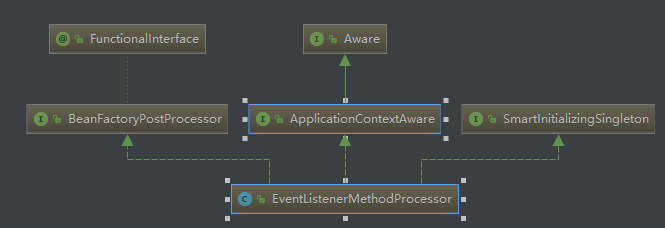
可以看到 EventListenerMethodProcessor 是实现了 BeanFactoryPostProcessor 和 SmartInitializingSingleton 这两个接口。在前文 Spring的BeanFactoryPostProcessor探究 中讲述了
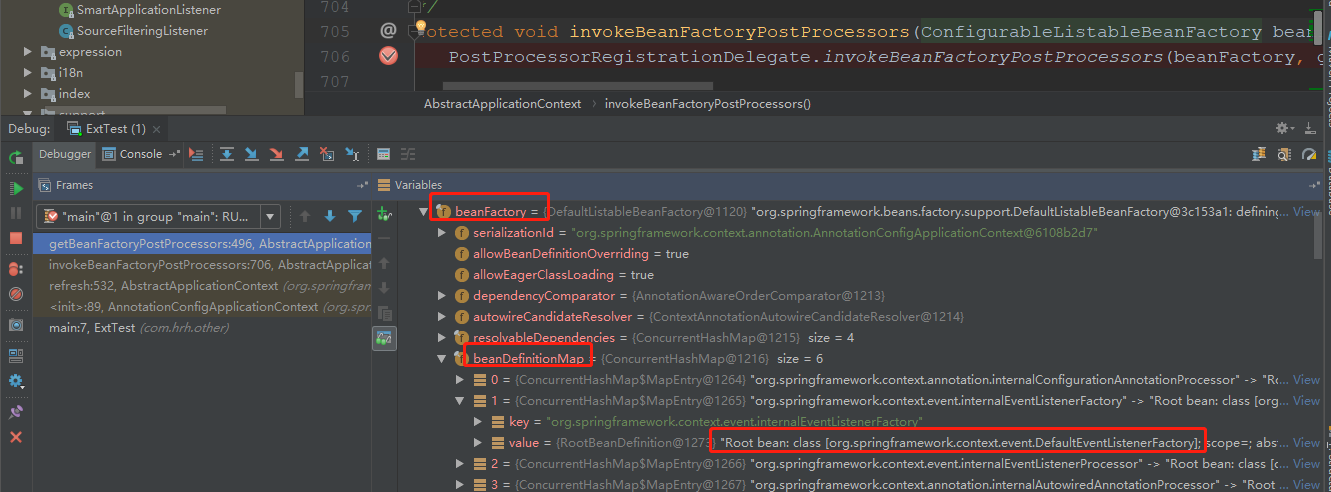
BeanFactoryPostProcessor 的执行时机,在 refresh 容器的时候, 调用 invokeBeanFactoryPostProce
ssors() 方法时, 会执行 BeanFactoryPostProcessor#postProcessBeanFactory() 方法设置一个默认的监听器工厂 :DefaultEventListenerFactory。
/**

 * Registers {@link EventListener} methods as individual {@link ApplicationListener} instances.

 * Implements {@link BeanFactoryPostProcessor} (as of 5.1) primarily for early retrieval,

 * avoiding AOP checks for this processor bean and its {@link EventListenerFactory} delegates.

 *

 * @author Stephane Nicoll

 * @author Juergen Hoeller

 * @since 4.2

 * @see EventListenerFactory

 * @see DefaultEventListenerFactory

 */

    public class EventListenerMethodProcessor

        implements SmartInitializingSingleton, ApplicationContextAware, BeanFactoryPostProcessor {

    ......

    @Override

    public void postProcessBeanFactory(ConfigurableListableBeanFactory beanFactory) {

        this.beanFactory = beanFactory;

        Map<String, EventListenerFactory> beans = beanFactory.getBeansOfType(EventListenerFactory.class, false, false);

        List<EventListenerFactory> factories = new ArrayList<>(beans.values());

        AnnotationAwareOrderComparator.sort(factories);

        //DefaultEventListenerFactory

        this.eventListenerFactories = factories;

    }

    .......

}
而SmartInitializingSingleton 这个接口只有一个方法 afterSingletonsInstantiated(),这个方法在全部单实例创建完成之后执行,接下来对这个方法进行深入探讨,我们对 EventListenerMethodProcessor里面的实现方法 afterSingletonsInstantiated 打一个断点 debug 运行下:

从中我们可以看到,流程是: IOC容器创建对象 --> refresh() --> finishBeanFactoryInitialization(beanFactory)(初始化剩下的所有单实例bean) --> beanFactory.preInstantiateSingletons()(初始化剩下的所有单实例bean)--> smartSingleton.afterSingletonsInstantiated()
    @Override

    public void preInstantiateSingletons() throws BeansException {

        if (logger.isTraceEnabled()) {

            logger.trace("Pre-instantiating singletons in " + this);

        }

        // Iterate over a copy to allow for init methods which in turn register new bean definitions.

        // While this may not be part of the regular factory bootstrap, it does otherwise work fine.

        //获取所有的注册bean名称

        List<String> beanNames = new ArrayList<>(this.beanDefinitionNames);

        // Trigger initialization of all non-lazy singleton beans...

        //先创建所有的单实例bean

        for (String beanName : beanNames) {

            RootBeanDefinition bd = getMergedLocalBeanDefinition(beanName);

            if (!bd.isAbstract() && bd.isSingleton() && !bd.isLazyInit()) {

                if (isFactoryBean(beanName)) {

                    Object bean = getBean(FACTORY_BEAN_PREFIX + beanName);

                    if (bean instanceof FactoryBean) {

                        final FactoryBean<?> factory = (FactoryBean<?>) bean;

                        boolean isEagerInit;

                        if (System.getSecurityManager() != null && factory instanceof SmartFactoryBean) {

                            isEagerInit = AccessController.doPrivileged((PrivilegedAction<Boolean>)

                                            ((SmartFactoryBean<?>) factory)::isEagerInit,

                                    getAccessControlContext());

                        }

                        else {

                            isEagerInit = (factory instanceof SmartFactoryBean &&

                                    ((SmartFactoryBean<?>) factory).isEagerInit());

                        }

                        if (isEagerInit) {

                            getBean(beanName);//创建bean实例

                        }

                    }

                }

                else {

                    getBean(beanName);//创建bean实例

                }

            }

        }

        // Trigger post-initialization callback for all applicable beans...

        //创建完成后进行遍历,如果bean是SmartInitializingSingleton类型,执行afterSingletonsInstantiated方法

        for (String beanName : beanNames) {

            Object singletonInstance = getSingleton(beanName);

            if (singletonInstance instanceof SmartInitializingSingleton) {

                final SmartInitializingSingleton smartSingleton = (SmartInitializingSingleton) singletonInstance;

                if (System.getSecurityManager() != null) {

                    AccessController.doPrivileged((PrivilegedAction<Object>) () -> {

                        smartSingleton.afterSingletonsInstantiated();

                        return null;

                    }, getAccessControlContext());

                }

                else {

                    smartSingleton.afterSingletonsInstantiated();

                }

            }

        }

    }
从上面可以看出其调用时机是,遍历容器中注册的 BeanDefinition, 调用所有 getBean() 方法创建实例之后, 才会开始遍历执行 afterSingletonsInstantiated() 方法。
接下来详细解析下 EventListenerMethodProcessor 的 afterSingletonsInstantiated 方法,重点看 processBean 方法:
    @Override

    public void afterSingletonsInstantiated() {

        ConfigurableListableBeanFactory beanFactory = this.beanFactory;

        Assert.state(this.beanFactory != null, "No ConfigurableListableBeanFactory set");

        String[] beanNames = beanFactory.getBeanNamesForType(Object.class);

        for (String beanName : beanNames) {

            if (!ScopedProxyUtils.isScopedTarget(beanName)) {

                Class<?> type = null;

                try {

                    type = AutoProxyUtils.determineTargetClass(beanFactory, beanName);

                }

                catch (Throwable ex) {

                    // An unresolvable bean type, probably from a lazy bean - let's ignore it.

                    if (logger.isDebugEnabled()) {

                        logger.debug("Could not resolve target class for bean with name '" + beanName + "'", ex);

                    }

                }

                if (type != null) {

                    if (ScopedObject.class.isAssignableFrom(type)) {

                        try {

                            Class<?> targetClass = AutoProxyUtils.determineTargetClass(

                                    beanFactory, ScopedProxyUtils.getTargetBeanName(beanName));

                            if (targetClass != null) {

                                type = targetClass;

                            }

                        }

                        catch (Throwable ex) {

                            // An invalid scoped proxy arrangement - let's ignore it.

                            if (logger.isDebugEnabled()) {

                                logger.debug("Could not resolve target bean for scoped proxy '" + beanName + "'", ex);

                            }

                        }

                    }

                    try {

                        processBean(beanName, type);

                    }

                    catch (Throwable ex) {

                        throw new BeanInitializationException("Failed to process @EventListener " +

                                "annotation on bean with name '" + beanName + "'", ex);

                    }

                }

            }

        }

    }

    private void processBean(final String beanName, final Class<?> targetType) {

        //不包含没有注解的class,注解是EventListener的类型,是Spring容器的类型

        if (!this.nonAnnotatedClasses.contains(targetType) &&

                AnnotationUtils.isCandidateClass(targetType, EventListener.class) &&

                !isSpringContainerClass(targetType)) {

            Map<Method, EventListener> annotatedMethods = null;

            try {

                //获取标注了 @EventListener 注解的监听方法

                annotatedMethods = MethodIntrospector.selectMethods(targetType,

                        (MethodIntrospector.MetadataLookup<EventListener>) method ->

                                AnnotatedElementUtils.findMergedAnnotation(method, EventListener.class));

            }

            catch (Throwable ex) {

                // An unresolvable type in a method signature, probably from a lazy bean - let's ignore it.

                if (logger.isDebugEnabled()) {

                    logger.debug("Could not resolve methods for bean with name '" + beanName + "'", ex);

                }

            }

            //监听方法添加到没有注解的集合

            if (CollectionUtils.isEmpty(annotatedMethods)) {

                this.nonAnnotatedClasses.add(targetType);

                if (logger.isTraceEnabled()) {

                    logger.trace("No @EventListener annotations found on bean class: " + targetType.getName());

                }

            }

            else {

                // Non-empty set of methods

                ConfigurableApplicationContext context = this.applicationContext;

                Assert.state(context != null, "No ApplicationContext set");

                List<EventListenerFactory> factories = this.eventListenerFactories;

                Assert.state(factories != null, "EventListenerFactory List not initialized");

                for (Method method : annotatedMethods.keySet()) {

                    for (EventListenerFactory factory : factories) {

                        // 判断是否支持该方法  在DefaultEventListenerFactory中写死的返回true

                        if (factory.supportsMethod(method)) {

                            //选择方法  beanName 这里是AddDataEventListener的beanName 默认是addDataEventListener

                            Method methodToUse = AopUtils.selectInvocableMethod(method, context.getType(beanName));

                            //将监听方法转换为ApplicationListener(ApplicationListenerMethodAdapter)对象

                            ApplicationListener<?> applicationListener =

                                    factory.createApplicationListener(beanName, targetType, methodToUse);

                            // 如果是ApplicationListenerMethodAdapter对象 就把context和evaluator传进去

                            if (applicationListener instanceof ApplicationListenerMethodAdapter) {

                                ((ApplicationListenerMethodAdapter) applicationListener).init(context, this.evaluator);

                            }

                            //将创建的 ApplicationListener 加入到容器中

                            context.addApplicationListener(applicationListener);

                            break;

                        }

                    }

                }

                if (logger.isDebugEnabled()) {

                    logger.debug(annotatedMethods.size() + " @EventListener methods processed on bean '" +

                            beanName + "': " + annotatedMethods);

                }

            }

        }

    }

    //class是在org.springframework包下,注解类型不是组件

    private static boolean isSpringContainerClass(Class<?> clazz) {

        return (clazz.getName().startsWith("org.springframework.") &&

                !AnnotatedElementUtils.isAnnotated(ClassUtils.getUserClass(clazz), Component.class));

    }
后面就是添加listener到Context中:
1)如果有applicationEventMulticaster,添加到ApplicationContext.applicationEventMulticas
ter中;
2)如果没有applicationEventMulticaster,添加到ApplicationContext.applicationListeners中;
最后是触发事件监听了 AbstractApplicationContext.publishEvent --> SimpleApplicationEventMulticaster.multicastEvent --> invokeListener --> doInvokeListener --> ApplicationListenerMethodAdapter.onApplicationEvent
@Override

public void onApplicationEvent(ApplicationEvent event) {

   processEvent(event);

}

ApplicationListenerMethodAdapter#processEvent

 public void processEvent(ApplicationEvent event) {

   Object[] args = resolveArguments(event);

   if (shouldHandle(event, args)) {

      // 反射执行真正的方法

      Object result = doInvoke(args);

      if (result != null) {

         handleResult(result);

      }

      else {

         logger.trace("No result object given - no result to handle");

      }

   }

}
在ApplicationListenerMethodAdapter.doInvoke中会反射执行真正的方法:
 protected Object doInvoke(Object... args) {

   //获取目标对象

   Object bean = getTargetBean();

   ReflectionUtils.makeAccessible(this.method);

   try {

     //反射执行监听方法

      return this.method.invoke(bean, args);

   }

   catch (IllegalArgumentException ex) {

      assertTargetBean(this.method, bean, args);

      throw new IllegalStateException(getInvocationErrorMessage(bean, ex.getMessage(), args), ex);

   }

   catch (IllegalAccessException ex) {

      throw new IllegalStateException(getInvocationErrorMessage(bean, ex.getMessage(), args), ex);

   }

   catch (InvocationTargetException ex) {

      // Throw underlying exception

      Throwable targetException = ex.getTargetException();

      if (targetException instanceof RuntimeException) {

         throw (RuntimeException) targetException;

      }

      else {

         String msg = getInvocationErrorMessage(bean, "Failed to invoke event listener method", args);

         throw new UndeclaredThrowableException(targetException, msg);

      }

   }

}
Spring笔记(8) - @EventListener注解探究的更多相关文章
- Spring笔记02_注解_IOC
目录 Spring笔记02 1. Spring整合连接池 1.1 Spring整合C3P0 1.2 Spring整合DBCP 1.3 最终版 2. 基于注解的IOC配置 2.1 导包 2.2 配置文件 ...
- Spring笔记(6) - Spring的BeanFactoryPostProcessor探究
一.背景 在说BeanFactoryPostProcessor之前,先来说下BeanPostProcessor,在前文Spring笔记(2) - 生命周期/属性赋值/自动装配及部分源码解析中讲解了Be ...
- Spring笔记04_AOP注解开发_模板_事务
目录 1. Spring基于AspectJ的注解的AOP开发 1. 1 SpringAOP的注解入门 1.2 Spring的AOP的注解通知类型 1.2.1 @Before:前置通知 1.2.2 @A ...
- Spring笔记(7) - Spring的事件和监听机制
一.背景 事件机制作为一种编程机制,在很多开发语言中都提供了支持,同时许多开源框架的设计中都使用了事件机制,比如SpringFramework. 在 Java 语言中,Java 的事件机制参与者有3种 ...
- Spring笔记01_下载_概述_监听器
目录 Spring笔记01 1.Spring介绍 1.1 Spring概述 1.2 Spring好处 1.3 Spring结构体系 1.4 在项目中的架构 1.5 程序的耦合和解耦 2. Spring ...
- Spring笔记:IOC基础
Spring笔记:IOC基础 引入IOC 在Java基础中,我们往往使用常见关键字来完成服务对象的创建.举个例子我们有很多U盘,有金士顿的(KingstonUSBDisk)的.闪迪的(SanUSBDi ...
- Spring笔记(3) - debug源码AOP原理解析
案例 @EnableAspectJAutoProxy//开启基于注解的aop模式 @Configuration public class AOPConfig { //业务逻辑类加入容器中 @Bean ...
- Spring系列20:注解详解和Spring注解增强(基础内功)
有部分小伙伴反馈说前面基于注解的Spring中大量使用注解,由于对Java的注解不熟悉,有点难受.建议总结一篇的Java注解的基础知识,那么,它来了! 本文内容 什么是注解? 如何定义注解 如何使用注 ...
- [Spring框架]Spring开发实例: XML+注解.
前言: 本文为自己学习Spring记录所用, 文章内容包括Spring的概述已经简单开发, 主要涉及IOC相关知识, 希望能够对新入门Spring的同学有帮助, 也希望大家一起讨论相关的知识. 一. ...
随机推荐
- MySQL中Redo Log相关的重要参数总结
参数介绍 下面介绍.总结一下MySQL的Redo Log相关的几个重要参数:innodb_log_buffer_size.innodb_log_file_size.innodb_log_files ...
- Rust之路(0)
Rust--一个2012年出现,2015年推出1.0版本的"年轻"语言.在 2016 至 2018 年的 stack overflow 开发人员调查中,被评比为 "最受欢 ...
- C# 范型约束 new() 你必须要知道的事
C# 范型约束 new() 你必须要知道的事 注意:本文不会讲范型如何使用,关于范型的概念和范型约束的使用请移步谷歌. 本文要讲的是关于范型约束无参构造函数 new 的一些底层细节和注意事项.写这篇文 ...
- Anno 框架 增加缓存、限流策略、事件总线、支持 thrift grpc 作为底层传输
github 地址:https://github.com/duyanming/dymDemo dym 分布式开发框架 Demo 熔断 限流 事件总线(包括基于内存的.rabbitmq的) CQRS D ...
- 面试官:如何写出让 CPU 跑得更快的代码?
前言 代码都是由 CPU 跑起来的,我们代码写的好与坏就决定了 CPU 的执行效率,特别是在编写计算密集型的程序,更要注重 CPU 的执行效率,否则将会大大影响系统性能. CPU 内部嵌入了 CPU ...
- I-Isolated Pointset
题意:给定T组数据,每组数据有一个数n,表示点集的个数,问是否存在一个点数为n的点集,使得任意两个点组成的边的垂直平分线过点集中的第三个点 本题非常巧妙,只需构造一个由(n-2)个相同共点(圆心)等边 ...
- TCMalloc 内存分配原理简析
一.TCMalloc TCMalloc简介 为啥要介绍 TCMalloc? 因为golang的内存分配算法绝大部分都是来自 TCMalloc,golang只改动了其中的一小部分.所以要理解golang ...
- 一文快速入门分库分表中间件 Sharding-JDBC (必修课)
书接上文 <一文快速入门分库分表(必修课)>,这篇拖了好长的时间,本来计划在一周前就该写完的,结果家庭内部突然人事调整,领导层进行权利交接,随之宣布我正式当爹,紧接着家庭地位滑落至第三名, ...
- 项目实战:流水线图像显示控件(列刷新、1ms一次、缩放、拽拖、拽拖预览、性能优化、支持OpenGL GPU加速)
需求 流水线图像扫描采集控件(带模拟数据测试)性能需求 1.需至少满足可1ms接收一次列数据,而不丢包(接收后可不必立马显示) 2.图片刷新率可达30HZ:限制需求 1.图片高度最小只能 ...
- Yum 命令出现[Errno 256] No more mirrors to try错误的解决方式
今天我在虚拟机上安装 NetCore 的 SDK 的时候,出现错误,执行命令:"yum install dotnet-sdk-3.1",最后安装失败,很多安装包没有找到镜像.解决方 ...