
Functional Programming without Lambda - Part 1 Functional Composition
Functions in Java
Prior to the introduction of Lambda Expressions feature in version 8, Java had long been known as a purely object-oriented programming language. "Everything is an Object" is the philosophy deep in the language design. Objects are entities with identity, states and behaviors, which essentially combines data and function. Java models almost everything with objects. The conceptual consistency makes Java easy to understand for beginners, but it doesn't fit every problem well.
More universal than object, data and function are two concepts found in all programming languages. Functions are simulated with interfaces in Java. When you do need a function, you have to define a class which implements the interface. The following code snippet demonstrates the Java way of simulating a function of type T -> R with a generic interface.
interface F1<T, R> {

  R apply(T arg);

}
Every time you need a function, you have to either explicitly or anonymously define a class to implement the interface. It causes a bunch of syntactic noise around the core feature code which you really need to write. Every once in a while, we see complains about this in the community.
// Java 6

// option 1: named class

class AgePredicate implements F1<Employee, Boolean> {

  public Boolean apply(Employee employee) {

    return employee.getAge() > 35; // business logic

  }

}

employees.filter(new AgePredicate());

// option 2: anonymous class

employees.filter(new F1<Employee, Boolean>() {

  public Boolean apply(Employee employee) {

    return employee.getAge() > 35; // business logic

  }

});
With the advent of lambda expression feature in Java 8, life is much easier. Java 8 still uses functional interfaces to represent functions, but there's no need to define a class any more:
// Java 8

employees.filter(employee -> employee.getAge() > 35);
Lambda != Functional Programming
Programmers are lazy, they don't like writing boilerplate code, they love conciseness. However, some programmers may have the illusion that functional programming is all about lambda expressions. This is simply not correct, there're more stuff in functional programming than lambda expressions.
There're 2 things that shape functional programming:
1. Higher-order function: functions as the first class citizen;
2. Functional composition: the unique way of composing small functions into a larger one.
Lambda expressions can be considered as a syntactic sugar to create functions concisely, but it's not indispensable. The key is you really understand the nature of function and how functions work together.
This article just wanted to impress you that functional programming has always been there in Java since the introduction of Generics feature in version 5. Most of our programmers just overlooked it.
Let's get started with a simple question:
map is a famous higher-order function which maps a transform function
fof typeT -> Rover a list of type[T](alias ofList<T>) and returns a list of type[R]. For example, mapx -> x * xover[1, 2, 3]will yield[1, 4, 9].
In terms of API design, there can be different options, so the question is which one in the following forms is the best in general?
1. map(x -> x * x, [1, 2, 3])
2. map([1, 2, 3], x -> x * x)
3. [1, 2, 3].map(x -> x * x)
The first 2 forms are both in functional style, they only differ in parameter order. The third form is in OO style.
However, although they look similar, when it comes to API design, we should always prefer the first form, only choose other forms when you really have special reasons. If you don't understand the reason now, don't worry, I'll explain it later.
Currying
Currying is an extremely important feature of functional programming. Currying means breaking a function with many arguments into a series of functions that each takes one argument and ultimately produce the same result as the original function.
Only a few programming languages support Currying at the language level. Haskell and Scala fall into this category, see currying in Haskell and currying in Scala for details. Many other modern languages supporting lambda expression (such as C#, Python and JavaScript) don't support Currying natively.
Let's get a sense of Currying with a Haskell code. Say we define a function add as below:
-- Haskell

add :: Int -> Int -> Int

add x y = x + y
The type of add is Int -> Int -> Int meaning it's a function which takes 2 Int arguments and returns an Int value. I hope the audience can get used to the Haskell form of function signature. It's a better form than the Java counterpart int add(int, int).
The interesting thing is what would happen if we don't feed all the arguments at once to add? Let's do an experiment in GHCi:
// Haskell (GHCi)

> :t add

add :: Int -> Int -> Int

> :t add 2

add 2 :: Int -> Int

> :t add 2 3

add 2 3 :: Int
The result shows: 1) the type of add if Int -> Int -> Int; 2) the type of add 2 is Int -> Int; 3) the type of `add 2 3 is Int. This explains why we prefer the arrow form of function signature, because it's intuitive. Originally you have a type Int -> Int -> Int, after feeding one Int, you get Int -> Int, after feeding another Int, you get Int.
Be aware that similar things will not work in C#, JavaScript or Python. Let's take a look at JavaScript for example:
// JavaScript

function add(x, y) {

  return x + y;

}

add(2); // add(2) => add(2, undefined) => NaN
add(2) doesn't return a function as what we got in Haskell, instead it automatically uses undefined as the second argument. That means Currying is not a feature of the JavaScript language.
Usually, you will need to do something like this to get the curried version of add:
// JavaScript

function add() {

  return function(x) { return function(y) { x + y; } }

}

add; // function of type object -> object -> object

add(2); // function of type object -> object

add(2)(3); // value 5
Java is no better than JavaScript on this point, but we are able to come up with a workaround. In the following snippet, F2<T1, T2, R> stands for a curried function of type T1 -> T2 -> R:
// Java 6

/** Function of type T1 -> T2 -> R */

public abstract class F2<T1, T2, R> extends F1<T1, F1<T2, R>> {

  /** Subclasses override this method to implement the function */

  public abstract R apply(T1 arg1, T2 arg2);

  /** Partial application */

  public final F1<T2, R> apply(final T1 arg1) {

    return new F1<T2, R>() {

      @Override public R apply(T2 arg2) {

        return F2.this.apply(arg1, arg2);

      };

    };

  }

}
Just put definitions of F1<T, R>, F2<T1, T2, R> ... in a library, then we can define curried functions as follows:
// Java 6

class Strings {

  /** Curried form of times(int, String) */

  public static F2<Integer, String, String> times() {

    return new F2<Integer, String, String>() {

      @Override String apply(Integer n, String str) {

        times(n, str);

      }

    };

  }

  public static String times(int n, String str) {

     ... // implementation

  }

}
Then we can use it as:
F2<Integer, String, String> nTimes = times();

F1<String, String> threeTimes = nTimes.apply(3);

threeTimes.apply("foo"); // "foofoofoo"
In Java 8, things get easier, you don't need to write the curried version manually. With the method reference feature, we can come up with a reusable function to convert a non-curried function into a curried one. :
// Java 8

F2<Integer, String, String> times = Currying.<Integer, String, String>curry(Strings::times);

assertEquals("abcabcabc", times.apply(3).apply("abc"));
More details here.
Functional Composition
All the things we did in the the previous section is to get the capability of partial application. Why partial application matters? Let's look at a problem:
Given a string of words separated by spaces, e.g. "I love programming in Java", write a function
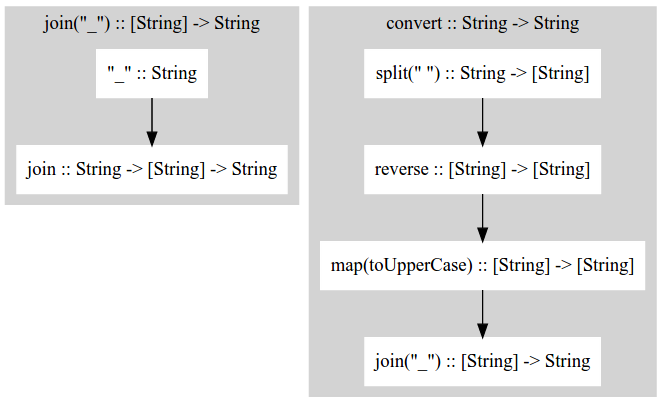
String convert(String input)to: 1) reverse the order of words; 2) convert the words to upper case; 3) join the words by underscore. For example,convert("I love programming in Java")will yield"JAVA_IN_PROGRAMMING_LOVE_I".
In Java 6, we can actually do like this:
// Java 6

String convert(String str) {

  // _ composes multiple functions into one function

  F1<String, String> f = _(split(" "), Lists.<String>reverse(), map(toUpperCase()), join("_"));

  return f.apply(str);

}
More details here.
The point here is the unique way of composing a bunch of small functions into a larger one.
Every programming language has its way to composition, they only differ in how. We call the style above functional composition. One of the biggest differences between functional composition and OO composition is that we don't even need to mention the data in functional composition, you can just partially apply the curried functions and compose then together. It's also called Point-Free style.
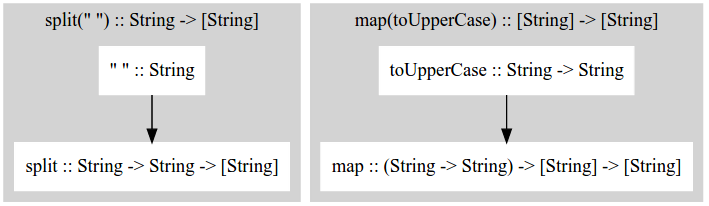
In functional composition, we need to pay special attention to the type of values and functions. For example, the type of compose function _ is (T -> U) -> (U -> R) -> (T -> R) meaning given a function f1 of type T -> U and a function f2 of type U -> R, it will return a function of type T -> R. So the restriction here is the return type of f1 is the parameter type of f2. If it's not satisfied, the compiler and IDE will warn you. Let's look at the example, since we want to have convert of type String -> String, the type of split(" ") must be String -> T where T can be anything, then since it's connected to Lists.<String>reverse(), here T is forced to be List<String>.
The following diagrams depicts the type of partially applied functions and composed functions:
Functional composition also depends on the way you define the types. Recall the 3 forms of map:
1. map(x -> x * x, [1, 2, 3])
2. map([1, 2, 3], x -> x * x)
3. [1, 2, 3].map(x -> x * x)
In general, we always prefer the first form which puts data at the end of the parameter list. One important reason for this is easier to partially apply the function and compose it with other functions. I'm not saying the second form doesn't work, if you have an existing function say f :: D -> T -> R which puts data at the beginning, just use flip(f) to turn the type into T -> D -> R, the implementation will not be changed.
In the next section, I'll tell another important reason for preferring the first form.
Functional Programming without Lambda - Part 1 Functional Composition的更多相关文章
- Functional Programming without Lambda - Part 2 Lifting, Functor, Monad
Lifting Now, let's review map from another perspective. map :: (T -> R) -> [T] -> [R] accep ...
- Java 中的函数式编程(Functional Programming):Lambda 初识
Java 8 发布带来的一个主要特性就是对函数式编程的支持. 而 Lambda 表达式就是一个新的并且很重要的一个概念. 它提供了一个简单并且很简洁的编码方式. 首先从几个简单的 Lambda 表达式 ...
- [Functional Programming Monad] Combine Stateful Computations Using Composition
We explore a means to represent the combination of our stateful computations using familiar composit ...
- [Functional Programming] Rewrite a reducer with functional state ADT
For example we have a feature reducer like this: // selectCard :: String -> Action String export ...
- Python Lambda & Functional Programming
Python Lambda & Functional Programming 函数式编程 匿名函数 纯函数 高阶函数 # higher-order functions def apply_tw ...
- Beginning Scala study note(4) Functional Programming in Scala
1. Functional programming treats computation as the evaluation of mathematical and avoids state and ...
- Functional programming
In computer science, functional programming is a programming paradigm, a style of building the struc ...
- 关于函数式编程(Functional Programming)
初学函数式编程,相信很多程序员兄弟们对于这个名字熟悉又陌生.函数,对于程序员来说并不陌生,编程对于程序员来说也并不陌生,但是函数式编程语言(Functional Programming languag ...
- Monad (functional programming)
In functional programming, a monad is a design pattern that defines how functions, actions, inputs, ...
随机推荐
- UWP VirtualizedVariableSizedGridView 支持可虚拟化可变大小Item的View(一)
Boss的需要时这样的,Item是可变大小的,同时根据不同的Window size,来确定Item的结构和大小Window 小的时候是 大的时候是这样的: 当然这size变化的过程中也允许其他结构,我 ...
- winform进程、线程、TreeView递归加载
进程: 一般来说,一个程序就是一个进程,不过也有一个程序需要多个进程支持的情况. 进程所使用的类:Process 所需命名空间:System.Diagnostics; 可以通过进行来开启计算机上现有的 ...
- Mongodb集群搭建的三种方式
转自:http://blog.csdn.net/luonanqin/article/details/8497860 MongoDB是时下流行的NoSql数据库,它的存储方式是文档式存储,并不是Key- ...
- [vue案例的知识点]todo-list
文章的原材料来自于vue的官方示例:https://cn.vuejs.org/v2/examples/todomvc.html,我们在学习过程中,试着对其中的一些知识点进行记录: 一.浏览器数据存储, ...
- JQuery基本知识框架思维导图(上)
一:认识jQuery 1.window.onload与$(document).ready()的对比 2.jQuery代码风格(1:链式代码风格2:位代码添加注释) 3.jQuery对象和DOM对象(1 ...
- iOS 遇到的错误总结
1.[[[NSBundle mainBundle] loadNibNamed:@"UIFeedbackController" owner:nil options:nil] firs ...
- java的基础知识文件操作和标识符
1.文件夹的操作 dir :显示当前文件夹中的所有文件和文件夹. cd 路径: 进入到指定的路径. cd .. : 回到上一级目录 cd \ : 回到当前目录的跟目录 md 文件夹名 创建一个 ...
- js返回顶部效果
当用户浏览的网页过于长的时候,用户在浏览到网页底部想要在返回顶部需要滚动好几次滚轮才能返回顶部,不仅麻烦,而且用户体验也会很差.现在的大多是页面都会在页面顶部或者是页面的可见区域的某一位置固定一个按钮 ...
- ST
这次说一下测试的基础部分 软件测试 软件测试(英语:software testing),描述一种用来促进鉴定软件的正确性.完整性.安全性和质量的过程.换句话说,软件测试是一种实际输出与预期输出间的审核 ...
- Smack4.1注册新用户
更新了smack4.1后,发现之前的注册表单不能使用了,很多属性都不能使用. 发现4.1把帐号的出来都集中到 org.jivesoftware.smackx.iqregister.AccountMan ...