
使用tensorflow进行mnist数字识别【模型训练+预测+模型保存+模型恢复】
import sys,os

sys.path.append(os.pardir)

import numpy as np

from tensorflow.examples.tutorials.mnist import input_data

from PIL import Image

import tensorflow as tf

def predict():

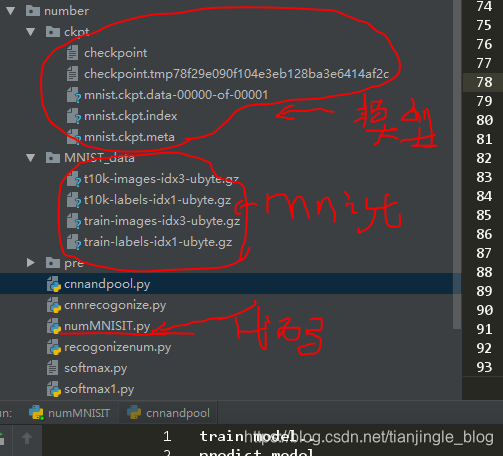
    meta_path = 'ckpt/mnist.ckpt.meta'

    model_path = 'ckpt/mnist.ckpt'

    sess = tf.InteractiveSession ()

    saver = tf.train.import_meta_graph (meta_path)

    saver.restore (sess, model_path)

    graph = tf.get_default_graph ()

    W = graph.get_tensor_by_name ("w:0")

    b = graph.get_tensor_by_name ("b:0")

    x = tf.placeholder (tf.float32, [None, 784])

    y = tf.nn.softmax (tf.matmul (x, W) + b)

    keep_prob = tf.placeholder (tf.float32)

    batch_xs, batch_ys=mnist.train.next_batch (100)

    one_img = batch_xs[0].reshape ((1, 784))

    one_num = batch_ys[0].reshape ((1, 10))

    temp = sess.run (y, feed_dict={x: one_img, keep_prob: 1.0})

    b = sess.run (tf.argmax (temp, 1))

    a = sess.run (tf.arg_max (one_num, 1))

    print(temp)

    print(one_num)

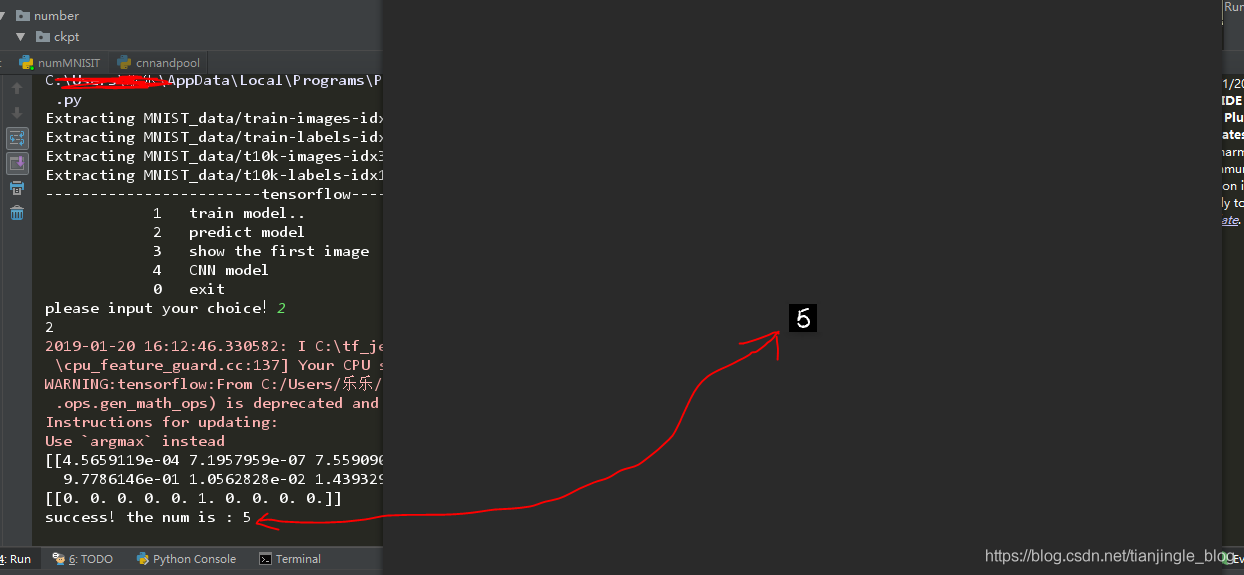
    if b == a:

        print ("success! the num is :", (b[0]))

        showImgTest(one_img)

    else:

        print ("mistakes predict.")

def trainNet():

    x = tf.placeholder (tf.float32, [None, 784])

    W = tf.Variable (tf.zeros ([784, 10]),name="w")

    b = tf.Variable (tf.zeros ([10]),name="b")

    y = tf.nn.softmax (tf.matmul (x, W) + b)

    y_ = tf.placeholder (tf.float32, [None, 10])

    keep_prob = tf.placeholder (tf.float32)

    # 定义测试的准确率

    correct_prediction = tf.equal (tf.argmax (y, 1), tf.argmax (y_, 1))

    accuracy = tf.reduce_mean (tf.cast (correct_prediction, tf.float32))

    #

    saver = tf.train.Saver (max_to_keep=1)

    max_acc = 0

    train_accuracy = 0

    #交叉熵

    cross_entropy = tf.reduce_mean (-tf.reduce_sum (y_ * tf.log (y)))

    # cross_error=cross_entropy_error_batch(y,y_)

    train_step = tf.train.GradientDescentOptimizer (0.01).minimize (cross_entropy)

    sess = tf.InteractiveSession ()

    tf.global_variables_initializer ().run ()

    for i in range (1000):

        batch_xs, batch_ys = mnist.train.next_batch (100)

        sess.run (train_step, feed_dict={x: batch_xs, y_: batch_ys, keep_prob: 1.0})

        if i % 100 == 0:

            train_accuracy = accuracy.eval (feed_dict={x: batch_xs, y_: batch_ys, keep_prob: 1.0})

            print ("step %d, training accuracy %g" % (i, train_accuracy))

        if train_accuracy > max_acc:

            max_acc = train_accuracy

            saver.save (sess, 'ckpt/mnist.ckpt')

if __name__ == '__main__':

    mnist = input_data.read_data_sets ("MNIST_data/", one_hot=True)

    choice=0

    while choice == 0:

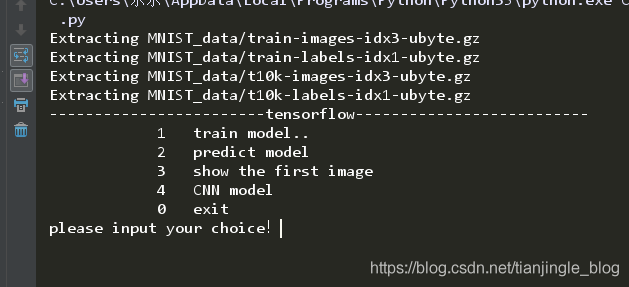
        print ("------------------------tensorflow--------------------------")

        print ("\t\t\t1\ttrain model..")

        print("\t\t\t2\tpredict model")

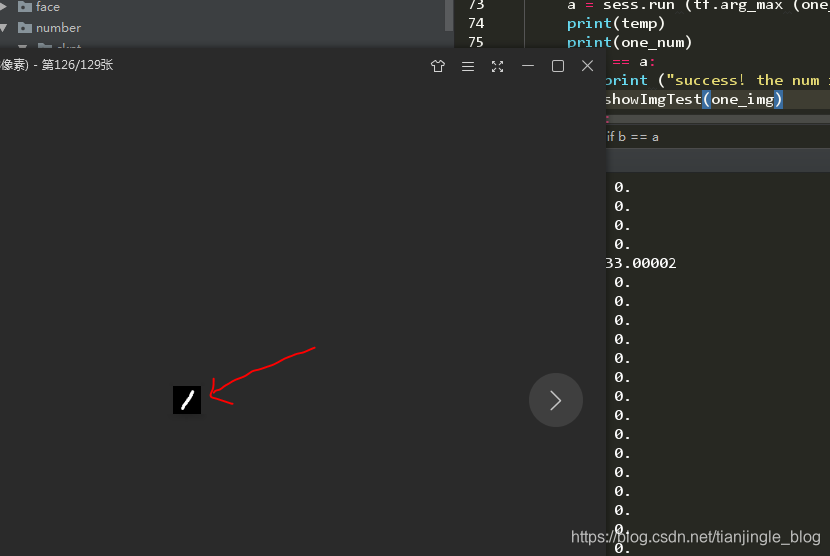
        print("\t\t\t3\tshow the first image")

        print ("\t\t\t0\texit")

        choice = input ("please input your choice!")

        print(choice)

        if choice == "1":

            print("start train...")

            trainNet()

        if choice=="2":

            predict()

        if choice=="3":

            showImg()

注:正在学习CNN,选项4还没有来的及做。后面补上
使用tensorflow进行mnist数字识别【模型训练+预测+模型保存+模型恢复】的更多相关文章
- TensorFlow学习笔记(三)MNIST数字识别问题
一.MNSIT数据处理 MNSIT是一个非常有名的手写体数字识别数据集.包含60000张训练图片,10000张测试图片.每张图片是28X28的数字. TonserFlow提供了一个类来处理 MNSIT ...
- 一个简单的TensorFlow可视化MNIST数据集识别程序
下面是TensorFlow可视化MNIST数据集识别程序,可视化内容是,TensorFlow计算图,表(loss, 直方图, 标准差(stddev)) # -*- coding: utf-8 -*- ...
- MNIST数字识别问题
摘自<Tensorflow:实战Google深度学习框架> import tensorflow as tf from tensorflow.examples.tutorials.mnist ...
- Pytorch CNN网络MNIST数字识别 [超详细记录] 学习笔记(三)
目录 1. 准备数据集 1.1 MNIST数据集获取: 1.2 程序部分 2. 设计网络结构 2.1 网络设计 2.2 程序部分 3. 迭代训练 4. 测试集预测部分 5. 全部代码 1. 准备数据集 ...
- Tensorflow手写数字识别训练(梯度下降法)
# coding: utf-8 import tensorflow as tffrom tensorflow.examples.tutorials.mnist import input_data #p ...
- TensorFlow深度学习实战---MNIST数字识别问题
1.滑动平均模型: 用途:用于控制变量的更新幅度,使得模型在训练初期参数更新较快,在接近最优值处参数更新较慢,幅度较小 方式:主要通过不断更新衰减率来控制变量的更新幅度. 衰减率计算公式 : deca ...
- 吴裕雄 python 神经网络——TensorFlow实现回归模型训练预测MNIST手写数据集
import tensorflow as tf from tensorflow.examples.tutorials.mnist import input_data mnist = input_dat ...
- Tensorflow手写数字识别---MNIST
MNIST数据集:包含数字0-9的灰度图, 图片size为28x28.训练样本:55000,测试样本:10000,验证集:5000
- Tensorflow手写数字识别(交叉熵)练习
# coding: utf-8import tensorflow as tffrom tensorflow.examples.tutorials.mnist import input_data #pr ...
随机推荐
- Ubuntu 12.04常用快捷键
===== 桌面 ===== ALT + F1: 聚焦到桌面左侧任务导航栏,可按上下键导航. ALT + F2: 运行命令 ALT + F4: 关闭窗口 ALT + TAB: 切换程序窗口 ALT + ...
- React 异步组件
之前写过一篇 Vue 异步组件的文章,最近在做一个简单项目的时候又想用到 React 异步组件,所以简单地了解了一下使用方法,这里做下笔记. 传统的 React 异步组件基本都靠自己实现,自己写一个专 ...
- MySql+Memcached架构的问题
Memcached采用客户端-服务器的架构,客户端和服务器端的通讯使用自定义的协议标准,只要满足协议格式要求,客户端Library可以用任何语言实现. Memcached服务器使用基于Slab的内存管 ...
- 1059. [ZJOI2007]矩阵游戏【二分图】
Description 小Q是一个非常聪明的孩子,除了国际象棋,他还很喜欢玩一个电脑益智游戏——矩阵游戏.矩阵游戏在一个N *N黑白方阵进行(如同国际象棋一般,只是颜色是随意的).每次可以对该矩阵进行 ...
- TensorFlow函数(八)tf.control_dependencies()
tf.control_dependencies(control_inputs) 此函数指定某些操作执行的依赖关系 返回一个控制依赖的上下文管理器,使用 with 关键字可以让在这个上下文环境中的操作都 ...
- c++ 浅拷贝和深拷贝 指针和引用的区别 malloc(free)和new(delete)的区别 重载重写重定义
4.malloc(free)和new(delete)的区别 malloc()函数: 1.1 malloc的全称是memory allocation,中文叫动态内存分配. 原型:extern void ...
- w10下Oracle 11g完全干净卸载
1.关闭oracle所有的服务.可以在windows的服务管理器中关闭: 2.打开注册表:regedit 打开路径: <找注册表 :开始->运行->regedit> H ...
- POJ 2250 (LCS,经典输出LCS序列 dfs)
题目链接: http://poj.org/problem?id=2250 Compromise Time Limit: 1000MS Memory Limit: 65536K Total Subm ...
- ZCMU 1019: 分金币
解题思路: 附上刘汝佳老师的解题过程: 首先最终每个人的金币数量可以计算出来,它等于金币总数除以人数n.接下来用M来表示每个人最终拥有的金币数. 现在假设编号为 i 的人初始有Ai 枚金币,对于1号来 ...
- iredmail 设置
一些问题和修改 1.收邮件很慢安装完毕后,测试会发现 发送邮件都是秒到,但收邮件特别慢 长达十几分钟,这是因为iredmail的灰名单规则导致的(需要外部邮箱进行3次投递才接收,防止垃圾邮件),禁用灰 ...