
c++builder 字节 编码 转换大全 String TBytes byte
System.SysUtils
System::DynamicArray<System::WideChar> TCharArray
System::TArray__1<System::WideChar> TCharArray;
TCharArray
String TBytes byte
编码类型有:ASCII、8BIT、7BIT、UCS2-BIG、UCS2-LIT、UCS2-80、UCS2-81、UCS2-82、UTF-8、UTF-16(Unicode)
RawToBytes
BytesToRaw
Byte一个字节,能存放0..255,就是unsigned char,小写的byte等价于大写的Byte。
array
TByteDynArray= array of Byte;
TIdBytes= array of Byte;
typedef System::DynamicArray<System::Byte> TIdBytes;
typedef System::DynamicArray<System::Byte> TBytes;
动态数组的写法
DynamicArray<Byte> TBytes;
DynamicArray<int> TInts;
TBytes = TArray<Byte>;
String> TBytes/TByteDynArray
Text.BytesOf()
BytesOf
WideBytesOf()
TBytes bv;
bv.set_length(8);
bytes=System::Sysutils::BytesOf(Caption);
bytes=System::Sysutils::WideBytesOf(Caption);//value is spec wide
bytes=Caption.BytesOf();
TBytes/TByteDynArray > String
Caption = System::Sysutils::StringOf(barr);
Caption = System::Sysutils::WideStringOf(barr);
String > <Utf8Bytes
TBytes bytes;
bytes = TEncoding::UTF8->GetBytes(Memo1->Text);
Memo1->Text = TEncoding::UTF8->GetString(bytes);
delphi
TEncoding.UTF8.GetBytes
TBytes/TByteDynArray > Byte *
TBytes bytes;
Byte * bt = &bytes[0];
byte bb[255];
或者
bt = new Byte[bytes.Length];
memcpy(bt,&bytes[0],bytes.Length);
TBytes初始化memset
TBytes bv;
bv.set_length(5000);
memset( &bv[0], 0,bv.Length );
Byte * >TBytes/TByteDynArray
Byte * bt;
TBytes bytes;
bytes = BytesOf(bt, sizeof(bt));
UnicodeString s1;
s1 = "Hello World!";
s1.Length(), ByteLength(s1)
ByteLength
TIdBytes
TIdBytes = array of Byte;
TBytes = TArray<Byte>;
uses IdGlobal;//head file
TIdBytes>String
String str=BytesToString( AValue: TIdBytes);
TIdBytes>TBytes
BytesToRaw(Buffer,abuffer,Length(Buffer));
SetLength(bs,0);
SetLength(bs,Length(idbs));
BytesToRaw(idbs,bs,Length(idbs));//error
BytesToRaw(idbs,bs[0],Length(idbs));//ok
buf :=TBytes( idbus);//ok
TBytes>TIdBytes
function RawToBytes(const AValue; const ASize: Integer): TIdBytes;
idbs := RawToBytes(bs[0], Length(bs));//必须加下标0,否则就是错是
idbs := RawToBytes(bs, Length(bs));//没有下标0是错的
结构体>TIdBytes
RawToBytes(SendData,SizeOf(SendData));//SendData是结构体变量,不要下标0
UTF8String Bytes>UnicodeString
字节转换为16进制
idbytes to hexString
String hexstr;

    for (int i = idbytes.Low; i <= idbytes.High; i++)

    {

        hexstr += IntToHex(idbytes[i], );

    }
delphi
PAnsiChar数组转为字符串
R: array[0..19] of AnsiChar;
sss:ansistring;
astr := AnsiString(r);
StrPCopy(r,astr);
Delphi7升级
AnsiChar(DelphiXE10)= Char(Delpih7)
Delphi7:
Object: array[1..6] of Char;
DelphiXE10,Berlin
Object: array[1..6] of AnsiChar;
sbytes := VarArrayOf([$AA, $EE, $81, $0, $0, $0, $0, $0, $0, $0, $0, $0, $0, $0, $0, $0]);
AnsiString>Bytes>AnsiString
bsa := TEncoding.ANSI.GetBytes(as1);
as1:= TEncoding.ANSI.GetString(bsa);
假UTF8Sring转换为汉字
UTF8String s8="闫换珍";
AnsiString s8a="闫换珍";
都是6个字节,一个汉字2个字节。
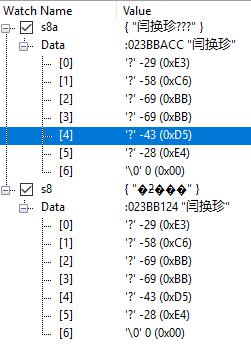
此时,想还原汉字this->Caption=???如何才能显示汉字
AnsiString  as21 = s8;//err

AnsiString  as22 = AnsiString(s8);//err

AnsiString  as2 = s8.c_str();//ok

String s991 =  s8;//err

String s992 = String(s8);//err

String s99 = s8.c_str();//ok 最可靠
as1:= TEncoding.ANSI.GetString(bs8);//ok
真UTF8String
UTF8String s8=L"闫换珍";//加上L标识才是真正的UTF8,一个汉字3个字节,UnicodeString函数是2个字节。
AnsiString s8a="闫换珍";
TBytes bs81 =TEncoding::UTF8->GetBytes(s8);
TBytes bs82 =TEncoding::UTF8->GetBytes(s8a);
两个bytes里是相等的,正确的。
char dest[256] = {0}; // room for 256 characters
UnicodeString src = L"闫换珍";
UnicodeToUtf8(dest, src.c_str(), 256);
//或者 UnicodeToUtf8(dest,256, src.c_str(), src.Length*();
dest与bs81,bs82值相等。
RawByteString srbRaw;
srbRaw = UTF8Encode(ss);
//ss = UTF8Decode(srb);
char Buf[512] = {0 };
strcpy(Buf, srbRaw.c_str());
Buf这个也是正确的utf8字节
UTF8String>String
String s=s8;
UnicodeString us1 =s8;
UnicodeString us11 = UTF8ToUnicodeString(s8.c_str());
UnicodeString us13 = UTF8ToString(s8.c_str());
UnicodeString us14 = Utf8ToAnsi(s8);
RawByteString rbs1 = AnsiToUtf8(s8);
word/short/int 简单类型转换为bytes
var Buf:TBytes; w:Word;begin w:=10; Buf:=RawToBytes(w);end;var Buf:Array[0..1] of Byte; w:Word;begin w:=10; Move(w,Buf[0],2);end;
doule>Byte[]
byte bt[8];
double ad;
memcpy(&bt[0], (byte*)&ad, 8);
memcpy(&bt[0], (byte*)&ajava, sizeof(double));
#if defined(USE_ENCODING)

     TBytes FirstLine; // A dynamic array of bytes

     FirstLine.Length = ;

     stream = _wfopen(OpenDialog1->Files->Strings[I].c_str(), L"r");

     fgets(&FirstLine[], FirstLine.Length, stream);

     Memo1->Lines->Append(TEncoding::UTF8->GetString(FirstLine));

     fclose(stream);

#else

     char FirstLine[];

     stream = _wfopen(OpenDialog1->Files->Strings[I].c_str(), L"r");

     fgets(FirstLine, sizeof(FirstLine), stream);

     Memo1->Lines->Append(UTF8String(FirstLine));

     fclose(stream);

#endif
delphi
LBuffer: TBytes;
SetLength(LBuffer, LFileStream.Size);
LFileStream.ReadBuffer(Pointer(LBuffer)^, Length(LBuffer));
C++builder VCL String
String astr="hello";
astr[0]//error,下标正确的是从1开始
StringToOleStr
字符串函数
String ss;
ss.LastDelimiter(" ");
最后一个空格出现的位置,这样就不用循环了
BSTR bs1;
fun(BSTR *name);
fun(&bs1);
Delphi Berlin 有此函数,int转换为16进制
ai:Integer;
ai:=17;
self.Caption:=ai.ToHexString;
StringList>字符数组
arr:TArray<string>;
list:TStringList;
arr := list.ToStringArray;
TStringDynArray
TMemoryStream>TBytes
LResponse: TMemoryStream;
unsigned char *>AnsiString
AnsiString str1= (char *)buff;
AnsiString str2((const char *)buff);
AnsiString>unsigned char*
strcpy(uchar,AnsiString(str).c.str());
ascii码转16进制
String Asc2Hex(String astr)

{

    TBytes bytes;

    bytes = TEncoding::ASCII->GetBytes(astr);

    String hexstr;

    for (int i = bytes.Low; i <= bytes.High; i++)

    {

        hexstr += IntToHex(bytes[i], );

    }

    return hexstr;

}
String Hex2Asc(String hexStr)

{

    int nLen = hexStr.Length();

    int j = ;

    String ahex;

    char achar;

    String retstr;

    if ( != (nLen % ))

    {

        return -;

    }

    for (int i = ; i < nLen; i = i + , j++)

    {

        ahex = hexStr.SubString(i, );

        ahex = "0x" + ahex;

        achar = char(ahex.ToInt());

        retstr = retstr + achar;

    }

    return retstr;

}
UnicodeString>std:string
String at="abc";
std:string sstr = AnsiString(at).c_str();
字符串数组
var arr:TArray<string>;
TStringDynArray

ArrayOfString2 = array of string;

string2Bytes
String astr = "中国";
TBytes b1,b2,b3,b4;
b1 = TEncoding::UTF8->GetBytes(astr);
b2 = TEncoding::ANSI->GetBytes(astr);
b3 = TEncoding::Default->GetBytes(astr);
b4 = TEncoding::Unicode->GetBytes(astr);
E4B8ADE59BBD
D6D0B9FA
D6D0B9FA
2D4EFD56  高地位修正后:4E2D 56FD    ,也有这样表单\u4e23 \u56fd

String s1,s2,s3,s4;

s1 = TEncoding::UTF8->GetString(b1);//中国
s2 = TEncoding::ANSI->GetString(b2);//中国
s3 = TEncoding::Default->GetString(b3);//中国
s4 = TEncoding::Unicode->GetString(b4);//中国

bytes数组转换成HexString
String bytesToHex(TBytes data)
{
   String hexstr;
  for (int i = 0; i < data.Length; i++)
     hexstr+= IntToHex( data[i],2);
  return hexstr;
}

特殊汉字
char=13,keypress,
包含key=13:复

包含tab
delphiAnsiChar array 转换为 tbytes
bts:tbytes;
outbuf: array[0..1000] of AnsiChar;

setlength(bts,200);
Move(bts[0[, outbuf[0], 200);
https://www.cnblogs.com/del88/p/5448317.html
 bytesof(str)
stringof(bytes) T
strAnsi:= PAnsiChar(AnsiString(str));
TBytes -> PChar : LPChar := PChar(LTBytes);
PChar -> TBytes:LTBytes := BytesOf(LPChar);
TBytes -> Array of AnsiChar:move(LTBytes[i],LArrayOfAnsiChar[k]);
Array of AnsiChar -> string:LString := StringOf(BytesOf(LArrayOfAnsiChar));
https://www.cnblogs.com/keynexy/p/5919962.html
c++builder 字节 编码 转换大全 String TBytes byte的更多相关文章
- 前端中常见字节编码(base64、hex、utf8)及其转换
/* * 字节编码转换 * 首先都需要转为二级制数组 (ArrayBuffer) * 然后才能转换对应的编码字符 * 前端常见编码: * base64:就是将二进制转为字符串,将每6个字节转为一个特定 ...
- java String与Byte[]和String 与InputStream转换时注意编码问题。。。
前一段日子,我在做rsa加密和通过http get方式获取验证码图片通过BitmapFactory创建bitmap 出现了一系列的问题. 通过一系列的调试,发现有些问题原来是在进行String 与By ...
- String和bytes的编码转换
import java.io.UnsupportedEncodingException; import java.nio.charset.Charset; /** * @author 作者 E-mai ...
- java String编码转换
/** * Get XML String of utf-8 * * @return XML-Formed string */ public static String getUTF8XMLString ...
- Python3中内置类型bytes和str用法及byte和string之间各种编码转换,python--列表,元组,字符串互相转换
Python3中内置类型bytes和str用法及byte和string之间各种编码转换 python--列表,元组,字符串互相转换 列表,元组和字符串python中有三个内建函数:,他们之间的互相转换 ...
- C# string字节数组转换
string转byte[]:byte[] byteArray = System.Text.Encoding.Default.GetBytes ( str ); byte[]转string:string ...
- C#字节数组转换成字符串
C#字节数组转换成字符串 如果还想从 System.String 类中找到方法进行字符串和字节数组之间的转换,恐怕你会失望了.为了进行这样的转换,我们不得不借助另一个类:System.Text.Enc ...
- PHP 支持中文目录和文件的的遍历:文件编码转换
在使用 readdir() 遍历指定目录时,使中文目录和文件名都正常显示需要使用 iconv() 进行文件编码转换: <?php header("Content-type:text/h ...
- java中string与byte[]的转换
1.string 转 byte[] byte[] midbytes=isoString.getBytes("UTF8"); //为UTF8编码 byte[] isoret = sr ...
随机推荐
- CentOS 6.5安装和配置ngix
一.安装配置ngix 这里用wget直接拉取并安装资源文件 首先安装必要的库(nginx 中gzip模块需要 zlib 库,rewrite模块需要 pcre 库,ssl 功能需要openssl库). ...
- 尺取法——POJ3061
#include <iostream> //nlogn复杂度的写法 #include <cstdio> #include <algorithm> using nam ...
- Laravel框架中Validor中错误信息$error的输出
@if (count($errors) > 0) <div class="alert alert-danger"> <ul> @foreach ($e ...
- halcon之共线连接union_collinear_contours_xld
union_collinear_contours_xld 很多时候当我们用edges_sub_pix, threshold_sub_pix 等算子得到边缘后,因为有噪声.物体本身断裂等原因 很多边缘 ...
- SpringInAction--SpringMvc高级技术(servlet、filter、multipart)
前面学了spirng的一些配置,以及web方面的知识,今天就在学习一下在spring比较常用的一些高级技术... 首先来介绍下什么叫servlet吧(来着维基百科) Servlet(Server Ap ...
- DIY远程控制开关(tiny6410+LED+yeelink+curl)
上一次,介绍了如何实现远程监控室内温度,大家伙反响还是很热烈的,笔者很欣慰,独乐乐不如众乐乐啊.不过话说回来,那个实现只能是远程监测家中温度,假如发现家里热得很,想远程打开空调开关提前降降温,回家后不 ...
- 【python】BytesIO与串化
一共有以下几个概念 1.类文件: File(path), open(path), BytesIO(), ... 文件读之前要seek(0) 2.字符串: file.read() 3.对象: dict, ...
- 2018-2019-2 《网络对抗技术》Exp1 PC平台逆向破解 20165222
Exp1 PC平台逆向破解 1,掌握NOP, JNE, JE, JMP, CMP汇编指令的机器码 NOP:空指令,作用就是直接跳到下一指令.机器码为:90. JNE:判断0标志位,不等于0跳转.机器码 ...
- C语言Socket编程(计算机网络作业)
最近我计算机网络课程要做作业了,没办法跟着老师一步一步的写C语言的代码,使用的计算就是Socket通信发送消息:代码实现的功能很简单,客户端向服务器端发送消息,服务器端接收客户端发来的消息,并且输出显 ...
- php浮点数比较
本文实例讲述了PHP中两个float(浮点数)比较方法.分享给大家供大家参考.具体如下: 最近在开发一个合同管理系统的时候,涉及到两个浮点数比较,算是把我郁闷惨了.在N久以前,就不晓得从哪里听来的一个 ...