
Entity Relationships
Entity Relationships:
Here, you will learn how entity framework manages the relationships between entities.
Entity framework supports three types of relationships, same as database: 1) One to One 2) One to Many, and 3) Many to Many.
We have created an Entity Data Model for the SchoolDB database in the Create Entity Data Modelsection. The following figure shows the visual designer for that EDM with all the entities and relationships among them.
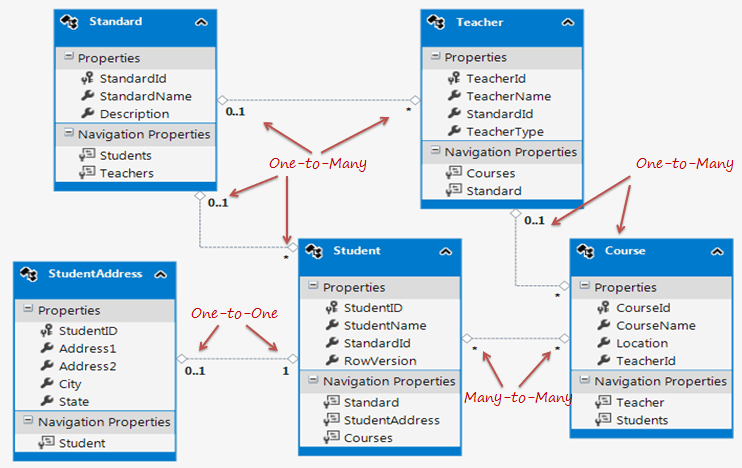
Let's see how each relation (association) is being managed by entity framework.
One-to-One Relationship:
As you can see in the above figure, Student and StudentAddress have a One-to-One relationship (zero or one). A student can have only one or zero address. Entity framework adds Student navigation property into StudentAddress entity and StudentAddress navigation entity into Student entity. Also, StudentAddress entity has StudentId property as PrimaryKey which makes it a One-to-One relationship.
The following code snippet shows Student and StudentAddress entity classes.
public partial class Student

{

    public Student()

    {

        this.Courses = new HashSet<Course>();

    }

    public int StudentID { get; set; }

    public string StudentName { get; set; }

    public Nullable<int> StandardId { get; set; }

    public byte[] RowVersion { get; set; }

    public virtual Standard Standard { get; set; }

    public virtual StudentAddress StudentAddress { get; set; }

    public virtual ICollection<Course> Courses { get; set; }

}

public partial class StudentAddress

{

    public int StudentID { get; set; }

    public string Address1 { get; set; }

    public string Address2 { get; set; }

    public string City { get; set; }

    public string State { get; set; }

    public virtual Student Student { get; set; }

}
As you can see in the above code, Student entity class includes StudentAddress navigation property and StudentAddress includes Student navigation property with foreign key property StudentId. This way EF handles one-to-one relationship between entities.
One-to-Many Relationship:
The Standard and Teacher entities have a One-to-Many relationship marked by multiplicity where 1 is for One and * is for many. This means that Standard can have many Teachers whereas Teacher can associate with only one Standard.
To represent this, The Standard entity has the collection navigation property Teachers (please notice that it's plural), which indicates that one Standard can have a collection of Teachers (many teachers). And Teacher entity has a Standard navigation property (Not a Collection) which indicates that Teacher is associated with one Standard. Also, it contains StandardId foreign key (StandardId is a PK in Standard entity). This makes it One-to-Many relationship.
The following code snippet shows Standard and Teacher entity class created by EDM.
public partial class Standard

{

    public Standard()

    {

        this.Students = new HashSet<Student>();

        this.Teachers = new HashSet<Teacher>();

    }

    public int StandardId { get; set; }

    public string StandardName { get; set; }

    public string Description { get; set; }

    public virtual ICollection<Student> Students { get; set; }

    public virtual ICollection<Teacher> Teachers { get; set; }

}

public partial class Teacher

{

    public Teacher()

    {

        this.Courses = new HashSet<Course>();

    }

    public int TeacherId { get; set; }

    public string TeacherName { get; set; }

    public Nullable<int> StandardId { get; set; }

    public Nullable<int> TeacherType { get; set; }

    public virtual ICollection<Course> Courses { get; set; }

    public virtual Standard Standard { get; set; }

}
As you can see in the above code snippet, Standard entity class has Teachers property of type ICollection, so that it can contain multiple Teacher objects. (It initializes Teachers property with HashSet<Teacher> in the constructor, so that you can add Teacher objects into collection without worrying about initializing it.)
Also, Teacher entity class includes Standard property with StandardId for foreign key property. Entity framework includes this foreign key property because we checked Include foreign key columns in the model in the EDM wizard while creating EDM in the Create Entity Data Model section.
Many-to-Many Relationship:
Student and Course have Many-to-Many relationships marked by * multiplicity. It means one Student can enrol for many Courses and also, one Course can be be taught to many Students.
The database design includes StudentCourse joining table which includes the primary key of both the tables (Student and Course table). Entity Framework represents many-to-many relationships by not having entityset for the joining table in CSDL, instead it manages this through mapping.
As you can see in the above figure, Student entity includes Courses property and Course entity includes Students property to represent many-to-many relationship between them.
The following code snippet shows Student and Course entity classes.
public partial class Student

{

    public Student()

    {

        this.Courses = new HashSet<Course>();

    }

    public int StudentID { get; set; }

    public string StudentName { get; set; }

    public Nullable<int> StandardId { get; set; }

    public byte[] RowVersion { get; set; }

    public virtual Standard Standard { get; set; }

    public virtual StudentAddress StudentAddress { get; set; }

    public virtual ICollection<Course> Courses { get; set; }

}

public partial class Course

{

    public Course()

    {

        this.Students = new HashSet<Student>();

    }

    public int CourseId { get; set; }

    public string CourseName { get; set; }

    public System.Data.Entity.Spatial.DbGeography Location { get; set; }

    public Nullable<int> TeacherId { get; set; }

    public virtual Teacher Teacher { get; set; }

    public virtual ICollection<Student> Students { get; set; }

}
Note: Entity framework supports many-to-many relationship only when the joining table (StudentCourse in this case) does NOT include any columns other than PKs of both the tables. If the join tables contain additional columns, such as DateCreated, then the EDM creates entity for middle table as well and you will have to manage CRUD operation for many-to-many entities manually.
Open EDM in XML view. You can see that SSDL has StudentCourse entityset, but CSDL doesn't have StudentCourse entityset. Instead, it's being mapped in the navigation property of the Student and Course entity. In MSL (C-S Mapping), it has mapping between Student and Course put into the StudentCourse table in <AssociationSetMapping/>
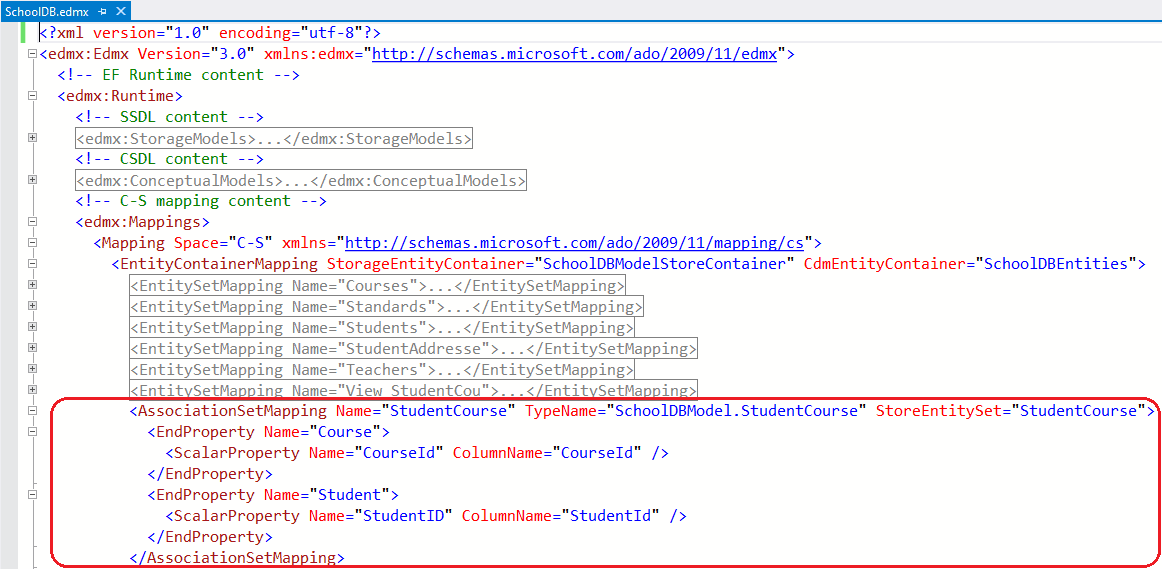
Thus, Many-to-Many relationship is being managed by C-S mapping in EDM. So when you add a Student in a Course or a Course in a Student entity and when you save it, it will then insert PK of the added student and course in StudentCourse table. So this mapping not only enables a convenient association directly between the two entities, but also manages querying, inserts, and updates across this joint.
Entity Graph:
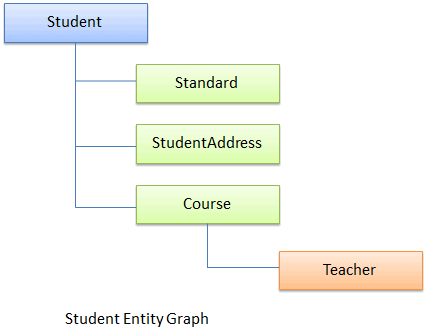
When an entity has a relationship with other entities, then the full object hierarchy is called an 'entity graph'. For example the following is a Student entity graph, that includes hierarchy of Student entity with Standard, StudentAddress & Course entities.
Entity Relationships的更多相关文章
- 实体之间的关系【Entity Relationships】(EF基础系列篇9)
Here, you will learn how entity framework manages the relationships between entities. Entity framewo ...
- EntityFramework 学习 一 Entity Relationships 实体的关系
下面,我们学习Entity Framework怎么管理实体间的关系 Entity Framework支持三种关系:一对一的关系.一对多的关系.多对多的关系 前面我们创建SchoolDB的实体数据模型, ...
- Entity Framework Tutorial Basics(9):Entity Relationships
这篇前面已经转载出来了,地址:http://www.cnblogs.com/purplefox2008/p/5646466.html
- EF(Entity Framework)系统学习系列
好久没写博客了,继续开启霸屏模式,好了,废话不多说,这次准备重新系统学一下EF,一个偶然的机会找到了一个学习EF的网站(http://www.entityframeworktutorial.net/) ...
- C#:ORM--实体框架EF(entity framework)(1)
本文来自:http://www.cnblogs.com/xuf22/articles/5513283.html 一.什么是ORM ORM(Object-relational mapping),中文翻译 ...
- JPA 教程
Entities An entity is a lightweight persistence domain object. Typically an entity represents a tabl ...
- 1.6.4 Uploading Structured Data Store Data with the Data Import Handler
1.使用DIH上传结构化数据 许多搜索应用索引结构化数据,如关系型数据库.DIH提供了一个这样的存储并索引结构化数据的机制.除了关系型数据库,solr可以索引来自HTTP的内容,基于数据源如RSS和A ...
- 一、Microsoft Dynamics CRM 4.0 SDK概述
Chapter 1. Microsoft Dynamics CRM 4.0 SDK Overview(SDK概述) You are probably reading this book because ...
- Java EE (4) -- Java EE 6 Java Persistence API Developer Certified Expert(1z0-898)
Overview of the Java Persistence API Describe the basics of Object Relational Mapping (ORM) Define t ...
随机推荐
- C8051F340 USB0 寄存器访问
/*************************************************************************** * C8051F340 USB0 寄存器访问 ...
- as3设计模式乱用之工厂模式
好久没写技术相关的日记了,一忙,二懒,三则被这单调的生活熏得没什么感悟. 其实这篇日记早就想写了,项目开发初期的时候,带学生.经常看到那种乱用设计模式的现象.一方面,公司面试人的时候喜欢问设计模式,另 ...
- (C#)Windows Shell 外壳编程系列2 - 解释,从“桌面”开始展开
(本系列文章由柠檬的(lc_mtt)原创,转载请注明出处,谢谢-) 接上一篇:(C#)Windows Shell 外壳编程系列1 - 基础,浏览一个文件夹 让我们详细解释一下 Shell 编程中最基本 ...
- Hibernate检索方式(转载)
我们在项目应用中对数据进行最多的操作就是查询,数据的查询在所有ORM框架中也占有极其重要的地位. 那么,如何利用Hibernate查询数据呢?Hibernate为我们提供了多种数据查询的方式,又称为H ...
- WPF中ItemsControl绑定到Google ProtocolBuffer的结构体时的性能问题
背景: 最近遇到一个DataGrid的性能问题:里面大概有4000个数据, 绑定的ItemSource的类也只有一层数据,即简单的List(里面每个是Protocol Buffer自动产生的一个类,1 ...
- 存储过程错误异常处理例子 --> DECLARE EXIT HANDLER FOR SQLEXCEPTION (转)
刚才一个朋友问到: mysql 有类似 mssql 退出执行的方法不? 比如我执行到某个条件,下面就终止执行了. 想起以前写的存储过程,找了好久才找到,就发给他,希望对他有所帮助,贴在这里,留作 ...
- U盘操作
一.8G的U盘被设置为2G,如何恢复 1.下载usboot 1.7 打开以后,选中U盘,点击[点击此处选择工作模式],选择[用0重置参数] ,然后点[开始].2.完成后它会提示拔下U盘,此时拔下U盘, ...
- java.nio.ByteBuffer中flip、rewind、clear方法的区别
对缓冲区的读写操作首先要知道缓冲区的下限.上限和当前位置.下面这些变量的值对Buffer类中的某些操作有着至关重要的作用: limit:所有对Buffer读写操作都会以limit变量的值作为上限. p ...
- Task Crontab
Crontab 1.查看任务 crontab -l 2.编辑任务 1)对应用户登录后编辑其下的作业 crontab -e 2)删除指定用户任务 crontab -u user -r 3)删除用户下指定 ...
- 第三章 Java内存模型(下)
锁的内存语义 中所周知,锁可以让临界区互斥执行.这里将介绍锁的另一个同样重要但常常被忽视的功能:锁的内存语义 锁的释放-获取建立的happens-before关系 锁是Java并发编程中最重要的同步机 ...