
Spring Cloud 升级之路 - 2020.0.x - 5. 理解 NamedContextFactory
spring-cloud-commons 中参考了 spring-cloud-netflix 的设计,引入了 NamedContextFactory 机制,一般用于对于不同微服务的客户端模块使用不同的 子 ApplicationContext 进行配置。
spring-cloud-commons 是 Spring Cloud 对于微服务基础组件的抽象。在一个微服务中,调用微服务 A 与调用微服务 B 的配置可能不同。比较简单的例子就是,A 微服务是一个简单的用户订单查询服务,接口返回速度很快,B 是一个报表微服务,接口返回速度比较慢。这样的话我们就不能对于调用微服务 A 和微服务 B 使用相同的超时时间配置。还有就是,我们可能对于服务 A 通过注册中心进行发现,对于服务 B 则是通过 DNS 解析进行服务发现,所以对于不同的微服务我们可能使用不同的组件,在 Spring 中就是使用不同类型的 Bean。
在这种需求下,不同微服务的客户端有不同的以及相同的配置,有不同的 Bean,也有相同的 Bean。所以,我们可以针对每一个微服务将他们的 Bean 所处于 ApplicationContext 独立开来,不同微服务客户端使用不同的 ApplicationContext。NamedContextFactory 就是用来实现这种机制的。
通过实例了解 NamedContextFactory 的使用
编写源码:
package com.github.hashjang.spring.cloud.iiford.service.common;

import org.junit.Assert;

import org.junit.Test;

import org.springframework.cloud.context.named.NamedContextFactory;

import org.springframework.context.annotation.AnnotationConfigApplicationContext;

import org.springframework.context.annotation.Bean;

import org.springframework.context.annotation.Configuration;

import org.springframework.core.env.Environment;

import java.util.List;

import java.util.Objects;

public class CommonNameContextTest {

    private static final String PROPERTY_NAME = "test.context.name";

    @Test

    public void test() {

        //创建 parent context

        AnnotationConfigApplicationContext parent = new AnnotationConfigApplicationContext();

        //添加 BaseConfig 相关配置

        parent.register(BaseConfig.class);

        //初始化 parent

        parent.refresh();

        //创建 testClient1,默认配置使用 ClientCommonConfig

        TestClient testClient1 = new TestClient(ClientCommonConfig.class);

        //创建 service1 与 service2 以及指定对应额外的配置类

        TestSpec testSpec1 = new TestSpec("service1", new Class[]{Service1Config1.class, Service1Config2.class});

        TestSpec testSpec2 = new TestSpec("service2", new Class[]{Service2Config.class});

        //设置 parent ApplicationContext 为 parent

        testClient1.setApplicationContext(parent);

        //将 service1 与 service2 的配置加入 testClient1

        testClient1.setConfigurations(List.of(testSpec1, testSpec2));

        BaseBean baseBean = testClient1.getInstance("service1", BaseBean.class);

        System.out.println(baseBean);

        //验证正常获取到了 baseBean

        Assert.assertNotNull(baseBean);

        ClientCommonBean commonBean = testClient1.getInstance("service1", ClientCommonBean.class);

        System.out.println(commonBean);

        //验证正常获取到了 commonBean

        Assert.assertNotNull(commonBean);

        Service1Bean1 service1Bean1 = testClient1.getInstance("service1", Service1Bean1.class);

        System.out.println(service1Bean1);

        //验证正常获取到了 service1Bean1

        Assert.assertNotNull(service1Bean1);

        Service1Bean2 service1Bean2 = testClient1.getInstance("service1", Service1Bean2.class);

        System.out.println(service1Bean2);

        //验证正常获取到了 service1Bean2

        Assert.assertNotNull(service1Bean2);

        BaseBean baseBean2 = testClient1.getInstance("service2", BaseBean.class);

        System.out.println(baseBean2);

        //验证正常获取到了 baseBean2 并且 baseBean2 就是 baseBean

        Assert.assertEquals(baseBean, baseBean2);

        ClientCommonBean commonBean2 = testClient1.getInstance("service2", ClientCommonBean.class);

        System.out.println(commonBean2);

        //验证正常获取到了 commonBean2 并且 commonBean 和 commonBean2 不是同一个

        Assert.assertNotNull(commonBean2);

        Assert.assertNotEquals(commonBean, commonBean2);

        Service2Bean service2Bean = testClient1.getInstance("service2", Service2Bean.class);

        System.out.println(service2Bean);

        //验证正常获取到了 service2Bean

        Assert.assertNotNull(service2Bean);

    }

    @Configuration(proxyBeanMethods = false)

    static class BaseConfig {

        @Bean

        BaseBean baseBean() {

            return new BaseBean();

        }

    }

    static class BaseBean {}

    @Configuration(proxyBeanMethods = false)

    static class ClientCommonConfig {

        @Bean

        ClientCommonBean clientCommonBean(Environment environment, BaseBean baseBean) {

            //在创建 NamedContextFactory 里面的子 ApplicationContext 的时候,会指定 name,这个 name 对应的属性 key 即 PROPERTY_NAME

            return new ClientCommonBean(environment.getProperty(PROPERTY_NAME), baseBean);

        }

    }

    static class ClientCommonBean {

        private final String name;

        private final BaseBean baseBean;

        ClientCommonBean(String name, BaseBean baseBean) {

            this.name = name;

            this.baseBean = baseBean;

        }

        @Override

        public String toString() {

            return "ClientCommonBean{" +

                    "name='" + name + '\'' +

                    ", baseBean=" + baseBean +

                    '}';

        }

    }

    @Configuration(proxyBeanMethods = false)

    static class Service1Config1 {

        @Bean

        Service1Bean1 service1Bean1(ClientCommonBean clientCommonBean) {

            return new Service1Bean1(clientCommonBean);

        }

    }

    static class Service1Bean1 {

        private final ClientCommonBean clientCommonBean;

        Service1Bean1(ClientCommonBean clientCommonBean) {

            this.clientCommonBean = clientCommonBean;

        }

        @Override

        public String toString() {

            return "Service1Bean1{" +

                    "clientCommonBean=" + clientCommonBean +

                    '}';

        }

    }

    @Configuration(proxyBeanMethods = false)

    static class Service1Config2 {

        @Bean

        Service1Bean2 service1Bean2() {

            return new Service1Bean2();

        }

    }

    static class Service1Bean2 {

    }

    @Configuration(proxyBeanMethods = false)

    static class Service2Config {

        @Bean

        Service2Bean service2Bean(ClientCommonBean clientCommonBean) {

            return new Service2Bean(clientCommonBean);

        }

    }

    static class Service2Bean {

        private final ClientCommonBean clientCommonBean;

        Service2Bean(ClientCommonBean clientCommonBean) {

            this.clientCommonBean = clientCommonBean;

        }

        @Override

        public String toString() {

            return "Service2Bean{" +

                    "clientCommonBean=" + clientCommonBean +

                    '}';

        }

    }

    static class TestSpec implements NamedContextFactory.Specification {

        private final String name;

        private final Class<?>[] configurations;

        public TestSpec(String name, Class<?>[] configurations) {

            this.name = name;

            this.configurations = configurations;

        }

        @Override

        public String getName() {

            return name;

        }

        @Override

        public Class<?>[] getConfiguration() {

            return configurations;

        }

    }

    static class TestClient extends NamedContextFactory<TestSpec> {

        public TestClient(Class<?> defaultConfigType) {

            super(defaultConfigType, "testClient", PROPERTY_NAME);

        }

    }

}
结果输出为:
com.github.hashjang.spring.cloud.iiford.service.common.CommonNameContextTest$BaseBean@3faf2e7d

ClientCommonBean{name='service1', baseBean=com.github.hashjang.spring.cloud.iiford.service.common.CommonNameContextTest$BaseBean@3faf2e7d}

Service1Bean1{clientCommonBean=ClientCommonBean{name='service1', baseBean=com.github.hashjang.spring.cloud.iiford.service.common.CommonNameContextTest$BaseBean@3faf2e7d}}

com.github.hashjang.spring.cloud.iiford.service.common.CommonNameContextTest$Service1Bean2@4648ce9

com.github.hashjang.spring.cloud.iiford.service.common.CommonNameContextTest$BaseBean@3faf2e7d

ClientCommonBean{name='service2', baseBean=com.github.hashjang.spring.cloud.iiford.service.common.CommonNameContextTest$BaseBean@3faf2e7d}

Service2Bean{clientCommonBean=ClientCommonBean{name='service2', baseBean=com.github.hashjang.spring.cloud.iiford.service.common.CommonNameContextTest$BaseBean@3faf2e7d}}
代码中实现了这样一个 Context 结构:
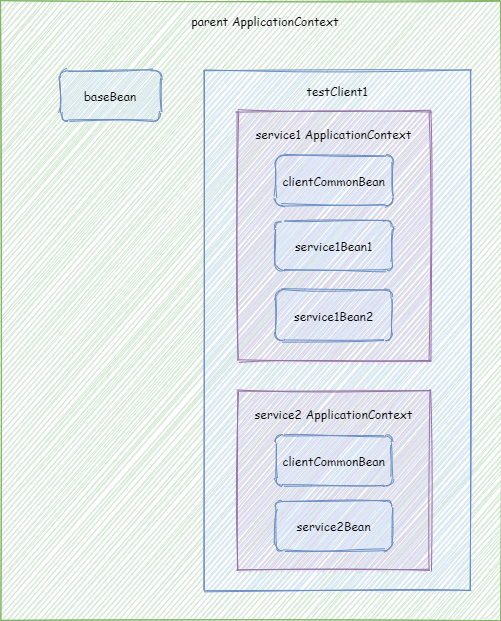
图中的被包含的 ApplicationContext 可以看到外层 ApplicationContext 的 Bean,也就是通过对被包含的 ApplicationContext 调用 getBean(xxx) 可以获取到外层 ApplicationContext 的 Bean (其实外层就是 parent ApplicationContext),但是外层的看不到内层私有的 Bean。
在我们的测试代码中,首先,创建了一个 AnnotationConfigApplicationContext。这个其实就是模拟了我们平常使用 Spring 框架的时候的根核心 ApplicationContext,所以我们将其命名为 parent。我们向里面注册了 BaseConfig,BaseConfig 里面的 BaseBean 会注册到 parent。之后我们 建 testClient1,默认配置使用 ClientCommonConfig。如果我们指定了 testClient1 的 parent ApplicationContext 为 parent,那么 parent 里面的 Bean 都能被 testClient1 里面的子 ApplicationContext 访问到。然后,我们创建 service1 与 service2 以及指定对应额外的配置类。service1 会创建 ClientCommonConfig、Service1Config1 和 Service1Config2 里面配置的 Bean。service2 会创建 ClientCommonConfig 和 Service2Config 里面配置的 Bean。
NamedContextFactory 的基本原理以及源码
NamedContextFactory 的核心方法是 public <T> T getInstance(String name, Class<T> type),通过这个方法获取 NamedContextFactory 里面的子 ApplicationContext 里面的 Bean。源码是:
/**

 * 获取某个 name 的 ApplicationContext 里面的某个类型的 Bean

 * @param name 子 ApplicationContext 名称

 * @param type 类型

 * @param <T> Bean 类型

 * @return Bean

 */

public <T> T getInstance(String name, Class<T> type) {

	//获取或者创建对应名称的 ApplicationContext

	AnnotationConfigApplicationContext context = getContext(name);

	try {

		//从对应的 ApplicationContext 获取 Bean,如果不存在则会抛出 NoSuchBeanDefinitionException

		return context.getBean(type);

	}

	catch (NoSuchBeanDefinitionException e) {

		//忽略 NoSuchBeanDefinitionException

	}

	//没找到就返回 null

	return null;

}

protected AnnotationConfigApplicationContext getContext(String name) {

	//如果 map 中不存在,则创建

	if (!this.contexts.containsKey(name)) {

		//防止并发创建多个

		synchronized (this.contexts) {

			//再次判断,防止有多个等待锁

			if (!this.contexts.containsKey(name)) {

				this.contexts.put(name, createContext(name));

			}

		}

	}

	return this.contexts.get(name);

}

//根据名称创建对应的 context

protected AnnotationConfigApplicationContext createContext(String name) {

	AnnotationConfigApplicationContext context = new AnnotationConfigApplicationContext();

	//如果 configurations 中有对应名称的配置类,则注册之

	if (this.configurations.containsKey(name)) {

		for (Class<?> configuration : this.configurations.get(name).getConfiguration()) {

			context.register(configuration);

		}

	}

	//如果 configurations 中有名称开头为 default. 的配置类,则注册之

	for (Map.Entry<String, C> entry : this.configurations.entrySet()) {

		if (entry.getKey().startsWith("default.")) {

			for (Class<?> configuration : entry.getValue().getConfiguration()) {

				context.register(configuration);

			}

		}

	}

	//注册 PropertyPlaceholderAutoConfiguration,这样可以解析 spring boot 相关的 application 配置

	//注册默认的配置类 defaultConfigType

	context.register(PropertyPlaceholderAutoConfiguration.class, this.defaultConfigType);

	//将当前 context 的名称,放入对应的属性中,在配置类中可能会用到

	//我们上面举得例子,就是通过 environment.getProperty() 获取了这个属性

	context.getEnvironment().getPropertySources().addFirst(new MapPropertySource(this.propertySourceName,

			Collections.<String, Object>singletonMap(this.propertyName, name)));

	if (this.parent != null) {

		// Uses Environment from parent as well as beans

		context.setParent(this.parent);

		//spring boot 可以打包成一种 fatjar 的形式,将依赖的 jar 包都打入同一个 jar 包中

		//fatjar 中的依赖,通过默认的类加载器是加载不正确的,需要通过定制的类加载器

		//由于 JDK 11 LTS 相对于 JDK 8 LTS 多了模块化,通过 ClassUtils.getDefaultClassLoader() 有所不同

		//在 JDK 8 中获取的就是定制的类加载器,JDK 11 中获取的是默认的类加载器,这样会有问题

		//所以,这里需要手动设置当前 context 的类加载器为父 context 的类加载器

		context.setClassLoader(this.parent.getClassLoader());

	}

	//生成展示名称

	context.setDisplayName(generateDisplayName(name));

	context.refresh();

	return context;

}
Spring Cloud 升级之路 - 2020.0.x - 5. 理解 NamedContextFactory的更多相关文章
- Spring Cloud 升级之路 - 2020.0.x - 1. 背景知识、需求描述与公共依赖
1. 背景知识.需求描述与公共依赖 1.1. 背景知识 & 需求描述 Spring Cloud 官方文档说了,它是一个完整的微服务体系,用户可以通过使用 Spring Cloud 快速搭建一个 ...
- Spring Cloud 升级之路 - 2020.0.x - 4. 使用 Eureka 作为注册中心
Eureka 目前的状态:Eureka 目前 1.x 版本还在更新,但是应该不会更新新的功能了,只是对现有功能进行维护,升级并兼容所需的依赖. Eureka 2.x 已经胎死腹中了.但是,这也不代表 ...
- Spring Cloud 升级之路 - 2020.0.x - 3. Undertow 的 accesslog 配置
上一节我们讲述了如何使用 Undertow 作为我们的 Web 服务容器,本小节我们来分析使用 Undertow 的另一个问题,也就是如何配置 accesslog,以及 accesslog 的各种占位 ...
- Spring Cloud 升级之路 - 2020.0.x - 6. 使用 Spring Cloud LoadBalancer (1)
本项目代码地址:https://github.com/HashZhang/spring-cloud-scaffold/tree/master/spring-cloud-iiford 我们使用 Spri ...
- Spring Cloud 升级之路 - 2020.0.x - 7. 使用 Spring Cloud LoadBalancer (2)
本项目代码地址:https://github.com/HashZhang/spring-cloud-scaffold/tree/master/spring-cloud-iiford 我们使用 Spri ...
- Spring Cloud 升级之路 - 2020.0.x - 2. 使用 Undertow 作为我们的 Web 服务容器
本项目代码地址:https://github.com/HashZhang/spring-cloud-scaffold/tree/master/spring-cloud-iiford 在我们的项目中,我 ...
- SpringCloud升级之路2020.0.x版-9.如何理解并定制一个Spring Cloud组件
本系列为之前系列的整理重启版,随着项目的发展以及项目中的使用,之前系列里面很多东西发生了变化,并且还有一些东西之前系列并没有提到,所以重启这个系列重新整理下,欢迎各位留言交流,谢谢!~ 我们实现的 S ...
- SpringCloud升级之路2020.0.x版-21.Spring Cloud LoadBalancer简介
本系列代码地址:https://github.com/HashZhang/spring-cloud-scaffold/tree/master/spring-cloud-iiford 我们使用 Spri ...
- SpringCloud升级之路2020.0.x版-23.订制Spring Cloud LoadBalancer
本系列代码地址:https://github.com/HashZhang/spring-cloud-scaffold/tree/master/spring-cloud-iiford 我们使用 Spri ...
随机推荐
- 全网最详细的Linux命令系列-cp命令
cp命令用来复制文件或者目录,是Linux系统中最常用的命令之一.一般情况下,shell会设置一个别名,在命令行下复制文件时,如果目标文件已经存在,就会询问是否覆盖,不管你是否使用-i参数.但是如果是 ...
- HTTPS证书通过cert-manager自动获取,部署,续期
HTTP-01验证和DNS-01验证 使用cert-manager给阿里云的DNS域名授权SSL证书 第一步:安装cert-manager 配置 CRD kubectl apply -f https: ...
- SQL语句练习(基础版)
最近在学习SQL基本语句的练习,在此分享一下笔者做过的练习以及个人的解决教程: 首先是基本练习表格的搭建,具体内容如下表所示: Snum Sname Ssex Sage Sphone Dname S0 ...
- IIS误删了默认网站,恢复方法
有时候安装好IIS后,会不小心把IIS的默认网站删除.重新去新建可能会出现一些错误例如"提示文件已存在无法执行"等奇怪的错误,下面是具体的默认网站的恢复方法 找到目录C:\wind ...
- BUAA_2020_OO_UNIT3_REVIEW
OO第三单元总结 1. JML语言的理论基础.应用工具链情况 1.1 JML理论基础 我觉得就是<离散数学>中的数理逻辑 由于我的<离散数学>是速成的,导致我不会写规格,只能勉 ...
- libnet的使用详解
最近搬砖需要对libnet进行介绍在这里对知识进行汇总. 1.libnet简介 在libnet出现以前,如果要构造数据包并发送到网络中,程序员要通过一些复杂的接口来处理.libnet的出现,为程序员提 ...
- antd+react项目迁移vite的解决方案
antd+react+webpack往往是以react技术栈为主的前端项目的标准组合,三者都有成熟的生态和稳定的表现,但随着前端圈的技术不断革新,号称下一代构建平台vite2的发布,webpack似乎 ...
- JAP 1.0.1 以及 《JAP产品技术白皮书》正式发布
快讯 JAP 1.0.1 正式发布 <JAP产品技术白皮书>正式发布.立即获取:白皮书 JAP 1.0.1 版本内容 新增功能/支持 添加 com.fujieid.jap.core.uti ...
- windows利器使用与配置
1 概述 这篇文章主要讲述了一些windows下的"利器"级别工具的使用以及配置. 2 Listary Listary是一款强大的搜索工具,可以快速搜索过滤各种文件. 点击这里下载 ...
- (十六)VMware Harbor 复制镜像
Step 1: 点击复制镜像后 Step 2: 填写复制镜像信息 Step 3:在sx628下,会多出一个镜像