
谣言检测()《Rumor Detection with Self-supervised Learning on Texts and Social Graph》
论文信息
论文标题:Rumor Detection with Self-supervised Learning on Texts and Social Graph
论文作者:Yuan Gao, Xiang Wang, Xiangnan He, Huamin Feng, Yongdong Zhang
论文来源:2202,arXiv
论文地址:download
论文代码:download
1 Introduction
出发点:考虑异构信息;
本文的贡献描述:看看就行...............................
2 Methodology
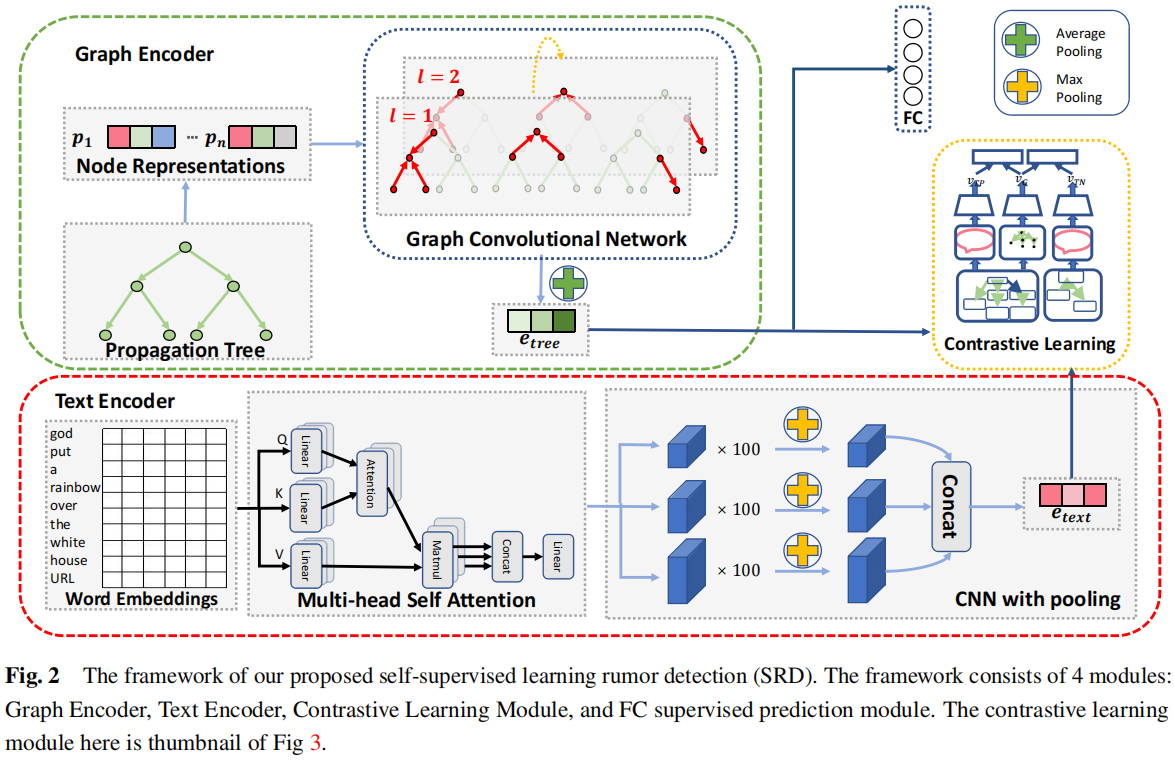
模块:
(1) propagation representation learning, which applies a GNN model on the propagation tree;
(2) semantic representation learning, which employs a text CNN model on the post contents;
(3) contrastive learning, which models the co-occurring relations among propagation and semantic representations;
(4) rumor prediction, which builds a predictor model upon the event representations.
2.1 Propagation Representation Learning
考虑结构特征
对于帖子特征编码:
$\mathbf{H}^{(l)}=\sigma\left(\mathbf{D}^{-\frac{1}{2}} \hat{\mathbf{A}} \mathbf{D}^{-\frac{1}{2}} \mathbf{H}^{(l-1)} \mathbf{W}^{(l)}\right)\quad\quad\quad(2)$
帖子图级表示:
$\mathbf{g}=f_{\text {mean-pooling }}\left(\mathbf{H}^{(L)}\right)\quad\quad\quad(3)$
2.2 Semantic Representation Learning
首先:在帖子特征上使用多头注意力机制得到初始词嵌入 $\mathbf{Z} \in \mathbb{R}^{l \times d_{\text {model }}}$ ($l$ 代表着帖子数,$d_{\text {model }}$ 代表帖子的维度):
$\boldsymbol{Z}_{i}=f_{\text {attention }}\left(\boldsymbol{Q}_{i}, \boldsymbol{K}_{i}, \boldsymbol{V}_{i}\right)=f_{\text {softmax }}\left(\frac{\boldsymbol{Q}_{i} \boldsymbol{K}_{i}^{T}}{\sqrt{d_{k}}}\right) \boldsymbol{V}_{i}\quad\quad\quad(4)$
$\boldsymbol{Z}=f_{\text {multi-head }}(\boldsymbol{Q}, \boldsymbol{K}, \boldsymbol{V})=f_{\text {concatenate }}\left(\boldsymbol{Z}_{1}, \ldots, \boldsymbol{Z}_{h}\right) \boldsymbol{W}^{O}\quad\quad\quad(5)$
接着:使用 CNN 进一步提取文本信息
考虑感受野大小为 $h$ ,得到 feature vector $\boldsymbol{v}_{i}$
$\boldsymbol{v}_{i}=\sigma\left(\boldsymbol{w} \cdot \boldsymbol{z}_{i: i+h-1}+\boldsymbol{b}\right)\quad\quad\quad(6)$
在 sentence 中遍历,得到词向量集合:
$\boldsymbol{v}=\left[\boldsymbol{v}_{1}, \boldsymbol{v}_{2}, \ldots, \boldsymbol{v}_{n-h+1}\right]$
在词向量集合 $\boldsymbol{v}$ 采用 max-pooling 得到全局表示 $\hat{\boldsymbol{v}}\quad\quad\quad(7)$:
$\hat{\boldsymbol{v}}=f_{\text {max-pooling }}(\boldsymbol{v})\quad\quad\quad(8)$
考虑使用 $n$ 个 feature map ,并拼接表示得到文本表示 $\mathbf{t}$:
$\mathbf{t}=f_{\text {concatenate }}\left(\hat{\boldsymbol{v}}_{1}, \hat{\boldsymbol{v}}_{2}, \ldots, \hat{\boldsymbol{v}}_{n}\right)\quad\quad\quad(4)$
2.3 Contrastive Learning
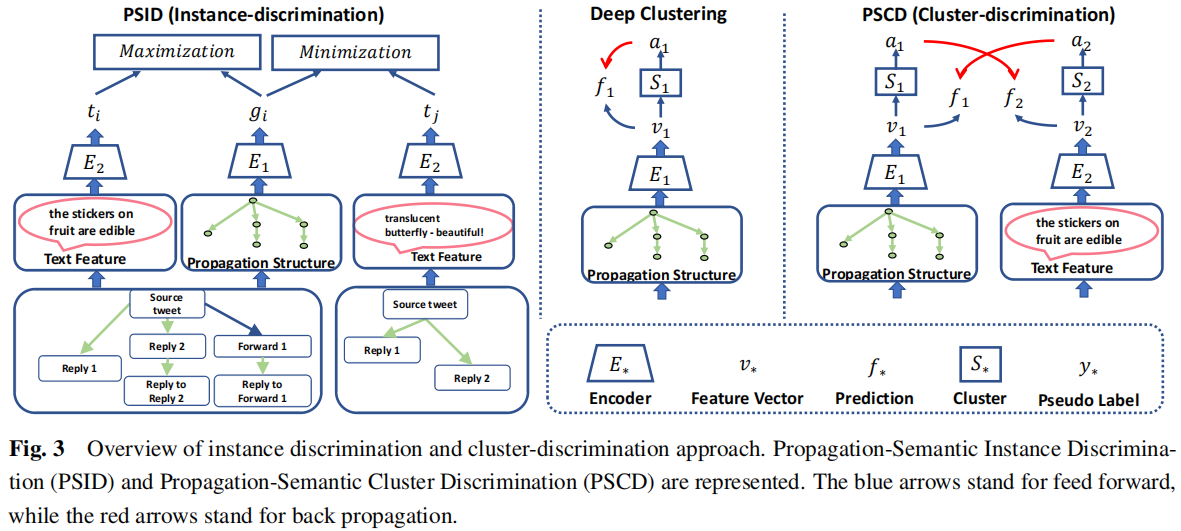
本文认为同一帖子的基于结构的表示 $\boldsymbol{g}_{i}$ 和基于语义 $\boldsymbol{t}_{i}$ 的表示是正对:
2.3.1 Propagation-Semantic Instance Discrimination (PSID)
${\large \mathcal{L}_{\mathrm{ssl}}=\sum\limits_{i \in C}-\log \left[\frac{\exp \left(s\left(\boldsymbol{g}_{i}, \boldsymbol{t}_{i}\right) / \tau\right)}{\sum\limits _{j \in C} \exp \left(s\left(\boldsymbol{g}_{i}, \boldsymbol{t}_{j}\right) / \tau\right)}\right]} \quad\quad\quad(10)$
2.3.2 Propagation-Semantic Cluster Discrimination (PSCD)
聚类级对比学习:
$\begin{array}{l}\underset{\mathbf{S}_{G}}{\text{min}}\quad \sum\limits _{c \in C} \underset{\mathbf{a}_{1}}{\text{min}} \left\|E_{1}(\mathbf{g})-\mathbf{S}_{G} \mathbf{a}_{1}\right\|_{2}^{2}+\underset{\mathbf{S}_{T}}{\text{min}} \sum\limits _{c \in C} \underset{\mathbf{a}_{2}}{\text{min}} \left\|E_{2}(\mathbf{t})-\mathbf{S}_{T} \mathbf{a}_{2}\right\|_{2}^{2}\\\text { s.t. } \quad \mathbf{a}_{1}^{\top} \mathbf{1}=1, \quad \mathbf{a}_{2}^{\top} \mathbf{1}=1\end{array}\quad\quad\quad(11)$
- $\mathbf{S}_{G}\in \mathbb{R}^{d \times K}$ 和 $\mathbf{S}_{T} \in \mathbb{R}^{d \times K}$ 分别代表了 基于结构信息和基于语义信息的可训练质心矩阵;
- $\mathbf{a}_{1}\in\{0,1\}^{K}$ 和 $\mathbf{a}_{2} \in\{0,1\}^{K}$ 代表了聚类分配;
- $E_{1}$ 和 $E_{2}$ 代表了编码器;
$\mathcal{L}_{\mathrm{ssl}}=\sum\limits _{c \in C} l\left(f_{1}\left(E_{1}(\mathbf{g})\right), \mathbf{a}_{2}\right)+l\left(f_{2}\left(E_{2}(\mathbf{t})\right), \mathbf{a}_{1}\right) \quad\quad\quad(12)$
其中,$l(\cdot)$ 是 negative log-softmax function $l(\cdot) = -\operatorname{LogSoftmax}\left(x_{i}\right)=\log \left(\frac{\exp \left(x_{i}\right)}{\sum\limits _{j} \exp \left(x_{j}\right)}\right)$,$f_{1}(\cdot)$ 、$f_{2}(\cdot)$是一个可训练的分类器。
PSCD 和 PSID 的处理过程如 Figure 3 :
2.4 Rumor Prediction
$p(c)=\sigma(\mathbf{W} \mathbf{g}+\mathbf{b})\quad\quad\quad(13)$
3 Experiments and Analyses
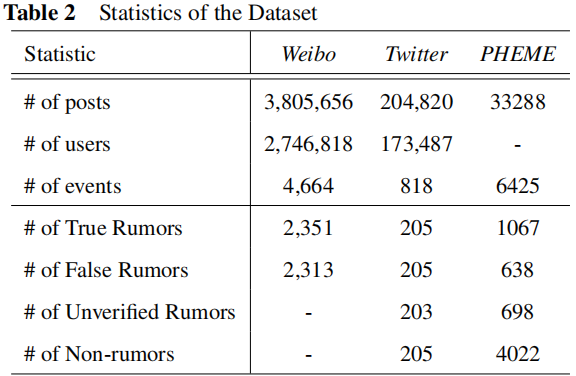
3.1 Dataset
3.2 Result
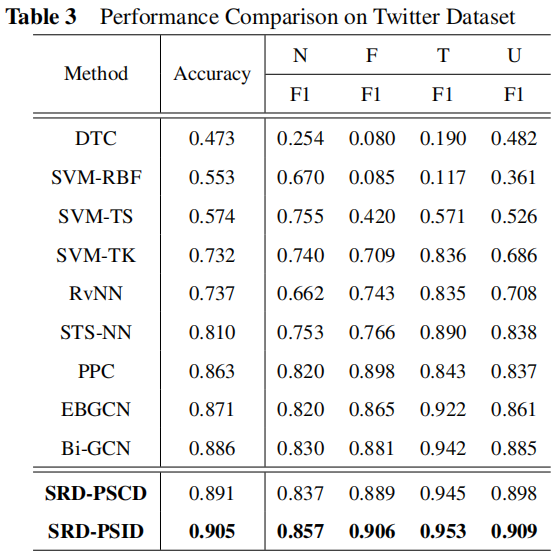
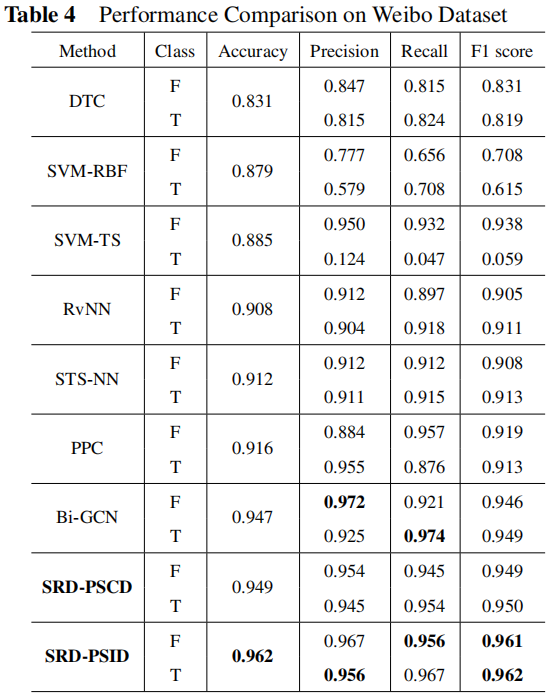
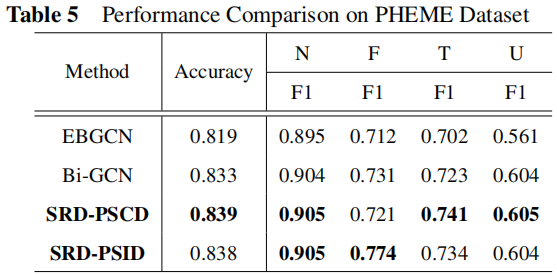
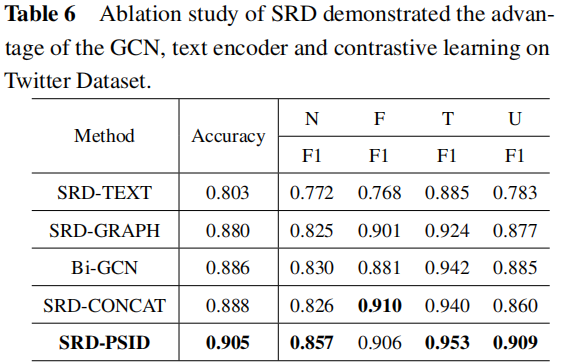
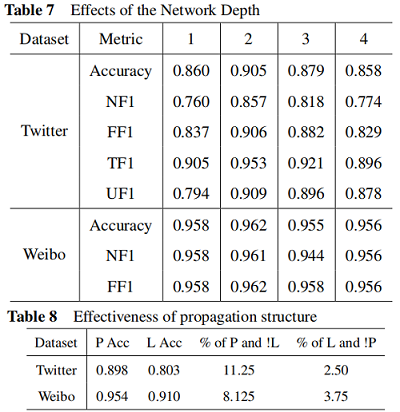
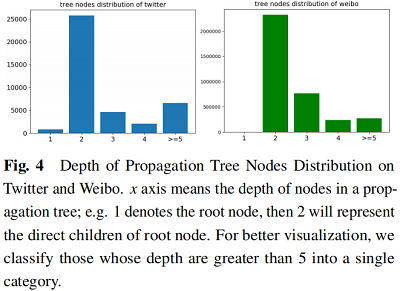
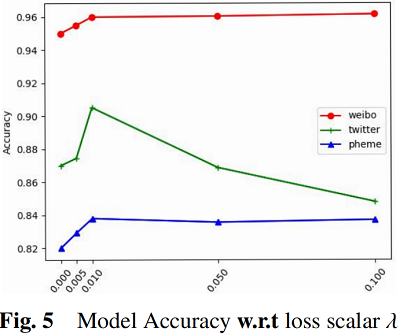
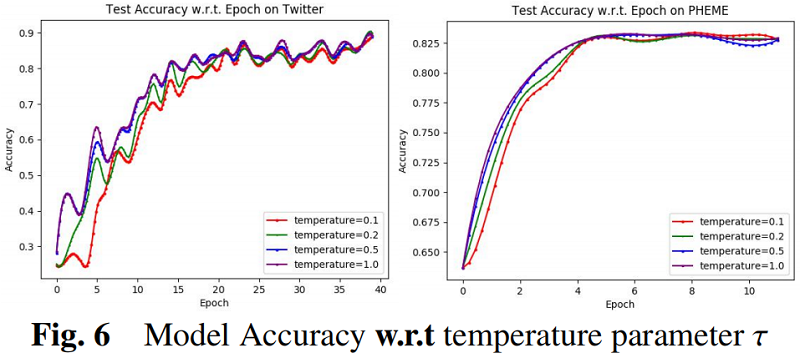
3.3 Ablation Analysis
谣言检测()《Rumor Detection with Self-supervised Learning on Texts and Social Graph》的更多相关文章
- 谣言检测——《MFAN: Multi-modal Feature-enhanced Attention Networks for Rumor Detection》
论文信息 论文标题:MFAN: Multi-modal Feature-enhanced Attention Networks for Rumor Detection论文作者:Jiaqi Zheng, ...
- 论文解读(FedGAT)《Federated Graph Attention Network for Rumor Detection》
论文信息 论文标题:Federated Graph Attention Network for Rumor Detection论文作者:Huidong Wang, Chuanzheng Bai, Ji ...
- 谣言检测(ClaHi-GAT)《Rumor Detection on Twitter with Claim-Guided Hierarchical Graph Attention Networks》
论文信息 论文标题:Rumor Detection on Twitter with Claim-Guided Hierarchical Graph Attention Networks论文作者:Erx ...
- 谣言检测(PSIN)——《Divide-and-Conquer: Post-User Interaction Network for Fake News Detection on Social Media》
论文信息 论文标题:Divide-and-Conquer: Post-User Interaction Network for Fake News Detection on Social Media论 ...
- 谣言检测()——《Debunking Rumors on Twitter with Tree Transformer》
论文信息 论文标题:Debunking Rumors on Twitter with Tree Transformer论文作者:Jing Ma.Wei Gao论文来源:2020,COLING论文地址: ...
- 谣言检测(PLAN)——《Interpretable Rumor Detection in Microblogs by Attending to User Interactions》
论文信息 论文标题:Interpretable Rumor Detection in Microblogs by Attending to User Interactions论文作者:Ling Min ...
- 谣言检测(RDEA)《Rumor Detection on Social Media with Event Augmentations》
论文信息 论文标题:Rumor Detection on Social Media with Event Augmentations论文作者:Zhenyu He, Ce Li, Fan Zhou, Y ...
- 目标检测系列 --- RCNN: Rich feature hierarchies for accurate object detection and semantic segmentation Tech report
目标检测系列 --- RCNN: Rich feature hierarchies for accurate object detection and semantic segmentation Te ...
- 谣言检测——(PSA)《Probing Spurious Correlations in Popular Event-Based Rumor Detection Benchmarks》
论文信息 论文标题:Probing Spurious Correlations in Popular Event-Based Rumor Detection Benchmarks论文作者:Jiayin ...
随机推荐
- 若依3.6.0使用Mybatis-plus分页失效以及完美替换Pagehelper
一.前言 小编最近在经历后端框架的迁移,虽然不是小编来做,但是有个分页的情况让小编和一个同事去搞. 说一下小编这边的需求: 原来框架使用Mybatis-plus进行分页,要更换的新框架若依是使用Pag ...
- 解决:Uncaught TypeError: $ is not a function
本来好好的,突然就出现的错误,不过这并不是什么难解决的错误: 我的问题是:在js文件里我定义了一个var $;变量,只要把这个去掉就没问题了. 出现这种错误的解决方法: 1,先看看你的jq文件是否已经 ...
- java基础———break,continue
break通常用在循环语句之中用来跳出循环: continue终止某次循环过程,跳过尚未执行的语句:接着执行下次是否执行循环的判定:
- 修改窗体的Title
直接上代码 /// <summary> /// 获取窗体的名称 /// </summary> /// <param name="hWnd">&l ...
- Python之创建数据库及功能示例样本
创建数据库实例 import pymysql db= pymysql.connect(host="localhost",user="root",password ...
- git reset总结
git reset git 的重置操作 有三种模式:hard.mixed(默认).soft 1. hard 用法 hard会重置stage区和工作区,和移动代码库上HEAD 和branch的指针所指向 ...
- Mysql 实现 向上递归查找父节点并返回树结构
需求:通过mysql 8.0以下版本实现,一个人多角色id,一个角色对应某个节点menu_id,根节点的父节点存储为NULL, 向上递归查找父节点并返回树结构. 如果只有叶子,剔除掉; 如果只有根,只 ...
- Java八股文纯享版——篇②:并发编程
注: 1.笔记为个人归纳整理,尽力保证准确性,如有错误,恳请指正 2.写文不易,转载请注明出处 3.本文首发地址 https://blog.leapmie.com/archives/c02a6ed1/ ...
- 华南理工大学 Python第5章课后小测-2
1.(单选)下面语句的输出结果是: ls = [] def func(a, b): ls.append(b) return a*b s = func("hi", 2) print( ...
- RedHat Linux升级内核
操作系统:Red Hat 6.4 内核文件:linux-3.10.1.tar.gz https://www.cnblogs.com/cherish-sweet/p/newyum.html uname ...