
Java规则引擎 Easy Rules
1. Easy Rules 概述
Easy Rules是一个Java规则引擎,灵感来自一篇名为《Should I use a Rules Engine?》的文章
规则引擎就是提供一种可选的计算模型。与通常的命令式模型(由带有条件和循环的命令依次组成)不同,规则引擎基于生产规则系统。这是一组生产规则,每条规则都有一个条件(condition)和一个动作(action)———— 简单地说,可以将其看作是一组if-then语句。
精妙之处在于规则可以按任何顺序编写,引擎会决定何时使用对顺序有意义的任何方式来计算它们。考虑它的一个好方法是系统运行所有规则,选择条件成立的规则,然后执行相应的操作。这样做的好处是,很多问题都很自然地符合这个模型:
if car.owner.hasCellPhone then premium += 100;

if car.model.theftRating > 4 then premium += 200;

if car.owner.livesInDodgyArea && car.model.theftRating > 2 then premium += 300;
规则引擎是一种工具,它使得这种计算模型编程变得更容易。它可能是一个完整的开发环境,或者一个可以在传统平台上工作的框架。生产规则计算模型最适合仅解决一部分计算问题,因此规则引擎可以更好地嵌入到较大的系统中。
你可以自己构建一个简单的规则引擎。你所需要做的就是创建一组带有条件和动作的对象,将它们存储在一个集合中,然后遍历它们以评估条件并执行这些动作。
Easy Rules它提供Rule抽象以创建具有条件和动作的规则,并提供RuleEngine API,该API通过一组规则运行以评估条件并执行动作。
Easy Rules简单易用,只需两步:
首先,定义规则,方式有很多种
方式一:注解
@Rule(name = "weather rule", description = "if it rains then take an umbrella")

public class WeatherRule {

    @Condition

    public boolean itRains(@Fact("rain") boolean rain) {

        return rain;

    }

    @Action

    public void takeAnUmbrella() {

        System.out.println("It rains, take an umbrella!");

    }

}
方式二:链式编程
Rule weatherRule = new RuleBuilder()

        .name("weather rule")

        .description("if it rains then take an umbrella")

        .when(facts -> facts.get("rain").equals(true))

        .then(facts -> System.out.println("It rains, take an umbrella!"))

        .build();
方式三:表达式
Rule weatherRule = new MVELRule()

        .name("weather rule")

        .description("if it rains then take an umbrella")

        .when("rain == true")

        .then("System.out.println(\"It rains, take an umbrella!\");");
方式四:yml配置文件
例如:weather-rule.yml
name: "weather rule"

description: "if it rains then take an umbrella"

condition: "rain == true"

actions:

  - "System.out.println(\"It rains, take an umbrella!\");"
MVELRuleFactory ruleFactory = new MVELRuleFactory(new YamlRuleDefinitionReader());

Rule weatherRule = ruleFactory.createRule(new FileReader("weather-rule.yml"));
接下来,应用规则
public class Test {

    public static void main(String[] args) {

        // define facts

        Facts facts = new Facts();

        facts.put("rain", true);

        // define rules

        Rule weatherRule = ...

        Rules rules = new Rules();

        rules.register(weatherRule);

        // fire rules on known facts

        RulesEngine rulesEngine = new DefaultRulesEngine();

        rulesEngine.fire(rules, facts);

    }

}
入门案例:Hello Easy Rules
<dependency>

    <groupId>org.jeasy</groupId>

    <artifactId>easy-rules-core</artifactId>

    <version>4.0.0</version>

</dependency>
通过骨架创建maven项目:
mvn archetype:generate \

    -DarchetypeGroupId=org.jeasy \

    -DarchetypeArtifactId=easy-rules-archetype \

    -DarchetypeVersion=4.0.
默认给我们生成了一个HelloWorldRule规则,如下:
package com.cjs.example.rules;

import org.jeasy.rules.annotation.Action;

import org.jeasy.rules.annotation.Condition;

import org.jeasy.rules.annotation.Rule;

@Rule(name = "Hello World rule", description = "Always say hello world")

public class HelloWorldRule {

    @Condition

    public boolean when() {

        return true;

    }

    @Action

    public void then() throws Exception {

        System.out.println("hello world");

    }

}

2. 规则定义
2.1. 定义规则
大多数业务规则可以用以下定义表示:
- Name : 一个命名空间下的唯一的规则名称
- Description : 规则的简要描述
- Priority : 相对于其他规则的优先级
- Facts : 事实,可立即为要处理的数据
- Conditions : 为了应用规则而必须满足的一组条件
- Actions : 当条件满足时执行的一组动作
Easy Rules为每个关键点提供了一个抽象来定义业务规则。
在Easy Rules中,Rule接口代表规则
public interface Rule {

    /**

    * This method encapsulates the rule's conditions.

    * @return true if the rule should be applied given the provided facts, false otherwise

    */

    boolean evaluate(Facts facts);

    /**

    * This method encapsulates the rule's actions.

    * @throws Exception if an error occurs during actions performing

    */

    void execute(Facts facts) throws Exception;

    //Getters and setters for rule name, description and priority omitted.

}
evaluate方法封装了必须计算结果为TRUE才能触发规则的条件。execute方法封装了在满足规则条件时应该执行的动作。条件和操作由Condition和Action接口表示。
定义规则有两种方式:
- 通过在POJO类上添加注解
- 通过RuleBuilder API编程
可以在一个POJO类上添加@Rule注解,例如:
@Rule(name = "my rule", description = "my rule description", priority = 1)

public class MyRule {

    @Condition

    public boolean when(@Fact("fact") fact) {

        //my rule conditions

        return true;

    }

    @Action(order = 1)

    public void then(Facts facts) throws Exception {

        //my actions

    }

    @Action(order = 2)

    public void finally() throws Exception {

        //my final actions

    }

}
@Condition注解指定规则条件
@Fact注解指定参数
@Action注解指定规则执行的动作
RuleBuilder支持链式风格定义规则,例如:
Rule rule = new RuleBuilder()

                .name("myRule")

                .description("myRuleDescription")

                .priority(3)

                .when(condition)

                .then(action1)

                .then(action2)

                .build();
组合规则
CompositeRule由一组规则组成。这是一个典型地组合设计模式的实现。
组合规则是一个抽象概念,因为可以以不同方式触发组合规则。
Easy Rules自带三种CompositeRule实现:
- UnitRuleGroup : 要么应用所有规则,要么不应用任何规则(AND逻辑)
- ActivationRuleGroup : 它触发第一个适用规则,并忽略组中的其他规则(XOR逻辑)
- ConditionalRuleGroup : 如果具有最高优先级的规则计算结果为true,则触发其余规则
复合规则可以从基本规则创建并注册为常规规则:
//Create a composite rule from two primitive rules

UnitRuleGroup myUnitRuleGroup = new UnitRuleGroup("myUnitRuleGroup", "unit of myRule1 and myRule2");

myUnitRuleGroup.addRule(myRule1);

myUnitRuleGroup.addRule(myRule2);

//Register the composite rule as a regular rule

Rules rules = new Rules();

rules.register(myUnitRuleGroup);

RulesEngine rulesEngine = new DefaultRulesEngine();

rulesEngine.fire(rules, someFacts);
每个规则都有优先级。它代表触发注册规则的默认顺序。默认情况下,较低的值表示较高的优先级。可以重写compareTo方法以提供自定义优先级策略。
2.2. 定义事实
在Easy Rules中,Fact API代表事实
public class Fact<T> {

     private final String name;

     private final T value;

}

举个栗子:
Fact<String> fact = new Fact("foo", "bar");

Facts facts = new Facts();

facts.add(fact);
或者,也可以用这样简写形式
Facts facts = new Facts();

facts.put("foo", "bar");
用@Fact注解可以将Facts注入到condition和action方法中
@Rule

class WeatherRule {

    @Condition

    public boolean itRains(@Fact("rain") boolean rain) {

        return rain;

    }

    @Action

    public void takeAnUmbrella(Facts facts) {

        System.out.println("It rains, take an umbrella!");

        // can add/remove/modify facts

    }

}
2.3. 定义规则引擎
Easy Rules提供两种RulesEngine接口实现:
- DefaultRulesEngine : 根据规则的自然顺序应用规则
- InferenceRulesEngine : 持续对已知事实应用规则,直到不再适用任何规则为止
创建规则引擎:
RulesEngine rulesEngine = new DefaultRulesEngine();

// or

RulesEngine rulesEngine = new InferenceRulesEngine();
然后,注册规则
rulesEngine.fire(rules, facts);
规则引擎有一些可配置的参数,如下图所示:
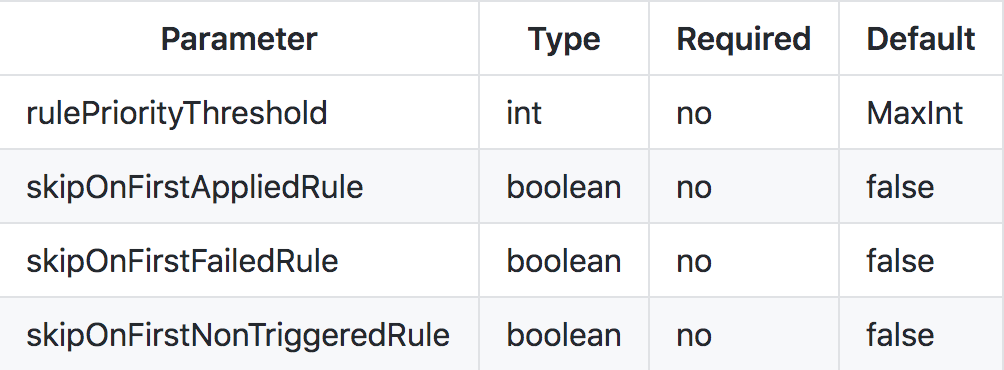
举个栗子:
RulesEngineParameters parameters = new RulesEngineParameters()

    .rulePriorityThreshold(10)

    .skipOnFirstAppliedRule(true)

    .skipOnFirstFailedRule(true)

    .skipOnFirstNonTriggeredRule(true);

RulesEngine rulesEngine = new DefaultRulesEngine(parameters);
2.4. 定义规则监听器
通过实现RuleListener接口
public interface RuleListener {

    /**

     * Triggered before the evaluation of a rule.

     *

     * @param rule being evaluated

     * @param facts known before evaluating the rule

     * @return true if the rule should be evaluated, false otherwise

     */

    default boolean beforeEvaluate(Rule rule, Facts facts) {

        return true;

    }

    /**

     * Triggered after the evaluation of a rule.

     *

     * @param rule that has been evaluated

     * @param facts known after evaluating the rule

     * @param evaluationResult true if the rule evaluated to true, false otherwise

     */

    default void afterEvaluate(Rule rule, Facts facts, boolean evaluationResult) { }

    /**

     * Triggered on condition evaluation error due to any runtime exception.

     *

     * @param rule that has been evaluated

     * @param facts known while evaluating the rule

     * @param exception that happened while attempting to evaluate the condition.

     */

    default void onEvaluationError(Rule rule, Facts facts, Exception exception) { }

    /**

     * Triggered before the execution of a rule.

     *

     * @param rule the current rule

     * @param facts known facts before executing the rule

     */

    default void beforeExecute(Rule rule, Facts facts) { }

    /**

     * Triggered after a rule has been executed successfully.

     *

     * @param rule the current rule

     * @param facts known facts after executing the rule

     */

    default void onSuccess(Rule rule, Facts facts) { }

    /**

     * Triggered after a rule has failed.

     *

     * @param rule the current rule

     * @param facts known facts after executing the rule

     * @param exception the exception thrown when attempting to execute the rule

     */

    default void onFailure(Rule rule, Facts facts, Exception exception) { }

}
3. 示例
<project xmlns="http://maven.apache.org/POM/4.0.0" xmlns:xsi="http://www.w3.org/2001/XMLSchema-instance"

  xsi:schemaLocation="http://maven.apache.org/POM/4.0.0 http://maven.apache.org/maven-v4_0_0.xsd">

    <modelVersion>4.0.0</modelVersion>

    <groupId>com.cjs.example</groupId>

    <artifactId>easy-rules-quickstart</artifactId>

    <version>1.0.0-SNAPSHOT</version>

    <packaging>jar</packaging>

    <dependencies>

        <dependency>

            <groupId>org.jeasy</groupId>

            <artifactId>easy-rules-core</artifactId>

            <version>4.0.0</version>

        </dependency>

        <dependency>

            <groupId>org.jeasy</groupId>

            <artifactId>easy-rules-support</artifactId>

            <version>4.0.0</version>

        </dependency>

        <dependency>

            <groupId>org.jeasy</groupId>

            <artifactId>easy-rules-mvel</artifactId>

            <version>4.0.0</version>

        </dependency>

        <dependency>

            <groupId>org.slf4j</groupId>

            <artifactId>slf4j-simple</artifactId>

            <version>1.7.30</version>

        </dependency>

    </dependencies>

</project>

4. 扩展
规则本质上是一个函数,如y=f(x1,x2,..,xn)
规则引擎就是为了解决业务代码和业务规则分离的引擎,是一种嵌入在应用程序中的组件,实现了将业务决策从应用程序代码中分离。
还有一种常见的方式是Java+Groovy来实现,Java内嵌Groovy脚本引擎进行业务规则剥离。
https://github.com/j-easy/easy-rules/wiki
Java规则引擎 Easy Rules的更多相关文章
- JAVA规则引擎JSR-94笔札
JAVA规则引擎JSR-94笔札 JSR-94 是由JCP(Java Community Process)组织所制定的java规则引擎API的java请求规范.它主要定义了规则引擎在java运行时的一 ...
- Java规则引擎及JSR-94[转]
规则引擎简介 Java规则引擎是推理引擎的一种,它起源于基于规则的专家系统. Java规则引擎将业务决策从应用程序代码中分离出来,并使用预定义的语义模块编写业务决策.Java规则引擎接 ...
- [Drools]JAVA规则引擎 -- Drools- 转http://blog.csdn.net/quzishen/article/details/6163012
[Drools]JAVA规则引擎 -- Drools 标签: java引擎exceptiongetterstringsetter 2011-01-25 14:33 113340人阅读 评论(35) 收 ...
- 【java规则引擎】之规则引擎解释
转载:http://www.open-open.com/lib/view/open1417528754230.html 现实生活中,规则无处不在.法律.法规和各种制度均是:对于企业级应用来说,在IT技 ...
- JAVA规则引擎 -- Drools
Drools是一个基于java的规则引擎,开源的,可以将复杂多变的规则从硬编码中解放出来,以规则脚本的形式存放在文件中,使得规则的变更不需要修正代码重启机器就可以立即在线上环境生效. 本文所使用的de ...
- [Drools]JAVA规则引擎 -- Drools 2
上一篇文章 http://blog.csdn.net/quzishen/archive/2011/01/25/6163012.aspx 描述了一些常用的drools的语法标签和一个模拟实例即发送积分的 ...
- [Drools]JAVA规则引擎 -- Drools
Drools是一个基于Java的规则引擎,开源的,可以将复杂多变的规则从硬编码中解放出来,以规则脚本的形式存放在文件中,使得规则的变更不需要修正代码重启机器就可以立即在线上环境生效. 本文所使用的de ...
- java 规则引擎资料汇集
1. ibm的developworks中较早的一篇关于规则引擎的文章 https://www.ibm.com/developerworks/cn/java/j-java-rules/ 2. 一篇硕士论 ...
- 【java规则引擎】drools6.5.0版本中kmodule.xml解析
kmodule.xml文件存放在src/main/resources/META-INF/文件夹下. <?xml version="1.0" encoding="UT ...
随机推荐
- 3.7 Go指针
1. Go指针 每个变量在运行时都拥有一个地址,这个地址代表变量在内存中的位置. Go 语言中使用&作符放在变量前面对变量进行“取地址”操作. 1.指针默认值nil 2.通过&(取地值 ...
- 01 基础版web框架
01 基础版web框架 服务器server端python程序(基础版): import socket server=socket.socket() server.bind(("127.0.0 ...
- 解决el-tree横向滚动条问题
代码如下 效果如图 仅做下记录,不做过多解释
- 最小比率树 poj2728
以下内容均为转载 http://www.cnblogs.com/ftae/p/6947497.html poj2728(最小比率生成树) poj2728 题意 给出 n 个点的坐标和它的高度,求一 ...
- CF820D Mister B and PR Shifts
题目链接:http://codeforces.com/problemset/problem/820/D 题目大意: 给出一个\(n\)元素数组\(p[]\),定义数组\(p[]\)的误差值为\(\su ...
- Poj1328 用雷达覆盖所有的岛屿
(此配图来自http://blog.csdn.net/zhengnanlee/article/details/9613161) 图中ABCD为海岛的位置.题目中会给出几个海岛的坐标位置,雷达覆盖半径d ...
- 6.Set集合类型操作使用
Set集合类型 (1)介绍 redis的set是string类型的无序集合set元素最大可以包含(2的32次方-1)个元素关于set集合类型除了基本的添加删除操作,其它有用的操作还包含集合的取并集(u ...
- [JavaWeb基础] 032.第三方插件pinyin4j的使用
突然发现了一个比较新奇的插件,就是可以把我们输入的汉字,输出它所有的拼音的jar包.下面以代码的形式简单的介绍下这个插件 package com.babybus.sdteam.pinyin4j; im ...
- MANIFEST.MF是个什么?
MANIFEST.MF是个什么? 写这篇文件主要记录JRA文件里面到底是什么?然后MANIFEST.MF又是什么?Springboot 如何只有Main方法就可以运行的? Springboot项目打包 ...
- parrot os 创建swap分区&swapon failed invalid argument解决
parrot os(不仅仅是debian系统),分区提示,查看系统格式为btrfs,需要注意的是btrfs无法添加swap分区,但是可以在5.0内核以上添加 以下命令,完成创建8g的swap分区 to ...