
Codeforces 844D Interactive LowerBound - 随机化
This is an interactive problem.
You are given a sorted in increasing order singly linked list. You should find the minimum integer in the list which is greater than or equal to x.
More formally, there is a singly liked list built on an array of n elements. Element with index i contains two integers: valuei is the integer value in this element, and nexti that is the index of the next element of the singly linked list (or -1, if the current element is the last). The list is sorted, i.e. if nexti ≠ - 1, then valuenexti > valuei.
You are given the number of elements in the list n, the index of the first element start, and the integer x.
You can make up to 2000 queries of the following two types:
- ? i (1 ≤ i ≤ n) — ask the values valuei and nexti,
- ! ans — give the answer for the problem: the minimum integer, greater than or equal to x, or ! -1, if there are no such integers. Your program should terminate after this query.
Write a program that solves this problem.
The first line contains three integers n, start, x (1 ≤ n ≤ 50000, 1 ≤ start ≤ n, 0 ≤ x ≤ 109) — the number of elements in the list, the index of the first element and the integer x.
To print the answer for the problem, print ! ans, where ans is the minimum integer in the list greater than or equal to x, or -1, if there is no such integer.
To make a query of the first type, print ? i (1 ≤ i ≤ n), where i is the index of element you want to know information about.
After each query of type ? read two integers valuei and nexti (0 ≤ valuei ≤ 109, - 1 ≤ nexti ≤ n, nexti ≠ 0).
It is guaranteed that if nexti ≠ - 1, then valuenexti > valuei, and that the array values give a valid singly linked list with start being the first element.
Note that you can't ask more than 1999 queries of the type ?.
If nexti = - 1 and valuei = - 1, then it means that you asked more queries than allowed, or asked an invalid query. Your program should immediately terminate (for example, by calling exit(0)). You will receive "Wrong Answer", it means that you asked more queries than allowed, or asked an invalid query. If you ignore this, you can get other verdicts since your program will continue to read from a closed stream.
Your solution will get "Idleness Limit Exceeded", if you don't print anything or forget to flush the output, including the final answer.
To flush you can use (just after printing a query and line end):
- fflush(stdout) in C++;
- System.out.flush() in Java;
- stdout.flush() in Python;
- flush(output) in Pascal;
- For other languages see documentation.
Hacks format
For hacks, use the following format:
In the first line print three integers n, start, x (1 ≤ n ≤ 50000, 1 ≤ start ≤ n, 0 ≤ x ≤ 109).
In the next n lines print the description of the elements of the list: in the i-th line print two integers valuei and nexti (0 ≤ valuei ≤ 109, - 1 ≤ nexti ≤ n, nexti ≠ 0).
The printed structure should be a valid singly linked list. In particular, it should be possible to reach all elements from start by following links nexti, and the last element end should have -1 in the nextend.
5 3 80
97 -1
58 5
16 2
81 1
79 4
? 1
? 2
? 3
? 4
? 5
! 81
You can read more about singly linked list by the following link: https://en.wikipedia.org/wiki/Linked_list#Singly_linked_list
The illustration for the first sample case. Start and finish elements are marked dark.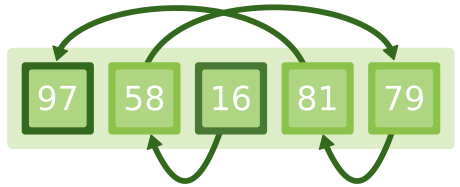
题目大意 给定一个元素按升序排序的单向链表,给定开头的下标,查询大于等于x的最小值。每次可以询问一个位置的值和它的下一个元素的下标。询问不得超过1999次。
这是一道有趣的题目。
1)如果n不超过1999暴力for整个链表。
2)否则随机1000个位置查值,然后找到第一个小于x的位置开始往后for。直到链表结束或者找到一个大于等于x的值。
另外直接srand((unsigned) time (0))会被卡掉,所以但是随机函数就过了。
Code
 /**

  * Codeforces

  * Problem#844D

  * Accepted

  * Time: 30ms

  * Memory: 500k

  */

 #include <bits/stdc++.h>

 using namespace std;

 typedef bool boolean;

 typedef pair<int, int> pii;

 typedef class Random {

     public:

         unsigned int pre;

         unsigned int seed;

         Random():pre(), seed((unsigned) time (NULL)) {    }

         Random(int seed):pre(), seed(seed) {    }

         /**

          * Generate a random number.

          * @return this function will return the random number it gernerated

          */

         unsigned int rand() {

 //            unsigned int ret = (seed * 7361238 + seed % 20037 * 1244 + pre * 12342 + 378211) * (seed + 134543);

 //            unsigned int ret = (seed * 7361238 + seed % 20037 * 1244 + pre * 12342 + 378211 + time(NULL) * pre) * (seed + 134543);

             unsigned int ret;

             if(ret & )

                 ret = (seed *  + seed %  *  + pre *  + (time(NULL) * (pre *  + seed *  + )) + );

             else

                 ret = (seed *  + seed %  *  + pre *  + (time(NULL) * (pre *  + seed *  + )) + );

             pre = seed;

             seed = ret;

             return ret;

         }

         /**

          * Generate a random number that between a variable low and a variable high.

          * @param low the variable low

          * @param high the variable high

          * @return if low is not more than high, it will return the random number or it will return 0

          */

         unsigned int rand(int low, int high){

             if(low > high)  return ;

             int len = high - low + ;

             return rand() % len + low;

         }

 }Random;

 Random r;

 int n, x, start;

 pii *val;

 pii ask(int p) {

     if(val[p].first != -)    return val[p];

     pii rt;

     printf("? %d\n", p);

     fflush(stdout);

     scanf("%d%d", &rt.first, &rt.second);

     return rt;

 }

 inline void init() {

     scanf("%d%d%d", &n, &start, &x);

     val = new pii[(n + )];

     for(int i = ; i <= n; i++)

         val[i].first = -;

 }

 inline void solve1() {

     pii data;

     for(int i = , p = start; i < n; i++) {

         data = ask(p);

         if(data.first >= x) {

             printf("! %d\n", data.first);

             fflush(stdout);

             return;

         }

         p = data.second;

     }

     puts("! -1");

     fflush(stdout);

 }

 const int asktime = ;

 boolean *vis;

 int pos[asktime + ];

 inline void solve2() {

     vis = new boolean[(n + )];

     memset(vis, false, sizeof(boolean) * (n + ));

     vis[start] = true;

     for(int i = ; i <= asktime; i++) {

         while(vis[(pos[i] = r.rand(, n))]);

         vis[pos[i]] = true;

     }

     int s = start;

     pii dat = ask(start);

     for(int i = ; i <= asktime; i++) {

         pii cmp = ask(pos[i]);

         if(cmp.first < x && cmp.first > dat.first)

             s = pos[i], dat = cmp;

     }

     while(s != -) {

         if(dat.first >= x) {

             printf("! %d\n", dat.first);

             fflush(stdout);

             return;

         }

         s = dat.second;

         dat = ask(s);

     }

     puts("! -1");

     fflush(stdout);

 }

 int main() {

     init();

     if(n <= )

         solve1();

     else

         solve2();

     return ;

 }
Codeforces 844D Interactive LowerBound - 随机化的更多相关文章
- cf 843 B Interactive LowerBound [随机化]
题面: 传送门 思路: 这是一道交互题 比赛的时候我看到了直接跳过了...... 后来后面的题目卡住了就回来看这道题,发现其实比较水 实际上,从整个序列里面随机选1000个数出来询问,然后从里面找出比 ...
- 【AIM Tech Round 4 (Div. 1) B】Interactive LowerBound
[链接]http://codeforces.com/contest/843/problem/B [题意] 给你一个数组模拟的单链表,放在一个长度为n的数组里面,然后告诉你表头的位置在哪里; 你可以最多 ...
- Codeforces 306D - Polygon(随机化+乱搞)
Codeforces 题目传送门 & 洛谷题目传送门 中考终于结束了--简单写道题恢复下状态罢. 首先这一类题目肯定没法用一般的方法解决,因此考虑用一些奇淫的乱搞做法解决这道题,不难发现,如果 ...
- CodeForces 753C Interactive Bulls and Cows (Hard)
题意:... 析:随机判断就即可,每次把不正确的删除,经过几次后就基本剩不下了. 代码如下: #pragma comment(linker, "/STACK:1024000000,10240 ...
- AIM Tech Round 4 (Div. 2)ABCD
A. Diversity time limit per test 1 second memory limit per test 256 megabytes input standard input o ...
- 【AIM Tech Round 4 (Div. 2) D Prob】
·题目:D. Interactive LowerBound ·英文题,述大意: 有一个长度为n(n<=50000)的单链表,里面的元素是递增的.链表存储在一个数组里面,给出长度n.表 ...
- Codeforces Round #192 (Div. 1) C. Graph Reconstruction 随机化
C. Graph Reconstruction Time Limit: 20 Sec Memory Limit: 256 MB 题目连接 http://codeforces.com/contest/3 ...
- Codeforces Round #439 (Div. 2) Problem E (Codeforces 869E) - 暴力 - 随机化 - 二维树状数组 - 差分
Adieu l'ami. Koyomi is helping Oshino, an acquaintance of his, to take care of an open space around ...
- Codeforces Round #358 (Div. 2) E. Alyona and Triangles 随机化
E. Alyona and Triangles 题目连接: http://codeforces.com/contest/682/problem/E Description You are given ...
随机推荐
- python知识补足
1.class的init功能,初始化class,给出一些初始值 __init__可以理解成初始化class的变量,取自英文中initial 最初的意思.可以在运行时,给初始值附值, class Cal ...
- Hibernate基础增删改查语法
1.创建好Hibernate项目,创建好实体类和测试类,如果不会创建Hibernate项目的同学,点此处:http://www.cnblogs.com/zhaojinyan/p/9336174.htm ...
- git add -A -u . 的区别
git add -u:将文件的修改.文件的删除,添加到暂存区. git add .:将文件的修改,文件的新建,添加到暂存区. git add -A:将文件的修改,文件的删除,文件的新建,添加到暂存区.
- PHP面向对象构造和析构函数
一.构造函数 用来生成对象的函数 <?php class Ren{ public $name; public $sex;//性别是人一出生就知道的,可以用构造函数来定义 /*public fun ...
- 《大话设计模式》c++实现 装饰者模式
一.UML图 介绍 装饰器模式(Decorator Pattern)允许向一个现有的对象添加新的功能,同时又不改变其结构.这种类型的设计模式属于结构型模式,它是作为现有的类的一个包装. 这种模式创 ...
- 基于TCP/IP协议的socket通讯server
思路: socket必须要随项目启动时启动,所以需用Spring自带的监听器,需要保持长连接,要用死循环,所以必须另外起线程,不能阻碍主线程运行 1.在项目的web.xml中配置listener &l ...
- [openjudge-搜索]Lake Counting(翻译及实现)
题目原文 描述 Due to recent rains, water has pooled in various places in Farmer John's field, which is rep ...
- STL容器之map
[1]map容器 map 是关联容器.容器中的每一个元素都是由一个键值和一个数据值组成的. set 是一个集合它以其元素作为键值(同一个键值只能出现一次),且默认以升序排列. list 是一个顺序容器 ...
- redis常见应用场景
redis应用场景总结redis平时我们用到的地方蛮多的,下面就了解的应用场景做个总结: 1.热点数据的缓存 由于redis访问速度块.支持的数据类型比较丰富,所以redis很适合用来存储热点数据,另 ...
- python将一个列表的元素随机打乱
java可以用Collections.shuffle(List)来实现,python怎么实现呢? python要利用random模块的shuffle方法 代码如下: import random x = ...