
C# SM2
Cipher
using Org.BouncyCastle.Crypto;

using Org.BouncyCastle.Crypto.Digests;

using Org.BouncyCastle.Crypto.Parameters;

using Org.BouncyCastle.Math;

using Org.BouncyCastle.Math.EC;

namespace SM2Test

{

    /// <summary>

    /// 密码计算

    /// </summary>

    public class Cipher

    {

        private int ct = 1;

        /// <summary>

        /// 椭圆曲线E上点P2

        /// </summary>

        private ECPoint p2;

        private SM3Digest sm3keybase;

        private SM3Digest sm3c3;

        private readonly byte[] key = new byte[32];

        private byte keyOff = 0;

        public Cipher()

        {

        }

        private void Reset()

        {

            sm3keybase = new SM3Digest();

            sm3c3 = new SM3Digest();

            byte[] p;

            p = p2.Normalize().XCoord.ToBigInteger().ToByteArray();

            sm3keybase.BlockUpdate(p, 0, p.Length);

            sm3c3.BlockUpdate(p, 0, p.Length);

            p = p2.Normalize().YCoord.ToBigInteger().ToByteArray();

            sm3keybase.BlockUpdate(p, 0, p.Length);

            ct = 1;

            NextKey();

        }

        private void NextKey()

        {

            SM3Digest sm3keycur = new SM3Digest(sm3keybase);

            sm3keycur.Update((byte)(ct >> 24 & 0x00ff));

            sm3keycur.Update((byte)(ct >> 16 & 0x00ff));

            sm3keycur.Update((byte)(ct >> 8 & 0x00ff));

            sm3keycur.Update((byte)(ct & 0x00ff));

            sm3keycur.DoFinal(key, 0);

            keyOff = 0;

            ct++;

        }

        public virtual ECPoint InitEnc(SM2 sm2, ECPoint userKey)

        {

            AsymmetricCipherKeyPair key = sm2.EccKeyPairGenerator.GenerateKeyPair();

            ECPrivateKeyParameters ecpriv = (ECPrivateKeyParameters)key.Private;

            ECPublicKeyParameters ecpub = (ECPublicKeyParameters)key.Public;

            BigInteger k = ecpriv.D;

            ECPoint c1 = ecpub.Q;

            p2 = userKey.Multiply(k);

            Reset();

            return c1;

        }

        public virtual void Encrypt(byte[] data)

        {

            //p2.Normalize();

            sm3c3.BlockUpdate(data, 0, data.Length);

            for (int i = 0; i < data.Length; i++)

            {

                if (keyOff == key.Length)

                    NextKey();

                data[i] ^= key[keyOff++];

            }

        }

        public virtual void InitDec(BigInteger userD, ECPoint c1)

        {

            p2 = c1.Multiply(userD);

            Reset();

        }

        public virtual void Decrypt(byte[] data)

        {

            for (int i = 0; i < data.Length; i++)

            {

                if (keyOff == key.Length)

                    NextKey();

                data[i] ^= key[keyOff++];

            }

            sm3c3.BlockUpdate(data, 0, data.Length);

        }

        public virtual void Dofinal(byte[] c3)

        {

            byte[] p = p2.Normalize().YCoord.ToBigInteger().ToByteArray();

            sm3c3.BlockUpdate(p, 0, p.Length);

            sm3c3.DoFinal(c3, 0);

            Reset();

        }

    }

}
SM2
using Org.BouncyCastle.Crypto.Digests;

using Org.BouncyCastle.Crypto.Generators;

using Org.BouncyCastle.Crypto.Parameters;

using Org.BouncyCastle.Math;

using Org.BouncyCastle.Math.EC;

using Org.BouncyCastle.Security;

using System;

using System.Collections.Generic;

using System.Linq;

using System.Text;

namespace SM2Test

{

    /// <summary>

    /// 加密处理中心

    /// </summary>

    public class SM2

    {

        public static SM2 Instance

        {

            get

            {

                return new SM2();

            }

        }

        public static SM2 InstanceTest

        {

            get

            {

                return new SM2();

            }

        }

        #region 曲线参数

        /// <summary>

        /// 曲线参数

        /// </summary>

        public static readonly string[] CurveParameter = {

            "FFFFFFFEFFFFFFFFFFFFFFFFFFFFFFFFFFFFFFFF00000000FFFFFFFFFFFFFFFF",// p,0

            "FFFFFFFEFFFFFFFFFFFFFFFFFFFFFFFFFFFFFFFF00000000FFFFFFFFFFFFFFFC",// a,1

            "28E9FA9E9D9F5E344D5A9E4BCF6509A7F39789F515AB8F92DDBCBD414D940E93",// b,2

            "FFFFFFFEFFFFFFFFFFFFFFFFFFFFFFFF7203DF6B21C6052B53BBF40939D54123",// n,3

            "32C4AE2C1F1981195F9904466A39C9948FE30BBFF2660BE1715A4589334C74C7",// gx,4

            "BC3736A2F4F6779C59BDCEE36B692153D0A9877CC62A474002DF32E52139F0A0" // gy,5

        };

        /// <summary>

        /// 椭圆曲线参数

        /// </summary>

        public string[] EccParam = CurveParameter;

        /// <summary>

        /// 椭圆曲线参数P

        /// </summary>

        public readonly BigInteger EccP;

        /// <summary>

        /// 椭圆曲线参数A

        /// </summary>

        public readonly BigInteger EccA;

        /// <summary>

        /// 椭圆曲线参数B

        /// </summary>

        public readonly BigInteger EccB;

        /// <summary>

        /// 椭圆曲线参数N

        /// </summary>

        public readonly BigInteger EccN;

        /// <summary>

        /// 椭圆曲线参数Gx

        /// </summary>

        public readonly BigInteger EccGx;

        /// <summary>

        /// 椭圆曲线参数Gy

        /// </summary>

        public readonly BigInteger EccGy;

        #endregion

        /// <summary>

        /// 椭圆曲线

        /// </summary>

        public readonly ECCurve EccCurve;

        /// <summary>

        /// 椭圆曲线的点G

        /// </summary>

        public readonly ECPoint EccPointG;

        /// <summary>

        /// 椭圆曲线 bc规范

        /// </summary>

        public readonly ECDomainParameters EccBcSpec;

        /// <summary>

        /// 椭圆曲线密钥对生成器

        /// </summary>

        public readonly ECKeyPairGenerator EccKeyPairGenerator;

        private SM2()

        {

            EccParam = CurveParameter;

            EccP = new BigInteger(EccParam[0], 16);

            EccA = new BigInteger(EccParam[1], 16);

            EccB = new BigInteger(EccParam[2], 16);

            EccN = new BigInteger(EccParam[3], 16);

            EccGx = new BigInteger(EccParam[4], 16);

            EccGy = new BigInteger(EccParam[5], 16);

            ECFieldElement ecc_gx_fieldelement = new FpFieldElement(EccP, EccGx);

            ECFieldElement ecc_gy_fieldelement = new FpFieldElement(EccP, EccGy);

            EccCurve = new FpCurve(EccP, EccA, EccB);

            EccPointG = new FpPoint(EccCurve, ecc_gx_fieldelement, ecc_gy_fieldelement);

            EccBcSpec = new ECDomainParameters(EccCurve, EccPointG, EccN);

            ECKeyGenerationParameters ecc_ecgenparam;

            ecc_ecgenparam = new ECKeyGenerationParameters(EccBcSpec, new SecureRandom());

            EccKeyPairGenerator = new ECKeyPairGenerator();

            EccKeyPairGenerator.Init(ecc_ecgenparam);

        }

        /// <summary>

        /// 获取杂凑值H

        /// </summary>

        /// <param name="z">Z值</param>

        /// <param name="data">待签名消息</param>

        /// <returns></returns>

        public virtual byte[] Sm2GetH(byte[] z, byte[] data)

        {

            SM3Digest sm3 = new SM3Digest();

            //Z

            sm3.BlockUpdate(z, 0, z.Length);

            //待签名消息

            sm3.BlockUpdate(data, 0, data.Length);

            // H

            byte[] md = new byte[sm3.GetDigestSize()];

            sm3.DoFinal(md, 0);

            return md;

        }

        /// <summary>

        /// 获取Z值

        /// Z=SM3(ENTL∣∣userId∣∣a∣∣b∣∣gx∣∣gy ∣∣x∣∣y)

        /// </summary>

        /// <param name="userId">签名方的用户身份标识</param>

        /// <param name="userKey">签名方公钥</param>

        /// <returns></returns>

        public virtual byte[] Sm2GetZ(byte[] userId, ECPoint userKey)

        {

            SM3Digest sm3 = new SM3Digest();

            byte[] p;

            // ENTL由2个字节标识的ID的比特长度

            int len = userId.Length * 8;

            sm3.Update((byte)(len >> 8 & 0x00ff));

            sm3.Update((byte)(len & 0x00ff));

            // userId用户身份标识ID

            sm3.BlockUpdate(userId, 0, userId.Length);

            // a,b为系统曲线参数;

            p = EccA.ToByteArray();

            sm3.BlockUpdate(p, 0, p.Length);

            p = EccB.ToByteArray();

            sm3.BlockUpdate(p, 0, p.Length);

            //  gx、gy为基点

            p = EccGx.ToByteArray();

            sm3.BlockUpdate(p, 0, p.Length);

            p = EccGy.ToByteArray();

            sm3.BlockUpdate(p, 0, p.Length);

            // x,y用户的公钥的X和Y

            p = userKey.Normalize().XCoord.ToBigInteger().ToByteArray();

            sm3.BlockUpdate(p, 0, p.Length);

            p = userKey.Normalize().YCoord.ToBigInteger().ToByteArray();

            sm3.BlockUpdate(p, 0, p.Length);

            // Z

            byte[] md = new byte[sm3.GetDigestSize()];

            sm3.DoFinal(md, 0);

            return md;

        }

    }

}
SM2Utils
using Org.BouncyCastle.Crypto;

using Org.BouncyCastle.Crypto.Parameters;

using Org.BouncyCastle.Math;

using Org.BouncyCastle.Math.EC;

using Org.BouncyCastle.Utilities.Encoders;

using System;

using System.Collections.Generic;

using System.Linq;

using System.Text;

namespace SM2Test

{

    class SM2Utils

    {

        public static void GenerateKeyPair(out ECPoint publicKey, out BigInteger privateKey)

        {

            SM2 sm2 = SM2.Instance;

            AsymmetricCipherKeyPair key = sm2.EccKeyPairGenerator.GenerateKeyPair();

            ECPrivateKeyParameters ecpriv = (ECPrivateKeyParameters)key.Private;

            ECPublicKeyParameters ecpub = (ECPublicKeyParameters)key.Public;

             privateKey = ecpriv.D;

             publicKey = ecpub.Q;

        }

        public static String Encrypt(byte[] publicKey, byte[] data)

        {

            if (null == publicKey || publicKey.Length == 0)

            {

                return null;

            }

            if (data == null || data.Length == 0)

            {

                return null;

            }

            byte[] source = new byte[data.Length];

            Array.Copy(data, 0, source, 0, data.Length);

            Cipher cipher = new Cipher();

            SM2 sm2 = SM2.Instance;

            ECPoint userKey = sm2.EccCurve.DecodePoint(publicKey);

            ECPoint c1 = cipher.InitEnc(sm2, userKey);

            cipher.Encrypt(source);

            byte[] c3 = new byte[32];

            cipher.Dofinal(c3);

            String sc1 = Encoding.Default.GetString(Hex.Encode(c1.GetEncoded()));

            String sc2 = Encoding.Default.GetString(Hex.Encode(source));

            String sc3 = Encoding.Default.GetString(Hex.Encode(c3));

            return (sc1 + sc2 + sc3).ToUpper();

        }

        public static byte[] Decrypt(byte[] privateKey, byte[] encryptedData)

        {

            if (null == privateKey || privateKey.Length == 0)

            {

                return null;

            }

            if (encryptedData == null || encryptedData.Length == 0)

            {

                return null;

            }

            String data = Encoding.Default.GetString(Hex.Encode(encryptedData));

            byte[] c1Bytes = Hex.Decode(Encoding.Default.GetBytes(data.Substring(0, 130)));

            int c2Len = encryptedData.Length - 97;

            byte[] c2 = Hex.Decode(Encoding.Default.GetBytes(data.Substring(130, 2 * c2Len)));

            byte[] c3 = Hex.Decode(Encoding.Default.GetBytes(data.Substring(130 + 2 * c2Len, 64)));

            SM2 sm2 = SM2.Instance;

            BigInteger userD = new BigInteger(1, privateKey);

            ECPoint c1 = sm2.EccCurve.DecodePoint(c1Bytes);

            Cipher cipher = new Cipher();

            cipher.InitDec(userD, c1);

            cipher.Decrypt(c2);

            cipher.Dofinal(c3);

            return c2;

        }

    }

}
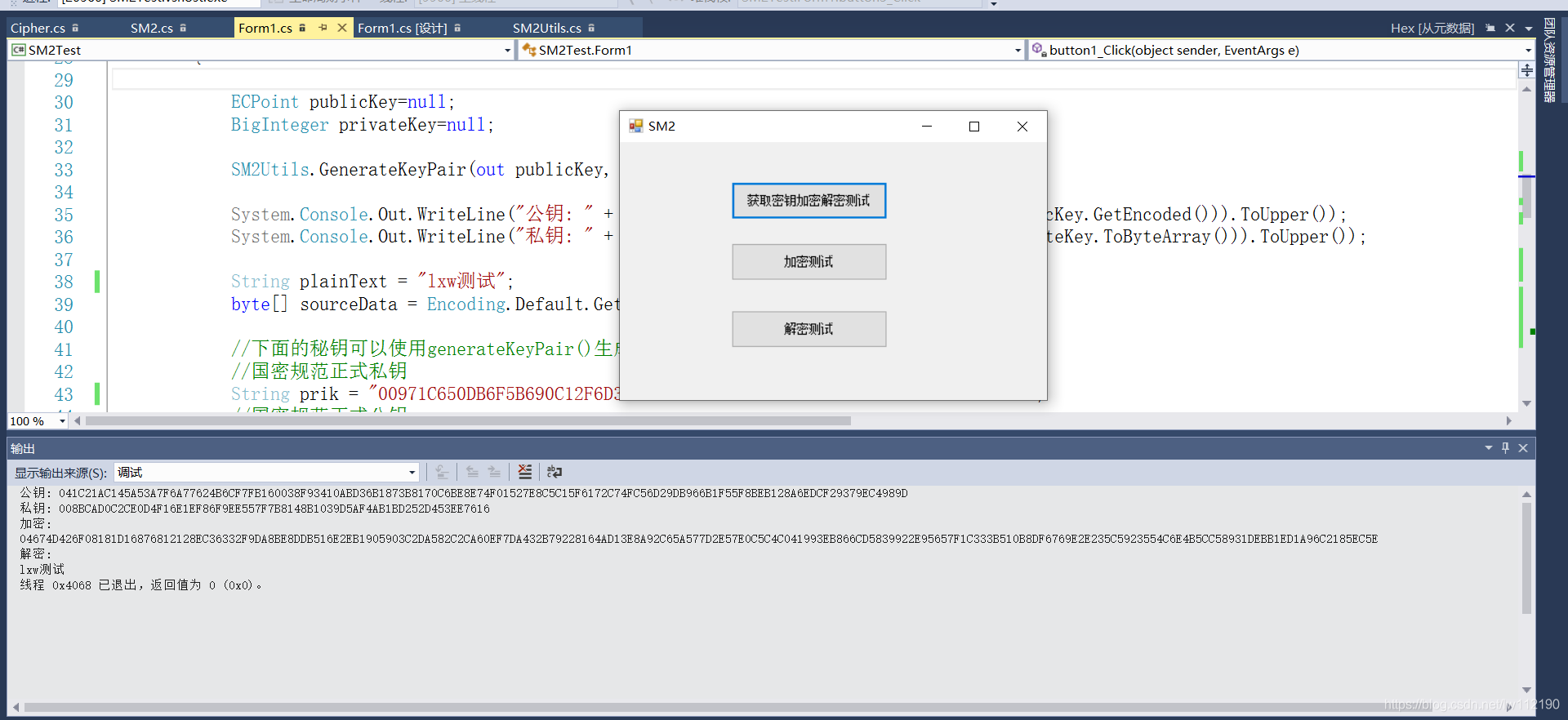
调用
using System;

using System.Collections.Generic;

using System.ComponentModel;

using System.Data;

using System.Drawing;

using System.Linq;

using System.Text;

using System.Windows.Forms;

using Org.BouncyCastle.Utilities.Encoders;

using Org.BouncyCastle.Math.EC;

using Org.BouncyCastle.Math;

namespace SM2Test

{

    public partial class Form1 : Form

    {

        public Form1()

        {

            InitializeComponent();

        }

        /// <summary>

        /// 获取公钥私钥 加密 解密

        /// </summary>

        /// <param name="sender"></param>

        /// <param name="e"></param>

        private void button1_Click(object sender, EventArgs e)

        {

            ECPoint publicKey=null;

            BigInteger privateKey=null;

            SM2Utils.GenerateKeyPair(out publicKey, out privateKey);

            System.Console.Out.WriteLine("公钥: " + Encoding.Default.GetString(Hex.Encode(publicKey.GetEncoded())).ToUpper());

            System.Console.Out.WriteLine("私钥: " + Encoding.Default.GetString(Hex.Encode(privateKey.ToByteArray())).ToUpper());

            String plainText = "lxw测试";

            byte[] sourceData = Encoding.Default.GetBytes(plainText);

            //下面的秘钥可以使用generateKeyPair()生成的秘钥内容

            //国密规范正式私钥

            String prik = "00971C650DB6F5B690C12F6D3651CAD3F6BB2DA9D67F29CA9AF4BAF84A6F2EF5FA";

            //国密规范正式公钥

            String pubk = "047DBFC88D4853D95D9BAD8489C2D77ED6EF012FD80853AA7549CA0857380FD217D323057F551BE49305D1A71AA190767288E3254377CD4970E0DE9CFBA7248E4E";

            System.Console.Out.WriteLine("加密: ");

            String cipherText = SM2Utils.Encrypt(Hex.Decode(pubk), sourceData);

            System.Console.Out.WriteLine(cipherText);

            System.Console.Out.WriteLine("解密: ");

            plainText = Encoding.Default.GetString(SM2Utils.Decrypt(Hex.Decode(prik), Hex.Decode(cipherText)));

            System.Console.Out.WriteLine(plainText);

            Console.ReadLine();

        }

        /// <summary>

        /// 加密

        /// </summary>

        /// <param name="sender"></param>

        /// <param name="e"></param>

        private void button2_Click(object sender, EventArgs e)

        {

            String plainText = "lxw测试";

            String pubk = "047DBFC88D4853D95D9BAD8489C2D77ED6EF012FD80853AA7549CA0857380FD217D323057F551BE49305D1A71AA190767288E3254377CD4970E0DE9CFBA7248E4E";

            byte[] sourceData = Encoding.Default.GetBytes(plainText);

            System.Console.Out.WriteLine("加密: ");

            String cipherText = SM2Utils.Encrypt(Hex.Decode(pubk), sourceData);

            System.Console.Out.WriteLine(cipherText);

            System.Console.Out.WriteLine(cipherText.Length);

        }

        /// <summary>

        /// 解密

        /// </summary>

        /// <param name="sender"></param>

        /// <param name="e"></param>

        private void button3_Click(object sender, EventArgs e)

        {

            String cipherText = "04214B8588CFBADBF06DB82D82FD7FE8BF1C28B583D7646F4D65810F1094B564B5F865BDC8AF6B7BE004ADF46DFFF501520EA3D7C9F161214FFAF8B45AE25C151BFC43B409675FC56FFCAD6A9209525FB694ED00BAB366437A1AA353D48F5FF627DCD9F3041A78EF";

            //国密规范正式私钥

            String prik = "00971C650DB6F5B690C12F6D3651CAD3F6BB2DA9D67F29CA9AF4BAF84A6F2EF5FA";

            //国密规范正式公钥

            String pubk = "047DBFC88D4853D95D9BAD8489C2D77ED6EF012FD80853AA7549CA0857380FD217D323057F551BE49305D1A71AA190767288E3254377CD4970E0DE9CFBA7248E4E";

            System.Console.Out.WriteLine("解密: ");

            String plainText = Encoding.Default.GetString(SM2Utils.Decrypt(Hex.Decode(prik), Hex.Decode(cipherText)));

            System.Console.Out.WriteLine(plainText);

        }

    }

}
C# SM2的更多相关文章
- SM2国密证书合法性验证
通常我们遇到过的X509证书都是基于RSA-SHA1算法的,目前国家在大力推行国密算法,未来银行发行的IC卡也都是基于PBOC3.0支持国密算法的,因此我们来学习一下如何验证SM2国密证书的合法性.至 ...
- 制作SM2证书
前段时间将系统的RSA算法全部升级为SM2国密算法,密码机和UKey硬件设备大都同时支持RSA和SM2算法,只是应用系统的加解密签名验证需要修改,这个更改底层调用的加密动态库来,原来RSA用的对称加密 ...
- java 解析国密SM2算法证书
首先说明用Java自带的解析x509证书类,是不能解析sm2算法的证书,执行会抛出异常. 用开源库bouncycastle能够解析.详细代码 private byte[] getCSPK(byte[] ...
- bouncycastle 国密SM2 API的使用
摘要:本文不对SM2做过多的介绍,主要介绍java bouncycastle库关于SM2的相关API的使用及注意事项 1. SM2 签名: 注意: 1)签名格式ASN1(描述了一种对数据进行表示.编码 ...
- 谈谈PBOC3.0中使用的国密SM2算法
转载请注明出处 http://blog.csdn.net/pony_maggie/article/details/39780825 作者:小马 一 知识准备 SM2是国密局推出的一种他们自己说具有自主 ...
- Postman接口自动化测试实例用到的完整的SM2前端加密算法代码
var __g__ = {}; !function(t,e){"object"==typeof exports?module.exports=exports=e():"f ...
- 学习笔记——SM2算法原理及实现
RSA算法的危机在于其存在亚指数算法,对ECC算法而言一般没有亚指数攻击算法 SM2椭圆曲线公钥密码算法:我国自主知识产权的商用密码算法,是ECC(Elliptic Curve Cryptosyste ...
- Expanded encryption and decryption signature algorithm SM2 & SM3
Expanded encryption and decryption signature algorithm supports multiple signature digest algorithms ...
- 关于国密算法 SM1,SM2,SM3,SM4 的笔记
国密即国家密码局认定的国产密码算法.主要有SM1,SM2,SM3,SM4.密钥长度和分组长度均为128位. SM1 为对称加密.其加密强度与AES相当.该算法不公开,调用该算法时,需要通过加密芯片的接 ...
- SM2椭圆曲线公钥密码算法
国家必须要有属于自己的一套加密机制才行...好复杂.分享下看哪位看得懂其中的原理 国家密码管理局于2010年12月17日发布了SM2椭圆曲线公钥密码算法,并要求为对现有基于RSA算法的电子认证系统.密 ...
随机推荐
- html+css:小米顶部菜单+二级菜单
1.源码 <!DOCTYPE html> <html lang="en"> <head> <meta charset="UTF- ...
- 信捷电气 - C++工程师面试题(社招:3-5年工作经验)
1. char i = 1; printf("%d",i); // char字节用printf以整数型打印出来 2. int (*a[10])int a[10]是函数指针数组 ...
- 前端树形Tree数据结构使用-🤸🏻♂️各种姿势总结
01.树形结构数据 前端开发中会经常用到树形结构数据,如多级菜单.商品的多级分类等.数据库的设计和存储都是扁平结构,就会用到各种Tree树结构的转换操作,本文就尝试全面总结一下. 如下示例数据,关键字 ...
- 类型判断,代码块,流程控制及循环---day05
1.类型判断isinstance 用来做判断类型 语法: 用法一: isinstance(要判断的值,要判断的类型) 返回的是真或者假 用法二: isinstance(要判断的值,(可能的类型))如果 ...
- python如何多版本共存
1. 先正常安装多个python版本,比如我电脑里面是安装的3.10以及3.12 2. 安装的时候建议不要选择系统盘,可以用两个目录安装,例如: d:\py310\... d:\py312\... 3 ...
- 【Azure 应用服务】在App Service for Windows中实现反向代理
问题描述 如何在App Service for Windows(.NET Stack)中,如何实现反向代理呢? 正向代理:客户端想要访问一个服务器,但是它可能无法直接访问这台服务器,这时候这可找一台可 ...
- 关于STM32Fx部分引脚不可以正常输出高低电平的解决办法(不可以正常使用)
一.概述 在一次电路版测试中,发现stm32的部分引脚不可以正常的输出高低电平,刚开始以为是板子没有焊接好所以导致的经过多次的测试,发现电路版没问题.当时就想不清楚了,后面就问学长,还有实验室的学长一 ...
- GDB调试入门笔记
目录 What? Why How 安装GDB 安装命令 查看是否安装成功 调试简单的程序 预备一个程序 调试 使用 break info list next print step 一些小技巧 在gdb ...
- [转] VSCode中 Vetur插件排版Vue文件 Col 标签子标签不被缩进的问题 iview viewDesign 自动格式化
[转] VSCode中 Vetur插件排版Vue文件 Col 标签子标签不被缩进的问题 iview viewDesign 自动格式化 问题 Col标签不对齐 首先直接放解决办法 在 vsCode se ...
- Obsidian 设置快捷键 Ctrl+Shift+J 打开OB(未启动则启动,启动未激活则激活,已激活则最小化)- autoHotKey
Obsidian 设置快捷键 Ctrl+Shift+J 打开OB(未启动则启动,启动未激活则激活,已激活则最小化)- autoHotKey 需求 将Obsidian作为主笔记软件使用,设置个快捷键,配 ...